THE SHORT ANSWER
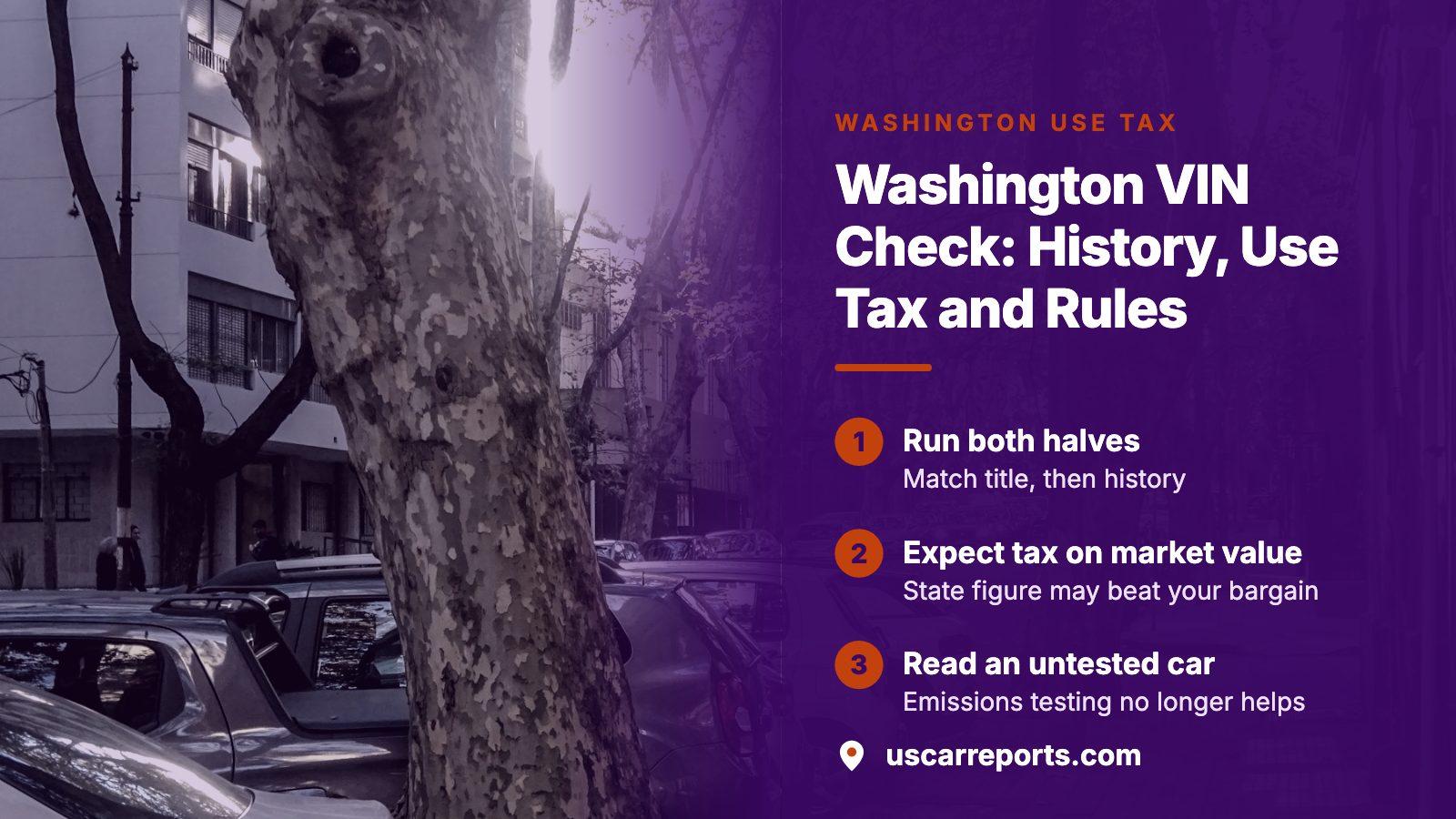
A Washington VIN check has two halves. First, confirm the VIN matches the title, run the free recall and theft lookups, then add a national title record to see brands from other states. Second, apply the state's rules: use tax may be figured on market value instead of your price, emissions testing ended in 2020, and the Department of Licensing handles the transfer. USCarReports shows a free preview before any payment.
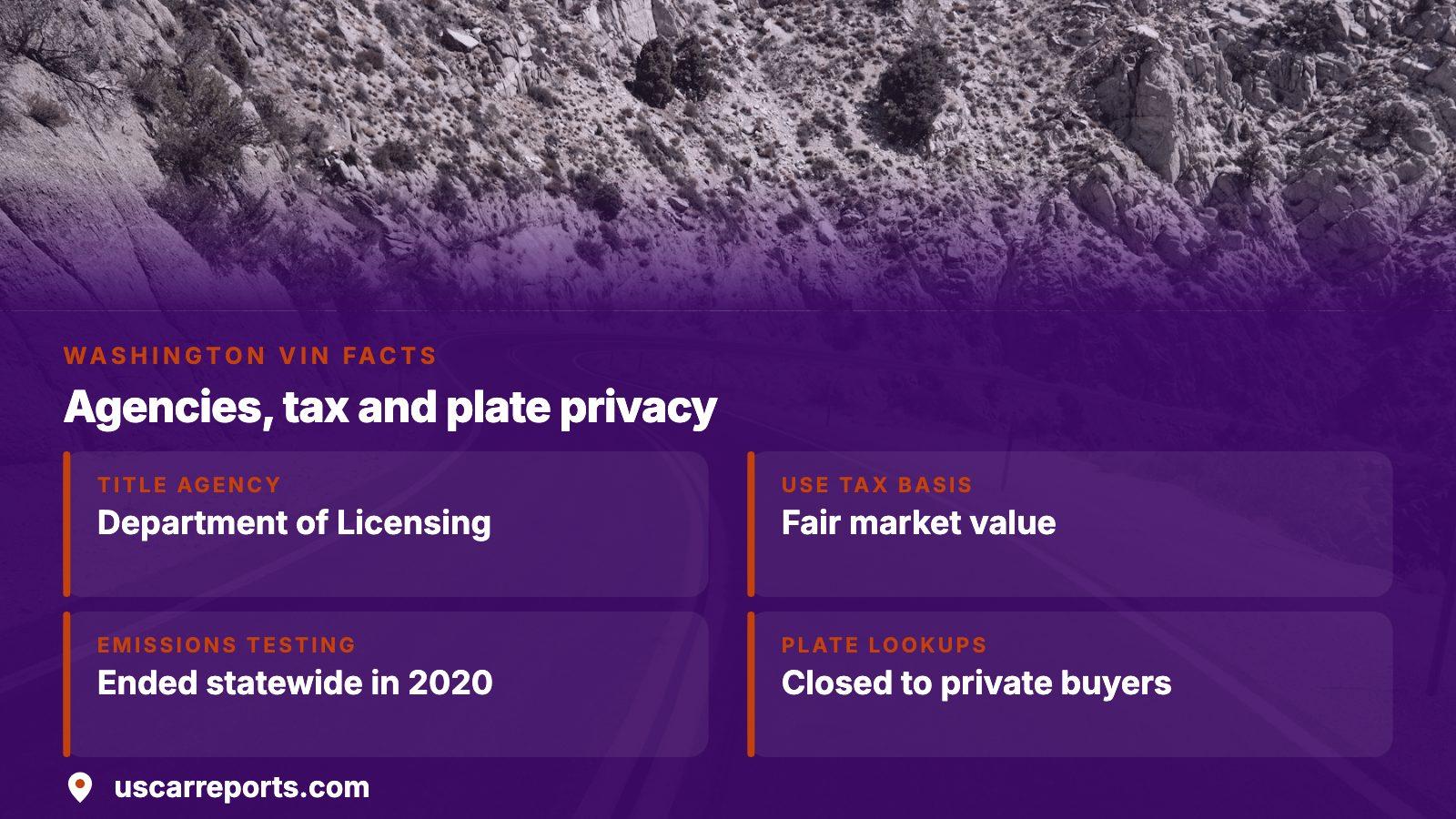
- Title agency
- Department of Licensing, via county auditors and licensing offices
- Use tax basis
- Fair market value, not only the bill-of-sale price
- Emissions testing
- Ended statewide in 2020
- Plate lookups
- Closed to private buyers by federal privacy law
What the lookups find, and what each one costs
The VIN works across state lines, so most of a Washington check is national. Title brands can come from any reporting state, and damage, mileage, auction and theft entries come from sources that ignore borders.
| Lookup | What it answers | Cost |
|---|---|---|
| VIN decode | Whether the build matches the ad: model year, body, engine | Free |
| NHTSA recall search | Which safety recalls remain unrepaired | Free |
| NICB VINCheck | Whether an insurer in the NICB program has the car on file as stolen or totaled | Free |
| Approved NMVTIS provider | Title brands reported by any state | Paid, per report |
| USCarReports report | Title brands, damage entries, odometer readings, liens, auction photos and market value | Free preview, then one payment |
None of these proves a car never crashed. A crash repaired out of pocket reaches no insurer and no database, so the inspection still matters.
Washington's buying rules at a glance
Washington's quirks are mostly administrative rather than mechanical. Here is the short list and what each item means at the car.
| Topic | How Washington handles it | What you do about it |
|---|---|---|
| Agency | Titles and registration go through the Department of Licensing, whose counters sit at county auditors and licensing offices | Take the paperwork there and ask about anything unusual |
| Tax on a private purchase | Use tax is assessed on fair market value | Budget for book value and gather proof of any lower price |
| Emissions | No periodic testing since 2020 | Scan the car yourself |
| Seller's duty | The seller must report the sale to the state within five days | Remind the seller and keep your own bill of sale |
| Plate lookups | Driver records are shielded by federal privacy law | Ask the seller for the VIN |
Use tax: when the state's number beats your bargain
A private purchase is registered with use tax, and Washington bases that tax on what the vehicle is worth on the market, not simply the price on your bill of sale. Picture a buyer who finds a pickup with a slipping transmission and pays well under book for it. At the counter, the state may still start from book.
- Photograph any damage on the day you buy, with the date visible.
- Get a written estimate or a mechanic's diagnosis that puts a cost on the problem.
- Have both parties sign a bill of sale showing the VIN, price and date, and keep a copy.
- Ask the licensing office how a declared value is contested and which documents it will read.
A lower number on paper is not a loophole
Writing less than you paid is fraud, and valuing by book exists partly because it was tried. If the discount was real, document it and let the process weigh the evidence.
No emissions test since 2020: what that does to a car's story
The state ended emissions testing at the start of 2020, and nothing replaced it. A car that a smog station elsewhere would turn away can be registered here without anyone looking at it, so the check-engine light is the one remaining signal.
- A seller waving an old passed-test sheet is showing you something from before 2020. A newer car with no test record is normal.
- Federal law still forbids defeating emissions equipment, so a deleted diesel is illegal, hard to resell and unwelcome in states that test.
A code reader plugged in under the dash lists stored faults and shows whether the car's self-checks have finished. A few minutes with one fills the gap the state test left.
West or east of the Cascades: ask where the car lived
The Cascades divide Washington into a damp west and a dry east. Wet-side cars wear in small places: blocked drains, tired door seals, carpets that never fully dry, connectors that corrode. Dry-side cars take summer heat and winter cold, closer to what Idaho does to a vehicle than to Seattle. Road salt is light on both sides, though the passes see de-icer.
Find out where the car spent its years, then test the answer. A Spokane car and a Seattle car call for different inspections, and the history should show where it was registered. On a western car, lift the carpet, pull back a door seal and note any electrical fault that appears only in wet weather.
Running a Washington VIN lookup, in order
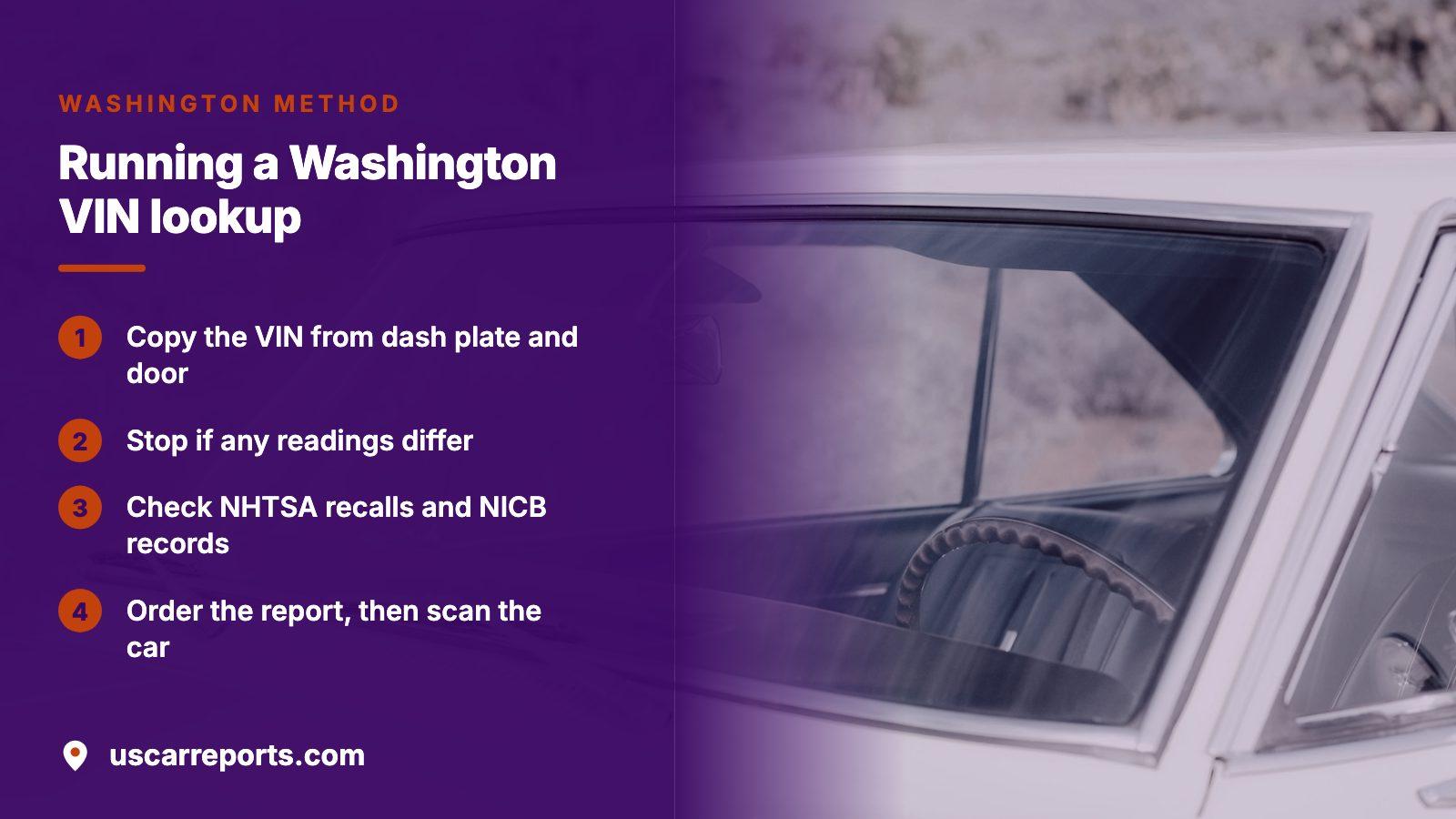
- At the car, copy the VIN from the dash plate and again from the door-frame label, then compare each to the title digit by digit.
- Any difference means stopping to get an explanation from the seller. If everything agrees, enter the VIN in the preview box on this site.
- Check NHTSA's recall search and NICB's theft and write-off records. Neither charges.
- If the car survives that, order the full report, a single payment that carries no subscription.
- Plug in a code reader, then have a mechanic look the car over.
- Estimate the use tax, check that the seller's name is the one on the title, then pay and complete the transfer at the licensing counter.
Reading the report: red flags for a Washington buyer
| What you find | What it may mean | Your next move |
|---|---|---|
| A brand applied by another state | The car was totaled or rebuilt before it came here | Ask for the repair paperwork, then pay a mechanic to examine the frame |
| Odometer readings that go backward | A rollback, or a replaced instrument cluster | Leave unless the seller can prove the replacement |
| A new title in another state soon after a loss | Someone may be trying to shed a brand | Line up the dates and ask why the car moved |
| A lien still shown | A lender may still have a claim on the car | Get a signed lien release before paying |
| Auction photos with damage | The repair story may not match the car | Match the photos against panel gaps and paint |
| An open recall | A safety repair is still owed | Have it done before you hand over money, or arrange it yourself |
A quiet report lowers the risk without erasing it. The worst flood and crash cases often produce no claim at all.
Plates, privacy and why the VIN is the right number
Washington driver records are covered by a federal statute, the Driver's Privacy Protection Act, which permits release only for listed uses. Curiosity about a stranger's car does not qualify, so a plate gets you no name. USCarReports works from VINs alone. Ask the seller for the number early and notice how they react.
Price, preview and what to do next
You can open the preview without paying or entering a card. A report is bought once for one car, with no subscription, and there are packs of 3, 5 or 10 for shoppers comparing cars. Current options are listed at /pricing.
Order the steps so each cheap one can end the deal before the next costly one begins: preview, federal lookups, full report, mechanic, then licensing office. A report cannot see what an inspector sees under the car, or read the paperwork you are asked to sign.
Where this information comes from
- Washington Department of Licensing — The state agency behind titles, registration and the use tax assessment.
- NMVTIS: National Motor Vehicle Title Information System — The federal title record that approved providers sell, covering brands from every reporting state.
- NICB VINCheck — A no-cost theft and total-loss lookup fed by participating insurers.
- NHTSA: Recalls — The no-cost open-recall search by VIN.
Sources and photos: Facts checked against the sources above in November 2026. Photos by Nikolai Kolosov, Wesley Tingey and Will Truettner on Unsplash; diagrams by USCarReports.
Keep reading
- Oregon VIN check: what the lookup shows and the rules you buy underThe neighbor to the south, for a car that crossed the state line.
- Idaho VIN Check: Salvage Brands, Arrival Inspection and Title RulesThe eastern neighbor, for a car that spent time across the border.
- Title status check: what the state lookup tells a car buyerHow to read a title's status before money changes hands.
- Sample reportSee how the records are laid out before you buy a report.
Frequently asked questions
How do I run a VIN check in Washington?
Read the VIN from the dash and the door frame and match it to the title. Then decode it, search NHTSA and NICB, and add a national title record. Inspect the car and complete the transfer through the Department of Licensing, once the seller's name matches the title.
Is there a free VIN check in Washington?
Part of one. The decode, NHTSA's recall search and NICB's theft lookup cost nothing from their own sources, while title brands come from approved NMVTIS providers for a fee. Here you open the preview without paying, and the full report is one purchase that never renews.
Why did Washington charge more use tax than I paid for the car?
The state figures use tax on a private purchase from the car's market value, and the price you wrote down counts as evidence, not as the answer. If the low price had a real cause, show it with dated photos, an estimate or a mechanic's written findings, and ask the licensing office how a declared value is reviewed.
Does Washington require an emissions test?
No. The program closed at the start of 2020, and registering a car needs no test. Federal law still prohibits tampering with emissions equipment, which keeps a deleted diesel illegal, so a scan before you buy tells you what the state no longer checks.
Can I look up a Washington license plate to find the owner?
No, not for private buyers. The Driver's Privacy Protection Act lets motor vehicle records release personal details only for listed purposes, and sizing up another driver is not one. Request the VIN from the seller and run the check on that instead.
Now check the car itself
The guide explains what to look for. The report shows what this VIN has on record.