
THE SHORT ANSWER
To check a VIN in Alaska, enter the 17-character number into a history report and read the title brands before anything else. Alaska's words carry specific meanings: a salvage title is an ownership document for a vehicle not yet rebuilt, a reconstructed title rests on a notarized builder's affidavit, and a parts-only title ends titling in every state. Match the seller's paper to the record, then pay a mechanic to look.
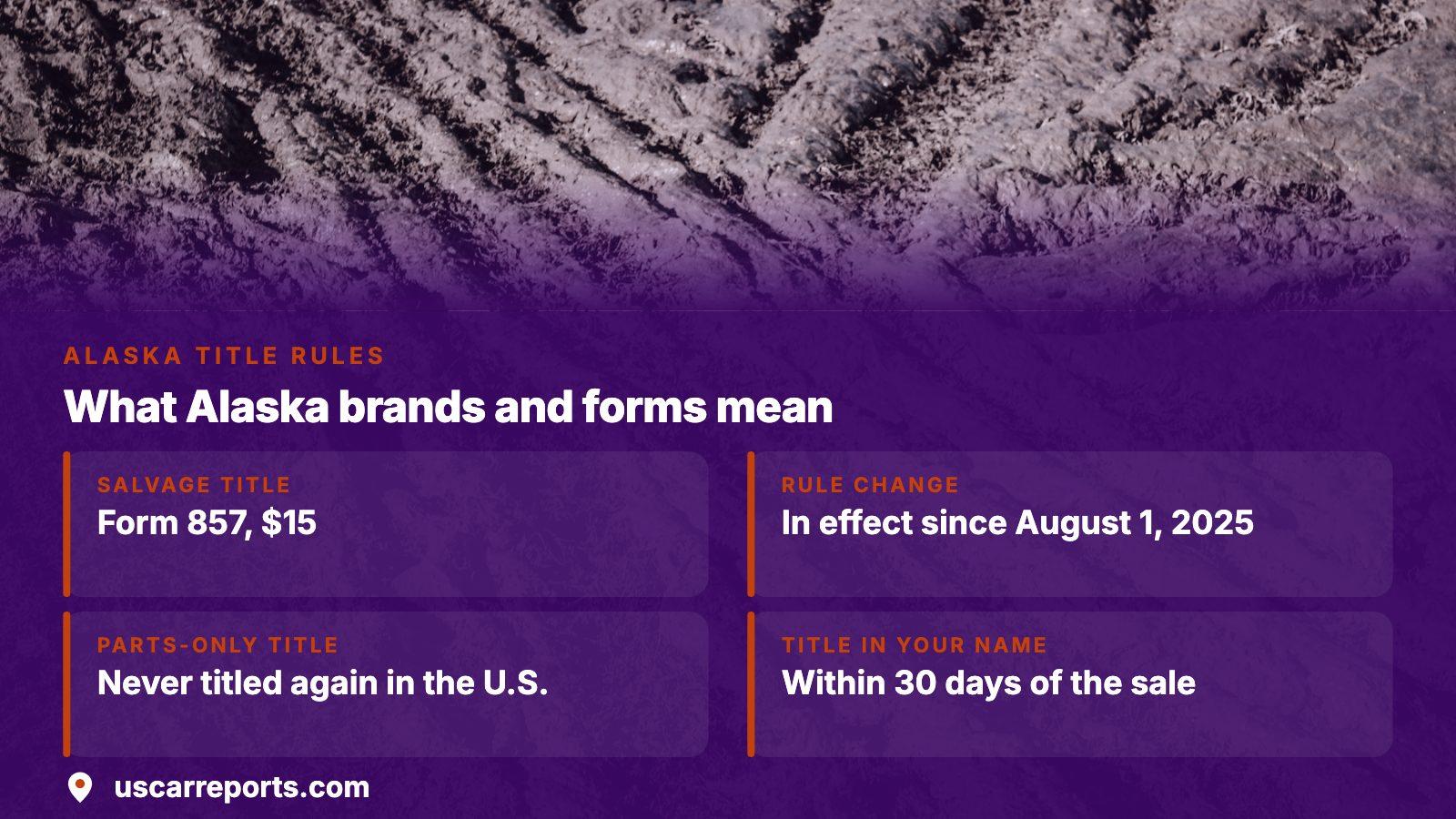
- Salvage title
- Form 857, $15
- Rule change
- In effect since August 1, 2025
- Parts-only title
- Never titled again in the U.S.
- Title in your name
- Within 30 days of the sale
What the check turns up before you drive out to look
The lookup starts with 17 characters and returns a file from every state that recorded anything about the car. A truck on a Fairbanks lot may carry a history written under another state's brand rules.
| Record | What it settles on an Alaska car |
|---|---|
| Title brands | Whether any state ever called the car junk, salvage or flood, and when. |
| Accident and damage entries | How hard it was hit, against the seller's description. |
| Odometer readings | A dated run of mileage to hold against the number on the title. |
| Salvage and auction photos | The car as it looked before any repair. |
| Liens and impounds | A lender's open claim or a tow-yard stay the seller skipped. |
| Theft and insurance records | Entries a clean-looking title can hide. |
| Recalls, owners, use type | Open repairs, how many drivers, any rental or fleet past. |
Alaska's brand words, as the DMV defines them
Listings use these words loosely. The DMV does not.
| On the title or record | What the DMV says it is |
|---|---|
| Junk brand | A brand a vehicle can carry. One holding a current Junk brand that was never reconstructed can now be given a salvage title. |
| Salvage title | An ownership paper, Form 857, $15. It reads SALVAGE, carries code SVG, and its remark calls the car unfinished and unfit for the road. |
| Reconstructed title | For a car whose chassis, body or engine was altered enough to differ materially from its original build. A notarized affidavit supports it. |
| Non-repairable or parts-only | Worth only parts or scrap after damage, wreck or fire. No state will title or register it again. |
From an NHTSA owner complaint
A 2015 GMC Sierra 1500 owner whose steering locked up had the truck towed to a Fairbanks dealership. The owner added that the truck carries a damaged title from a house fire that melted the grille and plastic trim, with repairs by a certified body shop.
The brand records that something happened; the history record and repair paperwork say what. Ask the seller to name the exact word on the title and find it in the record before you leave a deposit.
The August 2025 change, and a salvage title on a listing
Since August 1, 2025, a vehicle holding a current Junk brand, and never reconstructed, may be given a salvage title by the DMV. The stated uses: giving the car up to an insurer, handing it to a salvage company, retrieving it from impound, and proving ownership. Documents dated earlier predate the rule.
The printed remark matters most to a buyer. It describes an unfinished vehicle, bars roadway use, and requires a reconstructed title before registration. A salvage title is therefore proof of owning an unfinished car, not a halfway point to a license plate. The DMV reports salvage titles to the national title system for vehicles that normally report there, so confirm one in the report's brand history.
Reconstructed cars, and the one title that ends the road
To retitle a reconstructed vehicle, the builder follows a set path. An engine swap alone does not qualify.
- Hand in the title of whatever donor supplied the frame, plus receipts for the major parts.
- Have a law officer or DMV representative inspect it. At a state DMV office that costs nothing, and a one-way trip permit covers the drive there.
- Clear any recorded liens.
- File a notarized affidavit, Form 829, with the title application.
The builder signs that affidavit, so a seller of a reconstructed car should be able to name the person who did the work and show the paper. Parts-only is the hard stop; do not plan a project around one.
Running the check, from number to report
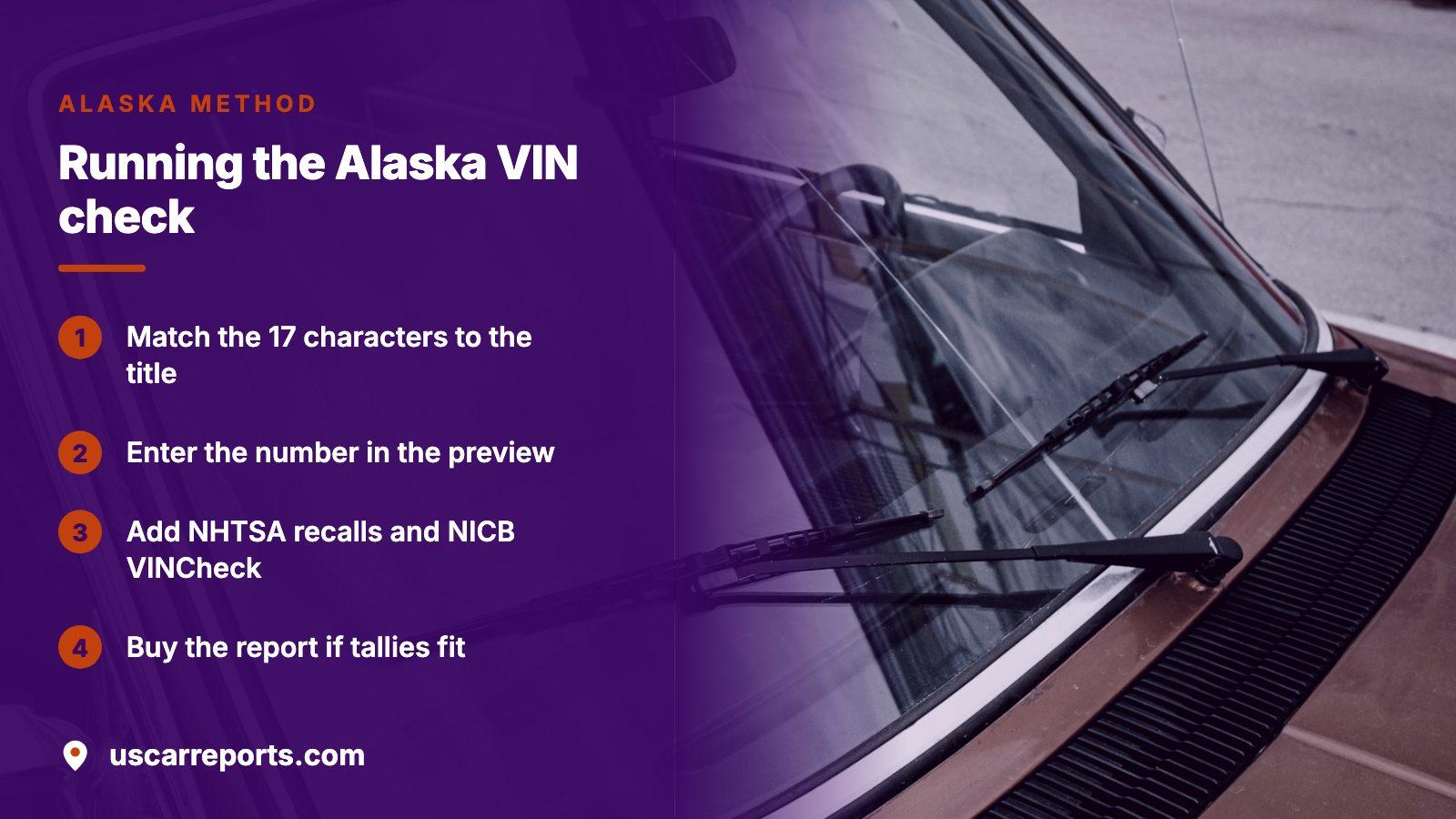
- Match the 17 characters on the car to the ones typed on the title. A wrong digit pulls up a stranger's record.
- Enter the number in the preview. It confirms the car's identity and shows how many title, auction and recall records exist.
- Add NHTSA's recall search and NICB's VINCheck. The DMV itself points buyers to NICB for cars reported stolen and never recovered.
- If the tallies match the story you were told, buy the report and start with the brands, then odometer, lien and theft entries.
- Set the report beside the seller's title: wording, mileage and lender should agree.
Alaska's buying rules, set beside the report
Each state page here sets the check beside that state's buying rules. These come from the Alaska DMV.
| Step | What Alaska expects |
|---|---|
| Titling in your name | An Alaska buyer applies within 30 days of the sale date, on Form V1 signed in ink. |
| The seller's signature | The owner releases the title and assigns it to you. A private seller cannot hand over a dealer reassignment. |
| Two names on the title | OR means one owner may sign. AND, or no word between, means all must. |
| Mileage | Written on the title at sale, never estimated, since it cannot be altered later. |
| A loan on the car | The lender must release it in writing. A PAID stamp or note does not count, and a recorded lien sends the title to the lender. |
| No title in hand | An inspector completes Form 811, at no charge at a state DMV office. |
Cars that arrive from another state
A car arriving from another state needs its latest out-of-state title, signed over to you if it was bought recently. An unpaid loan limits you to registration, not a title transfer, and with a lien the Alaska title is mailed to the lender. The title fee is $15.
When it is unclear which state holds the live title, the DMV suggests asking that state or pulling a title history report. The national record lists the title state, last title date and brands from every reporting state, but alone it leaves out repair, recall and maintenance data.
Red flags in the results, with one owner's account
- A brand word the seller never used, or used differently from the record.
- A salvage title on a car advertised as ready to drive.
- A reconstructed car with no affidavit, or a seller who cannot name the builder.
- A parts-only or non-repairable entry from any state.
- A lien entry although the seller insists the loan is cleared.
- Odometer readings that climb and then drop, or a title mileage below the last reported reading.
From an NHTSA owner complaint
An owner whose 2020 Kia Soul engine seized logged a string of calls and failed transport arrangements with an Anchorage Kia dealer and the maker's consumer line. Early on, the dealer confirmed a recall on the car. The final entry says the dealer declines to honor recalls on cars carrying rebuilt or salvage titles.
The complaint does not say this car's title was branded, and no outcome is on file. Still, before buying any car with a brand on record, ask a dealer how it would treat recall work.
Cost, and the order of next steps
The preview comes first and costs nothing. A report is a one-time charge, with multi-car packs for when several listings are on your short list; the pricing page shows pack sizes and current amounts. A report is paper, so a mechanic's look at the underbody, frame and wiring still comes before money moves.
- Compare the report's brand with the word on the title.
- Book an independent inspection, especially after a damage or reconstruction entry.
- Collect a signed title and a lien release if a lender appears.
- Apply in your own name within 30 days.
Where this information comes from
- Alaska DMV: salvage vehicle titles — The August 2025 rule, Form 857, the fee and the remark printed on the title.
- Alaska DMV: reconstructed or homebuilt vehicles — What counts as reconstructed, the steps, and the parts-only title.
- Alaska DMV: used vehicle purchase — The 30-day deadline, signatures, mileage and lien releases.
- Alaska DMV: transfer a vehicle from another state — Out-of-state titles, unpaid loans and the title fee.
- NMVTIS: understanding a vehicle history report — The five indicators on a national title report and what it leaves out.
- NHTSA owner complaint 11457342 — owner experience, paraphrased
- NHTSA owner complaint 11590485 — owner experience, paraphrased
Sources and photos: Facts checked against the sources above in November 2026. Photos by John Kakuk, Max Tokarev and Sean Foster on Unsplash; diagrams by USCarReports.
Keep reading
- Title status check: what the state lookup tells a car buyerHow to read a title's status once the record is in hand.
- Certificate of destruction by state: what the paper allowsWhat a retired car's paper allows, which bears on any parts-only entry.
- Registering a car in another state: deadlines, title and checksDeadlines and steps when a car crosses a state line.
- Sample reportSee a finished report before you run one.
Frequently asked questions
How do I run an Alaska VIN check?
Begin with the number on the vehicle itself, since an ad can be wrong. Put its 17 characters in the preview. If the record fits the seller's account, buy the report and compare brands, damage, mileage, liens and theft entries with the title before paying.
Does the Alaska DMV run a VIN lookup for buyers?
Its titles and used-purchase pages send buyers to the federal title search and describe no lookup of their own. A history report drawing on that national record fills the gap.
Can a car with an Alaska salvage title be registered?
Not as titled. The remark bars roadway use and requires a reconstructed title first, which means the inspection, lien releases and builder's affidavit the DMV lists. Price that work before you make an offer.
Can a parts-only title be cleared later?
The DMV says no: no state will title or register that vehicle again. The state frames the status as keeping heavily damaged total losses off the road. Buy such a car only if parts are the goal.
How soon must I title a used car in Alaska?
Within 30 days of the sale date, in the buyer's own name. Bring the signed title, a completed Form V1 and any lien release, and check names and mileage on the title before leaving the seller.
Now check the car itself
The guide explains what to look for. The report shows what this VIN has on record.