THE SHORT ANSWER
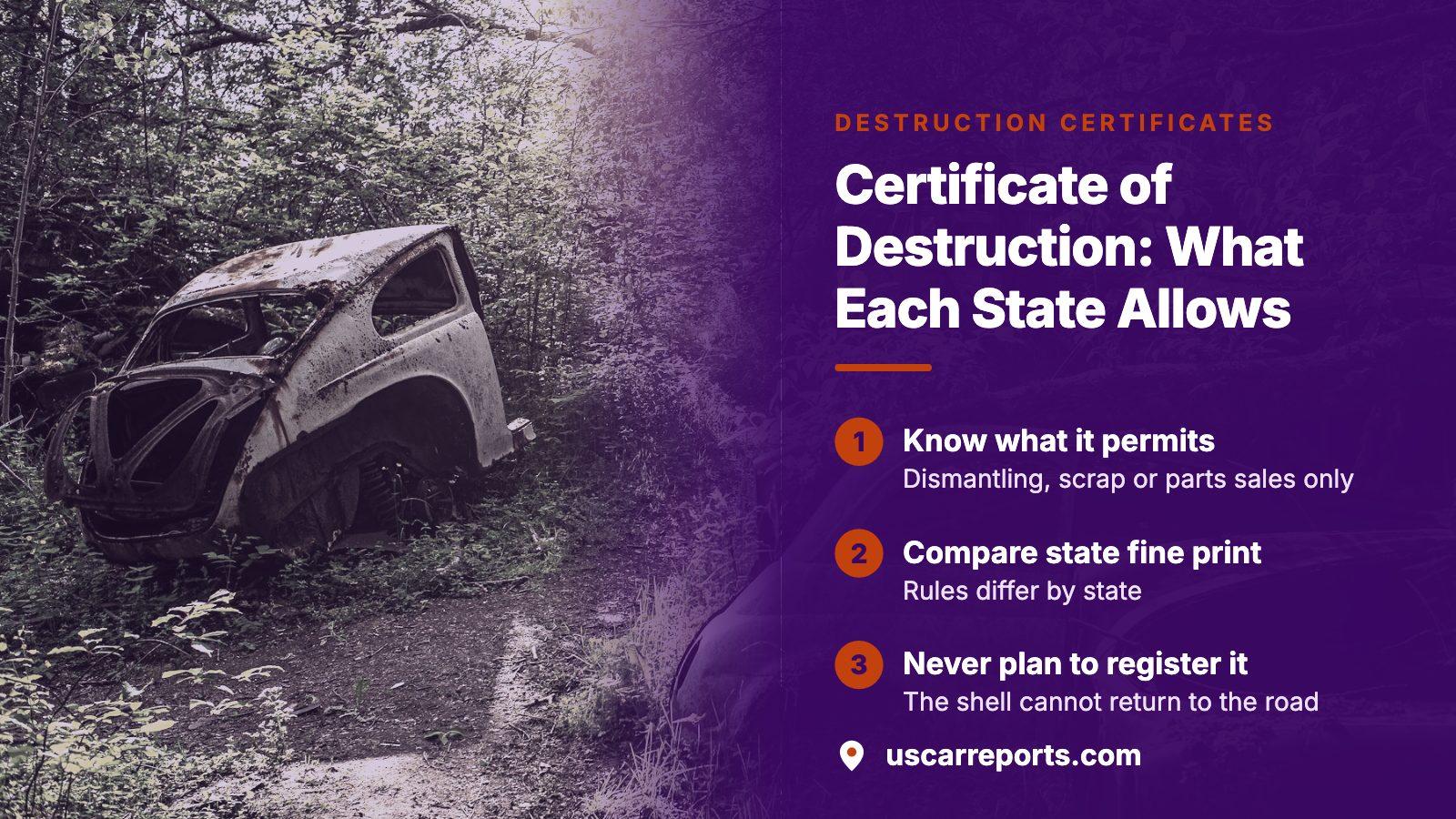
A certificate of destruction retires a car: the paper lets it be dismantled, scrapped or sold for parts, and nothing more. It cannot be registered, and none of the four states read for this page gives it the repair-and-inspect route that salvage titles have. Run the VIN before you pay, since a state, insurer or yard may already have retired the car. Judge the paper by what it permits, not by its name.
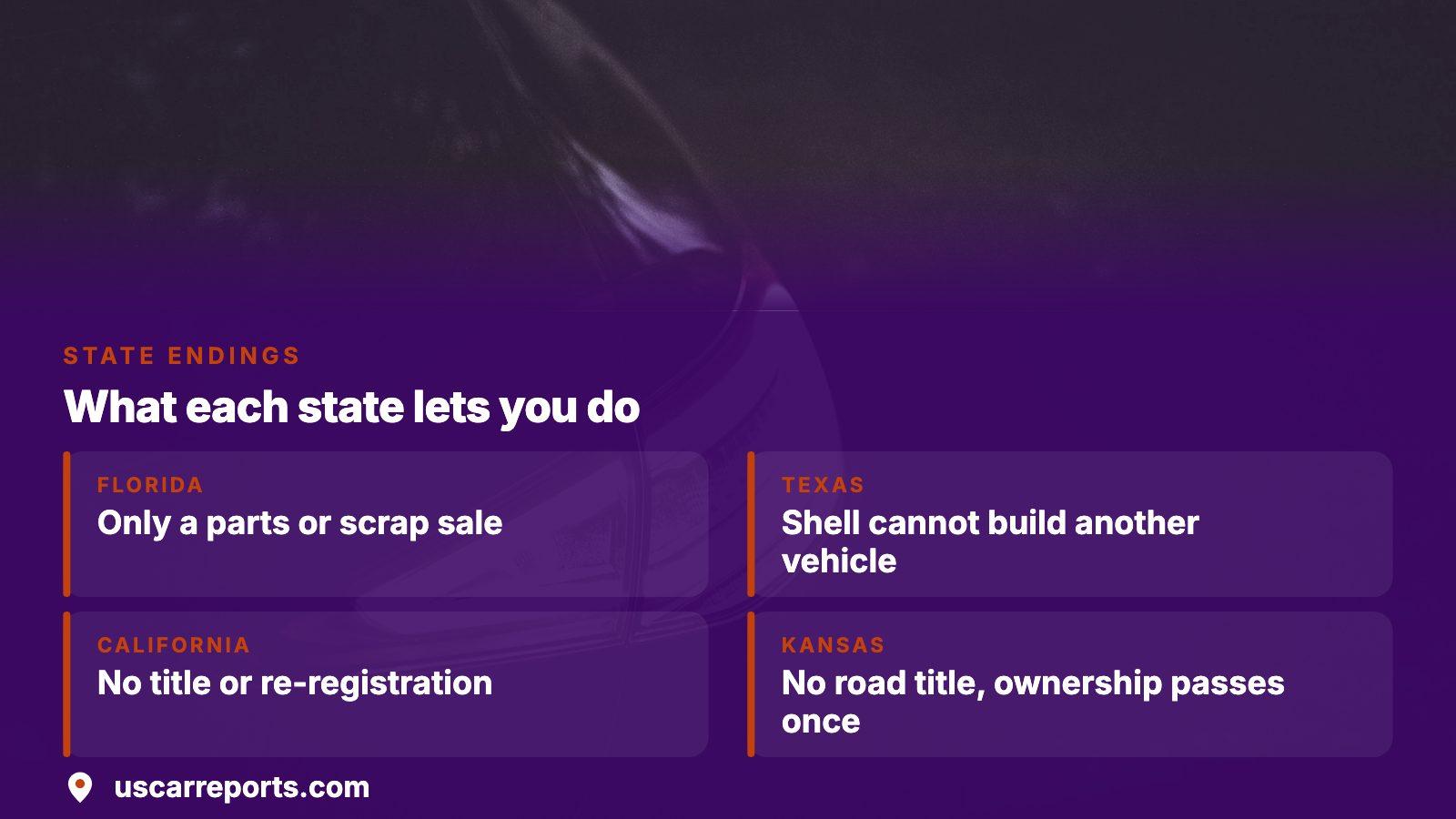
- Florida
- Only a parts or scrap sale is permitted
- Texas
- The shell cannot be reused to build another vehicle
- California
- No title or re-registration after issue
- Kansas
- No road title, and ownership passes once
Same paper, different names: four states side by side
States disagree about vocabulary much more than substance. Someone searching one phrase can miss a car carrying another, so compare how four states describe the paper and what each lets the car do.
| State | What the paper is called | What the rule says about road use |
|---|---|---|
| Florida | Certificate of destruction | Limited to a parts or scrap sale |
| Texas | Nonrepairable vehicle title | No rebuild for road use, and the shell cannot serve as the base of another vehicle |
| California | Non-Repairable Vehicle Certificate | After issue, no title or re-registration as junk or revived salvage |
| Kansas | Nonrepairable vehicle certificate | No road title or registration; dismantle or recycle, with no retail sale as a whole unit |
Elsewhere you will see junk, dismantle-only or parts-only wording. Skip the label and look for the line stating the permitted use. Dismantling, scrapping or parts there means the rest of this page applies to the car.
What the holder can lawfully do with the car
The lawful moves are few, and all of them are ordinary trades with real prices.
- Sell it whole to a dismantler who wants the components.
- Sell it to a scrap yard for the metal.
- Sell the parts one by one, where the state allows it.
Repairing the car and applying for a standard title is not on the list. A salvage title can lead to a rebuilt inspection in states that offer one, but this paper opens no such door. A seller who calls the car a project is describing something other than what the paper covers.
Florida: the 80 percent line and the 72-hour deadline
Florida is where many buyers first meet the phrase, so its mechanics are worth reading. For a vehicle with no insurance claim behind it, the state counts a total loss when repair or rebuild cost reaches 80 percent of the cost of a comparable replacement, which the rule calls like kind and quality.
The owner then has 72 hours from the moment the car becomes salvage to forward the title to the state and request a salvage title or a destruction certificate. Below 80 percent, Florida can issue a rebuildable salvage title on request, though no law makes the owner ask.
Do not carry Florida's number elsewhere
The 80 percent figure is written for uninsured vehicles and measured against replacement cost. Other states define a total loss in their own terms, so a percentage quoted in a forum post may not be the one that applies to your car.
Texas: five ways in, and a rule against reusing the shell
Texas lists five routes into the nonrepairable class, and not every one starts with a wreck.
- Damage so heavy that parts or scrap value is all that remains.
- A junk or dismantle-only paper arriving with a car from another state.
- A dealer's report to the department.
- The owner handing over ownership so the car can be torn down, scrapped or destroyed.
- A sale for export only.
The export route surprises people. A sound car can land in the class through a decision about where it was going, and if it later shows up in a local listing, the paper still says what it says.
Texas also bars putting the frame and body of such a vehicle into another one, whether to repair, rebuild or assemble it. The shell has no future as any car.
California and Kansas: the same limit, different fine print
California counts a car as non-repairable if the owner has declared it fit only for spare parts or scrap metal, if it has been stripped bare, or if only a burned-out shell remains. An insurer that settles the claim generally obtains the certificate; otherwise the owner must. Once it is issued, the DMV says the car cannot be titled or re-registered as junk or revived salvage.
Kansas pays more attention to transfers. Its statute bars a road title or registration, wants the vehicle dismantled, disassembled or recycled rather than sold as a unit at retail, and lets ownership pass only once, with a narrow exception for older vehicles that have no title. A certificate that has already changed hands once is near the end of its chain.
Moving the car to another state does not wash the record
Some buyers assume a looser state will re-title what a stricter one retired. Federal reporting makes that a poor bet. Under 28 CFR 25.56, junk and salvage yards report the vehicles they obtain every month to NMVTIS, the national title database, and send a supplement when what became of the vehicle was not known at the first report. Insurers send a monthly inventory of junk and salvage automobiles under 28 CFR 25.55.
The net has holes. The insurer duty reaches back only to the current model year plus four prior ones, so an older car totaled by an insurer falls outside it. A yard that sees fewer than five of these vehicles annually is exempt from the yard rule. And Texas treats an incoming junk or dismantle-only document as a reason to class the car as nonrepairable, so the receiving state reads what the first one wrote.
Five checks before money changes hands
- Ask to see the paper itself, photographed in full, not a description of it or a screenshot of the listing.
- Find the line stating what the holder may do with the car, and set the heading at the top aside.
- Match the VIN on the paper against the car and the advertisement.
- Run the VIN and look for junk, salvage or nonrepairable brands, plus any auction photos.
- Take a title that is still on its way as your answer: a seller who cannot produce the ownership paper before payment has already told you what you need.

Where a VIN check helps, and where it stops
The VIN is the one identifier that travels with a car from state to state, which makes it the natural first move when the paper trail looks thin. On USCarReports the 17-character VIN opens a free preview, and a full report is a single payment for one vehicle, with packs of several for people comparing cars. Cost details sit on the pricing page.
The report lays out title brands with the state that issued each one, salvage and auction records with photos, and theft and insurance entries, the places a retired car tends to leave a mark. It shows only what states, insurers and yards reported, so a clean result lowers the risk without ending it. Inspect the car and read the paper in person too, and use the NICB's no-cost VINCheck for theft and total-loss records.
Where this information comes from
- Florida HSMV: Procedure TL-35, salvage and derelict titling — Supports the parts-or-scrap limit, the 80 percent uninsured total-loss test and the 72-hour title deadline.
- TxDMV: Salvage and Nonrepairable Motor Vehicle Manual — Supports the five routes into the nonrepairable class, including export-only sales, and the ban on reusing the body and frame.
- California DMV: Non-Repairable Vehicle Certificate — Supports the definition of a non-repairable vehicle and the rule that it cannot be titled or re-registered.
- Kansas Statutes: nonrepairable vehicle certificate — Supports the bar on road titles, the dismantling requirement and the single transfer of ownership.
- 28 CFR 25.56: junk yards, salvage yards and auto recyclers — Supports the monthly yard reports, the final-disposition supplement and the exemption for very small operators.
- 28 CFR 25.55: responsibilities of insurance carriers — Supports the monthly insurer inventory and its five-model-year window.
- NICB: VINCheck — A no-cost screen for theft and total-loss records reported by participating insurers.
Sources and photos: Facts checked against the sources above in November 2026. Photos by Patrick von der Wehd, Anastasiia Nelen and Maurice Sahl on Unsplash; diagrams by USCarReports.
Keep reading
- Florida VIN check: title records, flood risk and Florida buying rulesFlorida's brands and storm-season history, where the phrase most often comes up.
- Texas VIN check: what to run, Texas title brands and buying rulesHow Texas titles and brands read on a VIN check before you buy.
- Title status check: what the state lookup tells a car buyerHow to read what a title says about a car's current legal status.
- Abandoned vehicle title: what each state issues, and to whomWhere a destroy-only paper also appears at the end of an abandoned-car process.
Frequently asked questions
Can a car holding a certificate of destruction be registered again?
No. Florida limits the certificate to a parts or scrap sale, California says the car cannot be titled or re-registered as junk or revived salvage, and Kansas bars a road title outright. Repair work, however good, does not change what the paper allows.
How does a certificate of destruction differ from a salvage title?
A salvage title records a total loss on a car that may be repaired and, in states that offer it, re-titled as rebuilt after an inspection. The destruction paper records the opposite decision: the car is done as a vehicle. In Florida, an owner whose repair cost stays under 80 percent can ask for a rebuildable salvage title instead.
Does moving the car to another state clear the certificate?
Not reliably. Yards and insurers report into the federal title record, so the earlier brand can surface in the next state, and Texas treats an incoming junk or dismantle-only paper as grounds for its own nonrepairable class. A promise of a clean title through a different state is a gamble, and you would be the one paying for it.
Can a VIN check show a certificate of destruction?
It can show a junk, nonrepairable or salvage brand when a state, insurer or yard reported one, and auction photos can fill in the story. It cannot show what nobody reported: an older car totaled by an insurer, or one passing through a very small yard, may leave no entry. Weigh a clean result alongside the paper itself.
What can I do with a car I already own that has one?
Sell it to a dismantler or scrap yard, or part it out where your state allows. Do not sell it to a private buyer as a rebuildable project, because the misstatement lands on you too. If you think the paper was issued by mistake, go to the issuing state's titles office quickly with insurance and repair documents, not an argument about how the car looks.
Now check the car itself
The guide explains what to look for. The report shows what this VIN has on record.