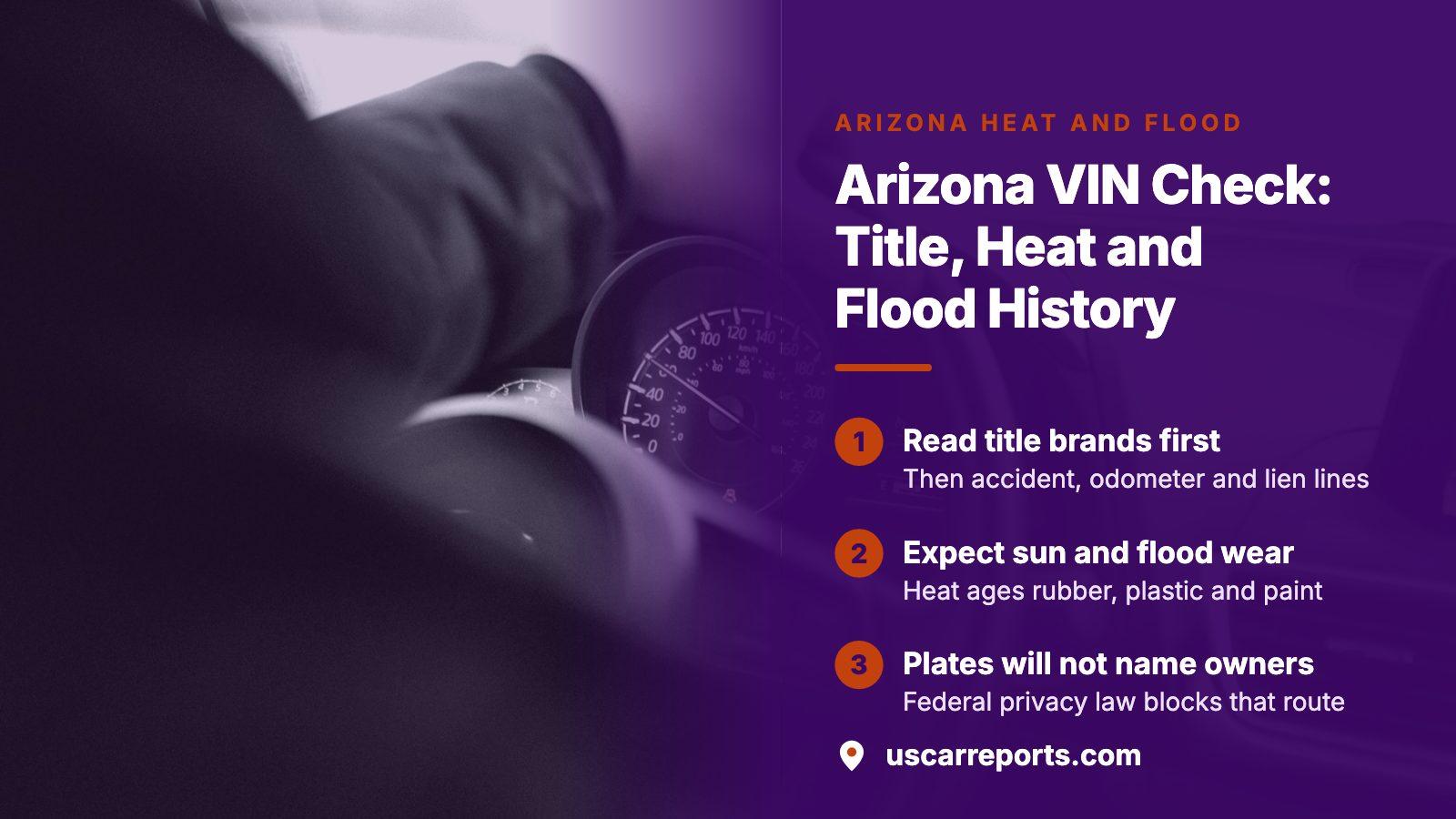
THE SHORT ANSWER
To check a VIN in Arizona, type the 17-character number into a history report and read the title brands first, then the accident, odometer, lien and theft entries. Match the seller's name to the title. The Motor Vehicle Division, inside the state Department of Transportation, finishes titles and registration, so the history check is a step you take before that. Heat wear and monsoon water still need a hands-on inspection.
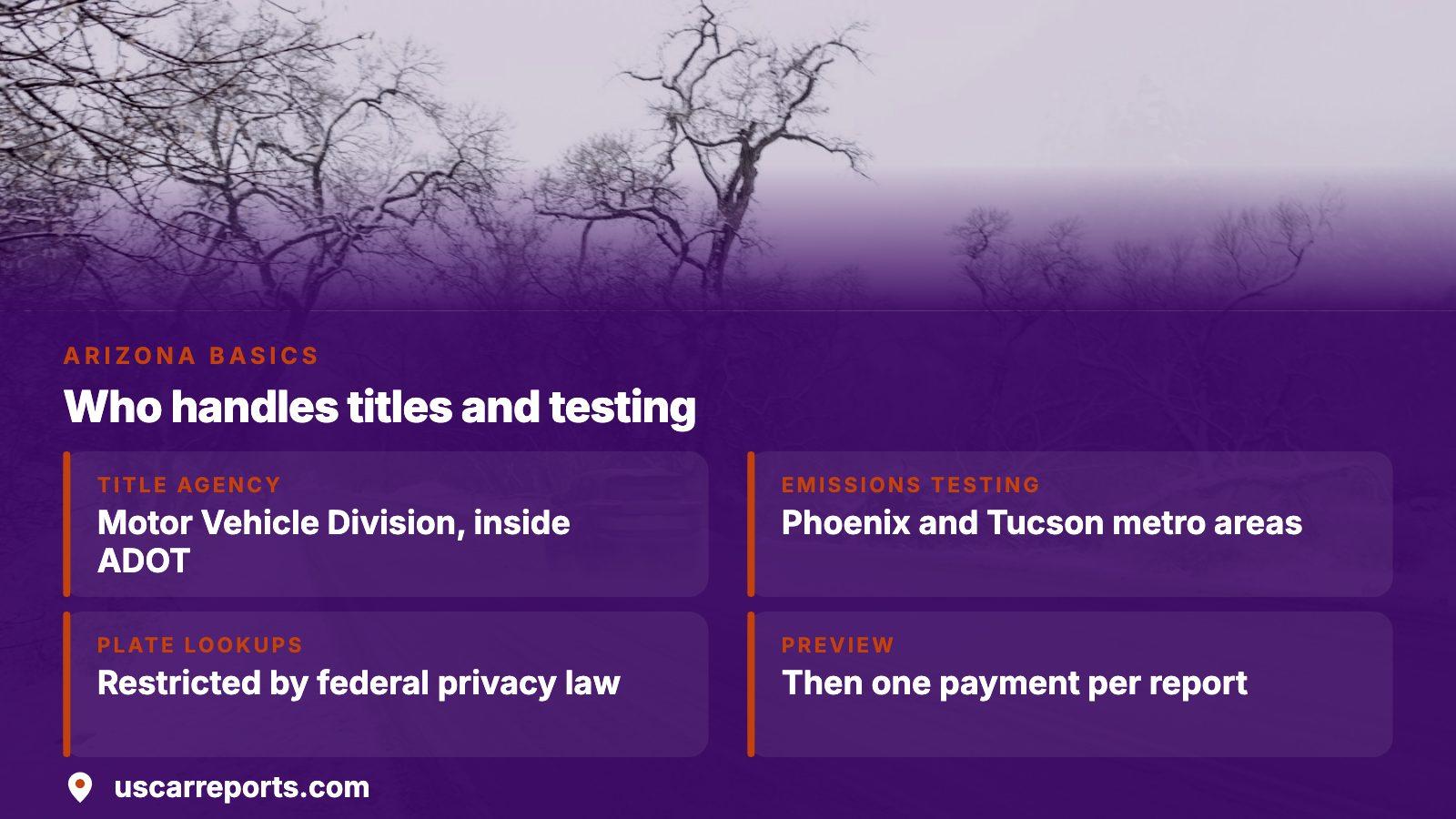
- Title agency
- Motor Vehicle Division, inside ADOT
- Emissions testing
- Phoenix and Tucson metro areas
- Plate lookups
- Restricted by federal privacy law
- Preview
- Free, then one payment per report
What an Arizona VIN lookup shows, record by record
One wrong character in the VIN pulls up a stranger's car, so settle the number first. After that, each record answers something an Arizona seller may not have raised.
| Record | What it settles on an Arizona car |
|---|---|
| Title brands | Salvage, flood and similar brands follow the car from any state that logged them, not only Arizona. |
| Accident and damage entries | Whether a repainted panel is sun repair or crash repair. |
| Odometer readings | A desert body can flatter low miles. A dated series shows whether the number climbed steadily. |
| Salvage and auction history, with photos | Sale photos show the car before any repair, water damage included. |
| Liens, impounds and theft | A recorded lien is a lender's unpaid claim on the car. Theft and insurance entries can exist with no mark on the title. |
| Recalls, owner count and use type | Safety repairs still open, how many people drove the car, and whether it worked as a rental or fleet vehicle. |
Arizona's buying rules, set beside the check
Each state page here pairs the VIN check with that state's buying rules. Arizona's are short.
| Your situation | What applies |
|---|---|
| Who finishes the transfer | The Motor Vehicle Division, or an authorized third-party office where a private provider staffs the counter. |
| Registering in metro Phoenix or Tucson | Most vehicles past their first few years must pass an emissions test to register. Most rural registrations sit outside the program. |
| The name on the paperwork | The seller's name should match the printed title letter for letter before any money moves. |
| Finding an owner from a plate | Closed to private individuals under the Driver's Privacy Protection Act. |
A warning light is a negotiating point
A lit check-engine light before the sale becomes your repair bill after it. If the car will be registered in the Phoenix or Tucson area, take that cost off the asking price.
Titles, the MVD, and making paper agree with record
Arizona has no DMV. The Motor Vehicle Division issues the state's titles, registrations and plates, and authorized third-party offices handle much of the counter work. None of that reveals the car's past. The national title record behind a history report comes from approved NMVTIS providers and reaches brands from every state that reports.
From an NHTSA owner complaint
An Arizona owner who complained about an engine failure on a 2015 Hyundai Sonata said the automaker refused help because its own record flagged the car as salvage. The owner said the title was clean, held a certified Arizona MVD record, and was told the flag could not be removed.
That is one side of a dispute, and the outcome is not on file. Still, when two records disagree about a title's status, find out why before you pay, and keep the seller's title and the history record side by side.
How to run an Arizona VIN lookup: the number first, then the preview
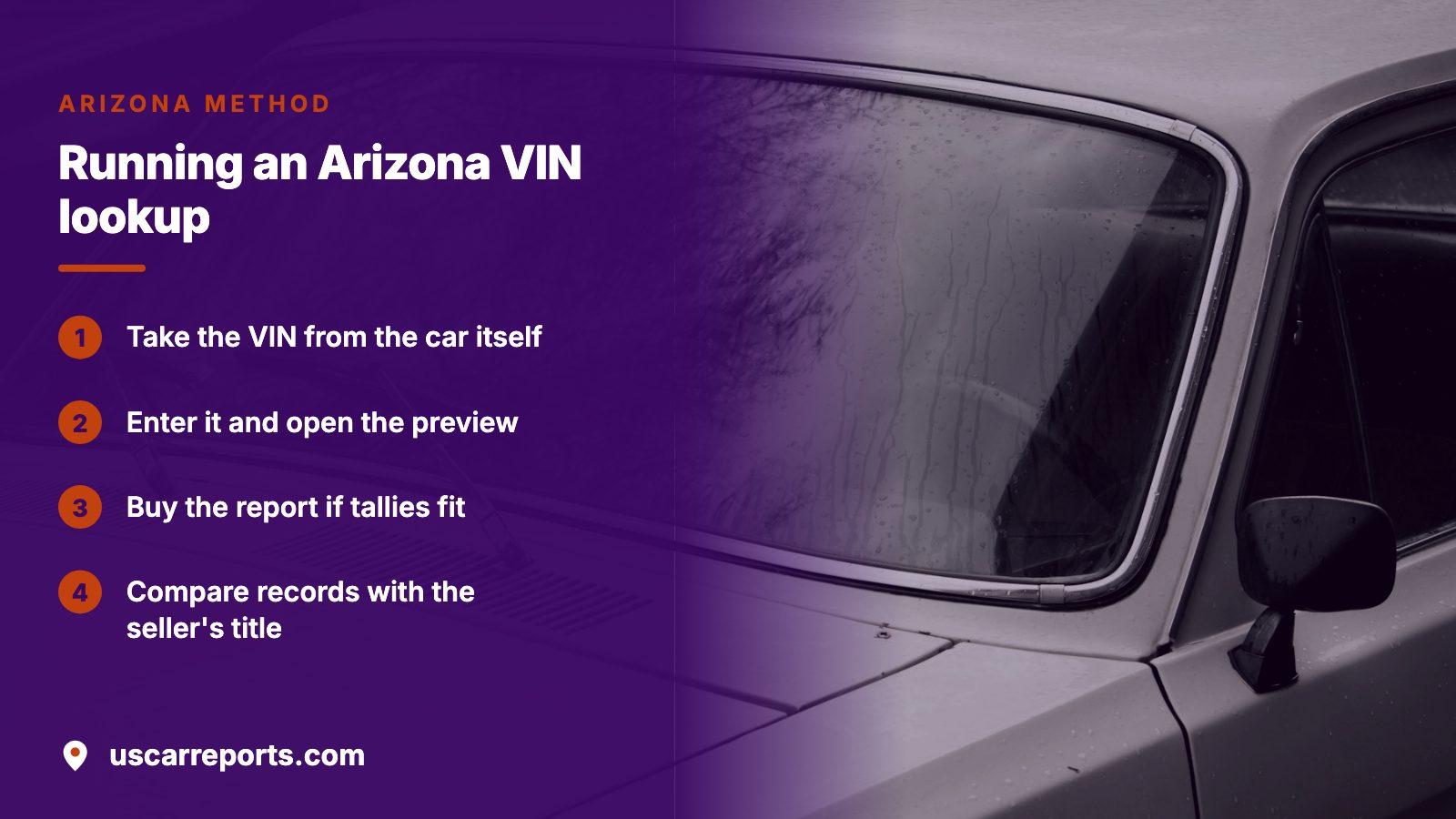
- Take the VIN from the car, not only the listing: visible from outside at the dashboard's lower corner, on the label along the driver's door edge, and on the title. All 17 characters must match.
- Enter it here and open the preview: year, make, model, trim, photos if any, the open recall count and a tally of title and auction records.
- If the tallies fit the seller's story, buy the report and open each record.
- Compare the records with the title the seller is holding, then inspect the car.
A seller who will not share the VIN has already told you something. A plate number is no substitute: privacy law stops private buyers from turning one into an owner's details.
Red flags in the results, and what a brand can cost later
- A flood, salvage or rebuilt brand from any state. Note which state issued it and when.
- Sale photos that show damage the seller left out, especially under new paint.
- An odometer reading that drops, or stalls for years.
- An open lien. Get the title cleared before you pay.
- A theft entry, or an impound nobody can explain.
- Open recalls. Ask if the repair was done.
From an NHTSA owner complaint
One parent who bought a 2014 Ford Focus for a son said the car had carried a rebuilt or salvage title but was fully repaired and a good car. When the son, by then studying in Tucson, took it to a Ford dealer there over a clutch problem, the dealer would not cover the repair, pointing to the salvage title. The parent saw no link between the brand and the clutch.
A brand can outlive the repair and shape what a dealer or warranty provider will honor. This is one owner's account and the dealer's side is not on file, so ask any warranty provider how it treats branded cars before you buy one.
What the report cannot see: quiet damage and heat wear
No record is not the same as no damage
A clean report means nothing was reported. A car that was damaged, never insured and never auctioned leaves no trail, so the inspection is half the check, not an extra.
Salt-state buyers come to Arizona for clean metal. What the sun can bake is another matter, so price the car on its rubber, seals, battery, paint and cooling parts rather than the shine.
- Squeeze the hoses and look over the belts. Hard, cracked or swollen rubber gives the game away.
- Read the battery date code. Heat kills batteries faster than cold, and three or four summers is about the limit.
- Drive up a grade with the A/C on and watch the temperature gauge. A slow pull-down points to a compressor or charge problem.
- Look for dash cracks and split seats. They say the car lived outside.
Fresh paint on a desert car may only be chalked clear coat. The damage entries and earlier sale photos show which.
Monsoon water in a state everyone calls dry
Monsoon storms land hard on ground that cannot soak them up, so washes run and underpasses can fill within minutes. Arizona turns out truly flooded cars each season, and since buyers assume a desert car is dry, a dried-out one may sell more easily here than on the Gulf coast.
- Fine silt under the spare and along the seat rails.
- Green or white crust on wiring connectors.
- Fog or a waterline inside the lamp lenses.
- Warning lights, windows or locks that act up at random.
A flood brand weighs the same on an Arizona title as anywhere else, and a clean title only says nothing was reported. The Texas guide here has a longer water checklist.
Paying for the report, and the order of next steps
The preview costs nothing to open. A report is bought once, singly or as packs of 3, 5 or 10, with no renewals. Check the pricing page for what it costs today.
- Run the preview with the VIN from the car.
- Buy the report if the tallies look right.
- Read the brands, damage and odometer entries against the seller's story.
- Inspect for heat and water, then price the repairs.
- Finish the paperwork at the MVD or an authorized office, with the seller's name matching the title.
Where this information comes from
- Arizona Department of Transportation: Motor Vehicle Division — The state agency behind Arizona titles, registration and transfers.
- NMVTIS: National Motor Vehicle Title Information System — The national title record, which covers brands from every state that reports.
- NICB VINCheck — A no-cost theft and salvage lookup fed by participating insurers.
- NHTSA: recalls — Open-recall lookup by VIN.
- NHTSA owner complaint 11362775 — owner experience, paraphrased
- NHTSA owner complaint 11724002 — owner experience, paraphrased
Sources and photos: Facts checked against the sources above in November 2026. Photos by Miles Loewen, Tigran Shishmanyan and Zoshua Colah on Unsplash; diagrams by USCarReports.
Keep reading
- Texas VIN check: what to run, Texas title brands and buying rulesA longer water checklist, since monsoon cars can need one too.
- Registering a car in another state: deadlines, title and checksNext step when a car is leaving Arizona or arriving from elsewhere.
- Title status check: what the state lookup tells a car buyerHow to read a title's status once the VIN record is in hand.
- Sample reportSee what a finished report looks like before you run one.
Frequently asked questions
How do I run a VIN check in Arizona?
Type the 17-character VIN into the preview, then buy the report to read the title brands and the damage, odometer, lien and theft entries. Add the NHTSA recall tool and NICB's theft and salvage search, which cost nothing.
Can I look up an Arizona car by license plate?
Private buyers cannot. Federal privacy law restricts who may see owner details in state vehicle files, and curiosity is not a permitted reason. Ask the seller for the VIN instead. It is stamped on the car and opens every record a purchase needs.
Is emissions testing required on an Arizona car?
It depends on the registration address. Phoenix and Tucson area registrations carry a testing condition for most cars beyond the first few years of age, and most rural registrations sit outside the program. Ask the MVD or an authorized office before you buy.
Can a desert car really be flood damaged?
Yes. Monsoon rain can outrun what dry ground absorbs, and flash floods catch vehicles every season. Check for silt, crusty wiring connectors and fog inside the lamps, and read the title brands.
What does an Arizona VIN check not tell me?
It cannot show heat wear on hoses, belts, batteries and cooling parts, or damage that never reached an insurer, an auction or a title agency. The test drive and a mechanic's look come after the report and before any deposit.
Now check the car itself
The guide explains what to look for. The report shows what this VIN has on record.