THE SHORT ANSWER
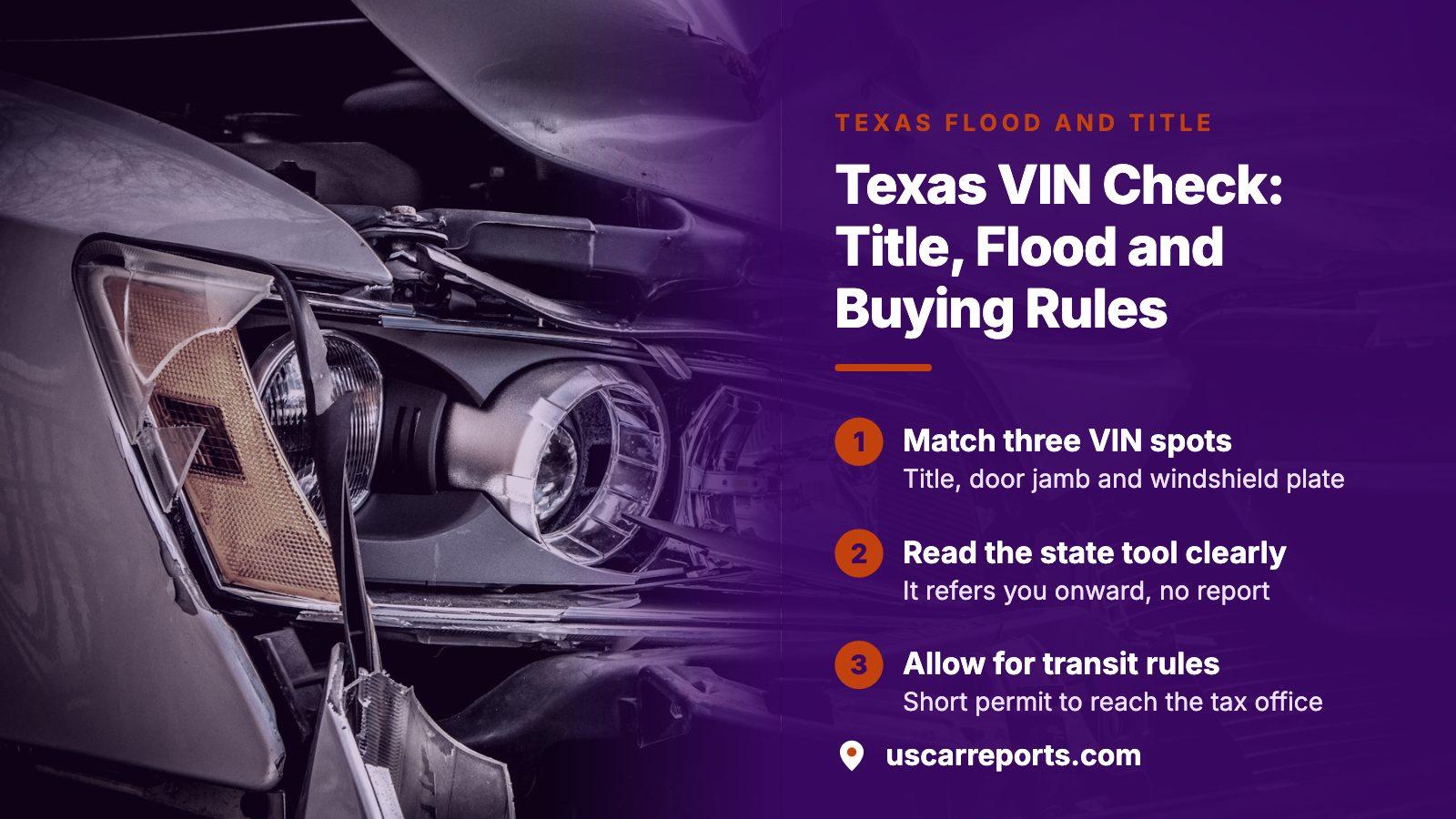
Confirm that the title, the door jamb and the windshield plate carry the same VIN, then decode it. Open-recall data from NHTSA and theft and salvage data from NICB are free. Add the title record that approved NMVTIS providers sell, since TxDMV Title Check only forwards you to one. Cars with Gulf coast history need a flood inspection too. A USCarReports report gathers title, damage, mileage and auction records after a free preview.
- Title Check
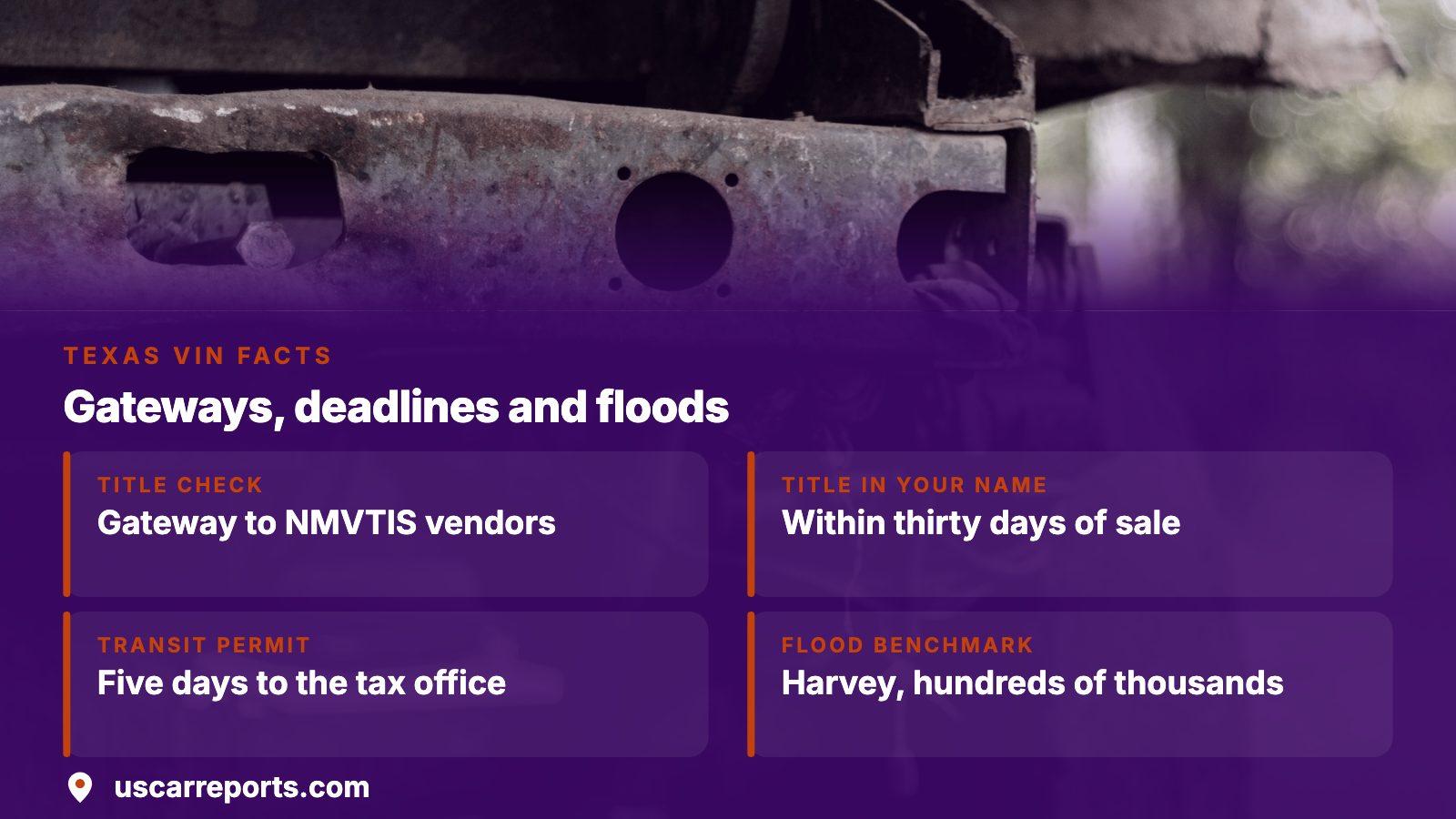
- A gateway to approved NMVTIS vendors, not a state-run report
- Title in your name
- Within thirty days of the sale
- Transit permit
- Five days to reach the county tax office
- Flood benchmark
- Harvey, with flooded vehicles in the hundreds of thousands
Why a Texas check is weighted differently from other states
Each state brands titles in its own words, sets its own buying paperwork and keeps its own records. Only the VIN travels between them. A state-level check therefore does two jobs: read the national history tied to the number, and apply the titling rules of the state you live in.
Texas leans on that national history harder than most. Pickups dominate sales, and cab, bed, engine and drivetrain shift a price more than the trim badge, yet listings get them wrong. Gulf storms flood cars most years. Vehicles also arrive from other states and across the border, so a lot's inventory often has its history elsewhere.
What a Texas VIN check finds, and what each part costs
| Lookup | What it answers | Cost |
|---|---|---|
| VIN decode | Factory build: cab, bed, engine, drivetrain | Free |
| NHTSA recall search | Open safety recalls on that VIN | Free |
| NICB VINCheck | Theft and salvage reports from participating insurers | Free, five searches a day |
| Approved NMVTIS provider | Title brands from every reporting state | Paid, per report |
| USCarReports report | Ownership and use type, brands on the title, crash and damage history, mileage readings, liens and impounds, theft and insurance records, salvage and auction photos, open recalls, market value, factory specs | Free preview, then one payment |
A decode says nothing about accidents, and insurer databases miss damage nobody claimed.
Running a Texas VIN lookup: finding the VIN and the order to work in
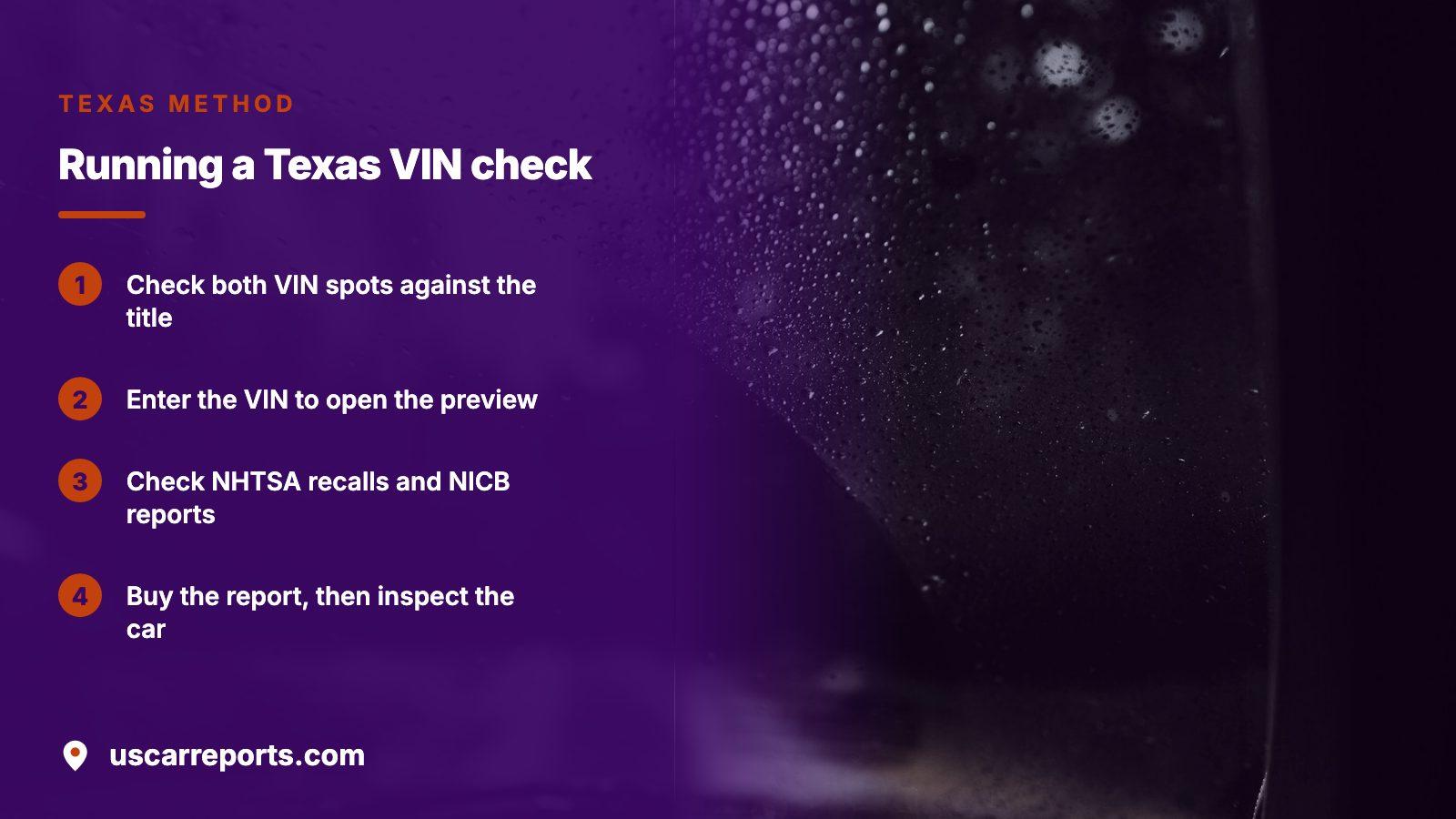
- Check both VIN locations, the windshield plate and the door jamb, against the title the seller hands you. Any difference needs an explanation before you go further.
- Enter the VIN here to open the free preview.
- Check open recalls on NHTSA's site, then look up theft and salvage reports with NICB. Both are free, and NICB allows five searches a day.
- If the car survives that, buy the full report: one payment, no subscription.
- Inspect the car, and finish the paperwork at the county tax office.
TxDMV Title Check: a referral, not a report
TxDMV's Title Check sounds like a state report. It is a referral. Texas holds no such report and sells none. The page tells you to find the VIN, have a card ready and pick an approved provider, which moves you to that vendor's own site. TxDMV says vendors charge from a couple of dollars up, and it tells buyers to compare what each includes.
Approval is the claim that matters. The federal government, through the Department of Justice, has signed off on each vendor to sell reports from NMVTIS. They all read the same national record, so a higher price buys packaging rather than extra title history.
One warning for private buyers: TxDMV says four providers sell these title reports to dealerships only. Check its list, and confirm a vendor serves individuals before entering card details.
Texas title brands, and the national names beside them
A Texas title speaks the state's vocabulary, while an approved provider's report speaks the national one. These are the Texas brands as TxDMV defines them.
| Texas brand | What it means |
|---|---|
| Salvage | Wrecked or damaged past a set share of retail value. Cannot return to public roads until rebuilt and inspected. |
| Rebuilt | Formerly salvage, since cleared by anti-theft and safety inspections. Drivable, and the brand stays. |
| Water damage | Damaged by floodwater. |
| Junk | Unfit for U.S. roads, worth parts or scrap only, never titled or registered again. |
| Gray market | Built for use outside the U.S. and imported. Texas will not title or register it. |
Fire Damage, Owner Retained, Salvage Retention and Salvage Stolen are national entries that Texas treats as salvage. Where a title and a report seem to disagree, TxDMV publishes conversion charts. The gap is usually wording, so compare events rather than labels.
Owner Retained deserves a hard look
An insurer wrote the car off and the owner kept it anyway. The entry cannot say whether anyone rebuilt it well. Ask what was repaired, by whom and with what invoices, and pay an independent mechanic to check the structure.
Gulf coast cars: floods, Harvey and the clean-title problem
Harvey set the benchmark: estimates for the Houston area alone reach into the hundreds of thousands of flooded vehicles. Insured cars were written off, branded and largely shipped overseas through auctions. Many uninsured ones were dried out and resold on clean titles.
The dangerous cars never produced a claim, so no database holds a trace. For anything with coastal Texas history, weigh what you see as heavily as what you read.
- Sand or silt in the spare tire well, beneath carpets and inside seat rails
- Corroded connectors and bare metal under the dashboard
- Fogging or a water line inside the lamp housings
- A musty smell, or heavy perfume covering something
- Carpet that looks fresher than the rest of the cabin
- A title that changed states soon after a named storm
Texas rules for buying from a private seller
- Never close a private sale without the title in hand. The seller signs it, dates it and records the odometer reading.
- Get the Application for Texas Title and/or Registration, signed by the seller and showing the sales price, plus any lien release or power of attorney.
- Take the seller to the county tax office. A representative can tell you whether the title is in order and whether it carries salvage or legal issues.
- File for the title in your name within thirty days of the sale. Later filings can bring delinquent transfer penalties.
- Bring proof of liability insurance to title and register the car.
- A Vehicle Transit Permit from TxDMV allows five days of driving to the tax office, and the seller keeps the plates.
- Be wary of a title reissued just before the sale; a wash or a flood can lie behind it.
Allow at least 20 business days for the title to arrive. With a lien, it goes to the lienholder.
Border and imported vehicles
Heavy border traffic means a car that began life in Mexico is not suspect for that alone. What matters is that the import was finished correctly, since Texas cannot title it otherwise.
- Ask whether it was imported, and ask for the import paperwork.
- Confirm a U.S. title exists today, in the seller's name.
- A Mexican-built car made for the U.S. market carries a standard VIN. One made for Mexico can differ in specifications and emissions equipment.
- If unsure, find out from the county tax office which paperwork it wants, and do that before you pay.
Pricing and the next step
Begin with the preview, which costs nothing. The full report is one payment with no subscription, so nothing renews and there is nothing to cancel. Packs of 3, 5 or 10 suit anyone comparing several cars. The pricing page at /pricing has the options.
Run the free lookups and read the preview. If the car still looks right, buy the report before paying a deposit. A clean report does not replace a mechanic's inspection, which TxDMV advises before you sign anything or hand over money.
Where this information comes from
- TxDMV: Title Check, Look Before You Buy — Supports the gateway model, the approved-provider steps, the dealer-only warning, the brand definitions and the transit permit.
- TxDMV: Salvage brands in the national system — Defines Owner Retained and the other salvage names, and says Texas treats each as a salvage vehicle.
- TxDMV: Buying or selling a vehicle — Source for the private-sale documents, the county tax office visit, the transfer deadline and the insurance requirement.
- NMVTIS: National Motor Vehicle Title Information System — The federal title record behind every approved provider's report.
- NHTSA: Recalls — The free open-recall search by VIN.
Sources and photos: Facts checked against the sources above in November 2026. Photos by Clark Van Der Beken, Justin Cron and Zoshua Colah on Unsplash; diagrams by USCarReports.
Keep reading
- Texas title check by VIN: brands, the 2003 cutoff and the 30-day clockThe Texas title record and brand definitions in more depth.
- Florida VIN check: title records, flood risk and Florida buying rulesThe other flood coast, for a car that has lived in both states.
- Title status check: what the state lookup tells a car buyerHow to read a title's status before money changes hands.
- Sample reportSee how the records are laid out before you buy a report.
Frequently asked questions
Can I run a Texas VIN check for free?
Part of it. Decoding the VIN, searching NHTSA for recalls and querying NICB for theft and salvage all cost nothing. The title record is the paid piece, bought from an approved provider that TxDMV links to. On this site you see the free preview first, then decide whether to pay once for the full report.
How do I check a VIN number in Texas?
First, make sure the windshield plate, the label inside the door and the title all show one VIN. Then decode it, run the recall and theft searches, pull the title record and inspect the car. Finish at the county tax office, before you pay.
Can I look up a license plate in Texas?
No. A plate will not tell a private person who owns the car or where they live. Under the Driver's Privacy Protection Act, those records stay closed except for defined uses, and idle interest in a stranger is not among them. In a sale, request the VIN. A seller who stalls is telling you something.
What does a Texas dealer have to post on a used car?
On passenger cars and pickups, TxDMV says a dealer must post a Buyers Guide showing whether it is sold as is or comes with a warranty. Read it before signing. Title-history problems with a dealer can be reported to TxDMV's Enforcement Division.
Does a clean Texas title prove the car never flooded?
No. A flood brand needs a claim or a state record behind it, and the worst cases leave neither. A car dried out and resold looks like any other on paper. Check for sand, corrosion and water lines in person.
Now check the car itself
The guide explains what to look for. The report shows what this VIN has on record.