THE SHORT ANSWER
To run a Connecticut VIN lookup, enter the car's 17-character VIN, open the preview, and buy the report if the record fits the seller's story. Read the title brands first. Connecticut stamps a written-off title SALVAGE, and a car with ten or more major parts damaged beyond repair gets SALVAGE PARTS ONLY, which can never be rebuilt, reregistered or retitled.
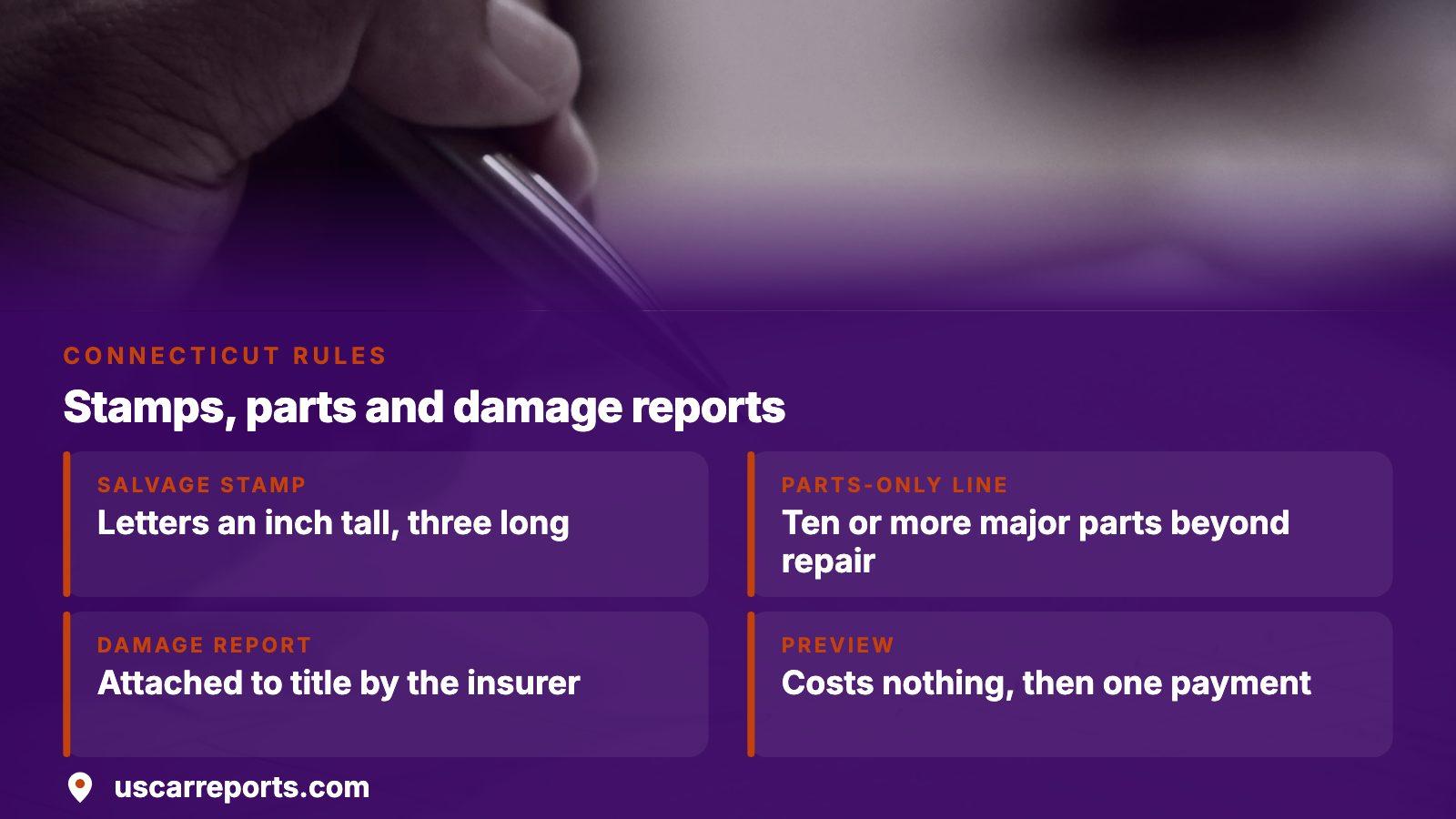
- Salvage stamp
- Letters an inch tall, three inches long at most
- Parts-only line
- Ten or more major parts beyond repair
- Damage report
- Attached to the title by the insurer
- Preview
- Free, then one payment per report
What a Connecticut VIN check reads off one number
Every record hangs on the VIN, so the lookup follows the car rather than the state on its registration. That matters here, because the brand that counts most is either on paper you can hold or in another state's file.
| Record | What it tells a Connecticut buyer |
|---|---|
| Brands on the title | Salvage and similar brands, including ones another state applied before the car arrived. |
| Accidents and damage | What happened and how bad it was, to set beside the damage report that should come with a branded title. |
| Odometer history | Whether the mileage climbed steadily or stalled. |
| Salvage and auction history, with photos | The car as it looked after a loss, before any repair. |
| Liens and impounds | Whether a lender or a towing lot may still hold a claim. |
| Theft and insurance records | Theft flags and insurer events that never reach a title. |
| Open recalls | Safety repairs the maker owes that nobody has done yet. |
| Owners, use type, market value and factory specs | How many owners and what use, what the car is worth, and what the factory built. |
Running a Connecticut VIN lookup before you pay
- Find the VIN on the car itself: on the small plate at the dashboard corner, or on the sticker in the driver's door frame. Check that it agrees with both the title and the listing.
- Enter it here and open the preview. It shows the year, make and model and how many title, auction and other records are on file.
- Hold those counts up against the seller's story. A seller who says clean while the preview shows several records has handed you your first question.
- Buy the report to open the records, then read them beside the paper title, in person, before any deposit.
One wrong character returns somebody else's car, so read the VIN off the dashboard plate rather than from a photo in a listing.

Connecticut's salvage rules at a glance
USCarReports pairs each state's VIN check with that state's buying rules. Connecticut's are unusually physical: where the title was issued here and the car is declared a total loss, the brand is printed on the paper itself.
| Situation | What Connecticut requires |
|---|---|
| Insurer declares a total loss | The insurer stamps SALVAGE on the title, in letters an inch tall and capped at three inches in length. |
| A loss is stamped | The appraiser's damage report on the vehicle goes onto the title as an attachment. |
| Ten or more major parts beyond repair | The title reads SALVAGE PARTS ONLY instead: no rebuild, no reregistration, no retitling. |
| Plain SALVAGE | The car may be rebuilt, reregistered and retitled. |
| Brand applied in another state | Appears on no Connecticut stamp, only in the national title record. |
SALVAGE or SALVAGE PARTS ONLY: one count apart
Both stamps open with the same word, and at that size the eye lands on it and stops. The words after it decide the car's future. Once an insurer's tally of major components too damaged to fix, and so needing replacement, reaches ten, the title carries SALVAGE PARTS ONLY instead. An engine or a transmission is the usual example.
The line is a count, with no room to bargain. A car with nine ruined components keeps the plain stamp and the chance of a rebuild. A car with ten is parts only, whatever anyone is willing to spend. The terms unrebuildable and unrepairable end the same way: no registration and no new title, under any circumstances.
A parts-only car is not a project
Treat a restoration pitch for a parts-only car as a warning about the seller. The vehicle's only lawful future is as a source of parts.
When a plain SALVAGE car is a fair deal
A plain SALVAGE title is not a death sentence. The car can be rebuilt, reregistered and retitled, and some buyers choose that route on purpose. The price has to reflect it, because a rebuilt car keeps the history on its paperwork, sells for less than a matching unbranded one, and can be harder to insure and finance.
- Price it as a branded car, however clean the repair looks.
- Ask for the repair invoices, plus any pictures taken while the work was underway.
- Set the auction photos in the report against the work you can see.
- Get an insurance quote before you agree on a number.
The record cannot grade the workmanship. A mechanic's inspection can.
Ask for the appraiser's report, not only the title
Connecticut has the insurer pair the appraiser's damage report with the title it stamps. In many states a brand is a verdict with no reasons given. Here the reasoning is supposed to ride along with the paper, so you can see what was wrong with the car rather than only that something was.
- If a seller shows a stamped title with nothing attached, ask where the report is before anything else.
- Read which parts it lists as damaged and compare them with the auction photos.
- Confirm that the report, the title and the car all show the same VIN.
Red flags in a Connecticut report
- Any title brand, along with the state and date that applied it.
- A parts-only, unrebuildable or unrepairable brand anywhere in the history.
- A clean-looking Connecticut title on a car whose record shows a brand from elsewhere.
- Photos from an auction or salvage sale that show damage nobody told you about.
- An odometer reading that drops or stops climbing.
- A lien still open, a record of impoundment, or a theft report.
A clean report is not a clean car
A clean record means nothing was reported. Damage that no insurer, auction house or title office ever recorded leaves no trail, so the report and a mechanic's inspection belong together.
Cars from other states, and what plates cannot tell you
A Connecticut stamp only describes a loss handled under a Connecticut title. A car that arrived from elsewhere carries whatever its earlier state recorded, and no Connecticut document will mention it. The national title record closes that gap, and the report's title records come through it.
Plates are a poor handle on a car. In Connecticut the plate stays with the registrant, not the vehicle, and sellers have a cancellation step to finish after a sale. Federal privacy law also limits what a plate lookup may return to a private buyer, while the VIN opens every record. Ask the seller for it.
Cost, and the order to work in
Opening the preview costs nothing. For the full Connecticut report you pay once, choosing a single report or a 3, 5 or 10 pack, and no subscription follows. The pricing page carries today's prices.
- Run the preview with the VIN from the car.
- Buy the report if the counts fit the seller's story.
- Read the brands, damage and odometer records beside the paper title and its attached report.
- Book a mechanic's inspection and ask your insurer for a quote.
- Finish the paperwork only once the seller's name is the one printed on the title.
Where this information comes from
- Connecticut DMV: salvaged and totaled vehicles — The state's own process for salvage vehicles and the inspection route back onto the road.
- Connecticut General Assembly: sale of salvage vehicles — A legislative research report on the stamp size, the attached damage report and the parts-only test.
- NHTSA: recalls — A no-cost open-recall lookup by VIN, independent of any state brand.
- NMVTIS: National Motor Vehicle Title Information System — The national title record, which holds brands from states other than Connecticut.
Sources and photos: Facts checked against the sources above in November 2026. Photos by Iain, Cole Keister and Masjid MABA on Unsplash; diagrams by USCarReports.
Keep reading
- New York VIN check: flood, city-street and road-salt history before you buyThe neighboring state's rules, for cars that cross the line.
- Title status check: what the state lookup tells a car buyerHow to read a title's status once the VIN record is open.
- Registering a car in another state: deadlines, title and checksThe next step when a car bought elsewhere is coming home.
- Sample reportSee what a finished report looks like before you run one.
Frequently asked questions
How can I check the VIN of a car in Connecticut?
Copy the 17-character number from the plate at the dashboard corner or the driver's door frame, enter it, and open the preview. Buy the report when the record count fits what the seller said. Then compare the brands and damage records with the paper title, and try the NHTSA recall tool, which costs nothing.
What does SALVAGE PARTS ONLY mean on a Connecticut title?
It means the insurer counted ten or more major parts damaged beyond repair. A car with that stamp can never be rebuilt, reregistered or retitled. Its only lawful future is as parts, so a seller pitching it as a restoration is either mistaken or testing you.
Can a Connecticut car titled SALVAGE be driven again?
Yes, if the stamp reads plain SALVAGE. Those cars can be rebuilt, reregistered and retitled. Expect the history to stay on the paperwork, a lower resale value than an unbranded twin, and extra effort to get insurance and financing. A mechanic should judge the repair.
Does a Connecticut title show what damaged the car?
Not by itself. The stamp only gives the brand. Connecticut does make the insurer fix the appraiser's damage report to that paper title, though, so ask the seller for it. A VIN report adds accident records and auction photos, which help check the report against the car.
Can I look up a Connecticut car by license plate?
No, not for a private buyer. The plate stays with the registrant, and federal privacy law limits what a plate lookup returns. Request the VIN from the seller. It sits on the dashboard plate and the title, and it opens every record a purchase needs.
Now check the car itself
The guide explains what to look for. The report shows what this VIN has on record.