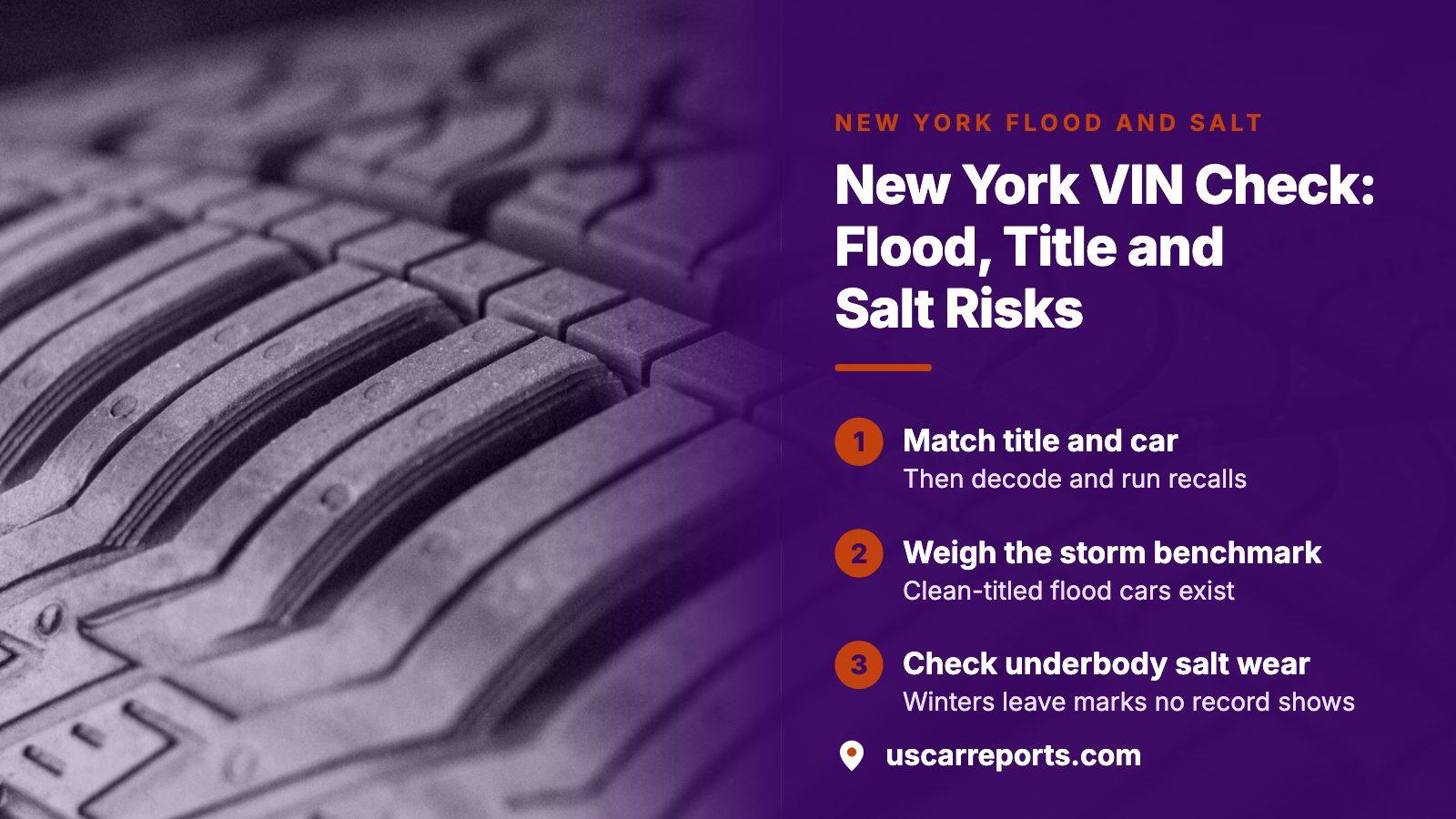
THE SHORT ANSWER
To check a VIN in New York, make sure the title and the car show the same number, decode it, then run the recall search at NHTSA and the theft and salvage search at NICB, both free. Add the national title record, which carries brands from any state. Finally, inspect for the part of New York the car came from: salt water or street wear downstate, road salt upstate. A USCarReports preview shows what the history holds before you pay.
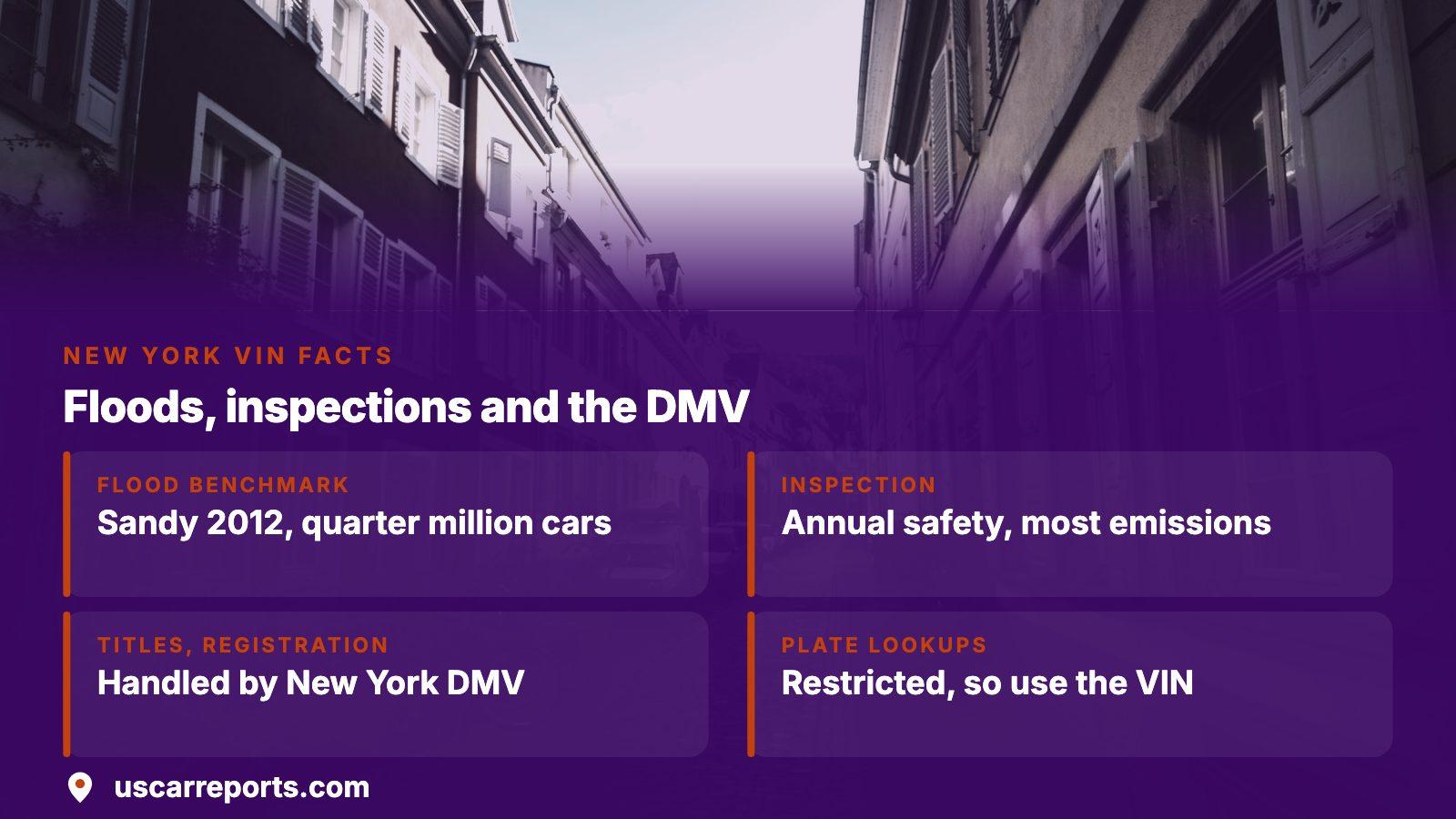
- Flood benchmark
- Sandy in 2012, roughly a quarter of a million vehicles
- Inspection
- Annual, safety statewide, emissions on most gasoline cars
- Title and registration
- Handled by the New York DMV
- Plate lookups
- Restricted by federal law, so use the VIN
What a New York VIN check finds, and what it leaves out
The VIN is the one thing that follows a car from state to state, so a VIN check asks for everything attached to that number. For a New York car, the useful answers are title brands from any state, damage and insurer events, odometer readings over time, theft reports, and auction listings that came with photos. A few lookups cost nothing.
| Lookup | What it answers | Cost |
|---|---|---|
| VIN decode | Whether the factory build matches the listing | Free |
| NHTSA recall search | Open safety recalls on that exact car | Free |
| NICB VINCheck | Theft and salvage reports from insurers | Free |
| National title record | Title brands from every reporting state | Paid, per report |
| USCarReports report | Brands, damage, mileage and auction photos in one document | Free preview, then one payment |
None of these says how the car was stored or driven. For that, the state matters.
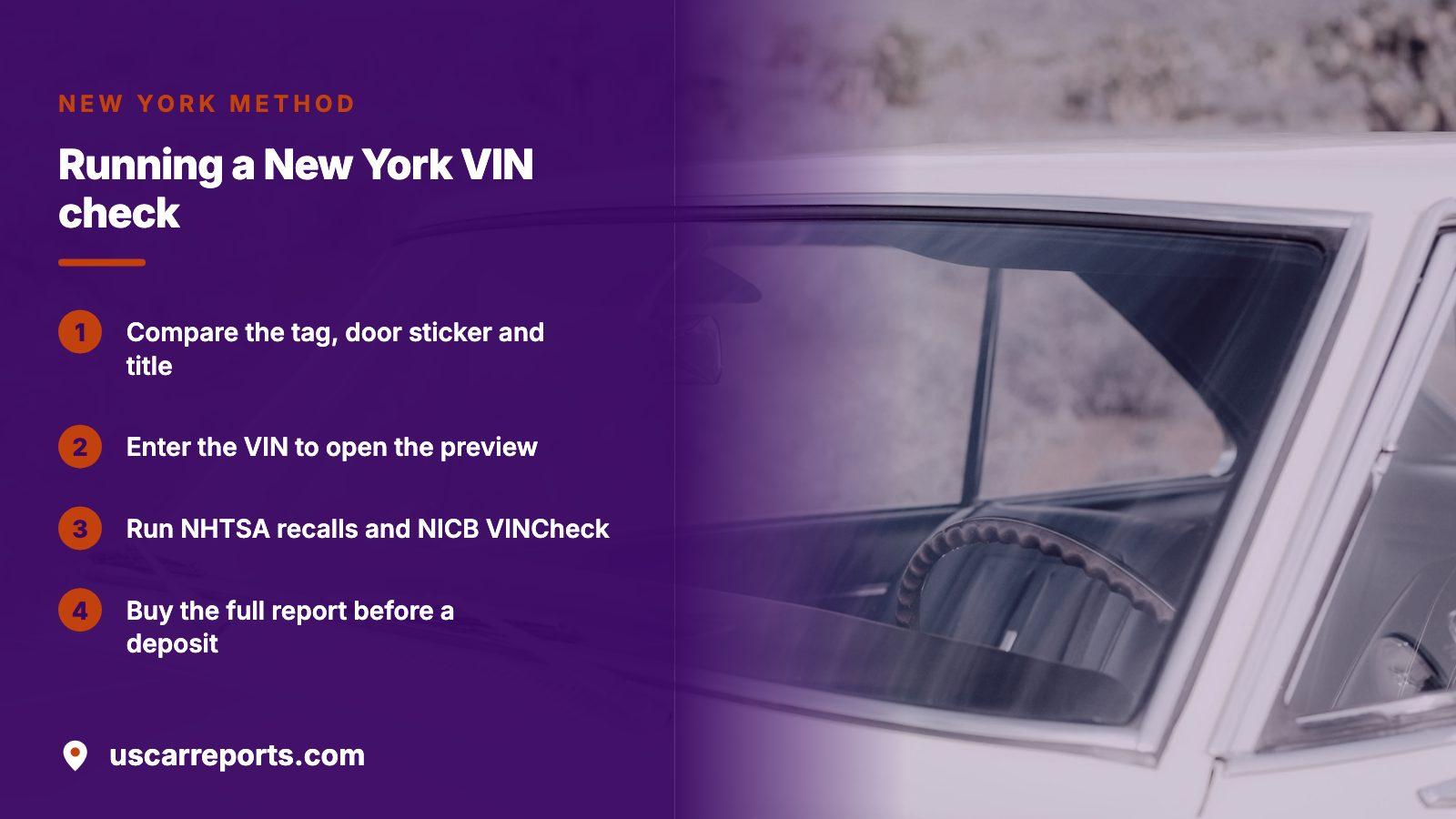
Running the check in an order that saves you trips
- Compare three places: the metal tag at the dashboard corner, the sticker on the driver's door edge, and the title. A single character out of place needs an explanation first.
- Enter the VIN on USCarReports to open the preview. Nothing is charged at this step.
- Run NHTSA's recall search and NICB's VINCheck. Neither commits you to anything.
- Buy the full report once the preview looks right and before you put down a deposit.
- Work out which New York the car lived in, then inspect for that one.
The early steps are cheap and can end the search. A mismatched number or an open theft entry saves you the drive.
The title and the DMV: what to confirm before money moves
In New York the DMV handles titles and registration, so the paperwork you finish there is the record that the car is now yours. Before that, read the title the seller shows you. The name printed on it should match the seller's identification exactly, and the VIN on it should match the car.
Then compare it with the national title record. A New York title can look tidy on a car that spent its earlier years elsewhere, and the national record gathers brands from every state that reports, so you are not relying on the seller's account.
When the names do not match
A seller who is not the person named on the title is selling something the paper does not show as theirs. Hold the deposit until the person named on the title is part of the sale, and take doubts about the paperwork to the DMV.
Downstate water: the storm benchmark and the clean-titled flood car
Hurricane Sandy in 2012 is still the yardstick for flood cars. Estimates put the vehicles it flooded around New York at roughly a quarter of a million, in garages, dealer lots, airport lots and on streets, all in salt water. Two patterns still repeat after any coastal flood.
Cars that went through insurers were branded and sold on at auctions that ship cars nationwide, so a car flooded in a coastal borough can be advertised in another state a year later. Cars nobody claimed on were dried, detailed and sold with ordinary titles. A brand search catches the first group. Only your own inspection catches the second.
- Silt or grit under the carpet, in the spare-wheel well and around the seat tracks
- Corrosion on the connectors under the dashboard
- Moisture or a waterline inside the lamp lenses
- Electrical faults with no pattern
- Seat or carpet fabric noticeably fresher than the rest of the cabin
Salt water is the worst kind of flood damage because corrosion carries on after the car dries. On a downstate car with coastal history, start here rather than finishing here.
City cars: low mileage that hides a hard life
Low mileage on an older city car reads as gentle use, and often is not. Street parking, short trips and potholes wear a car in ways the odometer never records.
| What you see | What it points to |
|---|---|
| Scraped bumper corners and wheel faces | Years of parallel parking by feel |
| Dents along both door edges | Tight curb space with a neighbor on each side |
| Chewed wiring or random electrical faults | Rodents, which are drawn to newer wiring insulation |
| Rusting exhaust and a tired battery | Short trips that never let the engine fully warm up |
| A worn cabin on a low-mileage car | Heavy passenger or delivery use |
Ask where the car slept at night. A garage-kept car and a street-parked one at the same mileage are different cars, and the answer should move the price. The ownership and use-type entry in a report is where a commercial past shows up.
Upstate winters: road salt on the frame and the lines
Upstate, roughly from the Hudson Valley northward and westward, cars face the same road-salt winters as Michigan's. Syracuse, Rochester and Buffalo are the obvious examples. Put the car on a lift and check the rockers and subframes first, then the frame, the fuel and brake lines, and the bolts that hold parts on.
Fresh undercoating is a question to ask, not a reassurance. Find out what it covers, when it went on and why the owner chose that moment. Rust hidden under a new coat is still rust.
The inspection sticker: a date worth reading, not a verdict
New York inspects registered vehicles every year. Safety is checked statewide, and most gasoline vehicles get an emissions test as well. The windshield sticker carries a date, so you can see when the car last passed. A current sticker is a small point in its favor. A sale timed just before the sticker runs out deserves a direct conversation with the seller.
A sticker sets a minimum
A pass covers the car's condition on one day: braking, lighting, tires and exhaust output. Water damage, hidden structural rust and title problems sit outside it.
Plates, owners and the case for asking for the VIN
A New York plate does not open an owner record to a private citizen. Under the federal Driver's Privacy Protection Act, motor vehicle records stay closed to idle curiosity; only listed uses qualify, and checking out a stranger's car does not count. USCarReports works from the VIN, and so should you. Everything in the checks above starts from that number, so ask for it in the first message. A seller who will not share the number before you travel is also telling you something.
Cost, and the sequence to follow
Enter the VIN to see the preview before paying anything. You pay nothing to view the preview. The report is then a one-time buy with no renewal, so there is nothing to cancel. Anyone comparing several cars can choose a 3, 5 or 10 set instead. Current options are on the pricing page at /pricing.
Preview first, free searches second, report third, deposit last. A clean report narrows the risk without replacing a mechanic's look at a car with downstate water history or upstate rust.
Where this information comes from
- New York State DMV — The agency behind New York titles, registration and the annual inspection program.
- NMVTIS: National Motor Vehicle Title Information System — The federal title record behind approved providers, described as protection against title fraud and unsafe vehicles.
- NHTSA: Recalls — The open-recall search by VIN.
- NICB: VINCheck — The theft and salvage lookup run by the insurance industry.
Sources and photos: Facts checked against the sources above in November 2026. Photos by Yvette S, Wesley Tingey and Karwin Luo on Unsplash; diagrams by USCarReports.
Keep reading
- New York title check by VIN: brands, liens and the MV-999 in the seller's handThe title side of a New York purchase, read on its own.
- Florida VIN check: title records, flood risk and Florida buying rulesA fuller water inspection for cars from coastal states.
- Michigan VIN check: salt, the Secretary of State and what a report can missUnderbody rust checks in depth, useful for cars from upstate winters.
- Sample reportSee how the records are laid out before you buy a report.
Frequently asked questions
Is there a free VIN check for a New York car?
Part of one. NICB's theft and salvage lookup, the NHTSA recall search and a decode all cost nothing. The national title record is the paid piece. USCarReports opens with a free preview, so you see what the history holds for that VIN before deciding on the full report.
Does Hurricane Sandy still matter when buying a used car?
As a pattern, yes. Insured flood cars were branded and moved through auctions, while uninsured ones were cleaned up and sold with ordinary titles. Any car from a coastal area can fit either group, so a clean title proves little. Check in person for silt, corroded connectors and waterlines.
What should I check on a used car from New York City?
Look past the odometer. Street-parked cars collect scrapes along corners and door edges, and rodents can chew wiring. Ask where it slept overnight and whether it worked as a rideshare or delivery vehicle, then ask for service records. Low mileage can still mean a hard life.
Is a car with a fresh inspection sticker a safe buy?
A fresh sticker means the car passed the state's checklist on the date shown, which is a useful signal. It does not cover flood damage, structural rust or title brands. Treat it as one input beside the history report and a mechanic's own inspection.
How is a New York VIN check different from one in another state?
The history tied to the VIN is national, so the records look alike everywhere. What changes is the local layer: the DMV that handles the title, the annual inspection, and wear that depends on whether the car lived downstate, in the city or in the snow belt.
Now check the car itself
The guide explains what to look for. The report shows what this VIN has on record.