THE SHORT ANSWER
To run a Hawaii VIN lookup, copy the 17-character number from the car, enter it in the preview on this page, and buy the report if the car stays on your list. It reaches back past the islands to earlier brands and mileage. Before any money moves, also confirm the safety inspection certificate is current, since Honolulu wants to see it at transfer.
- Safety certificate
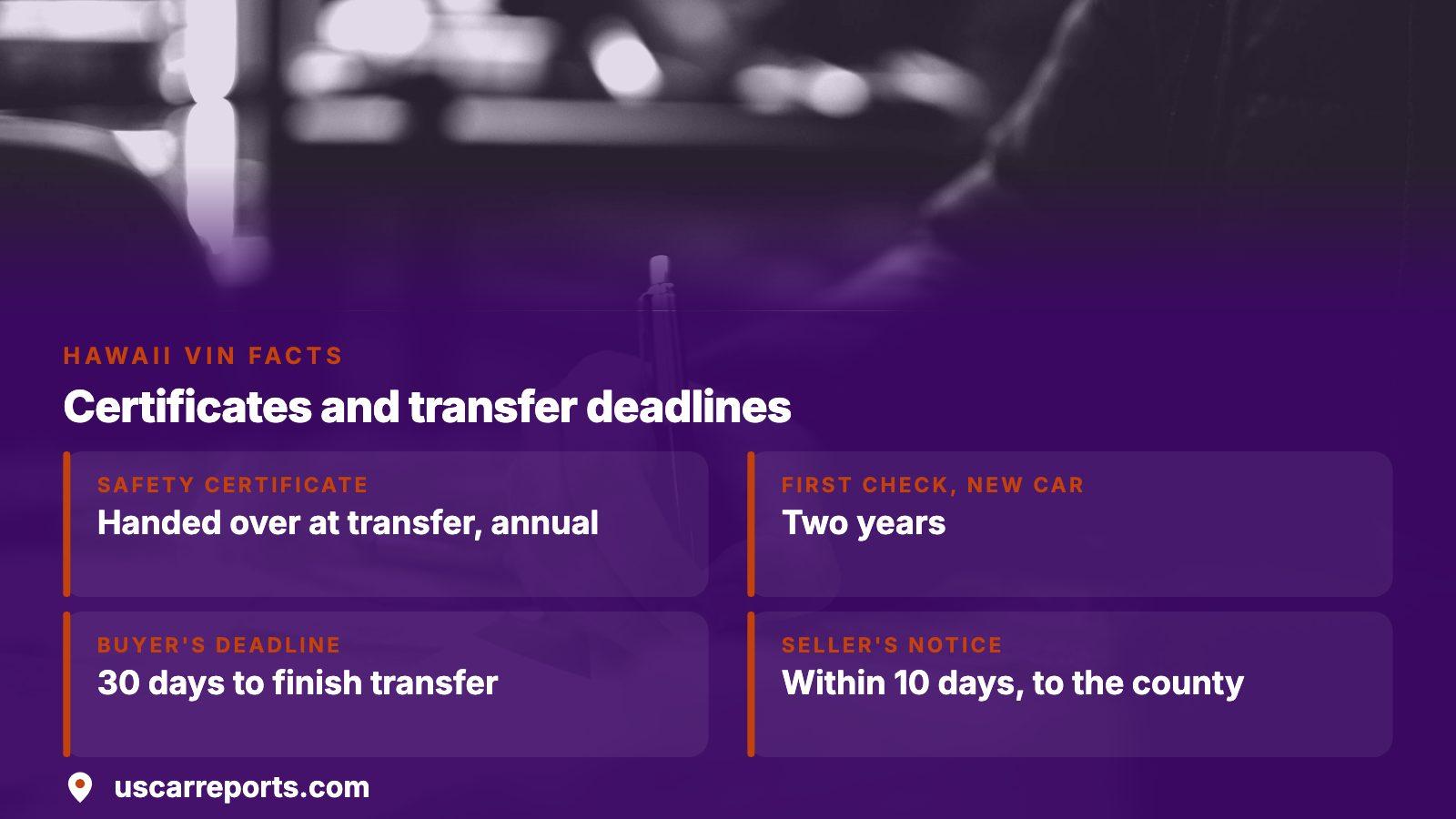
- Handed over at transfer; annual, with a two-year first check on a new car
- Buyer's deadline
- 30 days to finish the Oahu transfer
- Seller's notice
- Filed within 10 days with the county of last registration
- Preview
- Free, then one payment per report
What a Hawaii VIN lookup shows about an island car
A VIN lookup turns 17 characters into a record of what happened to the car, wherever it happened. For an island buyer, these entries do the most work:
| Record entry | Why it matters on the islands |
|---|---|
| Brand history | Salvage, junk or flood labels a mainland state applied before the car was loaded onto a ship |
| Total loss and salvage entries | An insurer payout or a yard transfer that may never have reached the Hawaii paper title |
| Odometer readings | Dated mileage to hold against the figure the seller writes on the title |
| Liens and theft | A lender's claim or a theft entry that must clear before the title can move |
| Open recalls | Safety repairs the maker still owes that exact car |
A car that crossed the Pacific brings a mainland record
No one drives a car to Hawaii. A vehicle first titled elsewhere comes in by ship, and Honolulu's paperwork reflects it: to move an out-of-state title on Oahu, the buyer must show a shipping receipt or bill of lading that dates the car's arrival, unless the car already holds a Honolulu out-of-state permit.
Salvage thresholds belong to each state, so damage that earns a brand in one place may earn none in the next. Paper titles also shed brands when the new state never consults the earlier ones. The federal database keeps every brand a state reports, so a shipping container does not erase one.
A thin local record is not a clean one
A recently registered Hawaii title with few entries often means a recent arrival, not a spotless car. Ask when it landed and which state titled it before.
A sensible order for checking a Hawaii car
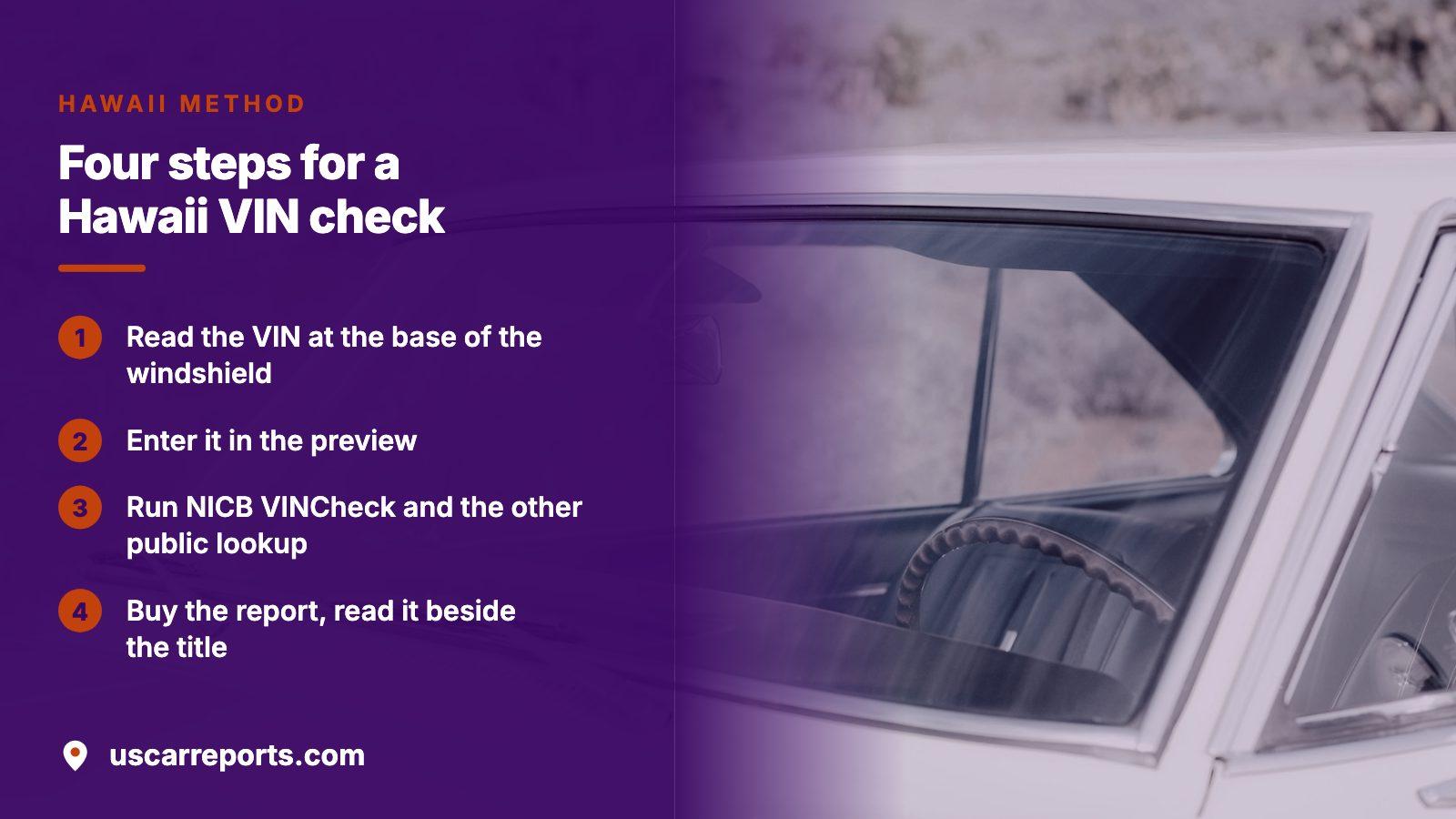
- Stand at the front left of the car and read the VIN off the base of the windshield. Match every character to the title and registration card; the number in the ad proves nothing.
- Enter it in the preview and see whether the decoded year, make and engine describe the car you are actually looking at.
- Run the two public lookups as well. NICB's VINCheck looks for insurer-reported theft, salvage and flood losses; NHTSA's recall search lists safety repairs still owed.
- Buy the report once the car has passed those steps, and read it beside the title before any deposit.
A mistyped VIN can match nothing, so an empty result proves little.
The safety certificate is part of the Hawaii sale
Honolulu names three papers every Oahu vehicle needs: a valid registration, a title and a state safety inspection certificate. The buyer turns in the current certificate with the title, and an expired one in city records means proof of a new inspection is required.
Inspections are annual, except that a new car's first check covers two years. The state transportation department posts approved-station directories by vehicle type, and vehicles rated 10,001 pounds or more are not on the car list.
Settle a lapsed inspection before the appointment
If the certificate has expired, agree with the seller who arranges and pays for the inspection. A pass speaks to the car's equipment on the day of the check. It is not a history, so it says nothing about brands, mileage or liens.
What each side owes the county after the handshake
Four county offices register vehicles in Hawaii: Honolulu, Maui, Hawaii and Kauai. The steps below are Honolulu's for Oahu, so confirm any difference with the county that will process your sale.
| Who | What to do | Timing or detail |
|---|---|---|
| Seller | Write the odometer reading in Section A of the title, then date, print and sign; joint owners all sign | Reading required for model year 2011 and newer; notarizing is optional |
| Seller | File the Notice of Transfer with the county of last registration | Due in 10 days; skipping it risks a fine as high as $100 |
| Buyer | Fill in Section D, then hand over the endorsed title, the prior registration and a valid safety certificate | Within 30 days of the transfer date the seller wrote on the title |
| Buyer | Book the appointment through AlohaQ and pay the transfer fee | A $50 penalty is added when the buyer is late |
| Lender | Complete Section B once a loan is paid off, or supply a lien satisfaction letter | Needed at submission |
| Buyer | Expect a bill for earlier years' unpaid taxes if the registration was delinquent | Charged to the new owner |
Reading the result against the title
Start with mileage. The seller writes a reading on the title, and the report lists dated readings from earlier records. A title figure below the latest reported one deserves a direct question to the seller. Model year 2010 and older need no odometer entry on the Honolulu title, so there the report may be your best dated trail.
Then read each brand for its state and date. The federal record never drops a brand once a state has reported it, so an old one missing from the Hawaii title still counts. A total-loss entry needs context too: an insurer can apply that label to a stolen car not recovered within 30 days, and it can stay on after the car turns up undamaged.
A clean report makes a nasty surprise less likely but cannot rule one out, since reporting gaps can produce a false all-clear in any database.
Red flags on Hawaii listings
- A mainland-titled car with no shipping paperwork. Honolulu asks for it at transfer, so a seller without it leaves you the problem.
- An expired inspection certificate, or a seller with no idea when the car last passed.
- A title that still names a lender, with no Section B signature and no lien satisfaction letter.
- A rebuilt car with nothing to show it met the reconstructed-vehicle requirements at an Oahu annual inspection.
- Corrosion where a quick look skips. Salt air and humidity reach seams, brackets and electrical connectors, so ask the mechanic to check them, not only the underbody.
When someone has to look at the car itself
Records cannot tell you whether the VIN stamped on the metal agrees with the paper. That takes someone looking at the car. Honolulu lists a VIN check service at its Kapahulu motor vehicle site, by appointment only. Ask the county what it covers in your case before counting on it.
Rebuilt cars deserve extra attention. On Oahu the reconstructed-vehicle requirements are met during the annual inspection, while the report's salvage entries and any auction photos show the damage behind the rebuild. Compare the two before accepting a seller's account of the repair.
Cost, and when to buy the report
Entering a VIN on this site costs nothing and returns the preview. Each report is bought once and nothing renews; packs of 3, 5 or 10 can cover a short list of cars. The pricing page lists current options.
NICB VINCheck and the NHTSA recall search cost nothing either, but each covers one slice: insurer-reported claims in one case, unrepaired recalls in the other. The FTC is blunt that a history report does not stand in for an independent inspection, so book a mechanic before a price is agreed.
Where this information comes from
- City and County of Honolulu: motor vehicle ownership transfer — The papers, deadlines, penalties, odometer entry, notice of transfer and out-of-state title steps used for Oahu.
- City and County of Honolulu: motor vehicle services — The appointment-only VIN check service and the reconstructed-vehicle rule at annual inspection.
- Hawaii DOT: Motor Vehicle Safety Office — Inspection station lists, the weight line for commercial vehicles and the four county registration offices.
- NMVTIS: consumer information — What the federal title database holds, how brands persist, and where reporting gaps appear.
- NICB: VINCheck — Which insurer records the no-cost lookup searches and what a clean result does not prove.
- NHTSA: check for recalls — What a VIN recall search shows and leaves out.
- FTC: used cars — Why a history report sits beside an independent inspection, not in place of one.
Sources and photos: Facts checked against the sources above in November 2026. Photos by A P, Wesley Tingey and Owen Michael Grech on Unsplash; diagrams by USCarReports.
Keep reading
- Registering a car in another state: deadlines, title and checksThe title steps that apply when a car is registered somewhere other than where it was first titled.
- Release of liability: what the notice does, state by stateHow a seller protects themselves after a sale, much like Hawaii's notice of transfer.
- Title status check: what the state lookup tells a car buyerWhat a status lookup shows about a title and what a VIN report adds.
- Sample reportA finished report, so you can see what one payment returns.
Frequently asked questions
How do I do a Hawaii VIN lookup before buying a used car?
Start at the car, not the listing: copy its VIN into the preview on this page. The report that follows covers earlier brands, mileage readings, liens and theft. Pair it with the NICB and NHTSA lookups, then have a mechanic inspect the car.
Does a Hawaii car need a safety inspection to change owners?
On Oahu, Honolulu counts a current safety certificate among the papers a transfer needs, and it wants proof of a current one whenever city records show a lapse. Other counties may differ, so ask the office handling your sale.
How long does a buyer have to transfer a title in Hawaii?
Honolulu gives the buyer 30 days, counted from the date the seller put on the title, then adds a $50 penalty. The seller files a separate notice of transfer within 10 days. Other counties may differ.
Can a mainland brand disappear when a car is shipped to Hawaii?
A paper title can lose a brand if the new state never consults the earlier ones. The federal database keeps every brand a state reports, so a report may show what the Hawaii title does not. Gaps exist, so treat a clean report as encouraging, not final.
Does the NICB lookup replace a paid Hawaii VIN report?
No. NICB reads only the theft, salvage and flood claims reported by insurers that take part, and it says a clean result is no guarantee. Use it as one no-cost step, then add the full report before you pay a deposit.
Now check the car itself
The guide explains what to look for. The report shows what this VIN has on record.