THE SHORT ANSWER
Filing a release of liability puts the sale date and the buyer's details on the state's record, which shifts responsibility for what happens after the sale. It does not transfer ownership, and the seller's name stays on the record until the buyer's title application arrives. The deadline is five days in California, five business days in Washington, 30 days in Texas and Florida. New York has no seller filing.
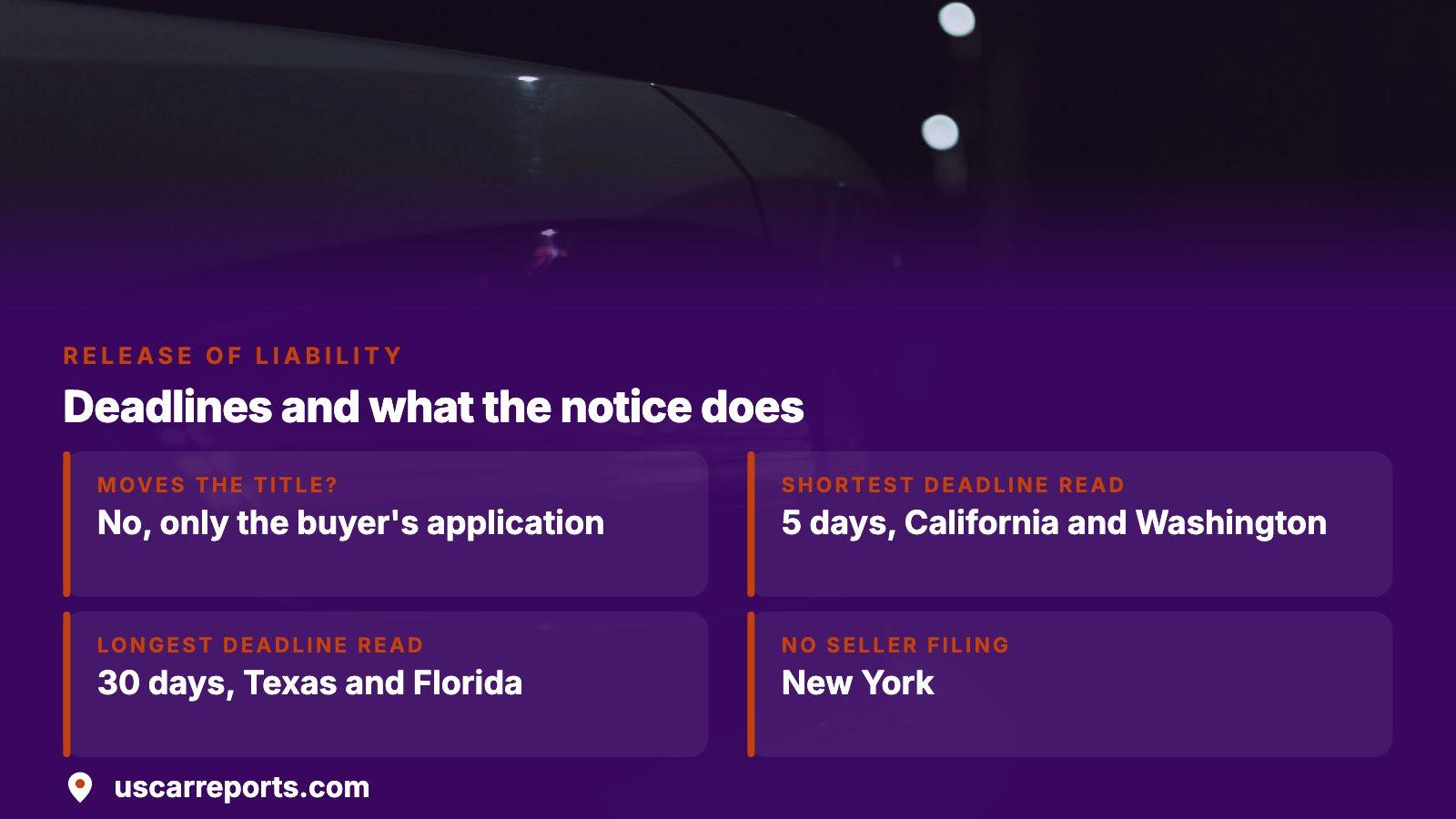
- Does it move the title?
- No, only the buyer's application does
- Shortest deadline read
- 5 days, California and Washington
- Longest deadline read
- 30 days, Texas and Florida
- No seller filing
- New York
Five states, five names and five clocks
There is no national form. Release of liability is California's phrase, and a seller who searches it in another state can wrongly decide nothing is required. The table reads five states from their statutes and agency pages.
| State | Deadline | Called there |
|---|---|---|
| Washington | 5 business days | Report of Sale |
| California | 5 calendar days | Notice of Transfer and Release of Liability |
| Texas | 30 days | Vehicle Transfer Notification |
| New York | None; registration ends on transfer | No seller filing exists |
| Florida | 30 days | Notice of Sale, form HSMV 82050 |
The clock belongs to the state that issued the registration, wherever the buyer lives.
What the notice does, and what it leaves alone
The notice puts one fact in the state's file: the vehicle changed hands on a stated date, to a named buyer. California's DMV says that once the record is marked, responsibility for parking and traffic violations and civil claims after the sale date moves to the buyer (Vehicle Code 5602). Three things stay untouched.
- Ownership. The buyer still has to complete the title application and pay the fees.
- The seller's name. Only the buyer's transfer, made with the title the seller endorsed, takes it off the record.
- The title itself. Texas holds back both title and registration until the purchaser applies (Transportation Code 501.147(f)), and Florida's manual says the seller's name remains on file until a title transfer is submitted.
Evidence, not a switch
California's DMV adds that in a lawsuit or complaint the court decides whether the seller complied. The filing is evidence a seller brings to that decision, not the decision.
Business days, and the received-by rule
Washington's statute (RCW 46.12.650) allows the owner five business days, and the report only counts if the agency's date stamp shows it arrived by the fifth. A Friday sale gives until the following Friday; five calendar days would end the following Wednesday. Mail that leaves on day four and arrives on day six misses the window.
Washington also attaches a fee under RCW 46.17.050, which has to come with the report. California's DMV updates its record within one business day of an electronic filing.
What the seller's notice means for the buyer
Most pages on this subject speak to sellers. A buyer sits at the other end of the same record, and the notice starts a clock on them.
- Texas: when the department receives the buyer's full name, address and phone number within 30 days, the buyer on the notice is presumed, subject to rebuttal, to be the owner and answerable for how the car is used or abandoned (501.147(c)).
- Washington: a buyer must apply for a title within 15 days of delivery. A late penalty follows, and going 45 days without applying is a misdemeanor, counted per day (RCW 46.12.650(6) and (8)).
- California: if the details on the notice are incomplete or illegible, the DMV may be unable to update the record, and the seller can lose the protection.
In practice, give the seller accurate contact details at the handover and apply for the title promptly.
Papers worth keeping from the day of the sale
- A bill of sale signed by both sides, which shows the buyer took part in the deal. A filing made alone cannot.
- The filing confirmation, saved as a PDF or screenshot rather than left in a browser tab. In Texas a copy of the filed form is the statutory proof of filing, and Florida's department does not keep form HSMV 82050, so the seller's copy is the only one.
- A photo of the odometer and of the signed title before the car leaves. The mileage written on a title is a federal disclosure (49 U.S.C. 32705).
- The buyer's phone number along with name and address. Texas lists all three on its form, and its presumption about the purchaser depends on them.
Keep the set for years. Disputes over a sold car tend to arrive when a toll authority or tow yard reads a record still carrying the old owner's name.

If the buyer is a dealership
The duty to file shifts when a dealer takes the car, and the four states differ on who carries it.
| State | Who files when a dealer takes the car |
|---|---|
| Texas | The dealer, if it holds a general distinguishing number |
| Florida | Nobody on the seller's side: no notice is required for a licensed dealer or an insurer taking the car |
| Washington | A dealer may file for the seller but does not have to, so the seller's clock keeps running |
| California | The dealer, within five calendar days and electronically (Vehicle Code 5901) |
Ask the dealership whether it is filing, and request a written reply.
Where the notice is weakest: tow yards and abandoned cars
A tow, storage and auction bill follows the registered owner on the record, and the clerk sending it is not weighing who sold what. Washington's statute speaks to this: for those costs, a seller's report by itself does not show the transfer was completed if nothing in the file shows the buyer knew about the car or accepted it. The documents it names instead all involve the buyer: a signed contract, the title, a receipt, or a purchase or wholesale order.
The state keeps a tally
Each quarter, Washington's Department of Licensing hands the Department of Revenue a tally of cars reported sold but never transferred: vehicles stuck between the seller's report and any buyer's application.
If the notice was never filed
Texas says in its statute that a seller who transfers a vehicle without reporting it takes on no civil or criminal liability for that omission (501.147(e)). What the seller loses is the complete defense that proof of filing provides under subsection (g). California's Vehicle Code 5602 counts proper endorsement and delivery of the title among the ways to keep the protection, so a correctly signed title helps even without a notice.
- File late if the state still takes the notice, since a late entry is better than none.
- Gather whatever the buyer signed, since it carries the most weight.
- Look up whether the title ever moved, and when.
- If the plates stayed on the car, find out whether anyone surrendered them.
The third step settles the most. A record naming the buyer means the exposure has largely closed. One still naming the seller years later means the sale never finished on paper.
Where a VIN check fits
A seller wondering whether the buyer ever titled the car and a buyer checking the seller's story want the same thing: title events in order. The USCarReports VIN check begins with a free preview, then a full report that lists title records, brands, liens and odometer readings with dates and states. The report is one payment, priced on the pricing page.
The seller's notice will not appear, because it is an entry in one state's own file rather than a title event. A long gap between the sale date and the next title date can appear, and so can a lien still on the record. Both deserve a question before money moves.
Where this information comes from
- California DMV: Notice of Transfer and Release of Liability — The five calendar day deadline, the one business day record update, and what the notice does not do.
- California Vehicle Code 5602: owner not liable after a bona fide sale — The routes by which a seller keeps protection, including endorsing and delivering the title.
- RCW 46.12.650: releasing interest, reports of sale — Business day deadline, receipt rule, towing carve-out, optional dealer filing, and the buyer's 15 and 45 days.
- Texas Transportation Code chapter 501 — Section 501.147 on the transfer notification, the buyer presumption, no liability for not filing, and the defense.
- FLHSMV Procedure TL-52: Mark Title Sold — Florida's 30-day notice, the dealer and insurer exceptions, and the seller's name staying on file.
- New York Vehicle and Traffic Law 420 — Why New York has no seller notice: registration expires on transfer and the seller removes the plates.
- 49 U.S.C. 32705: odometer disclosure requirements — The federal rule behind the mileage written on a title or transfer notice.
Sources and photos: Facts checked against the sources above in November 2026. Photos by tim, Alejandro Escamilla and Johnathan Kaufman on Unsplash; diagrams by USCarReports.
Keep reading
- Title status check: what the state lookup tells a car buyerHow to look up whether a car's title ever moved after the sale.
- Car title vs registration: what each proves and who keeps what at a saleWhy filing a notice or closing a registration does not finish a transfer.
- Abandoned vehicle title: what each state issues, and to whomWhat happens to a car left behind and who the state holds responsible.
- Texas VIN check: what to run, Texas title brands and buying rulesOne state's buying rules, including the transfer notification used above.
Frequently asked questions
What is a release of liability?
It is a notice sent to a state recording that a particular vehicle was sold to a particular person on a particular date. California titles its version Notice of Transfer and Release of Liability, while Washington says Report of Sale. It dates the sale on the record without completing it.
How many days does a seller have to file a release of liability?
The answer turns on which state issued the registration. California allows five calendar days and Washington five business days, while Texas and Florida allow 30 days. New York has no filing. When the clock is unclear, file the day the keys change hands.
Does a release of liability transfer the title?
No. It reaches the seller's side of the record only. The buyer must still apply for a title in their own name, and the state will not issue one on the seller's word. Until then the old owner's name sits on file.
Do I still need to file if I signed over the title?
Usually yes. In California a properly endorsed and delivered title can satisfy the liability section alone, but the notice adds a dated state record and ends renewal mailings. In Texas only a filed notice earns the complete defense. Sign the title correctly and file as well.
Does a release of liability show up on a VIN check?
No. It is an administrative entry in one state's file, not a title event, so it does not reach a history report. A VIN check shows title events, which tells you whether and when the buyer titled the car. A very recent transfer may not appear yet.
Now check the car itself
The guide explains what to look for. The report shows what this VIN has on record.