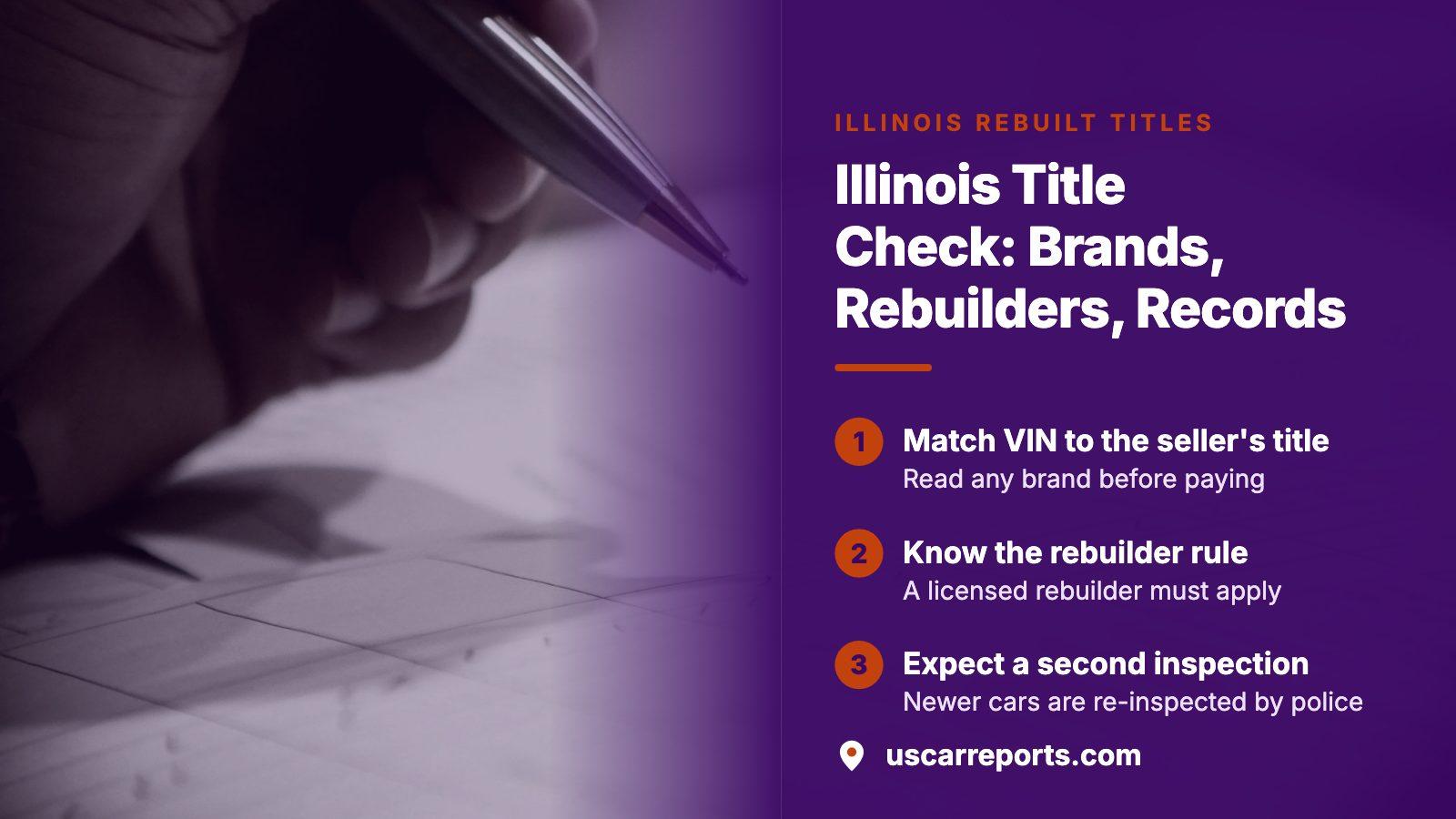
THE SHORT ANSWER
Copy the VIN from the car, match it to the seller's title, open the free preview on USCarReports and read any brand before you pay for the full report. A salvage-titled car cannot be plated until a rebuilt title issues, and a rebuilt brand means a licensed rebuilder was involved. Judge the state's inspection by its real scope, which is parts and ownership papers rather than workmanship.
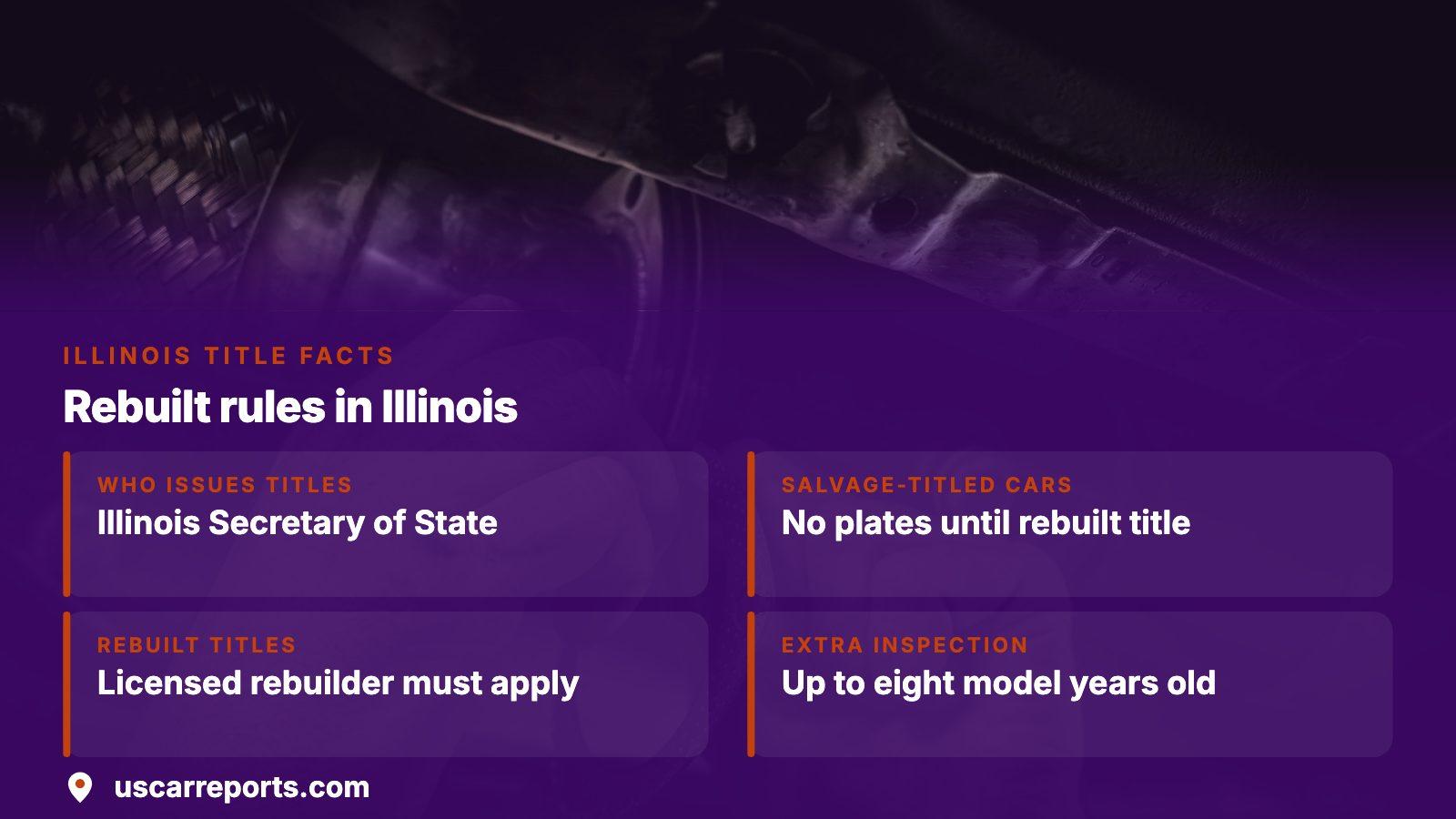
- Who issues titles
- The Illinois Secretary of State
- Salvage-titled cars
- No plates and no road use until a rebuilt title issues
- Rebuilt titles
- A licensed rebuilder must be the applicant
- Extra inspection
- Cars up to eight model years old are re-inspected by the Secretary of State's police
What a title check shows that the paper title keeps quiet
A paper title is one party's statement about a car. A title check by VIN asks the records instead. Has any state branded this vehicle, was it ever written off, and does the mileage rise the way it should? Illinois titles come from the Secretary of State, and damaged cars move through the state in volume, so a wreck may have been retitled elsewhere before it was listed here.
| Where you look | What it settles |
|---|---|
| The seller's paper title | Whose name it carries, and whether it reads salvage, rebuilt or clear |
| NHTSA recall search | Open safety recalls, which have nothing to do with title status |
| NICB VINCheck | Theft screening |
| An approved NMVTIS provider | Branding by any state, write-offs, odometer, and where the title sits now |
| USCarReports | A preview at no charge, then one payment for the full record |
Running the check before you travel or leave a deposit
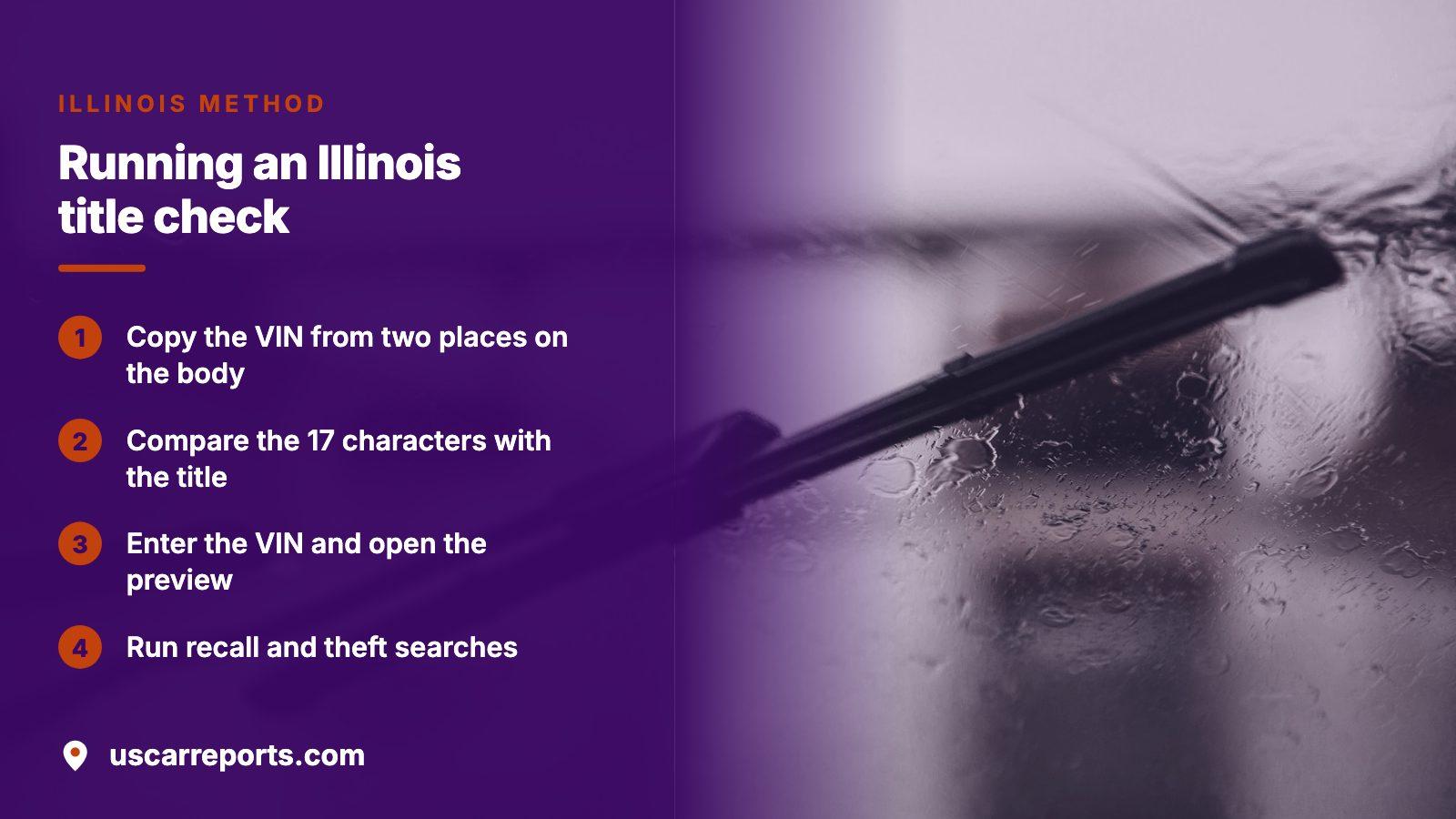
- Copy the VIN from the vehicle's own body in two separate places, never from the listing.
- Compare those 17 characters with the title, one at a time. A single wrong character stops the deal until someone explains it.
- Enter the VIN on USCarReports. The preview opens first and costs nothing, so you learn whether the car deserves more of your money.
- Run NHTSA's recall search and NICB's theft screening on the same number. Neither one reads the title.
- If the car still looks right, buy the full report: one payment, no subscription.
- Book your own mechanic, and say up front if the title reads rebuilt.
Salvage versus rebuilt: what Illinois requires at each stage
Illinois will not plate a salvage-titled car, and it may not be driven until a rebuilt title issues. The only trips allowed are to inspection stations, on permits. That makes the brand easy to test against a seller's story: a salvage car offered with a test drive means the title or the drive is not what it seems.
| Car's situation | What Illinois adds |
|---|---|
| Salvage-titled, any age | No plates and no ordinary driving; permits cover inspection trips only |
| Coming out of salvage | A licensed rebuilder as applicant, plus a transportation department inspection and a Certificate of Safety |
| Up to eight model years old | Secretary of State Police re-inspect the car |
| Nine model years old or older | No re-inspection by those officers |
Reading a rebuilt brand: the rebuilder and the inspection
Many states let a handy owner repair a wrecked car and file for the rebuilt title personally. Illinois does not. Only a licensed rebuilder can bring a car out of salvage, so an owner without that license hires one, and the rebuilder is the applicant who presents the car at a Secretary of State inspection station.
The inspection is narrower than most buyers assume. The state describes its purpose as confirming that an essential part was replaced and examining the ownership papers, both aimed at stolen vehicles and parts. It also says the inspection does not vouch for safety, road-worthiness or workmanship.
Provenance, not a repair grade
A rebuilt brand says where the parts came from and that the papers held up. It cannot say whether the frame is straight or the airbags are real. An older car skipping the extra inspection is no sign of better repair, so look harder, not less.
Ask the seller for the rebuilt-vehicle disclosure the Secretary of State expects, and for the rebuilder's name. A vague answer on either is the first thing to resolve.
Cars that arrive carrying another state's paperwork
Illinois handles two gaps differently. When the home state never issues salvage titles, a bill of sale takes their place. When it does issue them but the seller never handed one to the applicant, the application goes down the bonded-title route, which is slower, costlier and built around a hole in the ownership chain. Taking on a wrecked car from elsewhere with no salvage title in hand puts you on that road.
The national NMVTIS record keeps brands that any state applied, which is how a past the Illinois paper never mentions can still surface. The Justice Department's page counts 51 jurisdictions, the District of Columbia among them, that supply data and query the system before issuing a new title.
What a clean result covers, and what it leaves out
The federal report is short on purpose. It keeps five things: where the title sits now and when it last changed, any brands, the odometer reading, total-loss entries and salvage entries. The Justice Department calls an empty result good news, meaning none of the five turned up.
It says nothing about repairs, recalls or routine upkeep, and the department urges an independent inspection on top of it. The Federal Trade Commission agrees that a history report can surface crashes and flooding but usually not mechanical faults, and cannot replace a mechanic's look.
Red flags in an Illinois title result
- A rebuilt brand with no licensed rebuilder named or findable behind it
- A seller who cannot produce the rebuilt-vehicle disclosure, or talks around it
- A brand recorded in another state that the Illinois paper never mentions
- A VIN on the title that differs from the car by even one character
- Odometer readings that stall or step backward between records
- A salvage-titled car offered with plates or a test drive
- A theft entry or lender claim the seller never brought up
Treat a single oddity as a question for the seller and a cluster of them as a reason to leave.
Paperwork once the title checks out
A private purchase in Illinois carries a tax filing alongside the title application. The Department of Revenue's Form RUT-50 covers anyone who acquires a car from an individual, whether bought, gifted or transferred. It falls due within 30 days of taking the vehicle in Illinois, or within 30 days of bringing it into the state if the deal happened elsewhere.
- Paper filers include the return in the registration package sent to the Secretary of State, fees included.
- Electronic filers use MyTax Illinois or an approved registration-and-title provider, then print the form and hand it over, because the Secretary of State will not move forward on title and plates without it.
- Stapling on the bill of sale or other proof of purchase may head off notices; the instructions suggest it without demanding it.
- Purchases from certain unregistered out-of-state sellers, such as a dealer or lender, use Form RUT-25 instead.
What the check costs and where to start
The USCarReports preview costs nothing and shows whether the car merits a closer look. The full report is a single payment that never renews. Comparing a handful of cars? Packs cover three, five or ten VINs; /pricing has the terms.
When the preview and the title agree, buy the report before any money changes hands, then have a mechanic go over the car. On a rebuilt car that visit counts most, because the state's inspection stops short of the repair.
Where this information comes from
- Illinois Secretary of State: salvage vehicle inspections — Supports the licensed rebuilder rule, the purpose and limits of the inspection, and the second inspection by model year.
- Illinois Secretary of State: disclosure of rebuilt vehicle status — The disclosure a seller is expected to give on a rebuilt vehicle.
- Illinois Department of Revenue: Form RUT-50 instructions — The private-party use tax return, its 30-day due date and how it is filed.
- US Department of Justice: understanding an NMVTIS vehicle history report — What the federal report holds, who reports into it and what a clean one means.
- NMVTIS: state compliance — The count of jurisdictions that supply data and query the system before issuing titles.
- FTC: buying a used car — A history report is no substitute for an independent inspection.
- NHTSA: recalls — The open-recall search by VIN, separate from title status.
Sources and photos: Facts checked against the sources above in November 2026. Photos by Masjid MABA, Thibault Valjevac and Martin Fennema on Unsplash; diagrams by USCarReports.
Keep reading
- Illinois VIN check: records to run and Illinois buying rulesThe wider Illinois picture: records to run and buying steps.
- Bonded title: what it means for a buyer, state by stateThe route Illinois uses when the salvage paper never reached the buyer.
- Title status check: what the state lookup tells a car buyerHow to confirm a title's status in any state.
- Sample reportSee how the records are laid out before you buy.
Frequently asked questions
How do I run an Illinois title search by VIN?
Read the VIN on the car, check that the title shows the same number, then open the USCarReports preview to see what the number's history shows. Add NHTSA for recalls and NICB for theft. Finish the Illinois paperwork at the Secretary of State once the car is yours.
Is there a free Illinois title check?
Partly. NHTSA's recall lookup and NICB's VINCheck charge nothing, but neither reads title brands. The USCarReports preview costs nothing too, and the full report is one payment. Work through the no-cost steps first, then decide whether the car has earned the report.
Can I drive a salvage-titled car home in Illinois?
No. A salvage-titled car does not qualify for plates and may not be driven until a rebuilt title issues. Permits exist only for trips to inspection stations. Plan on a trailer, and treat a seller who suggests otherwise as a reason to recheck the title.
Does a clean Illinois title prove the car was never wrecked?
No. A paper title reflects one state's record on one date, and a car can be branded elsewhere first. The national record keeps brands from every state. Even an empty result only means nothing was recorded in its five areas; repairs sit outside it.
Do older rebuilt cars get the extra state inspection?
Only cars up to eight model years old, off-road vehicles included, get the second round with the Secretary of State's police. Nine or older are exempt from that step. The licensed rebuilder rule and the Certificate of Safety still apply, and fewer inspections never means better repair.
Now check the car itself
The guide explains what to look for. The report shows what this VIN has on record.