
THE SHORT ANSWER
A bonded title is a genuine state title issued when the previous owner's signature is missing, protected by a surety bond that compensates a later claimant with better proof of ownership. 34 states issue them, 22 at 1.5 times the car's value. Ten issue none. The bond speaks only to ownership, so liens, salvage brands and theft records need their own VIN check.
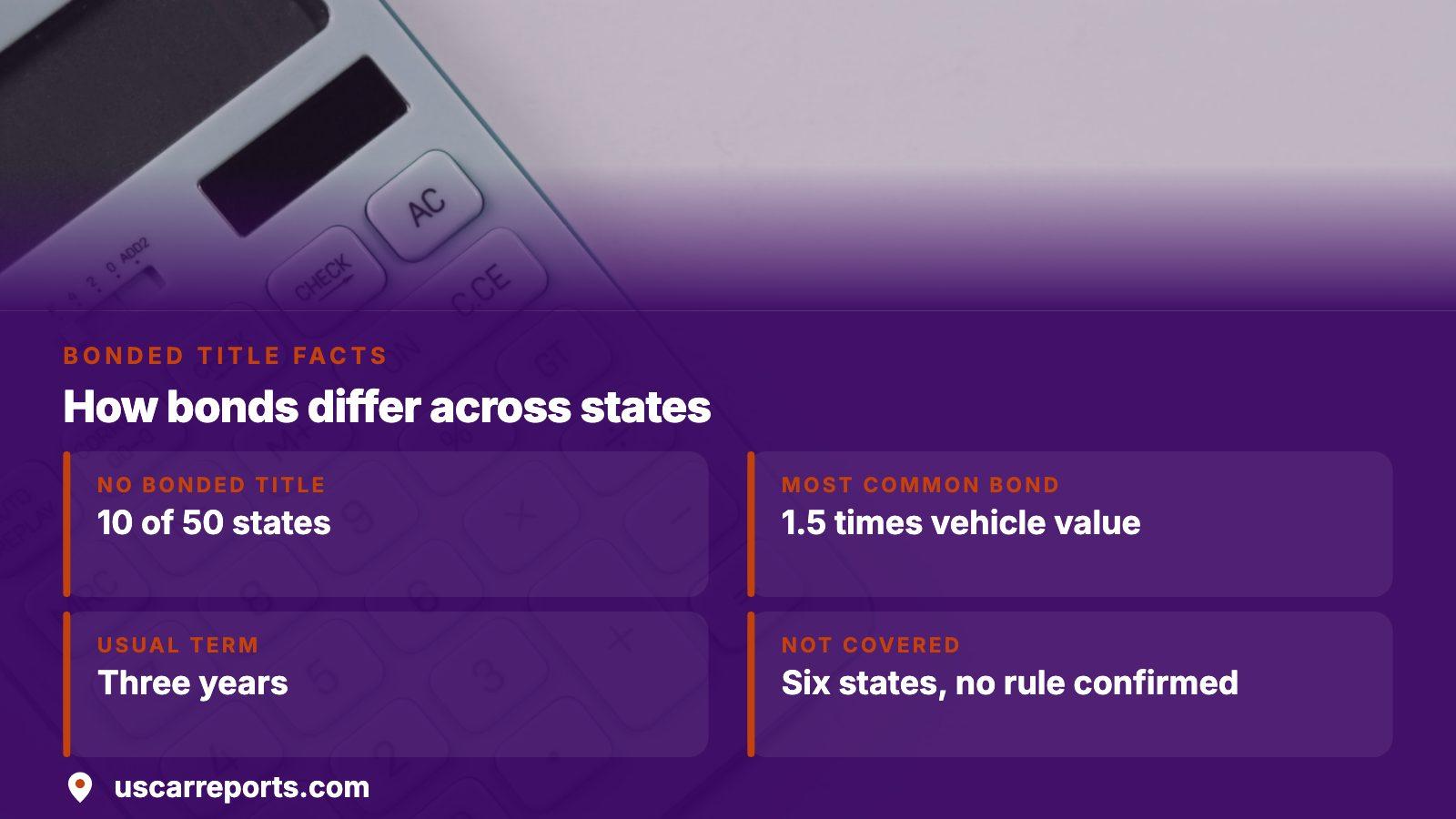
- States with no bonded title
- 10 of 50, each with a different substitute
- Most common bond
- 1.5 times the vehicle's value, in 22 states
- Usual term
- Three years; Georgia 4, Connecticut and Wisconsin 5
- Not covered here
- Six states with no rule confirmed
What a bonded title tells you before you buy
The seller of a bonded-title car could not get a signed title from the previous owner. Perhaps the paper was lost, perhaps the owner cannot be found, perhaps an earlier sale was never recorded. Rather than turn the applicant away, the state accepts a surety bond: a guarantee that if a person later proves a better right to the car, the bond pays that person.
Two points matter to the next buyer. The bond answers one gap, a missing signature, and tells you nothing about what the car went through on the road. And the title keeps its bonded brand while the bond stands, so ask the seller how much time it has left.
Which states issue one, grouped by how the bond is set
No national rule exists, and the figure quoted most often fits fewer than half the states. Find the state printed on the title in the table. Louisiana, Ohio, Hawaii, Kentucky, West Virginia and Illinois are left out, because no clear published rule could be confirmed for them; use the agency's own page there.
| Bond is set at | States |
|---|---|
| 1.5 times the vehicle's value (22 states) | Washington, Idaho, Nevada, Arizona, Alaska, Texas, Arkansas, Mississippi, Tennessee, North Carolina, Iowa, Minnesota, Wisconsin, Nebraska, South Dakota, Maryland, New York, Massachusetts, Rhode Island, New Hampshire, Vermont, Maine |
| 2 times the value (9 states) | Utah, Wyoming, Colorado, New Mexico, Missouri, Michigan, Florida, Georgia, Connecticut |
| The value itself (2 states) | California, Montana |
| A flat schedule by model year | Alabama, where the car's year band fixes the bond and no appraisal is made |
The multiple is only one setting. What it is applied to and how long the bond stands vary separately, so a neighbor's rule tells you little. Georgia writes its bond at twice the value, while Tennessee, just across the line, uses 1.5 times.
Ten states that skip the bond entirely
Here the instrument does not exist, so a seller who says bonded title is describing something other than what the state issued. Each state sends a missing signature down another road.
| State | Route used instead |
|---|---|
| Oregon | Form 550, a certification; its manual treats bonded titles as other states' practice |
| North Dakota | Its own process for untitled vehicles |
| Kansas | Court action to quiet title |
| Oklahoma | Form 753 affidavit |
| Indiana | Affidavit up to $5,000 NADA value, court order above |
| Virginia | Form VSA 12, an affidavit standing in for the title |
| Pennsylvania | Five kinds of ownership proof, no bond among them |
| New Jersey | Twelve steps, with newspaper notice and three outside affidavits |
| Delaware | Court order on ownership |
| South Carolina | Magistrate's order of sale |
A court order settles who owns the car and normally leads to an unbranded title, so a car that came through a judge is not worse for it. The buyer's task is narrower: match the story against the title record.
How long the bonded brand lasts
| State | Published term |
|---|---|
| Texas | 3 years, set by the Transportation Code |
| New York | 3 years, in the Vehicle and Traffic Law |
| Vermont | Bond returned at 3 years |
| Georgia | 4 years, per the department's bond form |
| Connecticut | 5 years |
| Wisconsin | 5 years |
| Colorado | No term published beside the amount |
| Wyoming | No term published; one-time and non-refundable |
At the end of the term the bond simply expires and the claim period ends, with no premium refunded. Whether the state then issues a clean certificate varies: some do on request, others let the entry fade.
Connecticut moved to twice the value and five years by public act in 2002, so pages still quoting 1.5 times and three years are out of date.
Where one state's rules stop at the border
Oregon shows how differently two states can treat the same paper. It accepts a bonded title from elsewhere as valid proof of ownership, then issues its own title with no bonded brand and no mention of a bond. A title branded where it was issued can arrive in Oregon clean.
Vermont runs the other way. It keeps its bond route for residents: the statute bars nonresident titles, and the state's own bond form repeats the limit. If the seller lives elsewhere and holds a Vermont bonded title, ask how it was obtained.
New York: in the statute, not at the counter
New York's statute names a bond, 1.5 times value over three years, but leaves it to the commissioner's discretion. No public application route exists, and the law does not oblige the state to issue a title when one is offered. A seller describing a New York bonded title owes you an explanation.
A title from a state the car never visited invites questions. It can resemble title jumping even when obtained honestly.
What the bond does not fix
A bond cures a single problem, the missing signature. Everything else in the car's record is untouched.
- A lender's lien. The lender is a living party with an interest, so a bond cannot absorb it. Texas allows a bond only if no lien is recorded, a lien is 10 or more years old, or every lien has a release.
- A salvage or nonrepairable history. Texas keeps junked and nonrepairable cars out of the bond route; those cars go through a rebuilt inspection and keep their brand.
- A broken chain of sales. The bond pays a claimant with better proof; it does not fill the gaps between earlier owners.
- Odometer, damage and flood history. Nothing posted against an ownership claim says what the car went through.
That is why a lien search belongs ahead of any price talk.
Run the VIN on a bonded-title car before paying
Copy the 17-character VIN from the metal tag at the lower corner of the windshield nearest the driver, then match it to the door-edge sticker and the title. If any copy differs, stop until the seller can account for it. Enter the VIN into the preview on USCarReports. Nothing is charged for the preview. For the full report you pay a single time, with no renewal; the amounts are listed on the pricing page.
- Title entries: which states have issued titles for this VIN, on what dates, and whether a bonded brand or an odd state appears.
- Liens and impounds: any lender interest still open against the car.
- Salvage and auction history, with photos: a total loss that a bond could never have cleared.
- Theft record: whether anyone has reported the car missing.
- Odometer readings: do the dates and mileage fit the seller's account.
A report shows what was recorded, not paperwork the seller never filed.

Questions for the seller, then the state agency
- Which state issued the title, and on what date?
- When does the bond end?
- Is there a written lien release, and who signed it?
- Why was no signed title available, and where was the car before?
- Can I see the original paperwork rather than copies?
Then read the page of the state on the title. Titling is state law, and USCarReports tracks the buying rules for each state, but the agency's current wording decides. Ask your lender and insurer before committing.
Where this information comes from
- TxDMV: Bought a vehicle without a title — Supports the Texas bond multiple, the value lookup order, the $15 fee and the lien and junked-vehicle limits.
- Texas Statutes: Transportation Code chapter 501 — Supports the three-year term in the bond provision, section 501.053.
- Georgia DOR: Bonded vehicle title — Supports Georgia's twice-value bond and the $18 fee.
- Connecticut General Assembly: Gen. Stat. 14-176 — Supports the twice-value, five-year bond and the 2002 amendment history.
- Oregon DMV: Vehicle Procedures Manual, chapter F — Supports Oregon treating bonded titles as other states' practice and reissuing them unbranded.
- Vermont Statutes: 23 V.S.A. 2020 — Supports the bar on bonded titles for nonresidents and the three-year return.
- New York Senate: Vehicle and Traffic Law 2105 — Supports the discretionary New York bond and the absence of a duty to issue a title.
Sources and photos: Facts checked against the sources above in November 2026. Photos by Scott Graham, Michal Biernat and Sasun Bughdaryan on Unsplash; diagrams by USCarReports.
Keep reading
- Title status check: what the state lookup tells a car buyerHow to read what a title's status says before money changes hands.
- Texas title check by VIN: brands, the 2003 cutoff and the 30-day clockThe state whose bond rules this page quotes most, with its own title steps.
- Georgia title check by VIN: brands, liens and the tax due at the counterGeorgia's twice-value bond sits next to its wider title paperwork.
- Abandoned vehicle title: what each state issues, and to whomAnother route to a title when the paperwork is missing.
Frequently asked questions
Does a bonded title count as clean?
Not quite. The car can be registered and insured, but the title keeps a bonded brand while the bond stands and shows the ownership record had a gap. It does not remove a lien, reverse a salvage brand or repair a broken chain of sales. Treat it as paperwork to verify.
How much does a bonded title cost?
There is no national price. Most states set the bond as a multiple of the car's value: 1.5 times in 22, twice in nine, once in two. The applicant also pays a state fee, $15 in Texas and $18 in Georgia, plus a surety premium that is a fraction of the bond. Alabama uses a flat schedule.
Which states do not issue a bonded title?
Ten: Oregon, North Dakota, Kansas, Oklahoma, Indiana, Virginia, Pennsylvania, New Jersey, Delaware and South Carolina. Each uses another route, such as an affidavit, a court order or a magistrate's order of sale. Oregon even accepts a bonded title from elsewhere and reissues it without the brand.
How long does the bonded brand stay on a title?
Usually three years where a term is published, as in Texas and New York. Georgia runs four, Connecticut and Wisconsin five, and Colorado and Wyoming publish none. When the term ends the bond expires without a refund, and what the record shows afterward depends on the state.
Should I buy a car that has a bonded title?
It can work, but the safety comes from the checks, not the title. Ask when the bond was issued and when it ends, get any lien release in writing, and run the VIN for brands, liens and theft before paying.
Now check the car itself
The guide explains what to look for. The report shows what this VIN has on record.