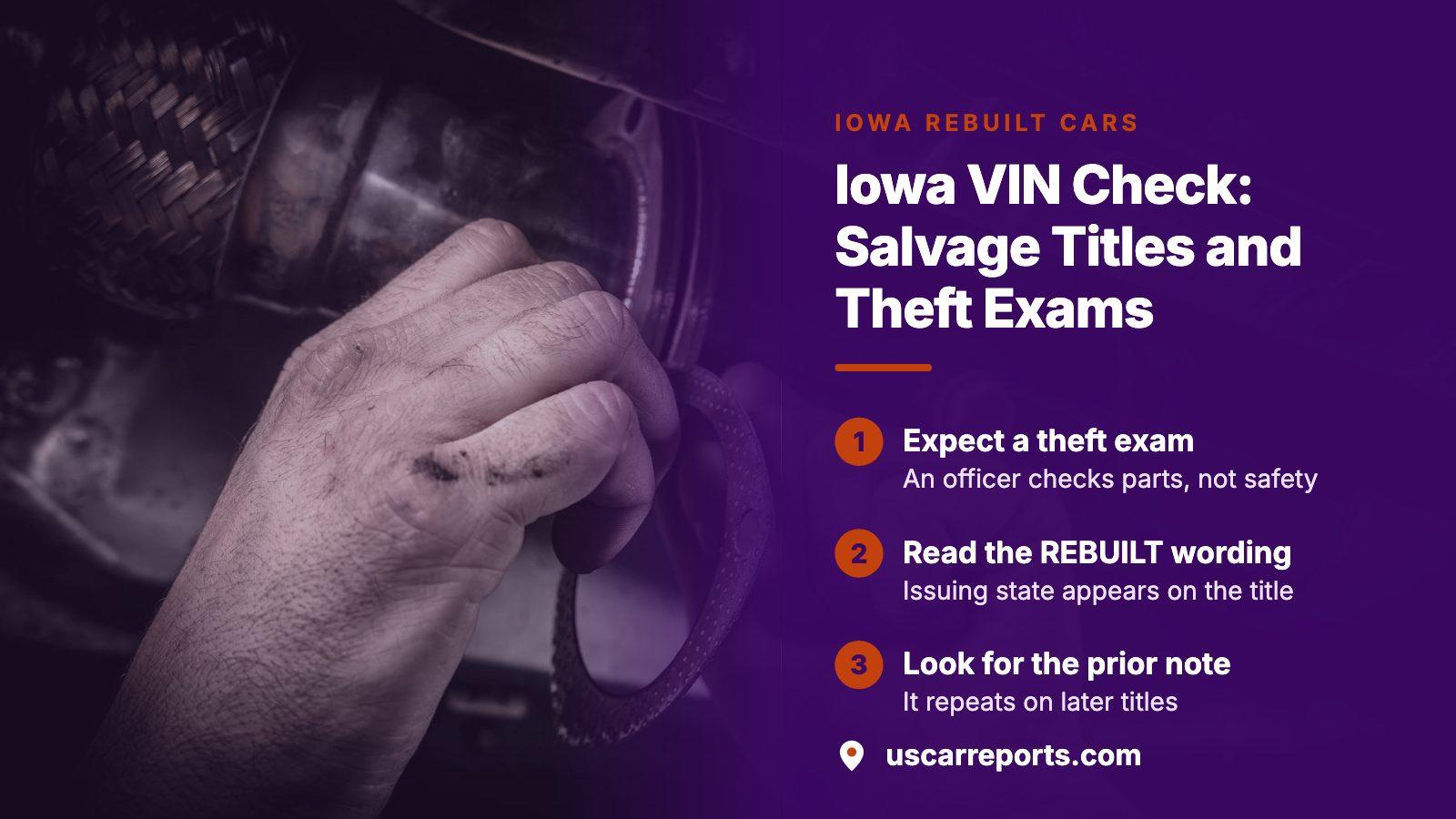
THE SHORT ANSWER
Take the VIN from the car, compare it with the seller's title, and enter it here for the free preview. Add NHTSA's recall search and NICB's VINCheck, then pull the national title history. In Iowa, a rebuilt car passes an officer's search for stolen parts rather than a test of the repair, and salvage or rebuilt wording, including other states' brands, carries onto every later title.
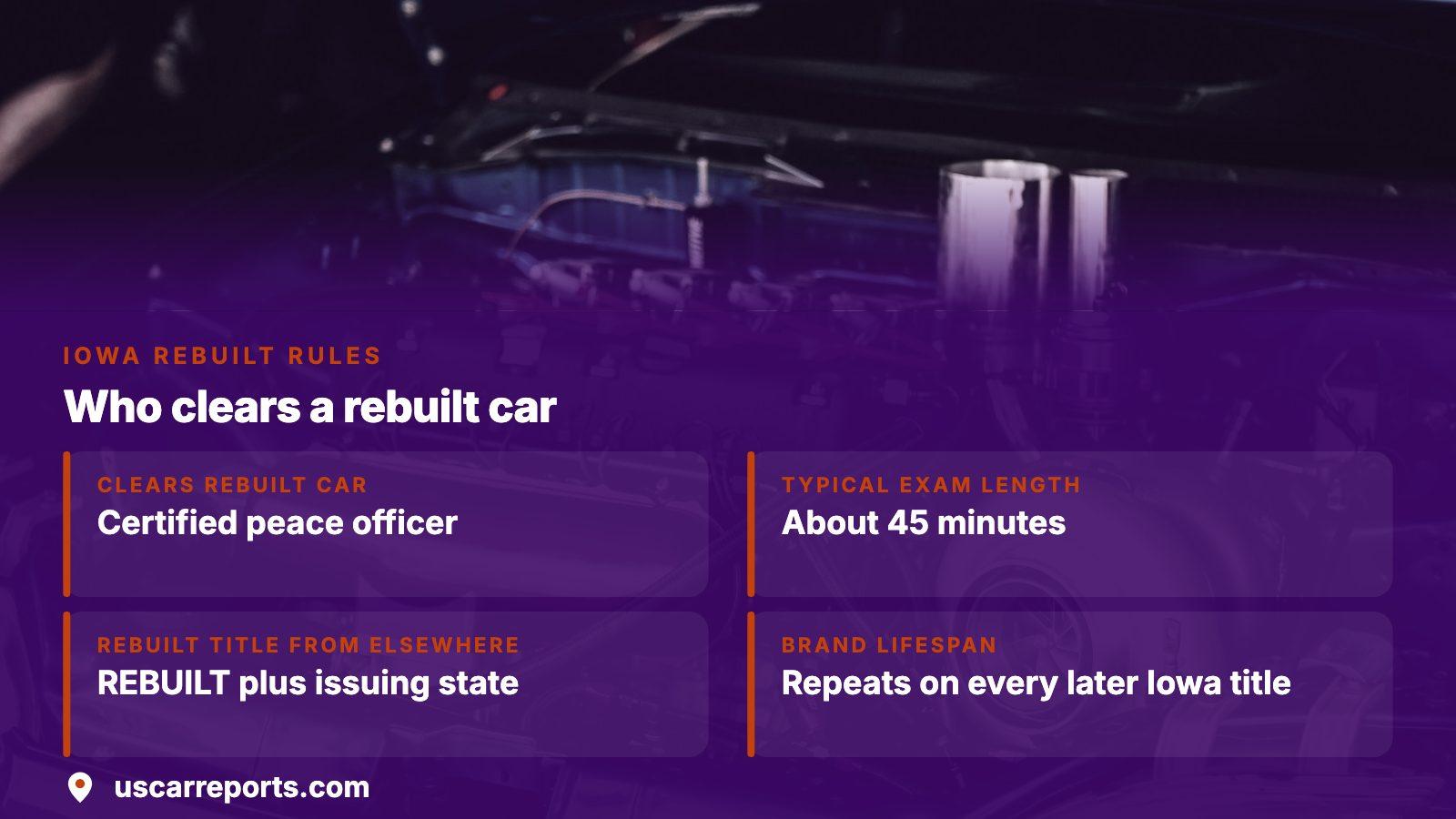
- Who clears a rebuilt car
- A certified peace officer, looking for stolen parts
- Typical exam length
- About 45 minutes, longer when numbers are hard to reach
- Rebuilt title from elsewhere
- Iowa prints REBUILT plus the issuing state's name
- Brand lifespan
- The previous-salvage note repeats on every later Iowa title
What an Iowa VIN lookup covers, and who supplies each piece
No single record covers an Iowa car. Federal agencies and an insurer-backed theft bureau publish free tools that answer narrow questions, while title history sits with approved providers of federal data. USCarReports sets that history beside each state's title rules.
| Question | Where the answer lives | Cost |
|---|---|---|
| Is any safety recall still open? | NHTSA's recall search, by VIN | Free |
| Did an insurer report it stolen or written off? | NICB VINCheck | Free |
| Which states have branded this number? | Title data from NMVTIS-approved providers | Paid |
| Damage entries, mileage readings, auction photos and liens together | The USCarReports report | Free preview, then one payment |
None of the free tools reads title history, and an Iowa title shows only what Iowa recorded. Unreported damage appears in neither.
Iowa's rebuilt-car gate is a theft exam, not a safety test
Once a salvage car is repaired, its owner needs a salvage theft examination before the county treasurer will issue a regular title. The examiner must be an officer holding the state law enforcement academy's certification for this work, which rules out shops, dealers and general mechanics. The repairs must be finished first, with only trim, body markings and paint allowed to wait.
The officer checks whether the vehicle or its replacement parts were stolen. By statute the exam is no safety inspection, and a court may not treat the signed certificate as proof the car is safe. Expect about 45 minutes, longer when identification numbers are hard to reach or the ownership papers are tangled.
What a pass tells you
A pass means an officer found no stolen components. It says nothing about frame alignment, weld quality or airbag repairs. A seller calling the car state-approved is stretching the certificate past what the law says. Hire a mechanic to answer the questions the officer was never asked.
Wording that stays on an Iowa title once it is there
Iowa does not let a brand quietly disappear. After a repaired salvage car passes its exam, the treasurer issues a regular title with a printed note that the vehicle was previously titled as salvage, and that note repeats on every Iowa title afterward. A car arriving from another state is handled by what its old title says.
| The out-of-state title says | What Iowa does |
|---|---|
| Rebuilt | Prints REBUILT on the new title, with the name of the state that issued the earlier one |
| Salvage, or a salvage certificate | Issues an Iowa salvage title, unless the owner passed the Iowa theft exam within thirty days of being assigned the old title |
| Junked | Issues a junking certificate in place of a title |
| Returned to the maker under a buyback law | Marks that history on this title and every later one |
A title reading REBUILT with another state's name beside it tells you where to look next. A title with no such wording, on a car whose national record shows a brand, deserves a direct question to the seller.
Where an Iowa car can be damaged and still hold a clean title
Brands follow thresholds, and thresholds leave gaps. Iowa's wrecked-or-salvage label starts only when repairs would cost more than seventy percent of what the car was worth undamaged. A car hurt badly but kept under that line never becomes a salvage vehicle on paper.
- Insurer-owned cars: when an insurer takes a car after a settlement and certifies written repair estimates below three thousand dollars, the treasurer issues a regular title with no salvage designation.
- Quiet private repairs: the statute's salvage-title duties fall on insurers that take ownership and on rebuilders and dealers who acquire a wrecked car, so a car fixed by its own owner may leave no brand at all.
A clean Iowa title therefore says no threshold was crossed on paper. Damage entries and auction photos in a VIN report cover ground the title never will.
Running an Iowa VIN search in a sensible order
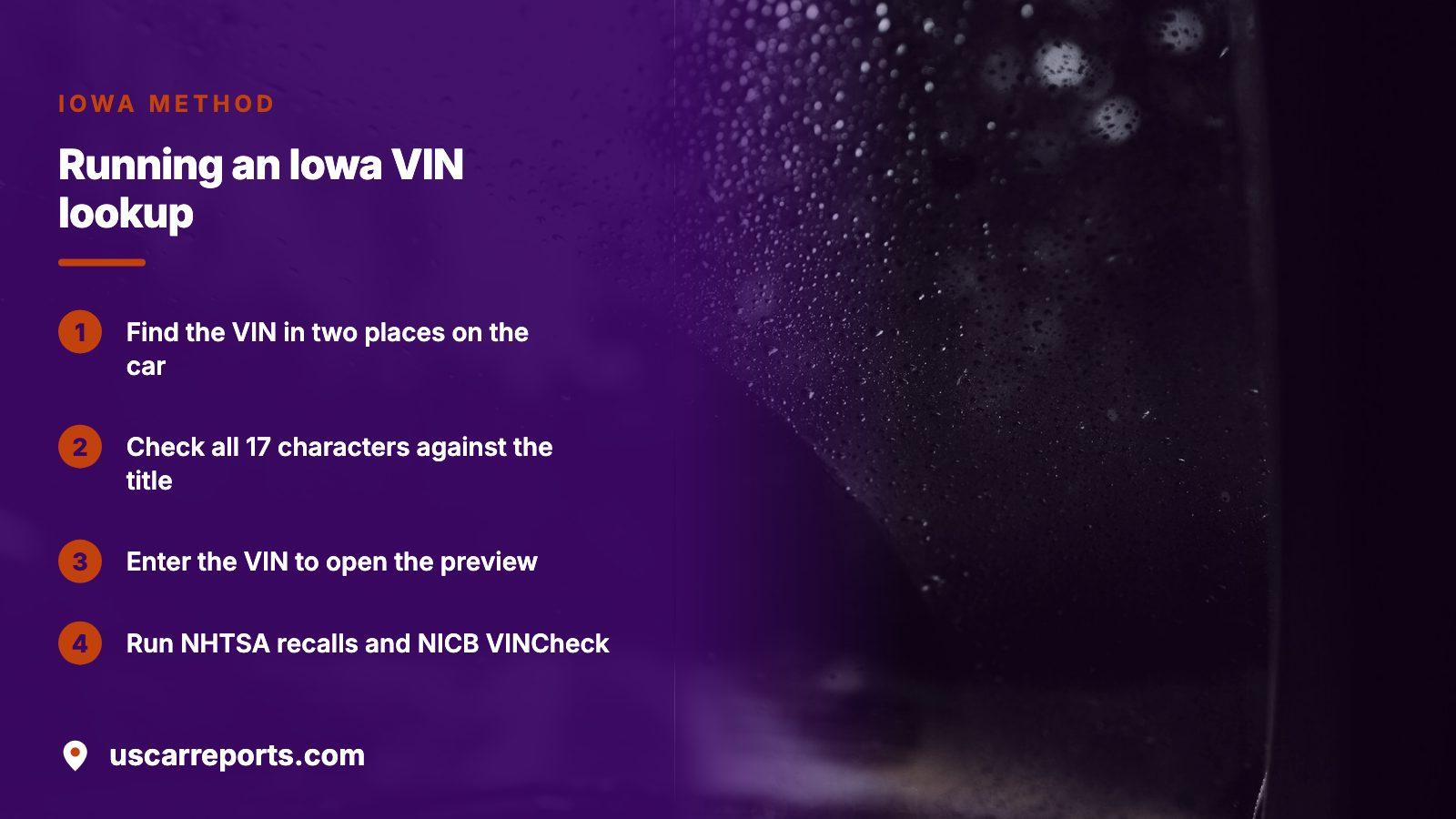
- Find the VIN in two places: on the strip under the windshield glass near the driver, and on the sticker on the driver's door edge. Photograph both and confirm they match.
- Check all 17 characters against the seller's title, one at a time.
- Enter the VIN on this page to open the preview. It costs nothing, and it shows whether the full report is worth buying.
- Check that number again in NHTSA's recall search and in NICB's VINCheck.
- Still interested? Buy the full report. That is one payment, and nothing renews.
- Read the title that will actually change hands: the brand line, any REBUILT or SALVAGE wording with a state name beside it, and the lienholder.
- Book an independent inspection before you leave a deposit.
Liens: why the seller may not be holding the title
Iowa sends the original title to the owner when no lender is involved. If a security interest exists, the title goes to the lienholder in first position, and delivery can be electronic. So a seller who still owes money may have no paper to hand you, and the lender's claim must be cleared before a clean title can pass.
- Get the lender's identity and the payoff amount in writing.
- Settle the payoff with the lender directly, never in cash handed to the seller.
- Look for a lien entry in the report that the seller never mentioned.
If a title is missing and the county cannot confirm who owns the car, Iowa has a bond route, with the bond set above the vehicle's value.
What should stop you when the Iowa report comes back
Read the dates first and the brands second, because a report is a timeline.
- A salvage or total-loss entry with no rebuilt title after it
- A brand in another state's records, but an Iowa title with no REBUILT or SALVAGE wording
- Odometer readings that stall or fall between entries
- Auction photos of damage the seller says never happened
- A theft record, impound or lien the seller left out
A single oddity deserves a direct question to the seller. Two of them, or any sign the car was junked, is reason enough to leave.
Winter salt and the damage no record contains
Iowa winters mean salted pavement, and rust is the quiet damage across the state's used cars. No title, theft exam or national database tracks it. Check the rocker panels, the mounts that hold the subframe, the steel brake and fuel lines and the tops of the front struts, which only a lift shows well. If the car was rebuilt, tell the shop when you book, because repair welds and rust often sit in the same places. A clean title and a passed exam leave all of it unexamined.
Price and your next move
Begin with the preview, which is free. The complete Iowa report is paid once and does not renew. Anyone comparing several cars can buy a multi-report pack instead, and the /pricing page lists the options.
A VIN lookup in Iowa belongs before the trip to see the car, and the full report belongs before any deposit or handshake. A clean report does not replace a mechanic, least of all on a car that was rebuilt.
Where this information comes from
- Iowa Code section 321.52: out-of-state sales, junked and salvage vehicles — The salvage definition, the theft exam, what the examiner checks and the designation that stays on later titles.
- Iowa Code section 321.24: issuance of registration and certificate of title — How Iowa treats rebuilt, salvage, junked and buyback titles from other states, and where the title is delivered when a lender holds a lien.
- Iowa DOT: salvage vehicles — The department's page on the theft examination, its prerequisites and its typical duration.
- Iowa Administrative Code chapter 761-405: salvage and other title designations — The examiner certification rule and the requirement that the car be completely repaired first.
- NMVTIS: National Motor Vehicle Title Information System — The federal title record and the list of approved providers.
- NICB: VINCheck — Free theft and total-loss lookup drawn from participating insurers.
- NHTSA: Recalls — The free open-recall search by VIN.
Sources and photos: Facts checked against the sources above in November 2026. Photos by Martin Fennema, Justin Cron and Willian Cittadin on Unsplash; diagrams by USCarReports.
Keep reading
- Title status check: what the state lookup tells a car buyerHow to confirm what a title says before money changes hands.
- Bonded title: what it means for a buyer, state by stateThe bond route Iowa and other states use when ownership cannot be confirmed.
- Illinois VIN check: records to run and Illinois buying rulesThe neighbor across the Mississippi, where cars often cross the border.
- Missouri VIN check: records to run and the state's buying rulesAnother border state, read the same way: records first, then local rules.
Frequently asked questions
How do I run an Iowa VIN check?
Take the 17-character VIN from the dashboard strip, compare it with the seller's title, then put it into the free preview here. Follow with NHTSA's recall tool and NICB's VINCheck, and buy the full report if the car still looks right. Last, read the title you will actually get.
Can I do an Iowa VIN lookup for free?
Partly. Both NHTSA's recall search and NICB's VINCheck are free, but neither reads title history, which is the paid piece. USCarReports shows a free preview of any Iowa VIN first, so you can stop there if the car looks wrong.
What does an Iowa salvage theft examination check?
A certified peace officer checks whether the vehicle or its replacement parts were stolen. The law says it is not a safety inspection, so a signed certificate does not vouch for the repair. It takes about 45 minutes.
Will an Iowa title show that a car was rebuilt in another state?
It should. When the earlier title says rebuilt, Iowa prints REBUILT on its own title with the name of the state that issued the earlier one, and that wording carries forward. If the national record shows a brand but the Iowa title shows nothing, ask the seller to explain the gap.
If an Iowa title looks clean, can you assume the car has never been wrecked?
No. Iowa brands a car only when paperwork crosses a threshold, and some insurer-owned cars with small repair estimates get a regular title. A car repaired privately may leave no brand. A VIN report and a lift inspection fill in what the paper leaves out.
Now check the car itself
The guide explains what to look for. The report shows what this VIN has on record.