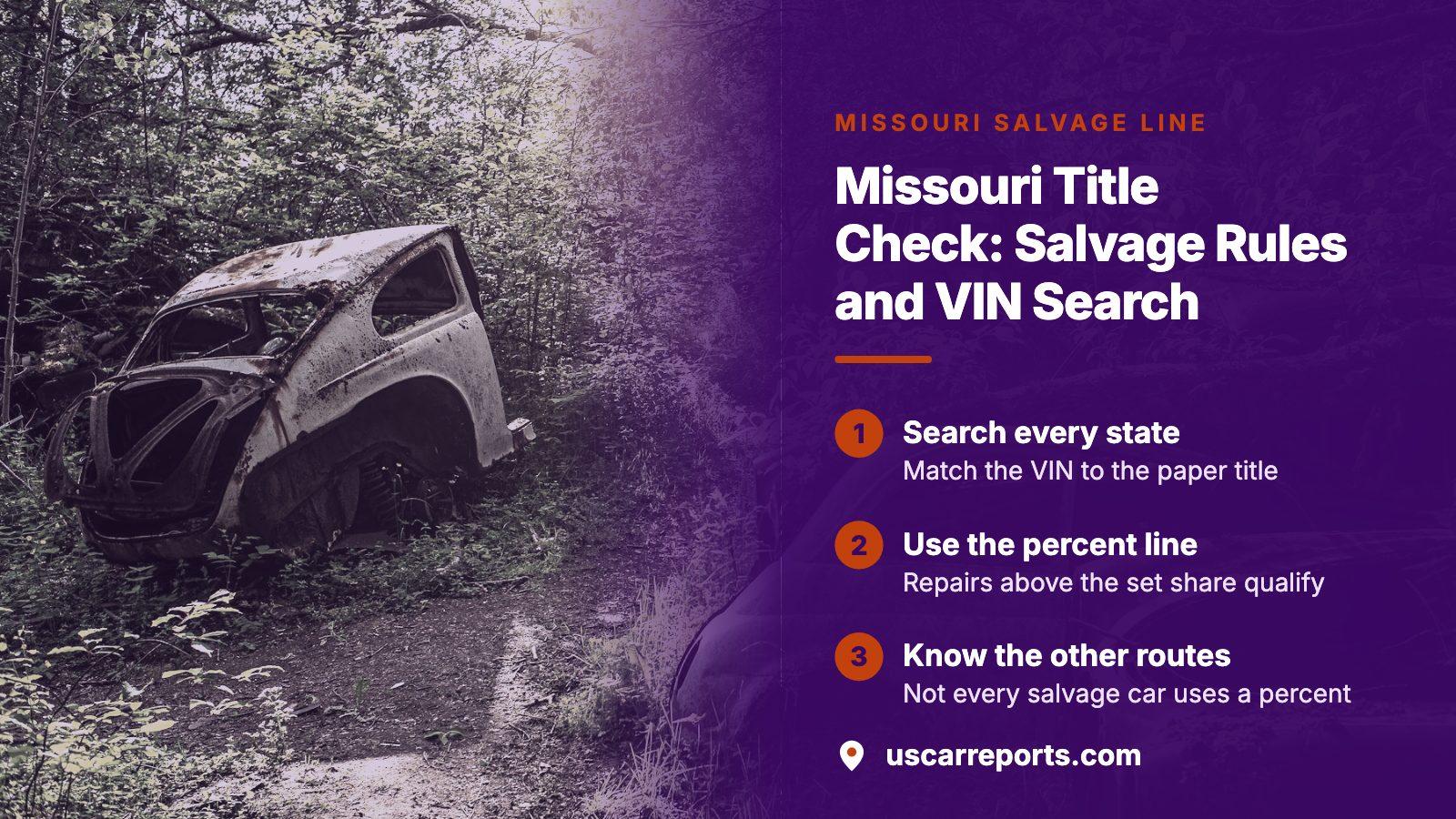
THE SHORT ANSWER
To check a Missouri title, take the VIN off the vehicle, compare it against the seller's paper title, and run a history search that spans every state. Then apply Missouri's rules: salvage means repairs above 80% of market value, but only for damage inside six years of the model year, and hail, airbags, tires and sound systems are excluded. A clean title on an older car proves little.
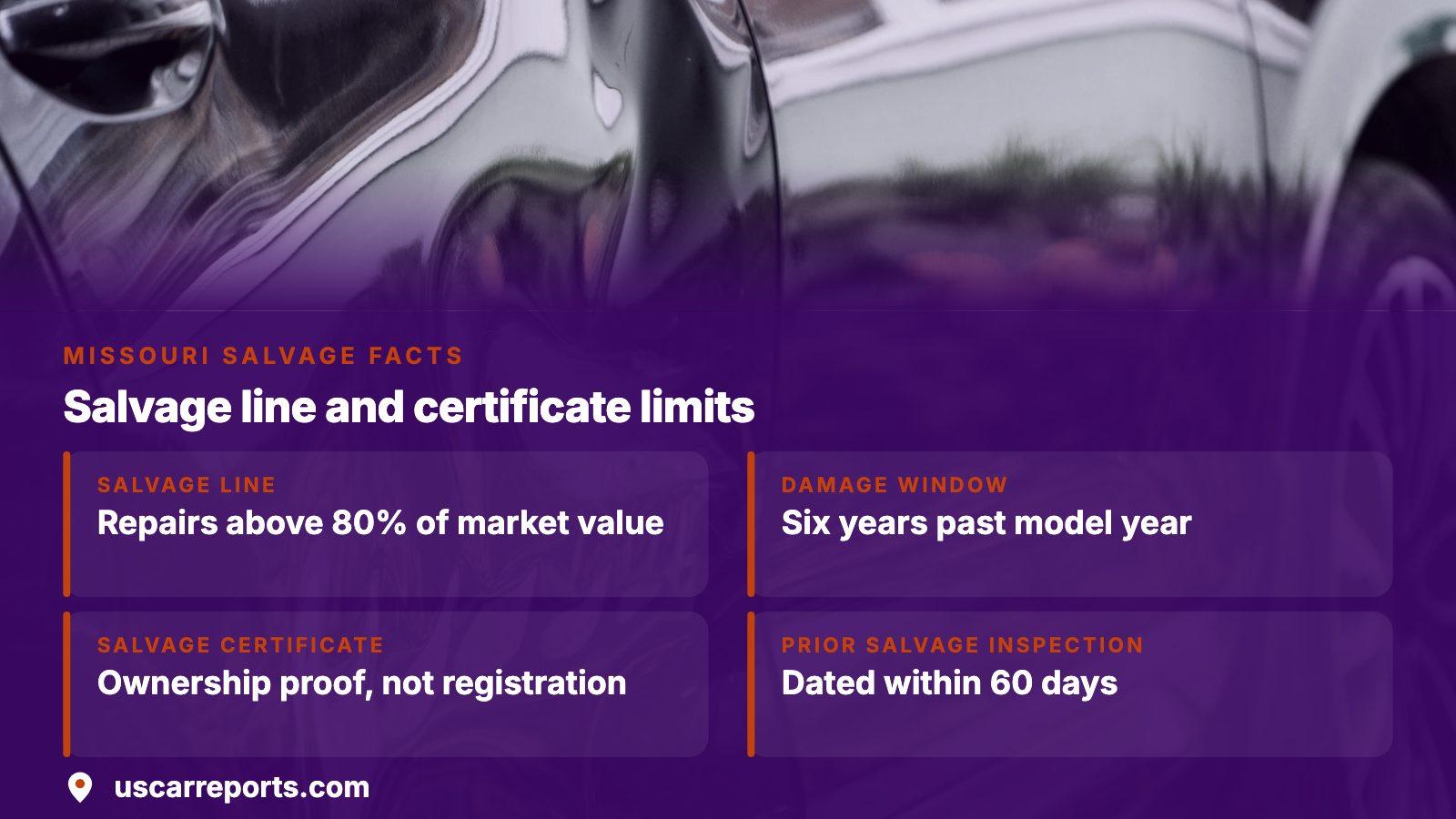
- Salvage line
- Repairs above 80% of fair market value
- Damage window
- Six years past the model year
- Salvage certificate
- Proof of ownership only, not valid for registration
- Inspection on prior salvage cars
- Dated within the last 60 days if the car will be registered
What a Missouri title search shows that the paper title does not
A Missouri title records only what Missouri recorded. A VIN search follows the car through every state it has lived in, so a brand stamped elsewhere, an auction listing or a lender's claim shows up before you sign.
| Record in the search | What it settles on a Missouri car |
|---|---|
| Title brands | Whether any state declared the car salvage or rebuilt |
| Damage and auction photos | The car before repair, which shows whether the wreck was one Missouri's formula ignores |
| Odometer readings | Whether dated mileage climbs in step with the dash |
| Liens, impounds and theft | Any lender, tow yard or police claim still attached |
| Open recalls | Safety repairs the maker still owes that VIN |
A history search reads records. It cannot see a bent frame, so it comes before the inspection and never replaces it.
How to search a Missouri title before you commit to a car
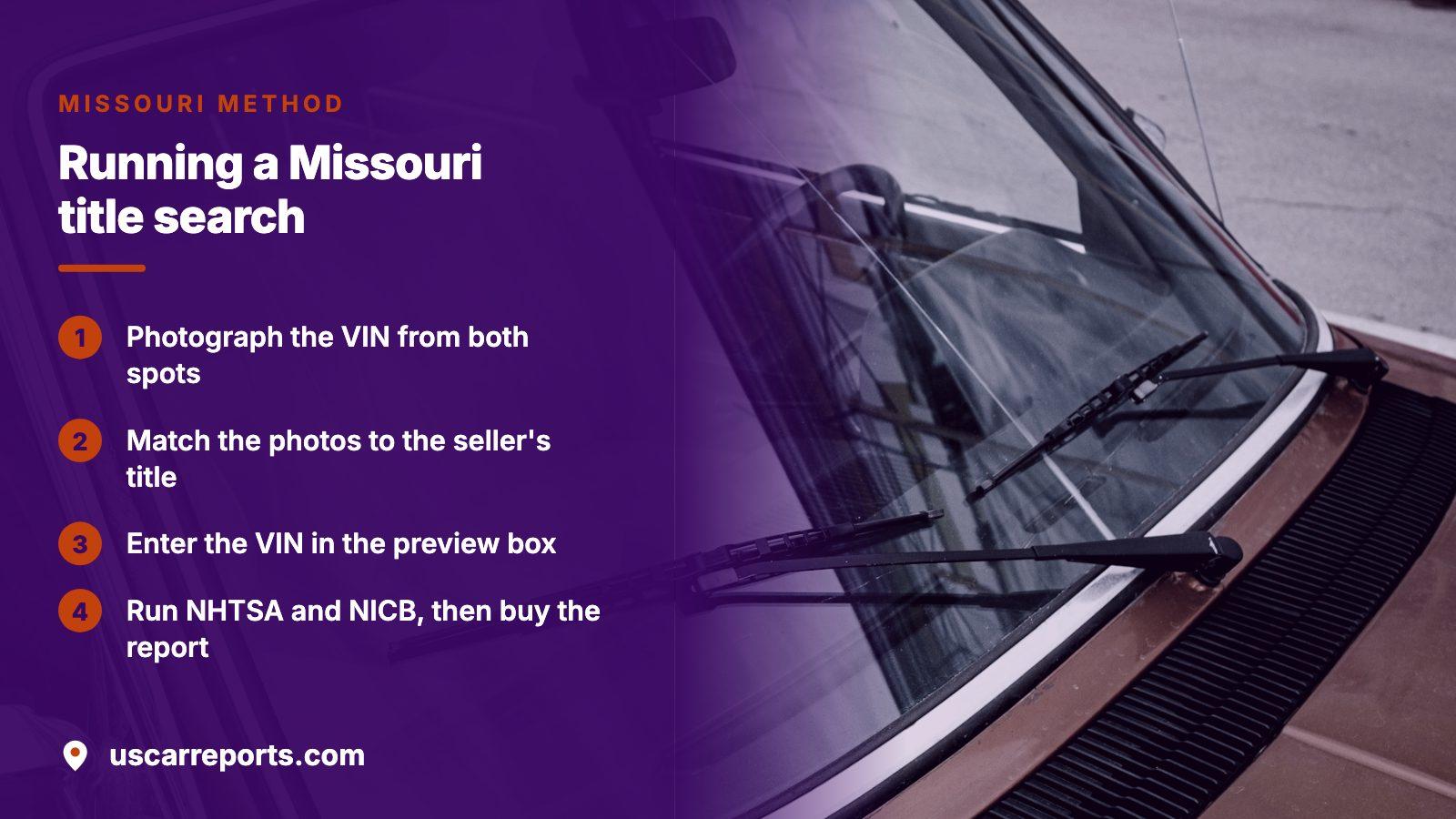
- Photograph the 17-character VIN from both spots where it is displayed: the dashboard plate seen through the glass, and the label in the driver's doorway.
- Match the photos to the number on the seller's title. Any mismatch ends the visit until it is explained.
- Put the VIN in the preview box above. The year, make and engine it names must fit the car.
- Run NHTSA's recall search and NICB's VINCheck, which cost nothing, to catch open recalls plus theft and salvage records.
- If the car still fits, buy the full report before any deposit.
- Compare title and report side by side, then book a mechanic.
Five ways a car becomes salvage in Missouri, and only one uses a percentage
Salvage in Missouri is not one test. The statute lets a vehicle into the system by any of these routes:
- Repair cost over the percentage line, covered in the next two sections
- The owner declaring it salvage
- A lienholder declaring it
- The car's insurer declaring it
- Abandoned property, titled under a salvage or abandoned-property label
Declarations carry neither the percentage nor the age limit that the damage test has. An insurer settling a claim can send a car into the system on its own call, so some older cars are branded even though the damage test could never reach them. Ask the seller which route applied.
The 80% line and the repair costs Missouri subtracts
Where the damage test applies, Missouri compares two figures: the cost of rebuilding the car so it can legally run on public roads, and 80% of its fair market value. Salvage starts when the first is larger, so what goes into that first figure matters as much as the percentage.
| Cost left out of the repair figure | What that means when you shop |
|---|---|
| Hail damage | Heavy hail never pushes a car toward a brand |
| Safety restraint systems | A big airbag bill after a crash goes uncounted |
| Tires | Dropped from the sum |
| Sound systems | A premium stereo cannot tip a car over the line |
| Sales tax | Left out, so the figure runs under a shop invoice |
Airbags and hail are the two to look for
A crash that fired the airbags is serious, yet fixing them never counts toward the brand test. A car can survive a substantial wreck, be repaired and carry no brand. Ask for repair invoices and read the report's damage photos before trusting a clean title.
The six-year window: why an older Missouri title proves less
The damage test only reaches a car that was hurt while still young: the damage has to fall within six years of the model year. Past that point no repair bill, however large against the car's value, can trigger this route to a brand.
Picture two cars of one model year with the same repair estimate, one hit in its fifth year and the other in its eighth. The first sits inside the window, so the 80% math decides its title. The second sits outside, and that path is closed. Old cars are worth little, so even a modest repair can exceed 80% of their value, and those are the cars the window leaves out.
Treat a clean older title as a starting point
On a car well past its model year, an unbranded title says little. Lean on the report's damage and auction history, and ask for repair records.
What a Missouri salvage certificate allows and what it blocks
A salvage certificate of title is proof of ownership for a car in salvage condition. It is not accepted for registration, so it will not get the car plated.
The certificate also moves under a tight limit: one reassignment on the back, and by registered dealers or insurers only. A private seller showing you more signatures than that owes you an explanation of how the paper traveled, and the VIN deserves a second look.
Prior salvage: Missouri's rebuilt designation and the exam behind it
Once a salvaged car is repaired, Missouri marks its original certificate of title prior salvage, following a vehicle examination certificate that shows the car was salvaged or rebuilt before. The examination is what turns a claim of repair into something the state records, so this title says more than an out-of-state document nobody examined. An insurer that pays out on a salvage vehicle the owner keeps triggers the same examination rules.
| Paperwork or check | When Missouri asks for it |
|---|---|
| Title and license application marked for prior salvage | Every time |
| The damaged car's original certificate of title | Every time |
| Safety inspection dated within the last 60 days | When the car will be registered |
| Identification or odometer inspection | When the car will not be registered yet |
The 60-day limit catches rebuilders: an inspection from early in a long repair can expire before filing. A seller who calls a rebuilt car road-ready should be asked for the inspection date.
Red flags to act on when the results come back
- A clean Missouri title on a car well past its model year, beside serious damage photos in the report
- A salvage certificate handed along by someone other than a registered dealer or insurer, or reassigned more than once
- A repaired car with no prior salvage designation and no account of its examination
- A rebuilt car sold as ready to register with an inspection older than 60 days
- A brand in the national record that the Missouri paper never mentions
One red flag earns a direct question. Two or three together earn a different car.
Cost, and your next steps on a Missouri car
The preview costs nothing and names the year, make and engine behind the VIN. A report is paid for once and never renews, and anyone with a long shortlist of Missouri cars can grab a pack of 3, 5 or 10. Rates are on /pricing.
- Run the preview, then the NHTSA and NICB searches.
- Buy the report before you pay a deposit.
- Hold the report against the title: brands, mileage and any lender.
- Have a mechanic inspect the car, with a close look at airbag repairs and hail dents.
- On a rebuilt car, ask to see the prior salvage paperwork.
Where this information comes from
- Missouri Revised Statutes: section 301.010 — The salvage definitions: the 80% repair test, the six-year window and the costs excluded from the figure.
- Missouri Revised Statutes: section 301.227 — The salvage certificate of title, its single reassignment and the prior salvage designation.
- Missouri Revised Statutes: section 301.190 — The vehicle examination certificate that supports a prior salvage title.
- NMVTIS: National Motor Vehicle Title Information System — The federal title and brand record, with the list of approved providers.
- NHTSA: Recalls — The open-recall search by VIN, which works whatever the title says.
Sources and photos: Facts checked against the sources above in November 2026. Photos by Patrick von der Wehd, Max Tokarev and Maxim Tolchinskiy on Unsplash; diagrams by USCarReports.
Keep reading
- Missouri VIN check: records to run and the state's buying rulesThe state's inspection and title-application rules, and how a VIN lookup fits them.
- Illinois Title Check by VIN: Brands, Rebuilders and RecordsThe same title check for the state next door, useful when a car has history on both sides of the line.
- Title status check: what the state lookup tells a car buyerHow to read a title's status wording before you pay.
- Sample reportSee how brands, damage photos and mileage are laid out in a report.
Frequently asked questions
How do I run a Missouri title search by VIN?
Read the VIN off the car, confirm it matches the seller's title, and enter it in the preview. Add NHTSA's recall search and NICB's VINCheck. If the car still fits, buy the full report, which reads brands from every state, something a Missouri title alone cannot show.
Can a wrecked Missouri car still have a clean title?
Yes. The damage test stops applying six years past the model year, and it excludes hail, airbags, tires, sound systems and sales tax. A repair that stays under the line never earns a brand. The report's damage and auction records show what the title does not.
Does hail damage count toward Missouri's salvage threshold?
No. Hail damage is subtracted before the repair figure meets the 80% line, so a hail-battered car can stay unbranded. Inspect the roof and hood for dents or fresh paint, and ask who paid for the repair.
What is a prior salvage designation in Missouri?
The state places it on an original certificate of title once a vehicle examination certificate shows the car was salvaged or rebuilt earlier. Registering such a car takes a marked application, the damaged car's original title and, for a car going on the road, a safety inspection dated within 60 days.
Does a Missouri title check cost anything?
The preview costs nothing. Every report is a single payment with nothing recurring, and a long list of cars can be covered with a pack of 3, 5 or 10. On their own sites, NHTSA's recall lookup and NICB's VINCheck are free to use. Prices are on the pricing page.
Now check the car itself
The guide explains what to look for. The report shows what this VIN has on record.