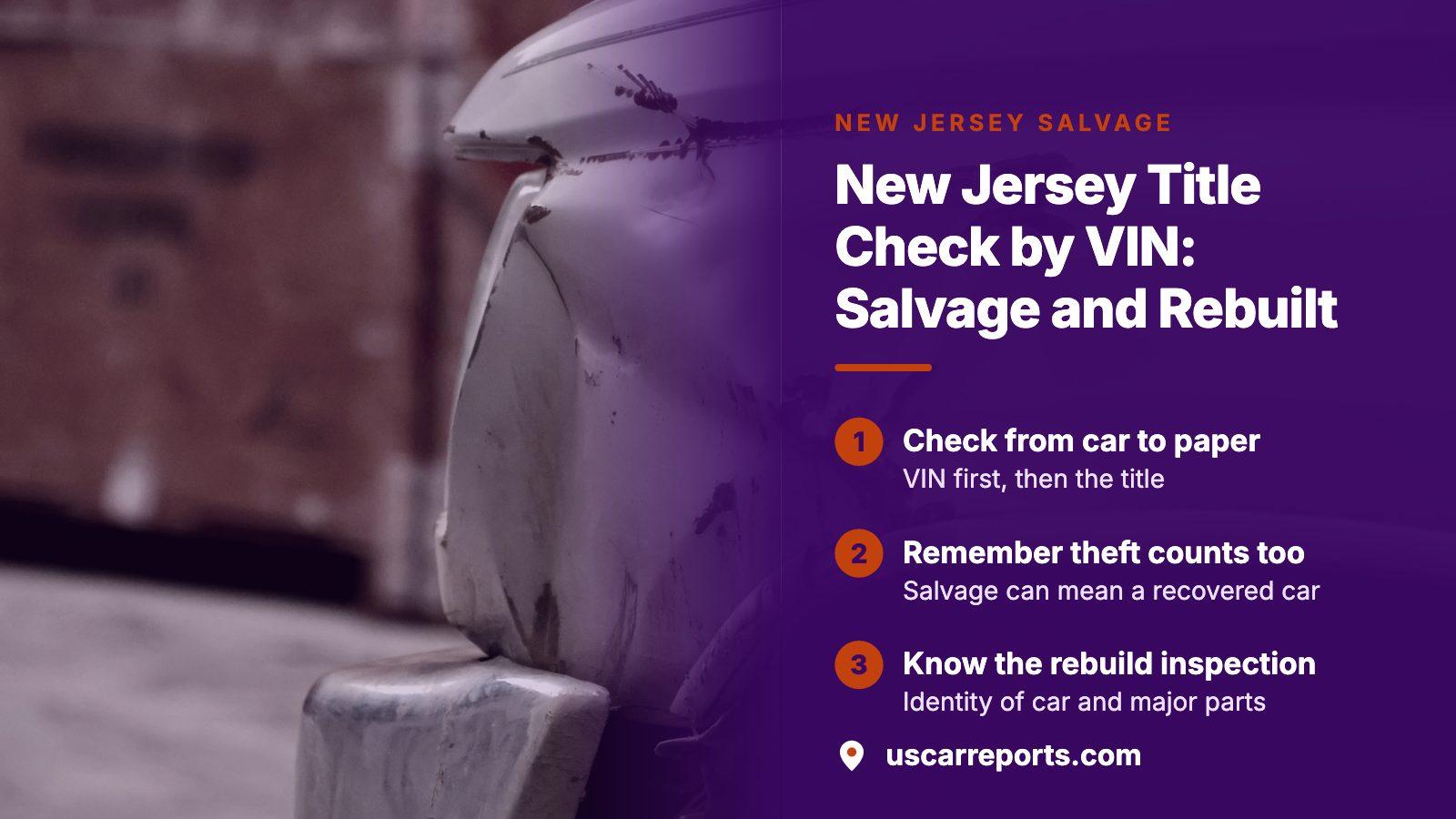
THE SHORT ANSWER
Put the car's VIN into USCarReports, look over the no-cost preview, and purchase the report only if the details agree with the listing. It lists brands plus total-loss and salvage entries from any state, so you can hold it against the New Jersey title. Treat a Jersey salvage entry as either a wreck or a recovered theft until the records say which. The rebuild inspection screens for stolen vehicles and parts, and the rule lists no workmanship test.
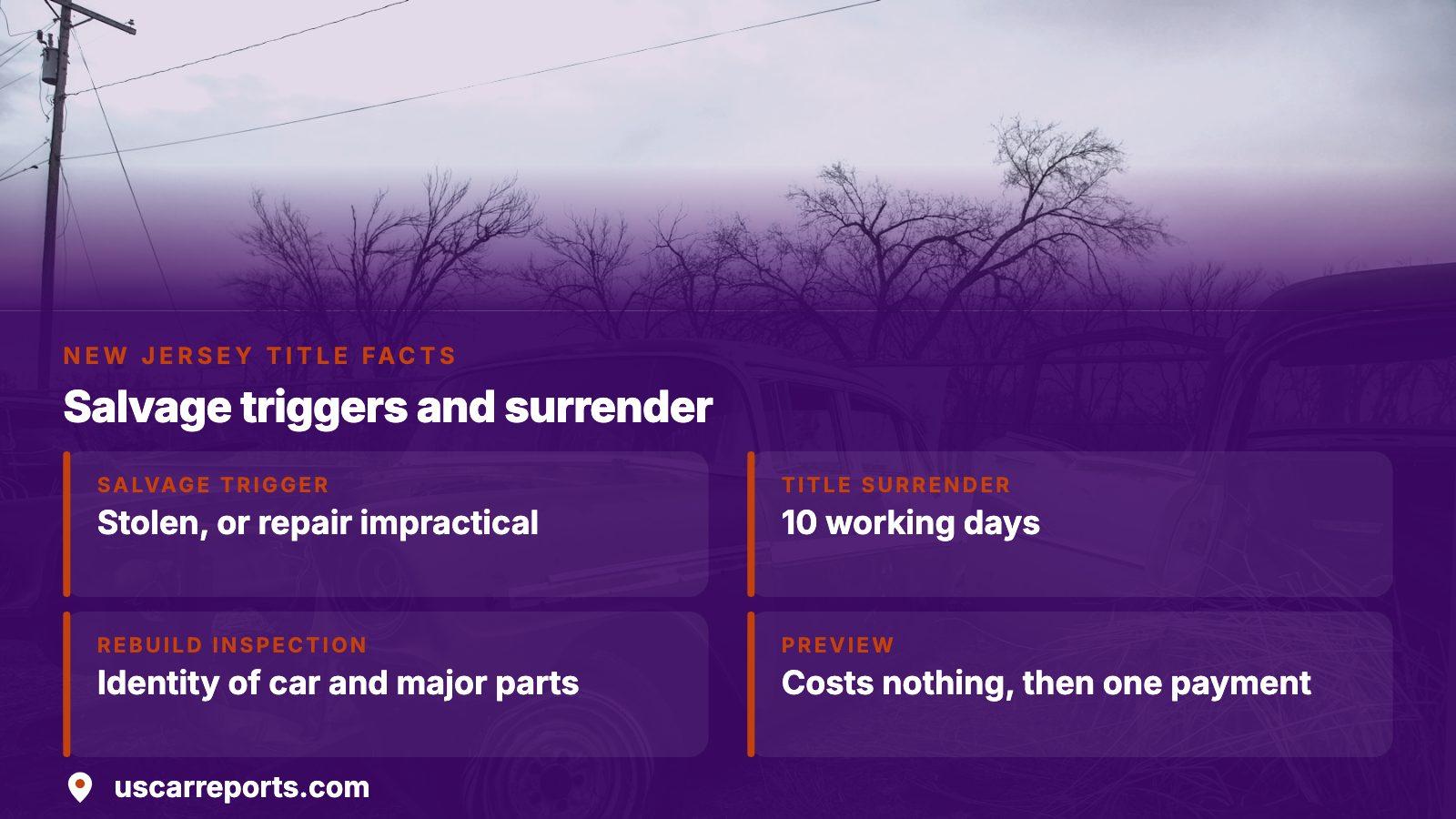
- Salvage trigger
- Reported stolen, or repair economically impractical
- Title surrender
- 10 working days
- Rebuild inspection
- Identity of the car and its major parts
- Preview
- Free, then one payment per report
What a New Jersey title check shows that the paper title does not
A New Jersey title records one car on one day. A search keyed to the VIN reaches further back, which counts most when the car has lived in other states.
| Entry in the report | What it tells you on a New Jersey car |
|---|---|
| Title brands, any state | Salvage, junk and flood labels stay in the national history, so a brand from elsewhere can show even when the Jersey document looks plain. |
| Salvage and auction entries, with photos | Photos from before the repair show the damage as it was. |
| Odometer readings | Dated readings that fall, or stay frozen for years, need an explanation. |
| Theft and insurance records | New Jersey treats reported thefts under its salvage rules, so a theft entry may explain a brand or sit on a record with none. |
| Liens and impounds | Shows whether a lender's claim or an impound entry is attached. |
Running it from the car, then matching it to the paper
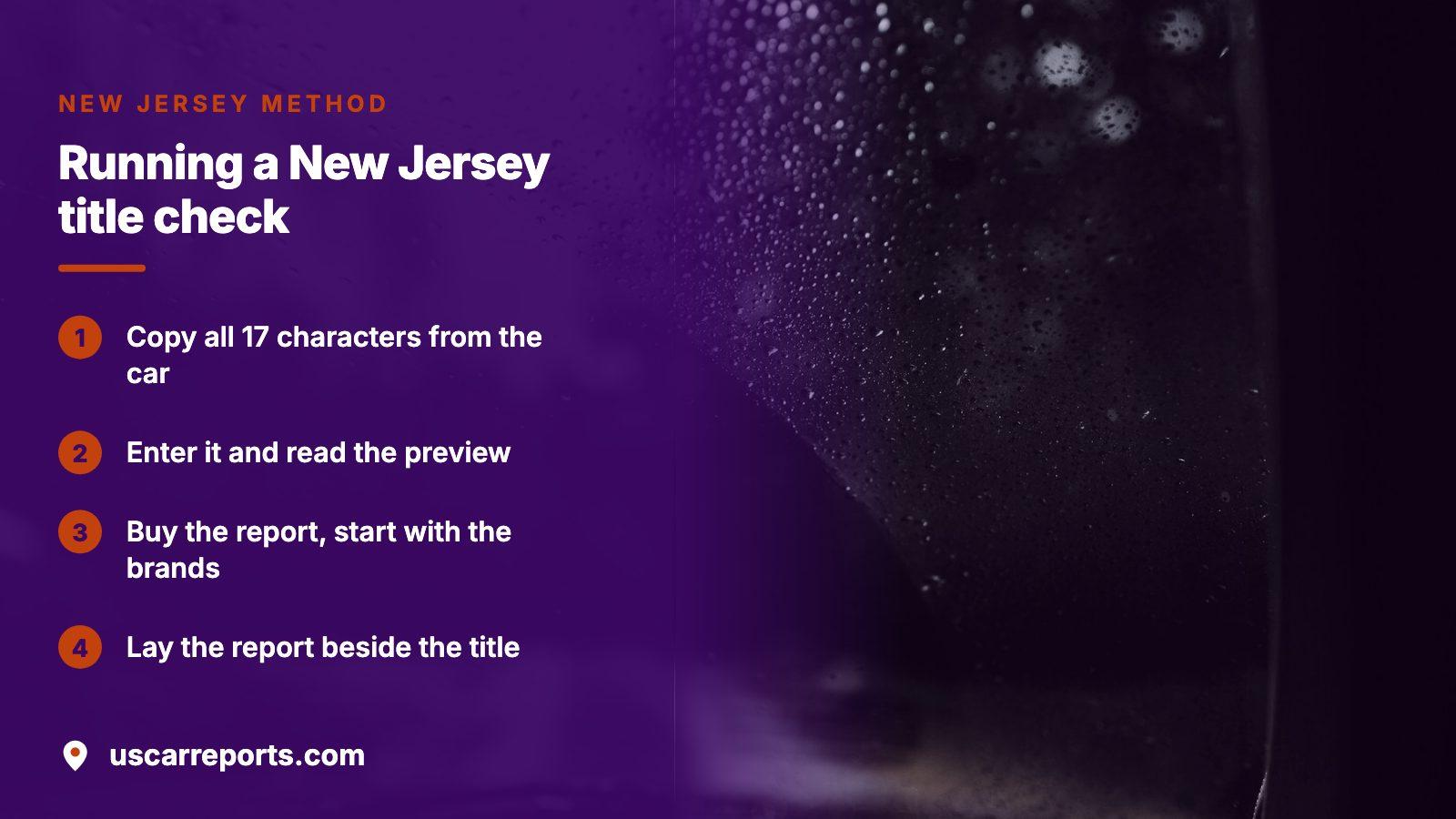
- Take the full 17-character VIN off the vehicle itself rather than the advertisement. One set is stamped on a dashboard plate in the corner by the driver's door, and another is printed on the sticker where the door latches. They should match, and a tampered plate matters in a state that sends recovered thefts with altered numbers to special inspection.
- Enter it on USCarReports and read the free preview. Year, make and model should match the ad.
- When they do, buy the report. Start with the brand entries, then the photos and the odometer dates.
- Lay the report beside the seller's New Jersey title. Brand wording, owner's name and any lender should fit together.
A New Jersey salvage car may be a wreck or a recovered theft
New Jersey's salvage rules cover vehicles reported stolen as well as vehicles damaged past the point where repair makes sense. The word salvage on a record does not say which. One car came out of a collision. The other disappeared and came back, sometimes stripped for parts.
A recovered theft can carry a clean title
The rules cut the other way too. A stolen car found without damage heavy enough to meet the salvage test, and with its VIN and plate unharmed, is issued ownership papers carrying no salvage mark. A theft entry in the report is where that history shows.
Where New Jersey draws the line on damage
New Jersey's line sits at the car's full value, not a fraction of it. The rule compares the repair estimate with the car's value immediately beforehand, and the car's age picks the version.
| Vehicle | When repair counts as economically impractical |
|---|---|
| Within eight model years of the current one | The repair estimate reaches or passes the car's pre-damage market value. |
| Older cars valued, before the damage, no lower than a same-model car five years from the current model year | A repair estimate that reaches the car's own pre-damage value, or an insurer's total-loss payout, triggers it. |
Three details settle a close call. The highest estimate on file wins. The owner's own estimate does not count; a valid figure comes from a licensed body shop or from an insurance adjuster working for a company licensed in New Jersey. Market value is an average of retail figures in manuals the banking and insurance commissioner has approved.
Read as written, only the second row names a total-loss payout as a trigger, and a cheap older car may fall outside the rules after heavy damage.
The ten working days that start the paper trail
After a theft report, or damage that meets the test, the person holding the certificate of ownership, whether owner or insurer, has 10 working days to turn it in to the state's Motor Vehicle Commission. The count also starts when a total-loss claim settles. The Commission then issues a salvage certificate of title, with any lender noted until the debt clears.
- Until the post-inspection certificate of ownership exists, the car changes hands only as salvage, by assigning the salvage title.
- A buyer has 10 working days to apply for a new salvage title.
- Registration for ordinary driving is off the table. A temporary registration lasting five days is the one exception, issued once an inspection appointment exists.
What the rebuild inspection tests, and what it leaves alone
A repaired salvage car must pass a State inspection before any certificate of ownership issues. The test is identity: the inspector verifies the VIN on the car and the identification numbers on its major parts. The MVC's current application names three specialty sites, at Eatontown, Secaucus and Winslow, and lists $200 for a car.
A rebuilt car that passed should have left a paper trail. Ask the seller for:
- The salvage title issued to whoever did the repairs.
- Itemized bills of sale covering each major part, with donor-car details for used ones.
- Before and after photos of all four sides, or an insurer's damage report if the before photos are missing.
- The repair work order.
- For a flood car, an insurer's damage report. For a recovered theft, the police report.
A pass is not a workmanship certificate
The rule lists three grounds for failing: a stolen car, a stolen major part, or a stolen vehicle's identification on the car or a part. Repair quality is not listed. Pay your own mechanic to judge the structure before you pay the seller.
The title after repairs, and how to read the paper
A car that passes still does not get a clean title. New Jersey's ownership papers for a rebuilt car carry a salvage designation, so the history stays on the document. Where a rebuilder merged several salvage vehicles, the Commission assigns a fresh VIN, and the plate may match no donor.
The paper changed recently. An MVC advisory to law enforcement says salvage and junk titles have been watermarked since October 1, 2025. After January 1, 2026, standard and salvage titles are green and junk titles brown, and both branded types stay watermarked. Older titles look different, so treat the paper as one clue and the VIN record as the main one.
Red flags in a New Jersey result
- A salvage, junk or total-loss entry, while the seller's title says nothing about it.
- A theft entry the seller cannot explain.
- Auction photos showing structural damage the ad never mentioned.
- A rebuilt car with no parts receipts or photographs behind it.
- A lender's claim or an impound entry that is still open.
Short report, same caution
The national title database keeps a short list: current title state, brands, odometer, plus total-loss or salvage history if any exists. Repair, recall and maintenance data live elsewhere, and the Justice Department page behind it urges an independent inspection before purchase.
Cost, then the order of the steps
The preview opens without payment. A full report is paid for one time, and if you're comparing several cars you can buy 3, 5 or 10 at once. Nothing auto-renews, and the amounts sit on the pricing page.
- Preview first. Buy the report once year, make and model agree with the ad.
- Look up open recalls with NHTSA and search NICB's VINCheck for theft and salvage reports from member insurers. Both cost nothing.
- If the car was rebuilt, collect the inspection paperwork described above.
- Have an independent mechanic examine the structure, which the state inspection does not.
Where this information comes from
- NJ MVC: salvage and rebuilt vehicles — How salvage vehicles are titled, and the repair-first, inspect-after order.
- NJ MVC: salvage certificates of title rules, N.J.A.C. 13:21-22 — The salvage definition, the damage test, the surrender deadline, inspection duties, grounds for failing and the title wording.
- NJ MVC: Salvage Inspection Fee Application, OS/SS-3 — The three inspection sites, the current fee and the documents an owner must supply.
- NJ MVC: updated vehicle title stock advisory — Watermark and paper color dates for standard, salvage and junk titles.
- US Department of Justice: understanding an NMVTIS vehicle history report — What the national title database holds, who reports to it and what it leaves out.
- NHTSA: recalls — Open-recall lookup by VIN, independent of title status.
- NICB: VINCheck — Theft and salvage lookup drawn from member insurers' reports.
Sources and photos: Facts checked against the sources above in November 2026. Photos by Everett Pachmann, Justin Cron and Leo_Visions on Unsplash; diagrams by USCarReports.
Keep reading
- New Jersey VIN check: flood history, title brands and the buying rulesThe rest of buying in New Jersey: flood history, the inspection sticker and the agency visit.
- Title status check: what the state lookup tells a car buyerWhat a state title lookup returns, and the lien line to read first.
- Registering a car in another state: deadlines, title and checksWhat a new state looks up before it titles a car that arrives with a brand.
- New York title check by VIN: brands, liens and the MV-999 in the seller's handThe neighboring state's brand and title rules, for comparison.
Frequently asked questions
How do I run a New Jersey title search by VIN?
Enter the VIN on USCarReports and confirm the preview matches the vehicle you are standing next to. Then buy the report and set its brand history against the New Jersey title the seller holds.
Is there a free New Jersey title search?
Only partly. The USCarReports preview costs nothing, and so do NHTSA's recall lookup and NICB's VINCheck. None is a full title history. The report here is a single purchase and never renews.
What makes a car salvage in New Jersey?
A theft report, or damage so heavy that repair is economically impractical. Within eight model years of the current one, that means an estimate reaching the car's pre-damage value. Older cars follow a second test that also counts an insurer's total-loss payout.
Is a rebuilt New Jersey car roadworthy because it passed inspection?
Not necessarily. The state's inspection verifies the VIN and the identification of major parts, and the rule's listed grounds for failing are all about theft. The title that follows still shows a salvage designation. Have an independent mechanic assess the repairs.
Can a salvage car be registered in New Jersey?
Not for ordinary driving until the post-inspection ownership papers are issued. The owner can get a five-day temporary registration to reach the inspection by showing the appointment notice, the salvage title and evidence of liability coverage.
Now check the car itself
The guide explains what to look for. The report shows what this VIN has on record.