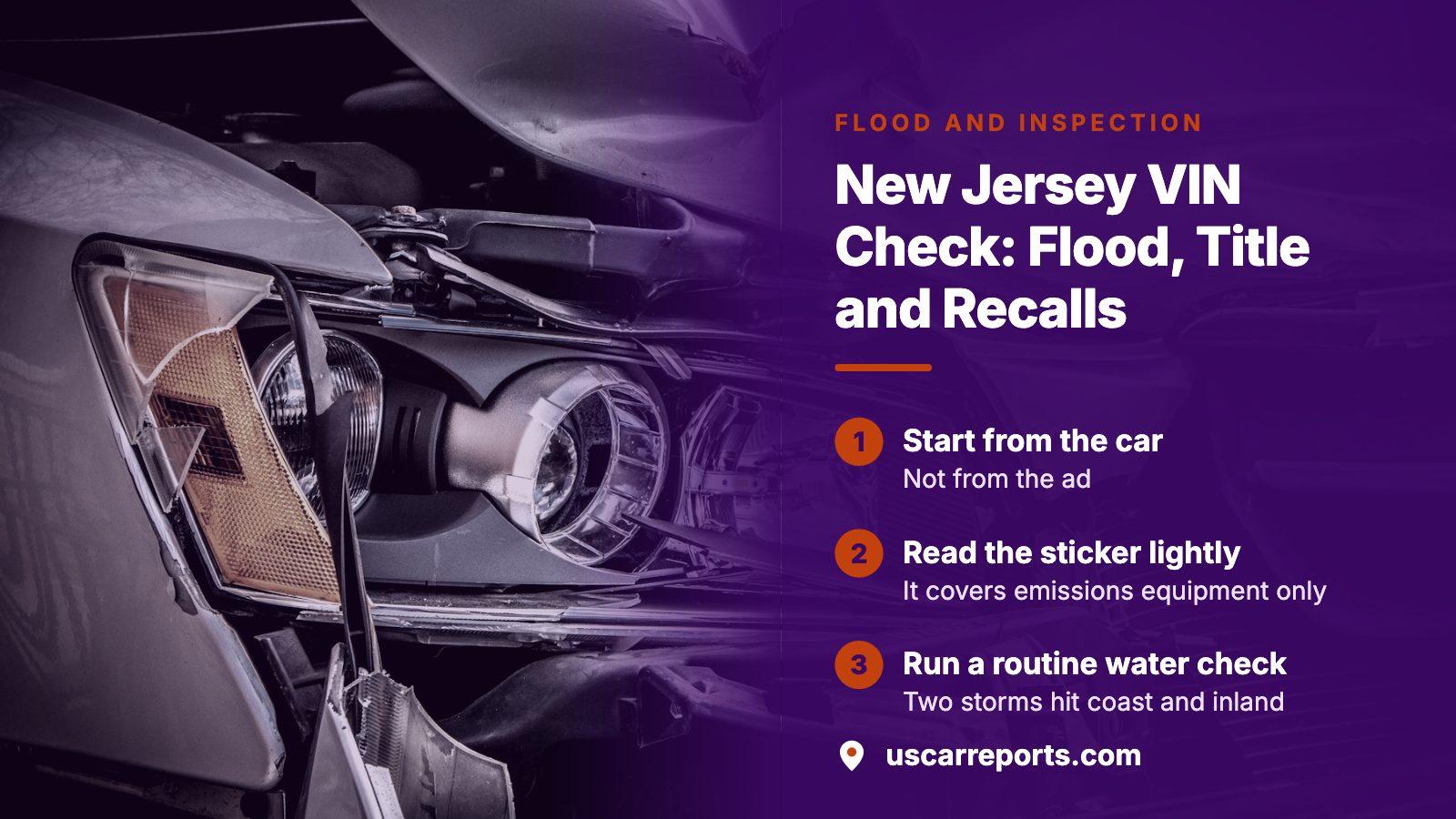
THE SHORT ANSWER
Enter the VIN to see a free preview, then buy the full report for title brands from any state, flood and salvage history, odometer readings, liens and theft records. In New Jersey, add what the state no longer does for you: pay a mechanic to inspect the brakes and tires, look for water damage, and see the signed title before any money or plates change hands.
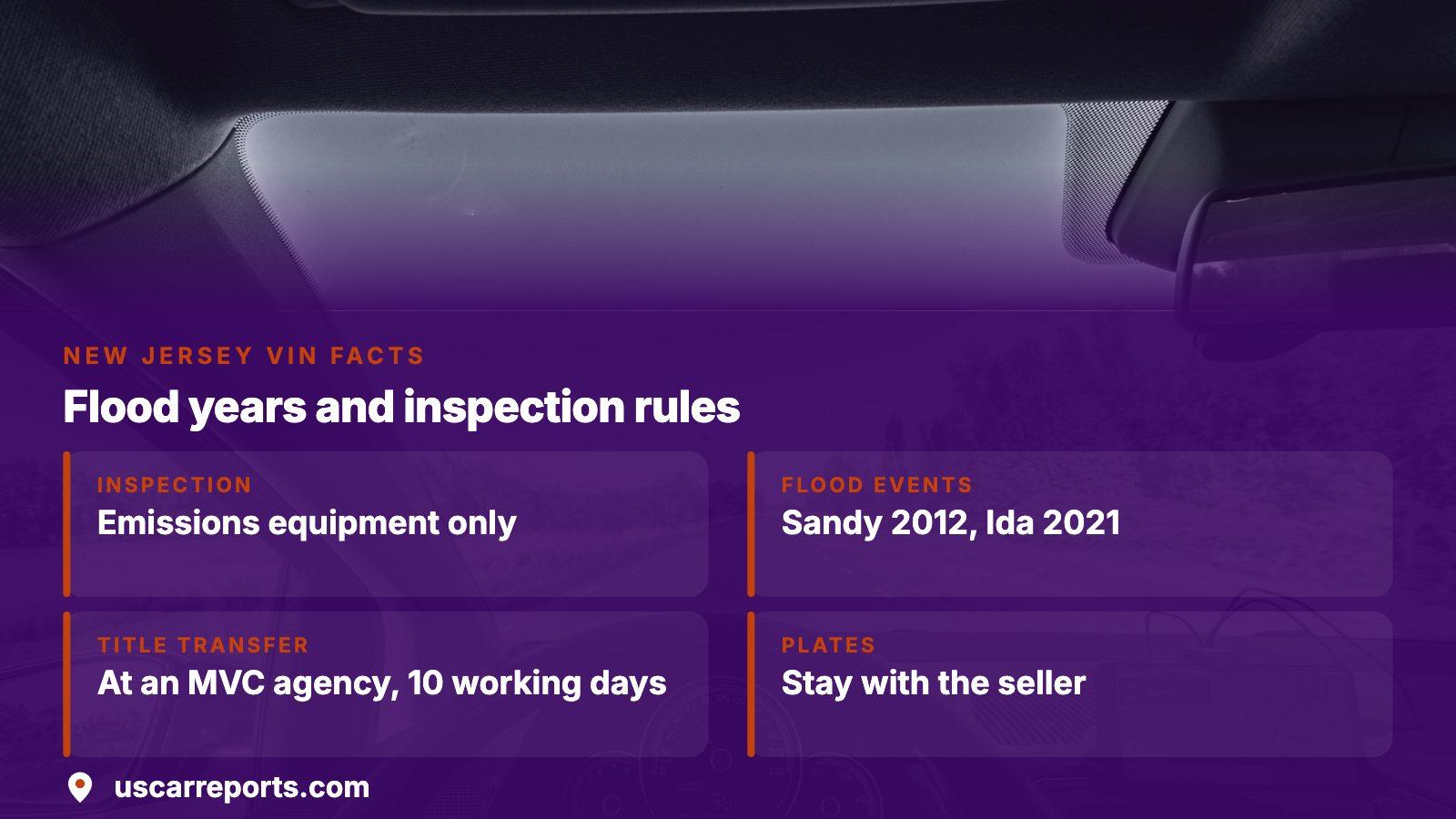
- Inspection
- Emissions equipment only; the mechanical part ended in 2010
- Flood events
- Sandy in 2012 on the coast, Ida in 2021 inland
- Title transfer
- Face to face at an MVC agency, within 10 working days
- Plates
- Stay with the seller; no owner lookup by plate
What a New Jersey VIN check finds on a used car
A New Jersey VIN lookup begins with the 17 characters on the car, yet the search reaches past the state line. It reads title records from every reporting state, and a car for sale here often arrived from somewhere else. The findings that count most:
- Title brands with the issuing state, so a flood or salvage brand from New York or Pennsylvania still appears on a New Jersey car.
- Salvage and auction history with sale photos, for comparing past damage against the panels in front of you.
- Odometer readings from several dates, showing whether the mileage climbs steadily or jumps backward.
- Liens, impounds, theft records and insurance claims, any of which can mean the seller has no right to sell. Open recalls are listed too.
This is desk work before the test drive. It does not read license plates, and it cannot replace a lift.
Running the check: start from the car, not the ad
Two spots carry the VIN: a tag at the bottom corner of the windshield nearest the steering wheel, and a sticker along the rim of the driver's door opening. Both should match the title and the registration. The tenth character also encodes the model year, so it should fit the seller's claim. A mismatch ends the deal before you spend a cent.
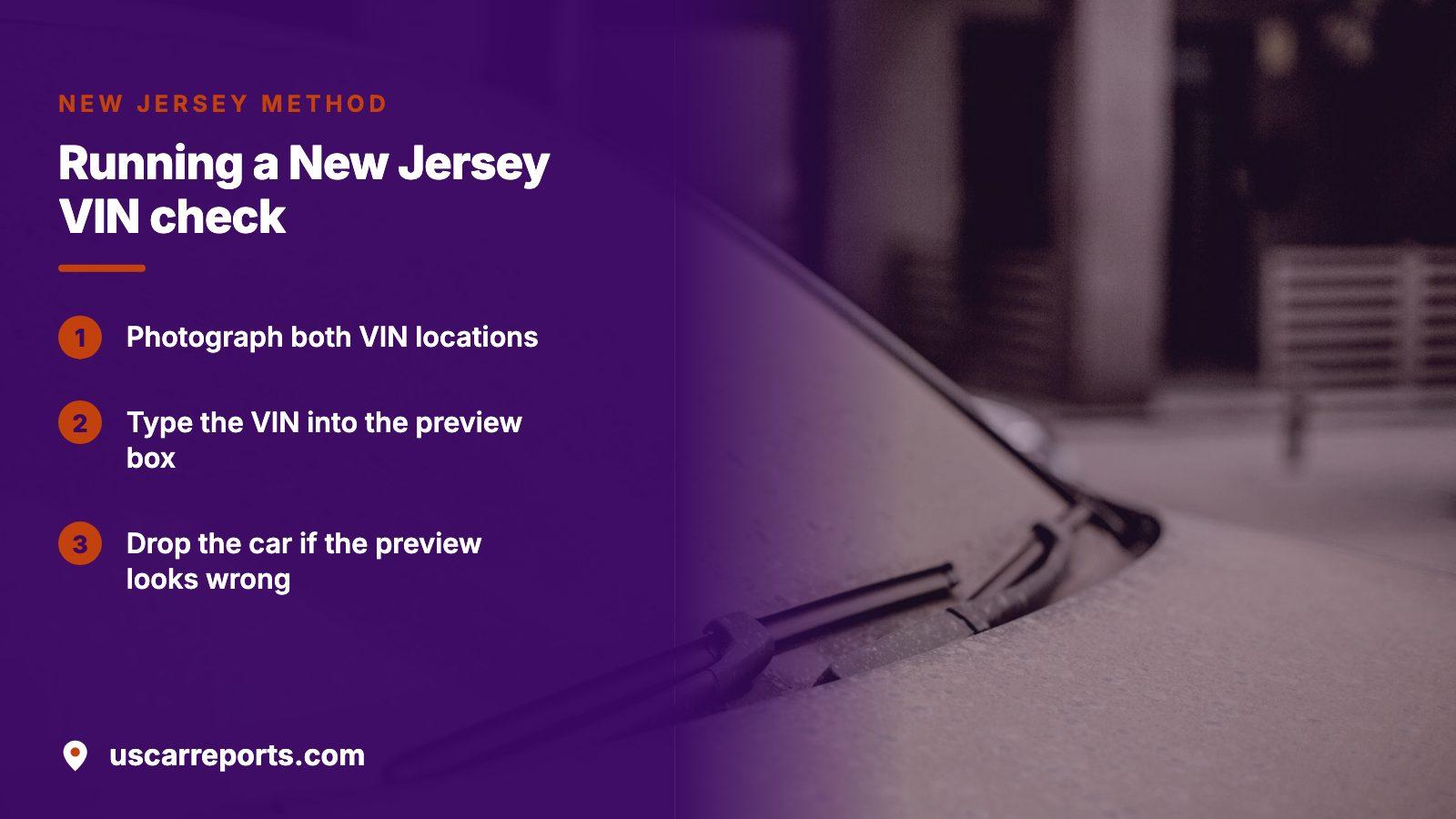
- Photograph both VIN locations on the car.
- Type the VIN into the box on this page to open the preview, which costs nothing.
- Study the preview and drop the car if something already looks wrong.
The inspection sticker says less than buyers assume
New Jersey dropped the mechanical part of its vehicle inspection in 2010. What is left is an onboard-diagnostics check of emissions components, once every two years, with new vehicles on a five-year schedule. The windshield sticker shows when the next check is due.
What the sticker does not cover
A sticker from a neighboring state's program can mean someone looked at the brakes and tires. A New Jersey sticker means nothing of the kind. Steering, suspension and frame go unexamined, and a car can hold a valid sticker while its brake pads are worn to the metal.
Owners must still keep mechanical and emissions equipment working, and the state says even exempt cars can be cited for broken or missing parts. That duty falls on the owner, not on the specific car you are considering. Have a mechanic check brakes, tires, steering and underbody and scan for fault codes, which can be cleared just before a sale.
Two floods, two directions: why a water check is routine
Superstorm Sandy, in 2012, was a coastal surge that left salt water in harbors, low neighborhoods and shore parking lots. Ida, in 2021, was a downpour that filled roads, garages and streets far from the sea. No part of the state was safe, so an inland suburban car deserves the same questions as a shore car.
A brand exists only if someone applied it. Insured total losses usually reach the title record, while a car dried out and resold without a claim leaves little trace. State consumer officials said after Sandy that a flood-damaged vehicle that was not a total loss must show the words Flood Vehicle on its title under Status. Read that line on the paper itself.
When the title itself was wrong
A New Jersey used-car dealer admitted selling seven Sandy-flooded cars after an employee at a Motor Vehicle Commission office created clean titles for them. The cars had come from auction labeled parts-only, and both people pleaded guilty. A clean title is evidence, not proof.
Inside the car, look under the carpet and in the trunk for silt or mildew, and check seat belts and door panels for stains.
Reading the results: what each finding means for a Jersey car
Set the report beside the paper title and see whether they tell one story. These findings call for action:
| What the report shows | What it can mean | What to do |
|---|---|---|
| A flood or salvage brand from any state | The car was written off or soaked, possibly in Sandy or Ida | Price it as a damaged car or walk away, whatever the seller says |
| Recent titles in New York or Pennsylvania | The car lived under road salt or on a city street | Put it on a lift and check the frame, rocker panels and brake lines |
| Several owners or retitles in a short span | Someone may be passing a problem car along | Ask why, and ask for service records |
| Odometer readings that fall or stall | A rollback or a swapped instrument cluster | Compare pedal and seat wear with the miles shown |
| A lien with no release | A lender may still hold a claim | Keep your money until you hold a written release |
| A theft or impound record | The car may be reported stolen | Stop, and call the police or the insurer |
New Jersey's buying rules: plates, signatures and the agency visit
A New Jersey sale has paperwork quirks that surprise out-of-state buyers. Check that the VIN on every document matches the car and the report before anyone signs.
| Item | What New Jersey expects |
|---|---|
| Plates | The seller removes them, and plates cannot pass to a different owner. You receive plates when you transfer the title. |
| The title | Seller and buyer both sign the back, with the sale date, the price and the buyer's driver license number. |
| Bill of sale | It lists the buyer's name and address, the sale date, the odometer reading and the price. |
| The transfer | Handled face to face at an MVC agency, with your license and proof of New Jersey insurance. A car with a New Jersey title should be transferred within 10 working days of the sale to avoid a late penalty. |
| A financed car | Bring the lender's details and the Universal Title Application. |
Where the car lived: Jersey plates, New York and Pennsylvania miles
Cars cross the New York and Pennsylvania lines constantly, so a New Jersey registration is no guarantee of New Jersey miles. One may have wintered under upstate salt, another sat curbside in a city for years. The ownership and title history in the report sorts them out: salt history calls for the underbody inspection, city history for a look at bumpers and door edges.
A plate number will not lead a private buyer to the owner. Owner data tied to a plate is protected by the Driver's Privacy Protection Act, and shopping is not a listed use. Get the 17 characters from the seller instead.
Cost, and the order to work in
The preview is free and shows what the record holds before you pay. The full report is a single payment, and multi-report packs exist for anyone with a shortlist. Nothing renews. The pricing page lists the pack sizes and current figures.
- Open the preview and drop any car that already looks wrong.
- Look up open recalls on NHTSA's site and theft and salvage records on NICB's VINCheck. Neither costs anything.
- Buy the report to see brands, odometer readings and liens from every reporting state.
- Ask to see the paper title in the seller's name, and match its VIN to the car.
- Book a mechanic for a pre-sale inspection that covers water damage and the underbody.
- Sign the bill of sale, then complete the transfer at an MVC agency.
Where this information comes from
- NJ Motor Vehicle Commission: How to get inspected — Confirms the onboard-diagnostics and emissions component check, the two-year cycle and the five-year schedule for new vehicles.
- NJ Motor Vehicle Commission: Transfer of ownership — Source for the plate removal, signature, bill of sale and in-person transfer steps.
- NJ Attorney General: flood and salvage title advice for buyers — Supports the Flood Vehicle title wording and the list of physical signs of water damage.
- WHYY: dealer admits selling Sandy-flooded cars — News report on the case of clean titles issued for flooded cars.
- NMVTIS: National Motor Vehicle Title Information System — The federal title database that gathers brands from every reporting state.
- NICB VINCheck — A no-cost theft and salvage search fed by participating insurers.
- NHTSA: Recalls — A no-cost lookup of open safety recalls by VIN.
Sources and photos: Facts checked against the sources above in November 2026. Photos by Clark Van Der Beken, JavyGo and Sander Jeurissen on Unsplash; diagrams by USCarReports.
Keep reading
- New Jersey Title Check by VIN: Salvage Rules and the Rebuild InspectionSalvage, flood and rebuilt titles in New Jersey, in more depth.
- New York VIN check: flood, city-street and road-salt history before you buyThe neighboring state that sends many cars and a lot of road salt across the line.
- Pennsylvania VIN check: history report first, notary visit secondHow buying and inspection rules change on the other side of the Delaware.
- Florida VIN check: title records, flood risk and Florida buying rulesThe full water-damage checklist, from a state that sees storm cars every year.
Frequently asked questions
How do I run a New Jersey VIN check?
Read the VIN from the car, enter it in the box on this page for the preview, and buy the full report if the car stays on your shortlist. Then read the paper title yourself and look the car up with NHTSA and NICB, which cost nothing.
Is there a free New Jersey VIN lookup?
Partly. The preview is free, and NHTSA's recall tool and NICB's VINCheck cost nothing. The full report on this site is one payment. None of them replaces the physical title or an inspection.
Does New Jersey inspect used cars for safety?
Not since 2010. The state checks emissions equipment on a schedule, and new vehicles go on a five-year schedule. Brakes, tires, steering and lights are not examined, so a mechanic you hire gives the only mechanical review.
Can a New Jersey VIN search show a flood car?
If an insurer wrote off the car and a state branded it, the brand shows up, whichever reporting state issued it. A car dried out and resold with no claim may carry no brand, so treat the report as a first screen and check for silt, rust and mildew.
Can I look up a New Jersey license plate to find the owner?
Not as a private buyer. Federal privacy law keeps owner details for permitted uses in every state, and comparing used cars does not qualify. Get the VIN from the seller and use that.
Now check the car itself
The guide explains what to look for. The report shows what this VIN has on record.