THE SHORT ANSWER
A family gift is still a transfer. The title is signed over with a mileage statement unless the model year is exempt, a recorded lender must release its lien beforehand, and the receiver then applies for a new title. To avoid sales tax, the receiver claims the gift or family exemption on that state's own form, and states disagree on who counts as family. Run the VIN before anyone signs.
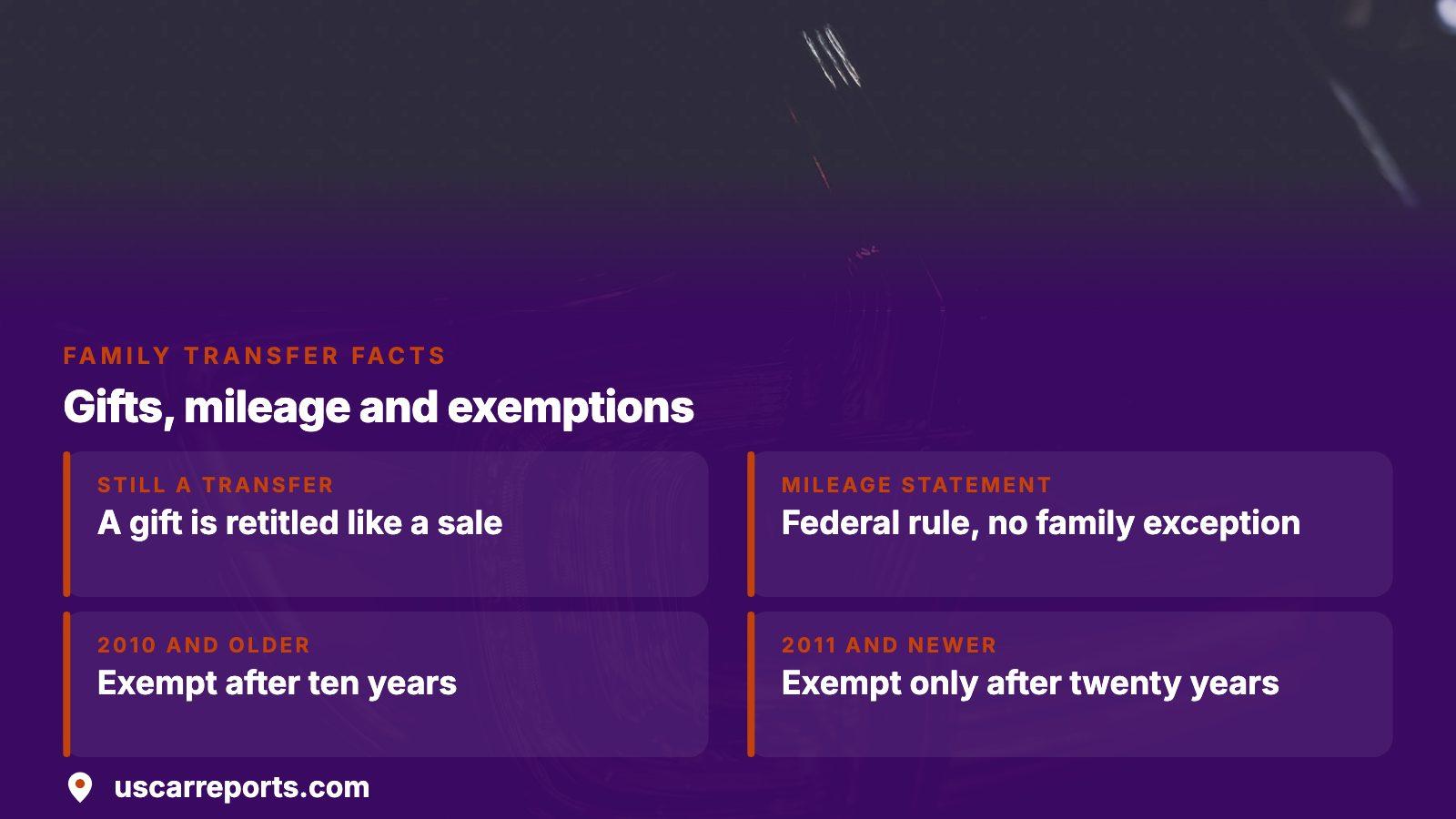
- Still a transfer
- A gift is retitled like any sale
- Mileage statement
- Federal rule, no family exception
- 2010 and older
- Exempt after ten years
- 2011 and newer
- Exempt only after twenty years
A gift still moves ownership, and the state writes the rules
A state records ownership the same way whether a car goes to a stranger for cash or to a daughter at no charge. Signing over the title, applying for a new one and waiting for it to issue are the same either way. Kinship removes no step.
What kinship does change is the tax bill, and that is where states split. Each one draws its own line around family, and each wants the claim made on a particular form, box or line of the title. Turning up without it usually means paying tax on a gift. The table below sets five states side by side before the checks that apply everywhere.
Five states, five ways to claim the family exemption
These come from each state's own agency pages, read in November 2026. Forms change, so confirm on the day you file.
| State | What the receiver files | What to watch |
|---|---|---|
| Texas | Title application signed by both people, plus the Comptroller's gift affidavit, signed by both and notarized | Filed in person with ID. A flat gift tax still applies, and the car must be on the receiver's insurance |
| California | The word gift written on the back of the title where a price would go, plus a statement of facts from the receiver | For a family transfer the statement names the relationship. The transfer fee is still due |
| New York | A bill of sale showing a zero price and marked as a gift, plus the state's statement of transaction at registration | The giver completes an extra section when the receiver is beyond spouse, parent, child, stepparent or stepchild |
| Pennsylvania | An affidavit of gift attached to the title paperwork (MV-1 or MV-4ST) | Gifts are not subject to sales tax, but a token price on the form draws a Revenue review |
| Illinois | The private-party vehicle use tax form, which the Secretary of State wants with any title transfer | Spouse, parent, sibling and child qualify for a reduced flat rate. Step-relations, in-laws and grandparents do not |
Where the family lists split: grandparents, siblings, stepparents
The same relative can be family in one state and a stranger in the next. A few pairings show how far the lists drift.
- Grandparent or grandchild: named in California's DMV manual and on the Texas list, left out of the Illinois exception.
- Stepparent or stepchild: counted in Texas and on New York's short list, excluded in Illinois.
- Sibling: named in Texas, California and Illinois. In New York a sibling falls outside the short list, so the giver completes the extra section.
- Pennsylvania ties its exemption to a genuine gift, not to a list of relatives, so the question there is whether anything was paid or any loan taken over.
Match the receiver's exact relationship to the state's wording before the visit. A wrong guess turns a gift into a taxed purchase at the counter.
The mileage statement follows the transfer, not the relationship
Federal odometer rules in 49 CFR Part 580 make the giver disclose mileage when ownership changes, and the statement goes on the title that reaches the receiver. The rule never asks about price or about how the two people are connected.
| Model year | When the statement stops being required |
|---|---|
| 2010 or earlier | Ten years after the model year, so these cars are already exempt |
| 2011 or newer | Only after twenty years, so the oldest of them are not exempt until transfers made in 2031 |
Trucks rated above 16,000 pounds and vehicles that are not self-propelled are exempt as well, though a family sedan will not be one of them. New York's DMV applies the same cutoffs.
Why a token price is the wrong shortcut
Some families write a small price on the paperwork to keep things simple. Pennsylvania's Revenue page calls that incorrect for a gift and says it often sends the file for review. The cleaner route is to describe the transfer as it happened: a gift in California's title wording, a zero price in New York's bill of sale, and in Texas an affidavit made for exactly this.
A loan taken over is not a gift
Pennsylvania treats a lien the receiver assumes as a payment, so sales tax is due on the amount still owed. Where a loan remains, the lender's release comes first and the gift label comes second.
The order that works on handover day
- Confirm no lender is recorded on the title. A loan paid off years ago is not the same as a lien released and recorded.
- Complete the mileage statement on the title unless the model year is exempt.
- Sign with names exactly as printed. A correction or an altered line usually means a duplicate title and a second trip.
- Add the state's claim: the word gift, an affidavit, or the tax form from the table.
- The receiver arranges insurance in their own name first. Texas wants the car on the receiver's policy before it registers.
- The giver files the state's notice of sale or transfer the same day, so tickets and tolls stop following the old name.
What a new title does not clean: check the VIN first
A title in a relative's name does not wipe the car's past. A salvage or flood brand on the old title carries into the new one, and a recorded lender or theft entry sits on the VIN, not on the paper in the family's glovebox.
That is the natural moment to run the check. USCarReports gives a free preview from the VIN, and the full report is one payment, with the options on the pricing page. It reads title brands, liens and odometer readings. NHTSA's recall lookup costs nothing and is worth clearing before the keys change hands. The national title record, NMVTIS, is what approved history providers draw on.
If a brand turns up
A brand does not stop a family transfer. The receiver should still hear about it from the giver, not from the next buyer.
Two cases that need a different job
A title that was signed but never filed with the state is an open title. The signature does not move ownership, the filing does, so tickets and tolls keep pointing at the signer. File it late and accept the penalty. Selling it on with the old signature and a new buyer's name written in is title jumping, which most states forbid.
When the registered owner has died, being the relative with the car and keys gives no power to sign. States offer a small-estate affidavit or a transfer through the estate, and the forms differ, so that route starts with the state agency, not the counter.
Where this information comes from
- 49 CFR Part 580: odometer disclosure requirements — Supports the disclosure duty at transfer and the model-year exemptions.
- Travis County Tax Office: gift transfer — Supports the Texas gift affidavit, notarization, relatives list and insurance requirement.
- California DMV: transactions not subject to use tax — Supports the gift wording on the title, the statement of facts and the family list.
- Pennsylvania Department of Revenue: Motor Vehicle Understated Value Program — Supports the affidavit of gift, the token-price warning and the assumed-lien rule.
- New York DMV: Statement of Transaction — Supports the gift claim at registration and the extra giver section.
- Illinois Department of Revenue: private party vehicle use tax instructions — Supports the family exception and the relatives it leaves out.
- NMVTIS: National Motor Vehicle Title Information System — The federal title record behind approved vehicle history reports.
Sources and photos: Facts checked against the sources above in November 2026. Photos by Shadow Photography, Masjid MABA and A n v e s h on Unsplash; diagrams by USCarReports.
Keep reading
- Release of liability: what the notice does, state by stateWhat the giver files so tickets and tolls stop following the old name.
- Title status check: what the state lookup tells a car buyerHow to read what a title says before anyone signs it.
- Car title vs registration: what each proves and who keeps what at a saleWhich filing the new owner needs, and which one proves ownership.
- Registering a car in another state: deadlines, title and checksFor a relative who lives in a different state from the giver.
Frequently asked questions
Do I owe sales tax when a parent gives me a car?
Often not, but the exemption is claimed, not automatic. Texas still charges a flat gift tax, Illinois a reduced flat use tax, and Pennsylvania exempts a true gift with conditions about tax already paid. Look up the receiving state's agency page before the visit.
Is a sale to a relative for a small price treated like a gift?
No. A sale is a sale, and the price has to be real, with tax generally due on what was paid. Pennsylvania says a nominal price on a gift is incorrect and often triggers a review. Describe the transfer the way it happened.
Does the odometer statement apply when the car is a gift?
Yes, unless the model year is exempt. Cars from 2010 and earlier drop out after ten years, while 2011 and newer need twenty. The rule follows the change of ownership and ignores price or kinship, so a hatchback from 2011 given to a niece still needs its mileage written in.
Are in-laws and stepchildren treated as family?
It depends on the state. Texas lists step and in-law relations, while Illinois leaves them out of its family exception. New York's short list names stepparents and stepchildren but not in-laws. Read the state's wording and bring proof of the relationship if a form asks.
The owner died and I have the car. Can I sign the title?
No. Holding the keys is not authority, and the title needs the signature of the owner or a person the estate appoints. Many states let a spouse or heir use a small-estate affidavit instead of full probate. Ask the state's motor vehicle agency which form applies.
Now check the car itself
The guide explains what to look for. The report shows what this VIN has on record.