THE SHORT ANSWER
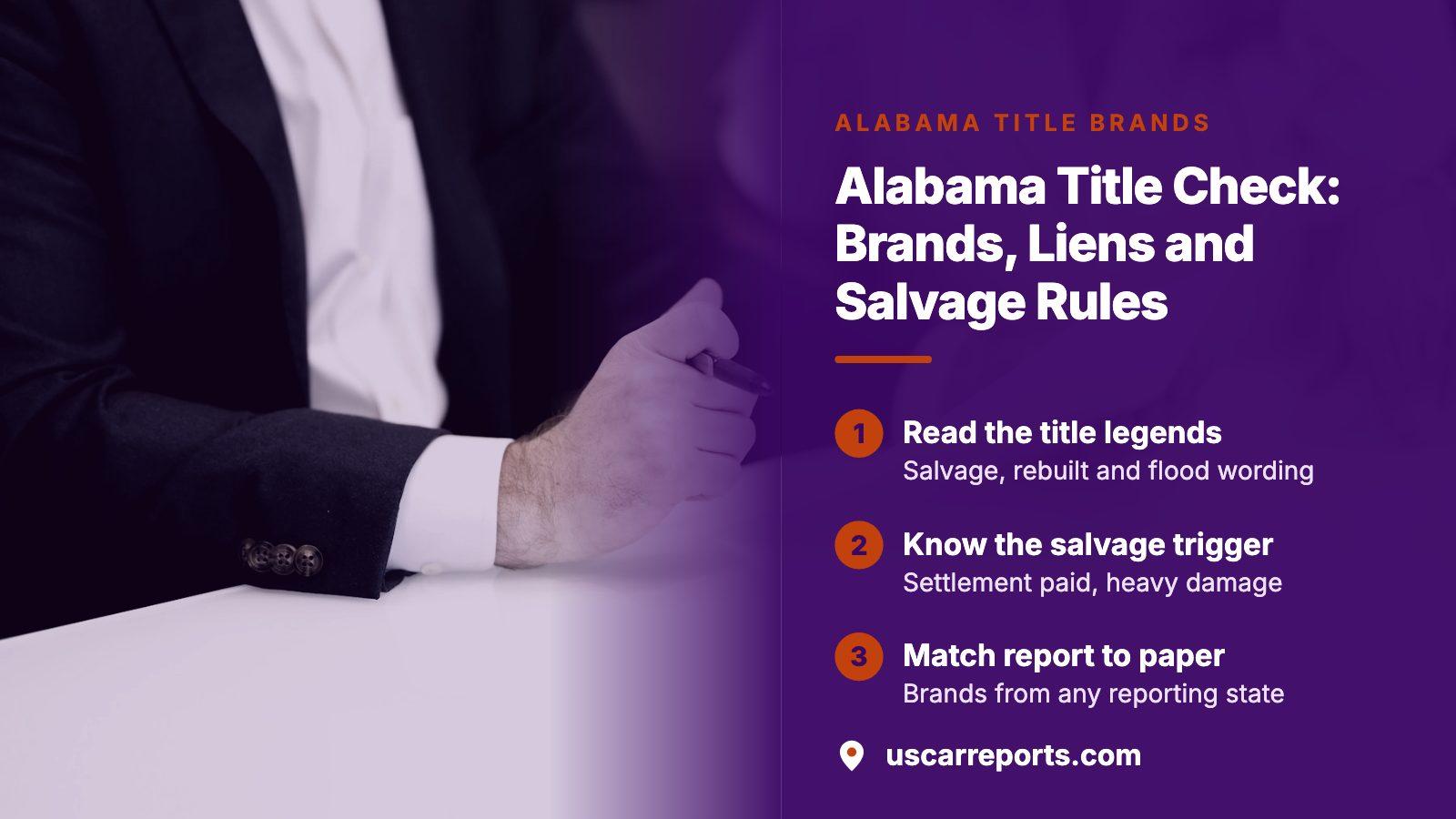
To check an Alabama title, read the VIN off the car, enter it to open the preview, and buy the report if the car stays on your list. The report lists brands and total-loss records from every reporting state, plus liens and mileage. Then set it beside the paper title and its Alabama legends: Salvage, Rebuilt, Flood Vehicle, or Parts Only – Non-Rebuildable.
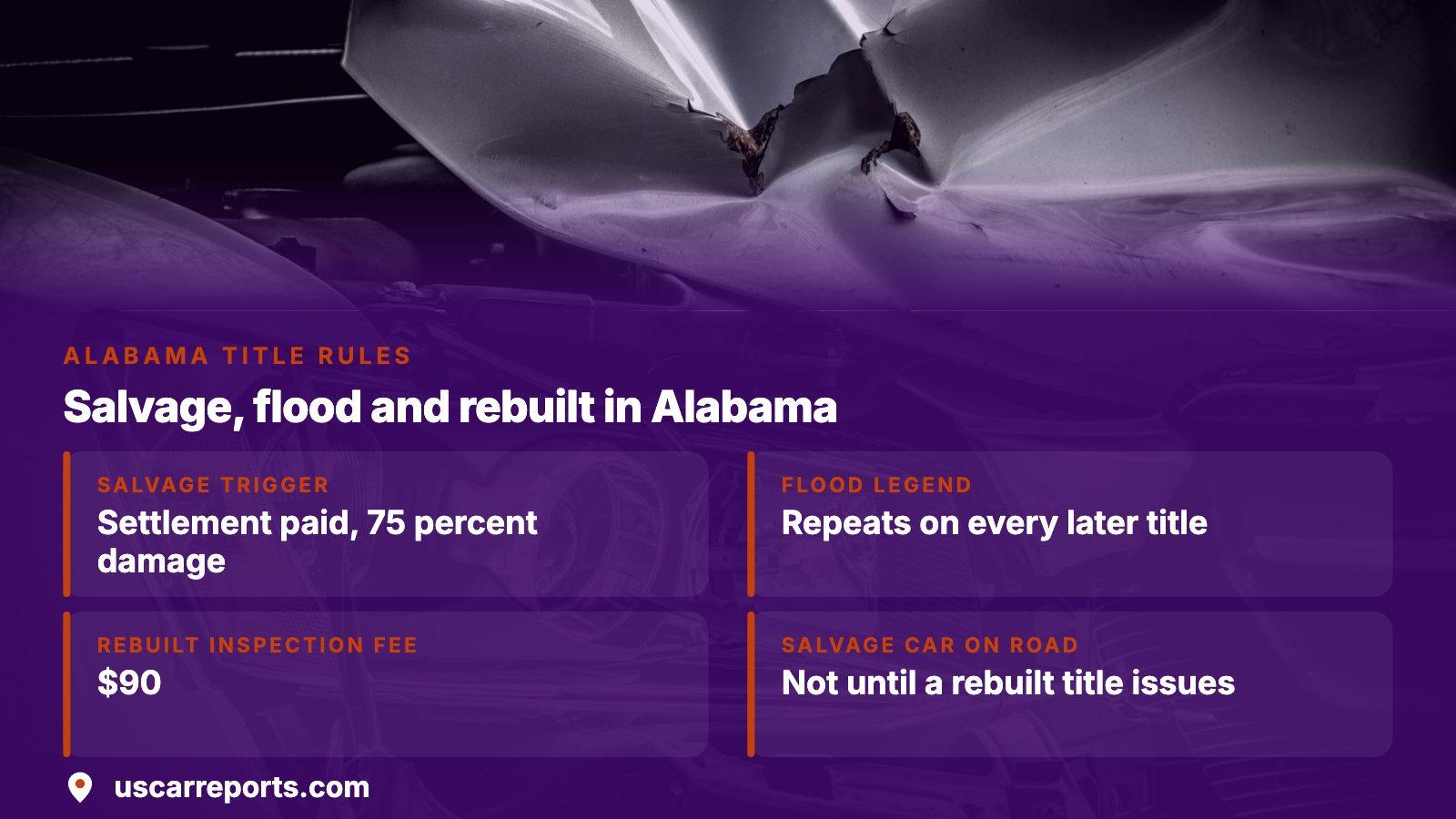
- Salvage trigger
- Settlement paid, damage at 75 percent or more of retail value
- Flood legend
- Repeats on every later title
- Rebuilt inspection fee
- $90
- Salvage car on the road
- Not until a rebuilt title issues
What an Alabama title check finds that the paper does not
A title is one state's snapshot at one moment. A VIN-based check adds the trail around it, which counts most when the car lived elsewhere first. Expect these findings:
- Odometer readings from separate dates, which should rise in a believable line.
- Liens and impounds that a lender or tow yard may still hold against the car.
- Brands such as salvage, rebuilt or flood, each tagged with the state that issued it.
- Auction and total-loss listings, sometimes with the sale photos.
- Theft flags, insurance entries and any open recall.
How Alabama keeps title records, and what it does not offer
Alabama titles run through ALVIN, the Department of Revenue's title system. The Department says it built the national title database, NMVTIS, into ALVIN, so a car's history is checked before an application is processed and again before a certificate issues. That is how a brand written by another state lands on an Alabama title.
| Department service | What it does |
|---|---|
| Application status | Follows a filing you already made, such as a rebuilt-title request. |
| Lien changes | Adds, continues, transfers or releases a lien on an Alabama title. |
| Rebuilt title application | Starts the inspection that follows a salvage title. |
These tools run on transactions. The Department's title menu lists none that returns a given car's title history by VIN, so a buyer needs a separate record check before paying.
Running the check, step by step
Begin at the vehicle itself rather than the advertisement. The 17-character number is stamped on the car.
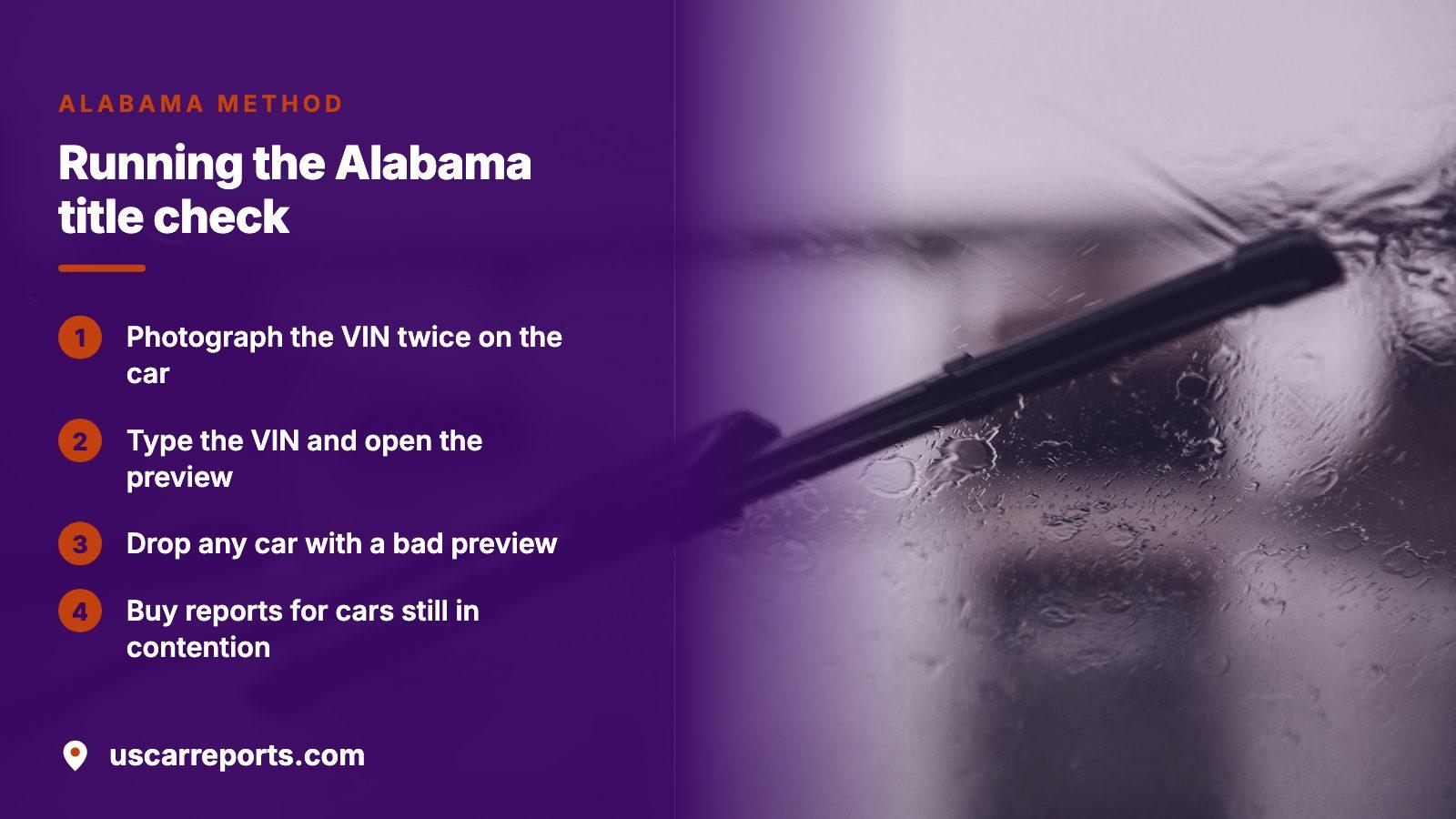
- Photograph the VIN twice: through the glass in the dash corner nearest the driver, and again from the door-frame label. Both must match the title.
- Type the VIN on this page. The preview opens at once and costs nothing.
- Drop any car whose preview already looks wrong.
- Buy the report for cars still in contention. You pay once per report, packs of 3, 5 or 10 suit a long shortlist, and no plan renews.
- Lay the report beside the paper title and note every difference in brands, liens and mileage.
Alabama title legends and what each one means
An Alabama title can carry words that change a car's future:
| Legend | What it tells you |
|---|---|
| Salvage | A total loss: a settlement was paid and the damage reached 75 percent of what the car was worth at retail beforehand. It cannot be registered or driven on Alabama roads until a rebuilt title is issued. |
| Rebuilt | The car was restored in Alabama and passed the Department's inspection, and the new title carries the word REBUILT. |
| Flood Vehicle | Water played a part in the loss. Every title issued afterward repeats the legend, including one issued once the car is rebuilt in any state. |
| Parts Only – Non-Rebuildable | The car was disclosed as junk or for parts only. It is never retitled. |
The total-loss definition leans on a payment. A car repaired out of pocket, with no insurer settlement, falls outside it, so a clean Alabama title does not prove a clean history.
Why the state of the loss matters more than the state on the title
Alabama issues its own salvage certificate only when the total loss happened inside Alabama. A car wrecked in Georgia or Mississippi falls under that state's salvage law, so the brand, or the lack of one, comes from there. A car that was never branded anywhere stays clean on paper everywhere.
Parts-only brands travel too
Alabama will not inspect a car for rebuilt status if another state branded it parts-only. If the report shows that brand, treat the car as a source of spares, whatever the seller calls it.
Buying a rebuilt Alabama car: what the seller's file should hold
A rebuilt title means the Department inspected the repair, so the seller or an earlier owner should hold the paper from that process. Ask for it before you negotiate.
- The salvage title and the rebuilt title, both showing the same VIN as the car.
- Bills of sale for the parts that were swapped in.
- Proof the applicant held the car as owner ahead of the salvage event, or a master dealer regulatory license.
- The inspection decal, which has its own unique number and should match the Department's file.
The inspection costs $90, split into $75 for the inspection and $15 for the new title, and it is generally scheduled within 1 to 2 weeks of the application. A car described as almost rebuilt is still a salvage car, and Alabama does not let it be registered or driven.
Red flags when the paper and the report disagree
| What you see | Why it matters | What to do |
|---|---|---|
| VIN on the car differs from the title | Alabama's own salvage process stops until a corrected title exists. | Pause the sale until the seller fixes the title. |
| A lien on the report and no release in hand | A lender still has a claim on the car. | Hold payment until a signed release arrives. |
| A lender holds an out-of-state title | Alabama generally issues no title in that case. | Ask who holds it and when it will reach you. |
| No title at all | The Department may demand a bond before it issues one. | Let the seller finish the bonded process first. |
| A brand on the report that the paper omits | The damage was recorded in another place or at another time. | Ask for the older titles, then reprice or walk. |
Twelve states mail the title to the owner, who surrenders it to title the car in Alabama, so ask where the car was last titled. When a bond is needed, the buyer has 90 days after it is executed to file through a designated agent, a clock the seller should respect before you pay.
Flood cars and the notice a seller must hand over
Alabama's Attorney General has warned that a car once totaled by water always carries a flood label on its title, and that a seller, donor or trader of such a car has to put the flood status in writing first. Skipping that notice falls under the state's Deceptive Trade Practices Act. The alert dates from 2016, so verify current practice with the Department.
Salvage and rebuilt cars have their own sale rule. A seller whose name is missing from the salvage title can still complete a sale if the buyer is handed a written notice, in print no smaller than 10-point, that the title is designated salvage or rebuilt. Keep that notice with the bill of sale, and look for silt, stains or mildew beneath the carpets and in the spare-tire well.
Cost, then the steps that follow the report
Opening the preview costs nothing. The full report that follows is paid for once per vehicle, with no subscription attached. Current options are listed on the pricing page.
- Search NHTSA for open recalls and put the VIN through NICB, neither of which costs anything.
- Ask the seller to show the paper title, and read its VIN against the car.
- Book a mechanic, adding a water check if the car has any link to the coast.
- Complete the transfer as soon as you pay, so the record names you.
Where this information comes from
- Alabama Department of Revenue: salvage and rebuilt vehicles — Who may apply for a rebuilt inspection, the paperwork, the fee and the wait.
- Alabama Department of Revenue: Rule 810-5-75-.57, salvage certificate of title — Supports the in-state loss requirement, the VIN match, the 75 percent test and the flood and parts-only legends.
- Alabama Department of Revenue: NMVTIS and ALVIN — How the national title database feeds Alabama's title system and why other states' brands appear.
- Alabama Department of Revenue: salvage titles and public roads — A salvage car cannot be registered or driven until a rebuilt title is issued.
- Alabama Department of Revenue: selling a salvage vehicle — The written notice a seller must give when the salvage title is not in the seller's name.
- Alabama Department of Revenue: lien FAQs — Out-of-state titles held by lenders and the states that mail titles to owners.
- Alabama Attorney General: flood-damaged vehicles consumer alert — Flood labels on titles, written disclosure by sellers, and signs of water damage.
Sources and photos: Facts checked against the sources above in November 2026. Photos by Carrie Allen www.carrieallen.com, Thibault Valjevac and Clark Van Der Beken on Unsplash; diagrams by USCarReports.
Keep reading
- Alabama VIN check: title age rules, liens and flood historyAlabama's age-based title line and flood rules, seen from the VIN side.
- Georgia title check by VIN: brands, liens and the tax due at the counterA neighbor whose salvage law applies when the loss happened across the line.
- Title status check: what the state lookup tells a car buyerHow to read a title's status wherever the car was registered.
- Certificate of destruction by state: what the paper allowsWhat a destruction or parts-only brand means for a car's future.
Frequently asked questions
How do I do an Alabama title check by VIN?
Read the VIN off the vehicle, type it into the box on this page, and purchase the report if the preview earns the car a second look. Then compare it with the paper title. The Department's online tools follow applications you file, so history by VIN comes from a report.
Is there a free Alabama title search?
Partly. The preview here costs nothing, and NHTSA's recall search and the NICB lookup are free too. None returns a full title history, and the Department's tools cover only filings you make. The full report is one payment.
Does an Alabama salvage title mean the car can never be driven?
Not never, but not yet. It cannot be registered or driven on Alabama roads until an inspection leads to a rebuilt title. The exception is a car disclosed as junk or parts only, which is never retitled. Ask which legend the title carries before you talk price.
Will an Alabama title show damage from another state?
It can. The Department checks NMVTIS before processing and again before issuing a title, and says other states' brands are recorded on Alabama certificates. A car damaged but never branded or claimed on shows nothing, so a report and an inspection still matter.
What if the seller has no title?
Do not pay until it is sorted out. The Department can require a bond when ownership or liens are in doubt, and the title application must follow within 90 days of the bond. A seller with neither a title nor a bond route is asking you to carry the risk.
Now check the car itself
The guide explains what to look for. The report shows what this VIN has on record.