
THE SHORT ANSWER
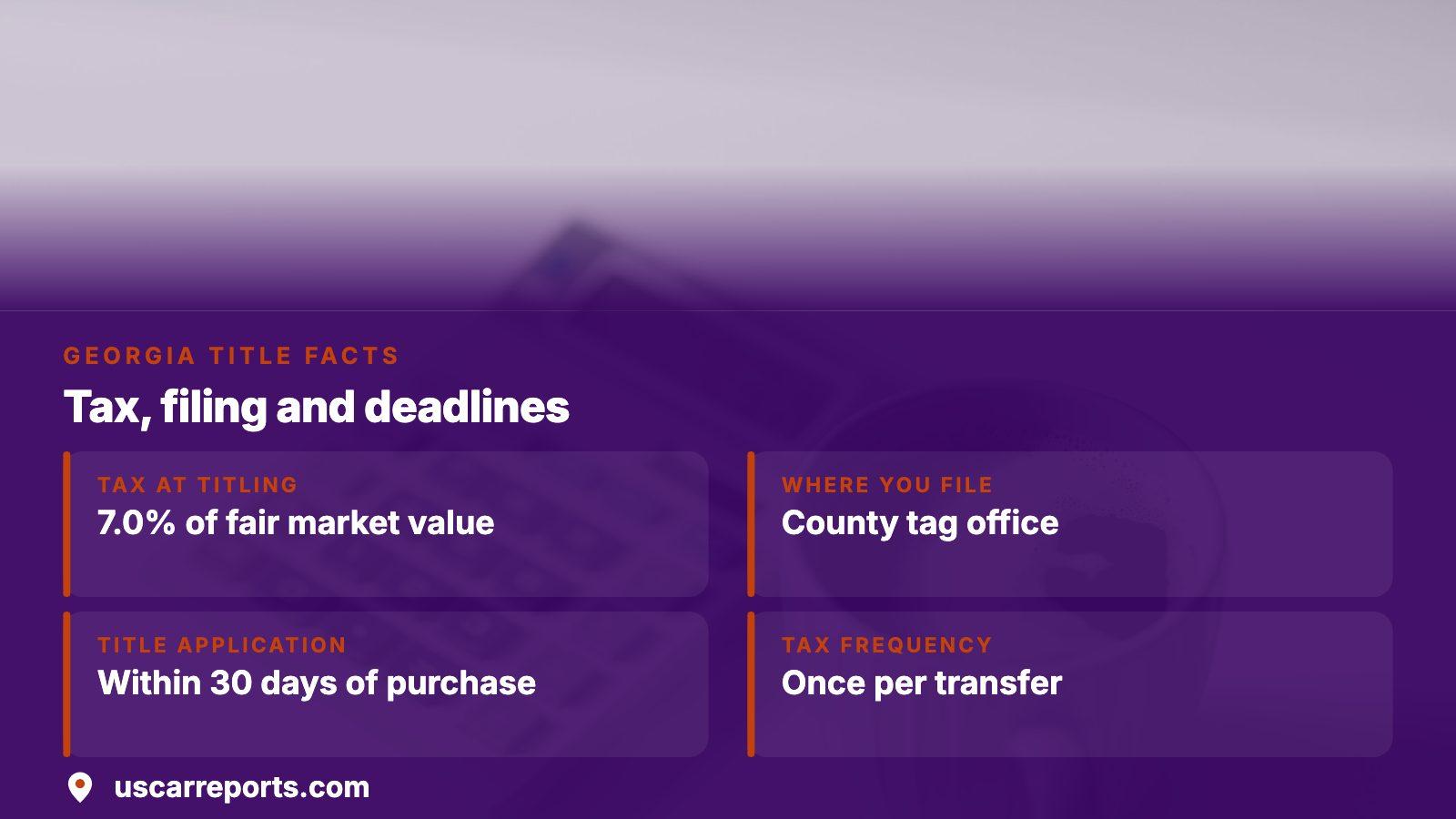
To search a Georgia title, copy the VIN off the car, open the preview, and buy the report if the car stays on your list. Then compare it with the paper title: the seller's name, any lender's release and the brand wording must all agree. The buyer files after the sale at a county tag office, where a one-time tax of 7.0% of fair market value is collected.
- Tax at titling
- 7.0% of fair market value, once per transfer
- Where you file
- County tag office, Georgia Department of Revenue
- Title application
- Within 30 days of purchase, at a county tag office
- Preview
- Free, then one payment per report
What a Georgia title check shows that the paper cannot
A Georgia title is one agency's note about one owner at one moment. A VIN check follows the car backward, which counts most when it spent years elsewhere before reaching Georgia.
- Brands from any state, including ones the title in your hand never mentions.
- Salvage-auction pictures, taken before the repairs.
- Dated odometer readings to hold against the figure printed on the title.
- Lender and tow-yard claims that could block a clean transfer.
- Theft and insurance entries, which can exist with no brand on any title.
Running a Georgia title search, step by step
- Trust the car over the ad for the VIN. It runs to 17 characters, stamped on a dash-corner plate that shows through the windshield and printed again on a doorway label by the driver's seat. Both should read alike, and the title should echo them.
- Type it into the form on this page. The year, make and engine the preview names should fit the car beside you.
- Pay for the report only if the preview fits.
- Lay the report beside the Georgia title and compare the owner's name, any brand wording and the lien section.
- Try the Department of Revenue's own title status service, listed among its online tools, for the state's view of the same car.

Which Georgia cars should come with a title
Georgia expects a certificate of title on any car from model year 1986 on. The Department of Revenue's checklist for private sales wants the original title, correctly signed over to the buyer, and takes a bill of sale in its place for a car from 1985 or earlier that needs no title.
That makes the rule simple: a newer car offered with a promise to mail the paper later is one you may be unable to register, and the repair bill lands on you.
Reading the title in the seller's hand
Check three things before money moves: whose name is on the face, what the lien section says, and whether the buyer's line on the back is still empty. The state wants each lien noted against the prior owner marked released in the boxes provided on the title.
A title signed over with no buyer named
Georgia Code 40-3-91(c) makes it a misdemeanor to hand over or take a title signed over in blank. A conviction can bring a fine as high as $100 or as many as 30 days in jail, for each certificate. Write your own name in before the seller leaves.
A lender's signature on the paper is not the last word. The Department of Revenue notes, in its replacement-title instructions, that a release written on a title leaves the lien on the state's records until the owner applies for a clear title. If the report shows a lender and the seller offers only a release, get the record cleared at a county tag office before paying.
How Georgia defines salvage, and what out-of-state brands trigger
- Damage so heavy that two or more component parts must be replaced to make the car operable.
- A total-loss claim paid by an insurer on a car that has not been repaired, whatever the extent of the damage.
- A car whose out-of-state title carries one of these labels: Salvage, Total Loss, Fire, Flood or Water.
Georgia does not allow a salvage vehicle on public roads. A rebuilt title requires a rebuilt inspection, held after the repairs but before painting, and the person doing the work must hold a rebuilder's license and keep receipts for the parts. A Flood or Water brand from another state sends the car through the same process, so that label on a report is a reason to ask for the rebuilt paperwork. Damage below these lines may carry no brand, so auction photos and a mechanic still matter.
The tax Georgia collects when the title changes hands
On most cars bought since March 1, 2013, a title ad valorem tax, TAVT, takes the place of sales tax. It is paid at each transfer, when the title application is filed in the buyer's home county, and the state puts the current rate at 7.0% of fair market value.
| Situation | TAVT treatment |
|---|---|
| Ordinary purchase, dealer or private | 7.0% of fair market value |
| New Georgia resident registering a car | 3% |
| Family transfer with Form MV-16, car already titled in Georgia with TAVT paid | 0.5% |
| Inheritance with Form T-20, car already in the TAVT system | 0.5% |
| Qualifying veterans with Form MV-30 | Exempt |
For a used car the base is the state's assessment-manual value, an average of current wholesale and retail figures, not the price on your bill of sale. Only dealer sales earn a trade-in credit. A cheap private deal can still carry a tax bill sized to the book, so run the Department of Revenue's TAVT estimator before agreeing on a price.
The clock and the counter after the sale
The fee schedule lets an owner file the title application at the county tag office up to 30 days after the purchase. A late filing adds a $10 penalty, and TAVT on a casual sale draws a 10% penalty after day 30, plus 1% for each further month. The private-sale page also carries a shorter notice, 7 days for title and registration, so ask the tag office which clock applies and plan for the shorter.
- A Georgia driver's license or ID card, and the original title assigned to you with every lien released.
- Form MV-1, the title and tag application, which you sign.
- Proof of insurance on record with the state, or a liability binder.
- Form T-22B if the car has never been registered in Georgia.
- An emissions certificate where the county requires one, as in metro Atlanta.
- Payment: $18 for the title, $20 for a plate, the TAVT and any penalties.
Georgia red flags that should end the visit
- No title in hand on a car newer than 1985, or a name on it that is not the seller's.
- A title signed over with the buyer's line empty.
- A lender on the report or the state record, with no release to match.
- A flood, water or salvage brand on the report that the seller's story leaves out.
- A title mileage below the report's latest reading. On a car 20 model years old or more, the title may say exempt instead of a number, leaving older readings as your only test.
A clean report starts the inspection
A crash repaired out of pocket may sit in no database at all. Pay a mechanic of your own to inspect the car, then read the title once more at the counter.
Cost, and the sequence that follows
Nothing is charged for the preview. Reports are sold per VIN, and shoppers with a long list can pick a pack sized three, five or ten. No plan renews behind any of it. Rates live on the pricing page.
- Preview first, report if the car still fits.
- Read title and report side by side, lien section first.
- Estimate the TAVT and budget it as its own line.
- Book the mechanic, then file at the county tag office well inside the 30-day window.
Where this information comes from
- Georgia DOR: Title Ad Valorem Tax and annual ad valorem tax — The 7.0% rate, the March 2013 start, and the reduced rates for new residents, relatives, heirs and veterans.
- Georgia DOR: TAVT frequently asked questions — How a used car's value is set from the assessment manual and when a trade-in reduces the tax.
- Georgia DOR: Title and register a vehicle purchased in a casual sale — The papers a buyer brings, the title and plate fees, and the 7-day notice for finishing title and registration.
- Georgia DOR: Motor vehicle fees, fines and penalties — The 30-day title window and late penalty, the casual-sale TAVT penalty, the blank-title offense and the replacement title fee.
- Georgia DOR: Salvage titles — What counts as a salvage vehicle, including a car branded in another state.
- Georgia DOR: Titles for rebuilt or restored vehicles — The inspection and licensing steps before a rebuilt title can be issued.
- Georgia DOR: Replace lost or stolen title — How a replacement is requested, and why a lender's release on the paper may not clear the state record.
Sources and photos: Facts checked against the sources above in November 2026. Photos by Bence Balla-Schottner, Max Tokarev and Ben Wicks on Unsplash; diagrams by USCarReports.
Keep reading
- Georgia VIN check: find liens and title problems before you buyThe VIN side of Georgia buying, from title-pawn liens to emissions counties.
- Transfer a car title to a family member: who counts as family, by stateWhat a transfer between relatives involves, useful if the 0.5% family rate may apply.
- Bonded title: what it means for a buyer, state by stateThe route for a car whose seller cannot produce proof of ownership.
- Title status check: what the state lookup tells a car buyerHow to read a title's status wherever the car was last registered.
Frequently asked questions
How do I run a Georgia title check by VIN?
Run the VIN from the car's dash plate through the preview on this page. If the car still looks right, buy the report and set it against the paper title, owner's name and lien section first. The Department of Revenue also lists an online title status service.
Is there a free Georgia title search?
In part. The preview here is free, and the Department of Revenue runs its own online title status tool. Those give a first look and Georgia's view. The paid report adds brand history, auction photos and odometer readings gathered across states.
What is TAVT, and does it depend on my purchase price?
TAVT is Georgia's title ad valorem tax, collected once when the title is applied for. The rate is 7.0% of fair market value, and for a used car that value comes from the state's assessment manual rather than the sale price.
What if the owner cannot find the title?
Hold the payment. The owner of record can request a replacement at a county tag office for an $8 fee, and the new title carries a legend marking it as a replacement. If the state's file still lists a lender, that lien needs a release first.
Does a Georgia title show accidents?
Only the serious ones. Georgia's salvage label turns on two or more component parts needing replacement, or on an insurer's unrepaired total-loss claim, so lighter damage can leave a clean title. Damage records and auction photos in a report fill part of the gap.
Now check the car itself
The guide explains what to look for. The report shows what this VIN has on record.