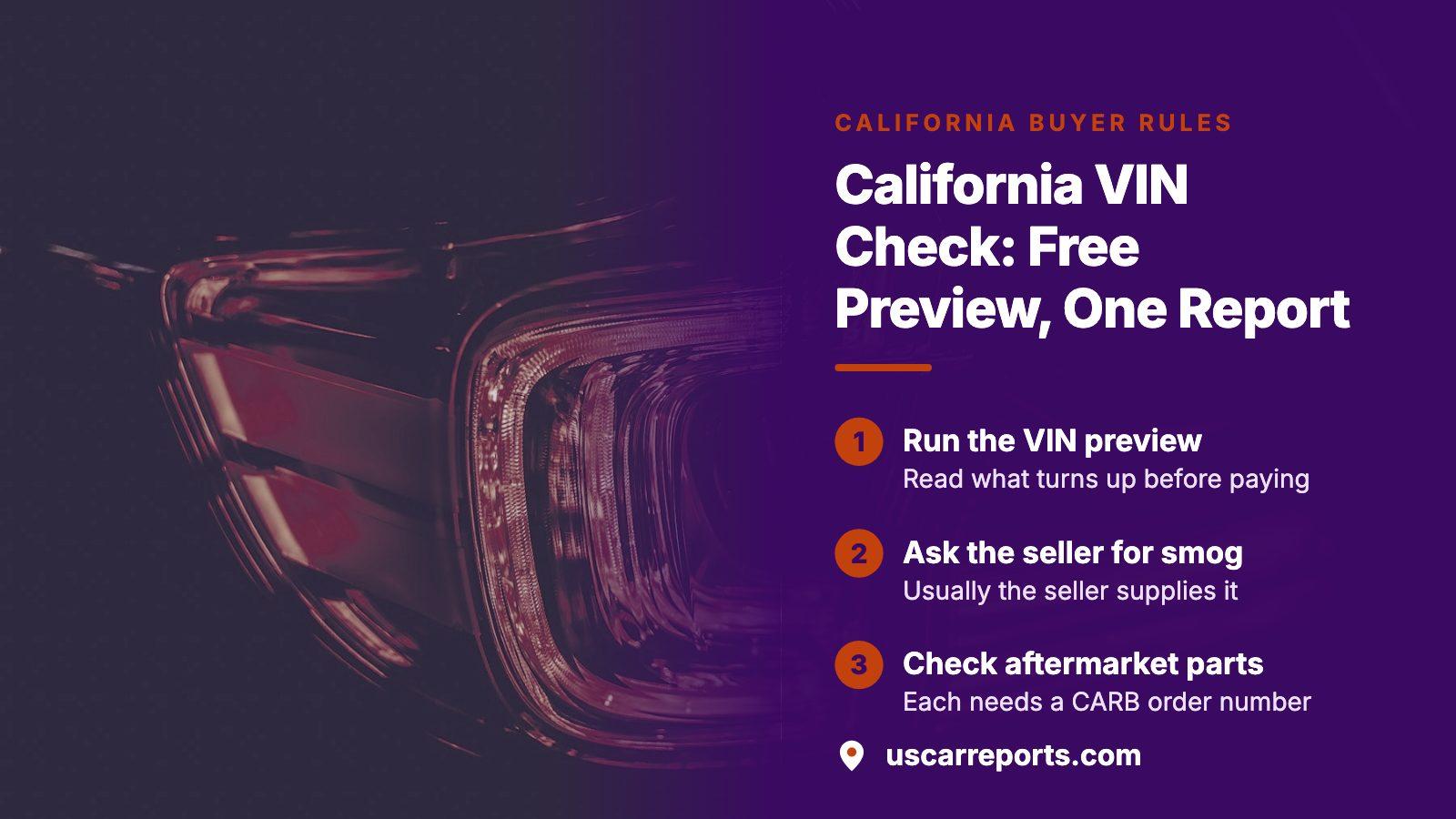
THE SHORT ANSWER
To check a VIN in California, enter the 17 characters into the preview, read what turns up, and buy the full report if the car still looks right. Before any money moves, get the seller's current smog certificate, which in most private sales is the seller's job and is generally valid for 90 days. On an out-of-state or modified car, confirm it can pass smog here first.
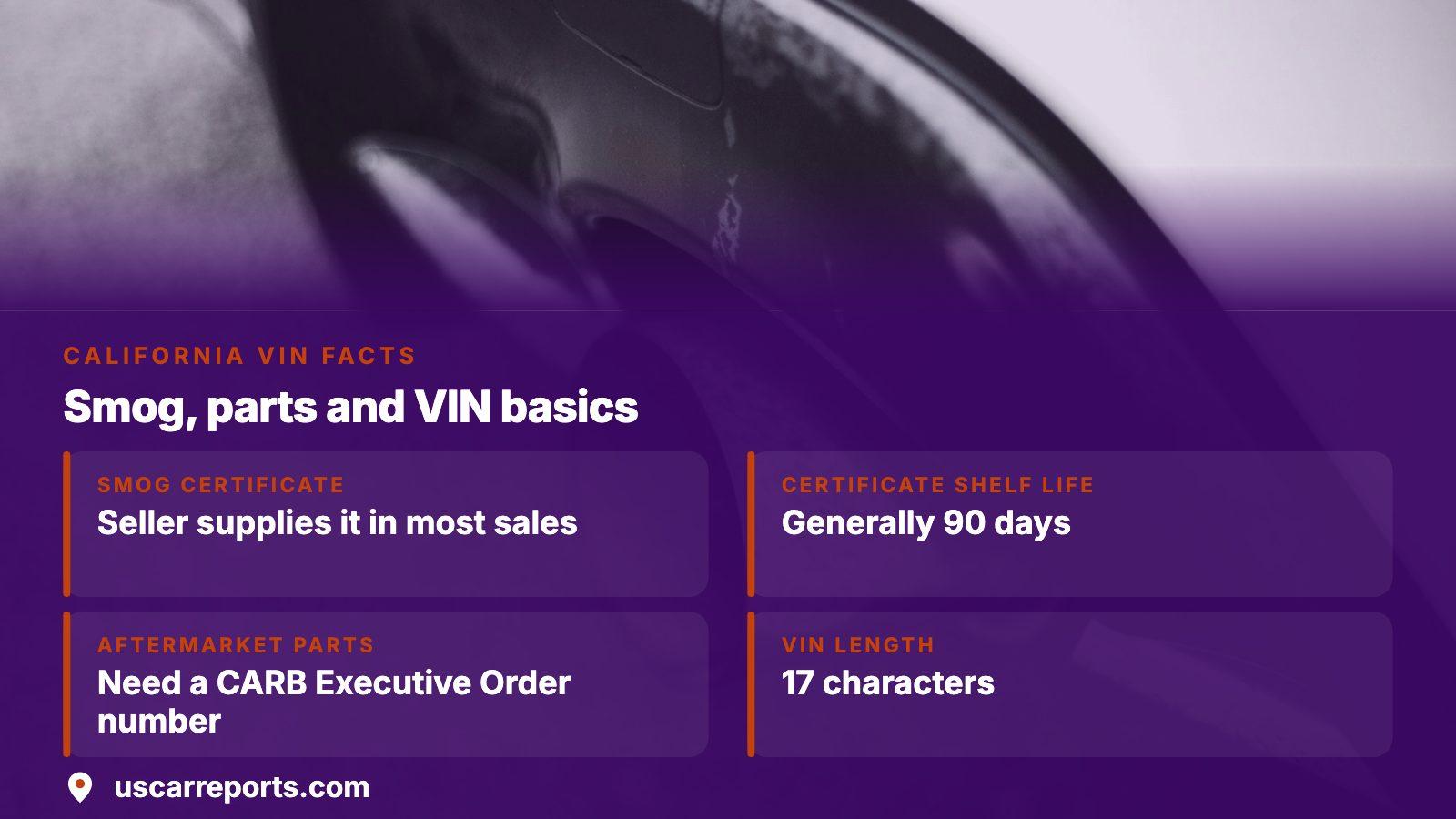
- Smog certificate
- Supplied by the seller in most private sales
- Certificate shelf life
- Generally 90 days, so read the date
- Aftermarket parts
- Need a CARB Executive Order number
- VIN length
- 17 characters
What the report shows about a California car
USCarReports runs VIN and title checks state by state, and each state page covers that state's buying rules. In California the rules carry unusual weight, because a car has to pass smog to be registered. A clean report on a car that cannot pass is still a problem, and so is a fresh smog pass on a car whose title carries a salvage brand.
| Record in the report | California question it helps settle |
|---|---|
| Title brands | Is this a fire, flood or total-loss car with a tidy listing? |
| Salvage and auction history with photos | Does the damage in the pictures match the seller's story? |
| Accident and damage records | What repair work should an inspector look at? |
| Odometer readings | Do the readings over time agree with the dash? |
| Liens and impounds | Can the seller sign over a clean title at the DMV? |
| Theft and insurance records | Was the car reported stolen or written off? |
| Open recalls, use type, market value, specs | What is unrepaired, was it a rental, and is the price in range? |
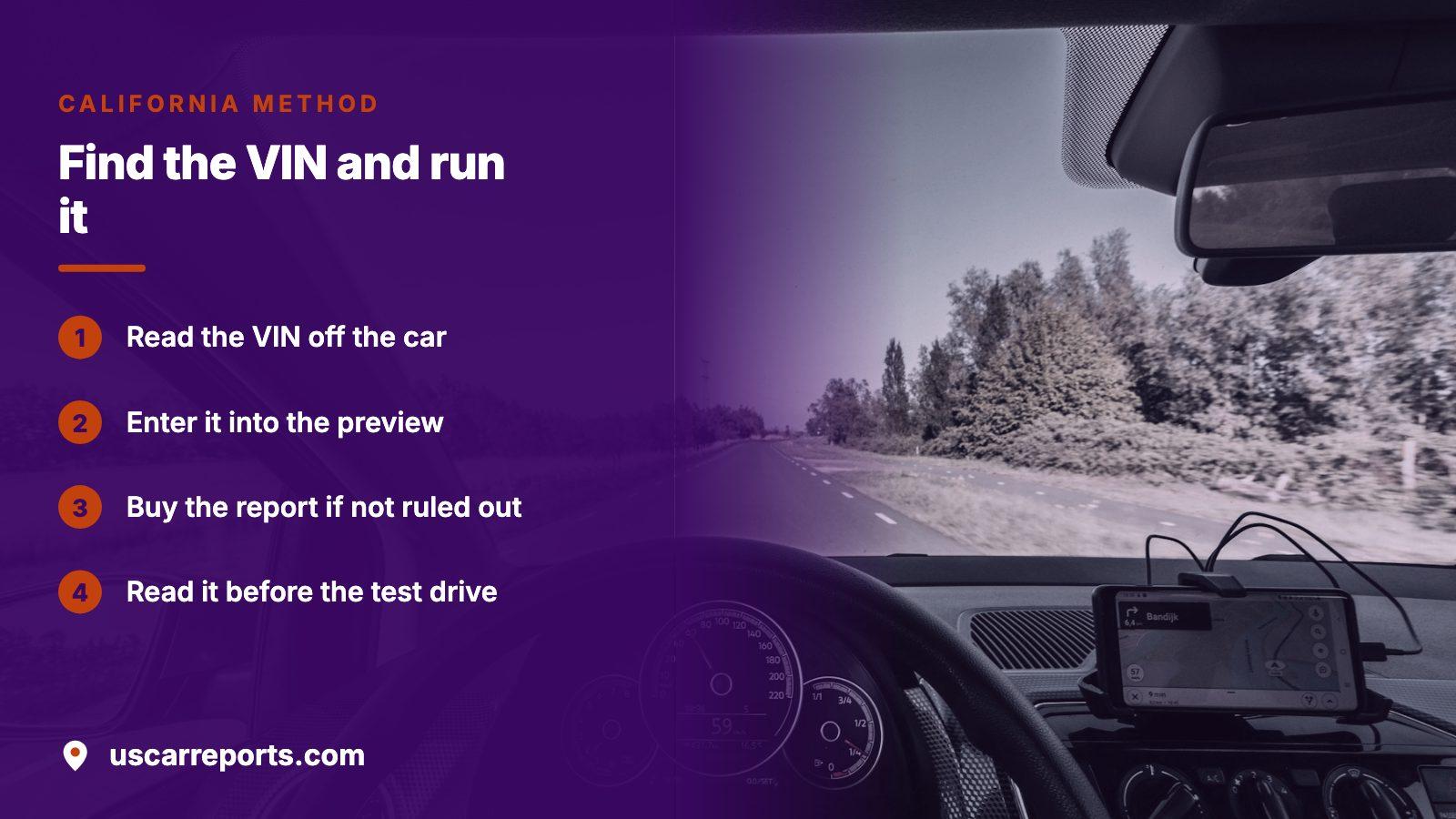
Find the VIN and run the check
The VIN is 17 letters and digits, and a VIN never contains the letters I, O or Q. Look through the windshield at the base of the dashboard on the driver's side, then at the sticker on the driver's door frame. Both should show the same code as the title and registration papers. A mismatch is a finding before you have run anything.
- Read the VIN off the car, then compare it with the listing.
- Enter it into the preview, which is free and shows whether any records exist before you spend a cent.
- If the preview does not rule the car out, buy the report. A single report fits one car, while a larger set of 3, 5 or 10 fits a shortlist.
- Read the report before the test drive, then take the findings to the pre-purchase inspection.
The smog certificate belongs to the seller
No history report can tell you whether a car passes smog today. California handles that with a rule aimed at the seller. In a typical private deal the seller supplies a valid certificate at handover. These are generally good for 90 days, so the printed date matters as much as the word pass.
- Ask for the certificate before you talk price, and check that it lists this car's VIN.
- Read the date. A pass from last year, or from an earlier sale, says nothing about the car today.
- If the check-engine light is on, the car fails, whatever explanation comes with it.
The sentence to treat as a warning
"You can get it smogged after you buy it" pushes a known risk onto you. A seller who expected a pass would simply hand over the certificate.
Some vehicles and some transfers are exempt from the smog requirement at sale. If a seller claims one, check the claim against the rules the DMV publishes instead of accepting it at the curb.
Cars from other states can be legal there and unregistrable here
Out-of-state cars are where the report and the state rules pull furthest apart. A car built to the federal emissions specification, or one wearing parts that were fine where it was sold, can fail a California inspection. Sometimes the low price is the seller's way of admitting it. Arizona cars are a common pull for California shoppers who want rust-free metal, and the same checks apply to them.
- Under the hood, the emissions label states whether the car is California-certified.
- Be wary of a recently imported car offered for sale soon after it arrived.
- Diesels: make sure none of the emissions hardware has been removed or altered.
- Ask why an out-of-state car is for sale here, and weigh the answer.
- Get proof, before payment, that this exact car will pass a California smog inspection.
The title and ownership records in the report give you a starting point for where the car has actually been.
Modified cars need an EO number for each part
California is strict about anything that touches emissions. An intake, a turbo, an exhaust section ahead of the catalytic converter or an engine tune needs an exemption from the California Air Resources Board, shown as an Executive Order number. Inspectors look at the car as well as the tailpipe, so a part lacking a number can sink an otherwise clean test.
Treat each EO number like a receipt. Sellers who chose legal parts usually kept the paperwork, because it is what makes the car sellable. If it is missing, price the car as though those parts must come off, and find out what the stock parts cost to put back.
Fire, smoke, salt air and winter flooding
California weather leaves marks the report can only partly show. Insured fire cars tend to be branded and auctioned, which puts them in title and salvage records. Uninsured ones may be dried off and resold with no paper trail, so the physical inspection still has to do its share.
- Burn areas: look for trim cracked or warped by heat, plastics that have changed color, and soot in the cabin air filter or door cavities.
- Resprayed or melted parts with a vague story: compare the report's history and photos with what you see.
- Coast: check fasteners, connectors and bright trim for salt-air aging.
- Counties near burn scars: winter debris flows and floods produce genuine water-damage cars, so run the water inspection there too.
Findings that should stop the payment
Some findings change the price. Others should pause the sale until someone explains them.
| What you find | What to do |
|---|---|
| A brand on the title | Walk away, or price the car as damaged and get an independent inspection first. |
| An open lien | Hold payment until the lien is released in writing. |
| A theft record | Stop and have the seller explain, with documents. |
| Odometer readings that drop | Treat it as a possible rollback and ask for service records. |
| Seller's name differs from the title | Pause until the seller explains. The name must match exactly. |
| Smog certificate missing, stale or for another VIN | Ask for a fresh one, or leave. |
Cost, and what to do after the report
The VIN preview carries no charge and shows whether there is anything worth buying. The report itself is a single payment that never renews. Get one for the car you are close to committing to, or a multi-report set if a few different vehicles are in play. See the pricing page for today's rates.
When the report looks clean, finish the California side. Collect the smog certificate, gather EO numbers on anything modified, and complete the transfer through the DMV with the seller's name matching the title. Keep the report with your paperwork. If the seller's story and the records disagree later, you will want it.
Where this information comes from
- California DMV — Where titles, registration and transfers are handled, and where smog exemption rules are published for checking a seller's claim.
- California Air Resources Board — The agency that certifies emissions and issues the exemptions behind EO numbers on aftermarket parts.
- NMVTIS: National Motor Vehicle Title Information System — The federal title record, covering brands from every reporting state.
- NHTSA: Recalls — A free recall lookup by VIN, useful as a cross-check on any report.
Sources and photos: Facts checked against the sources above in November 2026. Photos by A n v e s h, Sander Jeurissen and Erik Mclean on Unsplash; diagrams by USCarReports.
Keep reading
- California title check by VIN: brands, salvage rules and the 10-day clockThe title side of a California purchase, covered on its own.
- Registering a car in another state: deadlines, title and checksWhat registering a car in a different state involves after the sale.
- Arizona VIN Check: Title Brands, Heat Wear and Flood HistoryArizona is a popular source of rust-free cars, with its own buying rules.
- Sample reportSee what the records look like before you decide to buy.
Frequently asked questions
How should a buyer run a VIN check on a California car?
Make sure the dashboard, the door-frame sticker and the paperwork show one VIN, then enter its 17 characters into the preview. Buy the full report if the car still interests you. After that, deal with the state side by asking the seller for a current smog certificate that lists the same VIN.
Who pays for the smog check on a used car?
Normally the seller. A private seller generally has to hand over a valid certificate at the moment of sale. If you are asked to handle smog afterward, you are being asked to take over that obligation, and any failure that comes with it. Some transfers are exempt, so check an exemption claim against the DMV's published rules.
Will California register a car bought in another state?
Usually, as long as the car meets California's requirements. Problems come from cars never built to California's emissions specification, or ones carrying non-compliant parts. Read the underhood emissions label and confirm the car can pass smog here before you pay, not after you drive it across the border.
Are modified cars legal in California?
Parts that affect emissions need a CARB exemption, shown as an Executive Order number. A turbo, intake or exhaust without one can fail the visual part of the smog inspection even when the tailpipe test is clean. Ask the seller for the number on each part, plus the receipts.
Can I find a car's owner from a California license plate?
A private citizen cannot. A federal privacy statute for driver records limits who may receive the personal details the DMV holds, and they go only to people with a listed permitted purpose, and idle interest in somebody else's car is not on that list. USCarReports works from the VIN, so get that from the seller and read it off the car too.
Now check the car itself
The guide explains what to look for. The report shows what this VIN has on record.