THE SHORT ANSWER
Run a California title check in three moves: copy the VIN from the car itself, open the free preview, and purchase the full report for whichever cars survive it. Then set the findings beside the title's VEHICLE HISTORY panel, last recorded mileage and owner name. With no percentage rule behind California's salvage brand, an unbranded title is not proof of an undamaged car.
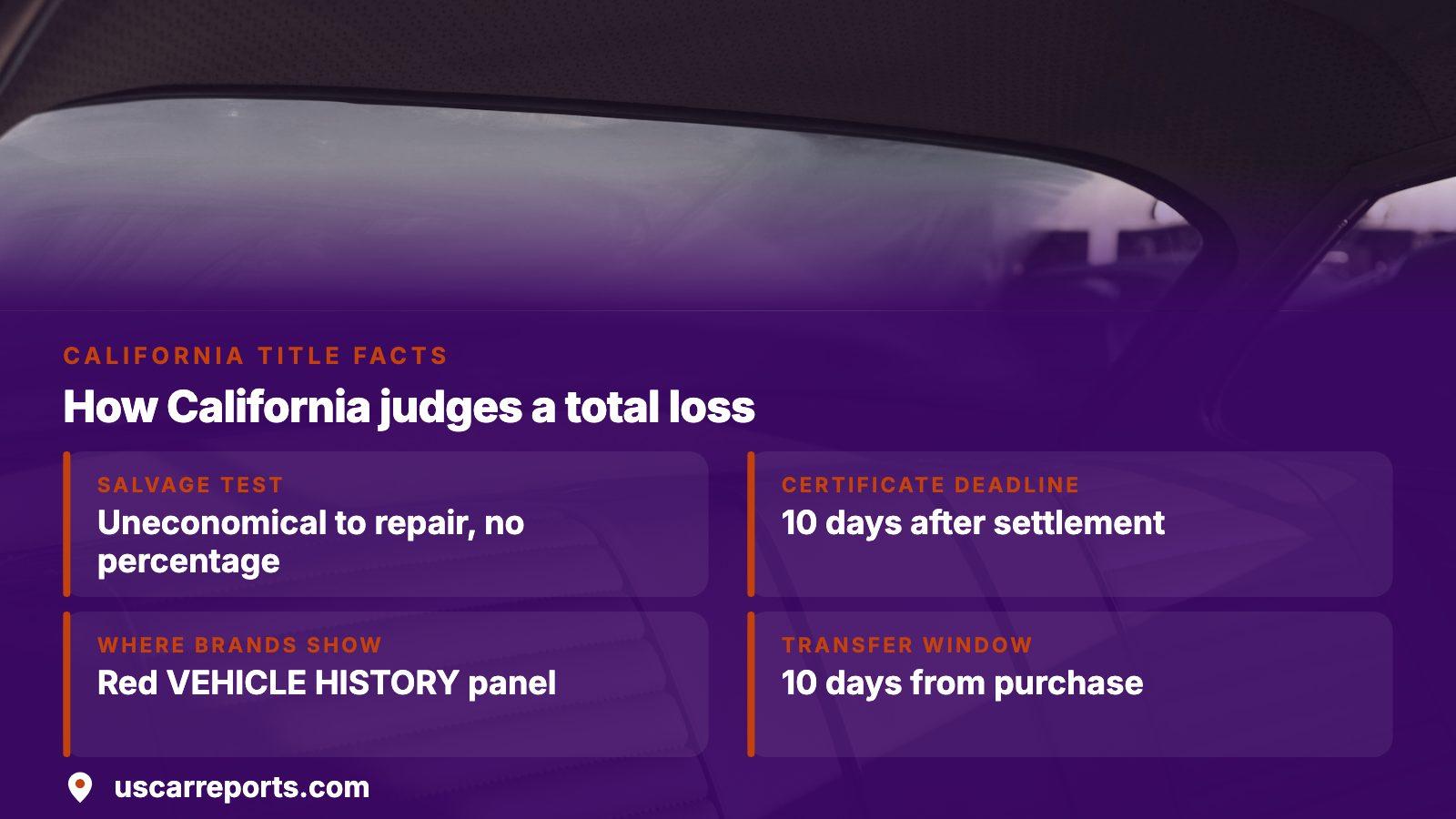
- Salvage test
- Owner or insurer judged repair uneconomical; no percentage
- Certificate deadline
- 10 days after the insurer's settlement
- Where brands show
- Red VEHICLE HISTORY panel on newer titles
- Buyer's transfer window
- 10 days from the purchase
What the VIN record adds to a California title
A title speaks for one state at one moment. The VIN record covers the years before it, which matters whenever the car arrived from somewhere else. USCarReports works state by state, so this page reads that record through California's rules.
- Brands from other states, with the issuing state named.
- Total-loss and salvage auction entries, with photos where they exist.
- Mileage readings on several dates that ought to rise steadily.
- Liens or impounds that could stall the transfer.
- Theft or insurance entries, and any open recall.
California's brand vocabulary
California marks a car's history with brands, and the newest titles and salvage certificates print them in a red VEHICLE HISTORY panel at the upper right. Read that panel before you discuss price.
| Brand | Meaning in plain terms |
|---|---|
| Salvaged | Crash damage, or heavy harm from flood or vandalism. Cars once dismantled as junk are included. |
| Original or Prior Taxi, Original or Prior Police | A former for-hire or law-enforcement car, usually with high mileage. |
| Non-USA | Made for another market, then converted to pass US and California rules. |
| Warranty Return | Taken back by the manufacturer under the Lemon Law. |
| Remanufactured | Put together from reconditioned or secondhand parts by a licensed remanufacturer. |
Salvaged is one word for three different stories, so the brand never says whether the cause was a wreck, a flood or vandalism.
No percentage threshold: a judgment call with a 10-day deadline
Plenty of states settle salvage with a ratio of repair cost to value. California's test is whether the owner or the insurer decided that repair made no economic sense, with the result that the car went unrepaired for the owner.
A deadline attaches to the answer. After an insurer settles with the owner, the insurer or its agent has 10 days to apply for the salvage certificate. If no settlement is paid, applying is the owner's job.
Everything hinges on someone filing. A car repaired privately, or one no insurer ever touched, can carry heavy damage with no California brand, and the DMV concedes that disclosure laws are tough to police when a car comes from another state.
Salvage, nonrepairable, revived: three documents, three futures
| Document | Issued when | Effect on the car |
|---|---|---|
| Salvage certificate | After a total loss, made out to the insurer or registered owner at the time of the damage, not to a later buyer. | Passed on through its assignment space; the car can still be repaired. |
| Nonrepairable certificate | The owner declared the car fit only as a parts donor or scrap, it was stripped, or only a burnt shell survives. | The DMV will not retitle it or register it again as junk or revived salvage. |
| Revived salvage record | A reported total loss was later restored to running order. | Registered again after inspection. |
Whenever a listing says rebuilt, ask which document applies and ask to see it.
Running the check on a California car
Begin with the vehicle in front of you. One copy is a metal plate on the dashboard, in the corner nearest the steering wheel and readable from outside, and another is a label on the door frame. If the two disagree, or the pink slip shows a third version, that is a finding before any search.
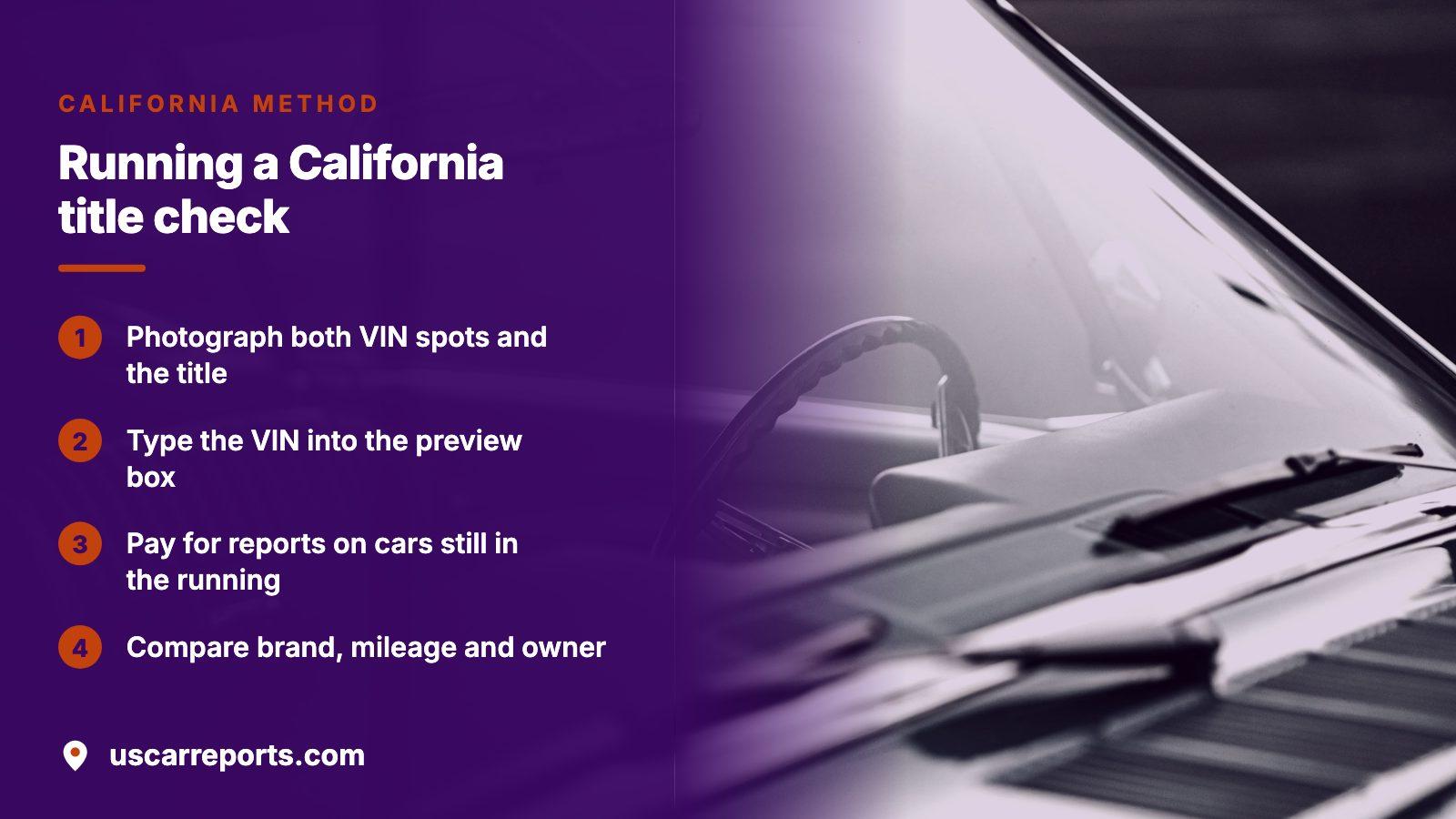
- Photograph both VIN spots and the seller's title together.
- Type the VIN into the box on this page; the preview opens at no charge.
- For a car still in the running, pay for its report. One report covers one car, multi-report bundles of 3, 5 or 10 suit a long shortlist, and no plan auto-renews.
- Lay the report next to the title and compare brand, last recorded mileage and the owner's name.
- Send each discrepancy to the seller by email, so the answer is on record.
Reading the results against the California paper
| What turns up | What to do about it |
|---|---|
| The report lists a brand the title omits | Ask the seller to account for it before anything else. |
| Salvaged on the title but an ordinary asking price | Negotiate as for a damaged car, and learn the cause first. |
| A revived salvage car with no record of inspection | Ask which inspection cleared it and request receipts for any replaced parts. |
| Mileage that goes down between readings | Suspect a rollback and ask to see service records. |
| A lien still open | Withhold payment until the lender confirms release in writing. |
| The person selling is not the person the title names | Insist on a bill of sale signed by that seller and the person the title names. |
Silence in the national title record is a good sign, the Justice Department says, but it still urges an independent inspection before you buy.
Clues on the car that the paper cannot give
Where no brand was ever applied, the car itself is the evidence. The DMV points buyers to these spots:
| Where to look | What the DMV flags |
|---|---|
| Inner fenders | Major repair work on the structure. |
| Trunk floor | Mud, mold or rust under the carpet. |
| VIN plate | Fastened with anything but rivets. |
| Warning lights | The restraint warning light staying lit. |
| Airbag covers | Resealed or badly fitted. |
| Doors, hood, tailgate, hatch | NHTSA labels missing. |
The DMV adds a caution: some rebuilt salvage cars were poorly repaired or tested, and some contain stolen parts. If CHP or the DMV finds the car or a part stolen, registration is refused and the car or part is seized.
Transfer rules after the check
The check ends and the DMV paperwork begins. Deadlines run short on both sides.
- Buyers must transfer ownership within 10 days of the purchase; sellers must tell the DMV about the sale within 5 days.
- The title, called a pink slip, needs the seller's signature on line 1.
- When the seller is someone other than the owner named on the title, a bill of sale must carry both signatures.
- A car under 10 years old needs an odometer record. If the title has no mileage line, REG 262 carries it.
- A lost, stolen or damaged title is replaced on REG 227.
Rebuilt cars face a further step. California law has the DMV or the CHP inspect salvaged vehicles, and one salvaged in another state is sent to the CHP. The officers look for altered identification numbers, false paperwork and parts that look stolen, and a pass yields form CHP 97C.
Cost and next steps
No charge applies to the preview. The report is bought once per car, nothing recurs, and the pricing page lists the current choices. Save it for the car you are about to commit to, not every listing you scroll past.
- Open recalls show up in NHTSA's lookup by VIN, which costs nothing.
- NICB's VIN database, described in the Justice Department's buying tips as free and including flood damage.
- A mechanic's inspection, with a water check if flood is in the history.
- The DMV transfer, filed within the 10-day window, with the report kept in your folder.
Where this information comes from
- California DMV: total loss, salvage and nonrepairable vehicles — Who must obtain the salvage certificate, the 10-day deadline and what nonrepairable means.
- California DMV: branded titles — The brand list, the VEHICLE HISTORY panel and the DMV's physical warning signs.
- California DMV: junk and revived salvage vehicles — What revived salvage means and that such a car must be registered again.
- California DMV: registering a vehicle bought from a private party — Buyer and seller deadlines, title signature, bill of sale and odometer paperwork.
- California DMV: online vehicle record request — The online service covers your own record; another person's goes by mail on form INF 70.
- CHP: Salvage Vehicle Inspection Program — What the inspection checks and the certificate a pass produces.
- US Department of Justice: NMVTIS, understanding a vehicle history report — Who reports to the national title database and what a clean record means.
Sources and photos: Facts checked against the sources above in November 2026. Photos by Annika Wischnewsky, Dylan Michaud and Brandon Russell on Unsplash; diagrams by USCarReports.
Keep reading
- California VIN Check: Run the Report, Then Hold the Seller to SmogThe smog and registration side of a California purchase.
- Title status check: what the state lookup tells a car buyerHow a state title lookup works and what it leaves out.
- Certificate of destruction by state: what the paper allowsNonrepairable and destroyed-car paper compared across states.
- Alabama title check: read the paper title, then the VIN recordA state with a percentage trigger, set against California's judgment test.
Frequently asked questions
How do I do a California title check by VIN?
Read the VIN off the car, type it in here and see whether the preview justifies a purchase. Compare the result with the pink slip's VEHICLE HISTORY panel, mileage and owner. The DMV's online record tool serves your own vehicle only; another person's record is requested by mail.
Is there a free California title search?
Only in pieces. This site's preview is free, as are NHTSA's recall search and the NICB database. None returns a full California title history. The DMV's online tool prints your own vehicle's record for a fee. A complete report here is one payment.
What does a Salvaged brand mean on a California title?
It marks a car that was wrecked or badly damaged some other way, such as flood or vandalism, and it can also mean a car previously dismantled as junk. The brand does not name the cause. Ask the seller, then look at sale photos and records in the report.
Can a car with a rebuilt history be registered in California?
Yes. California calls the status revived salvage: a car once reported as a total loss, now back in running order and registered again. The DMV inspects it or sends it to the CHP, and a vehicle safety systems certificate is part of the file. A nonrepairable certificate is different; the DMV will not move that car to revived salvage.
A California title shows no brand. Does that rule out a serious accident?
Yes. Brands follow reported total losses, and the DMV concedes seller disclosure is hard to enforce. A repair paid out of pocket can leave nothing on the paper. Combine the report, the DMV's physical warning signs and a mechanic's inspection.
Now check the car itself
The guide explains what to look for. The report shows what this VIN has on record.