THE SHORT ANSWER
Enter the car's VIN on USCarReports to open a preview that costs nothing, then pay for the full report only if the car passes that first look. Compare the result with the title in the seller's hand. In Colorado the rebuilt brand reads Rebuilt from Salvage and the salvage line sits high, so an unbranded title is weaker proof of an undamaged car than it appears.
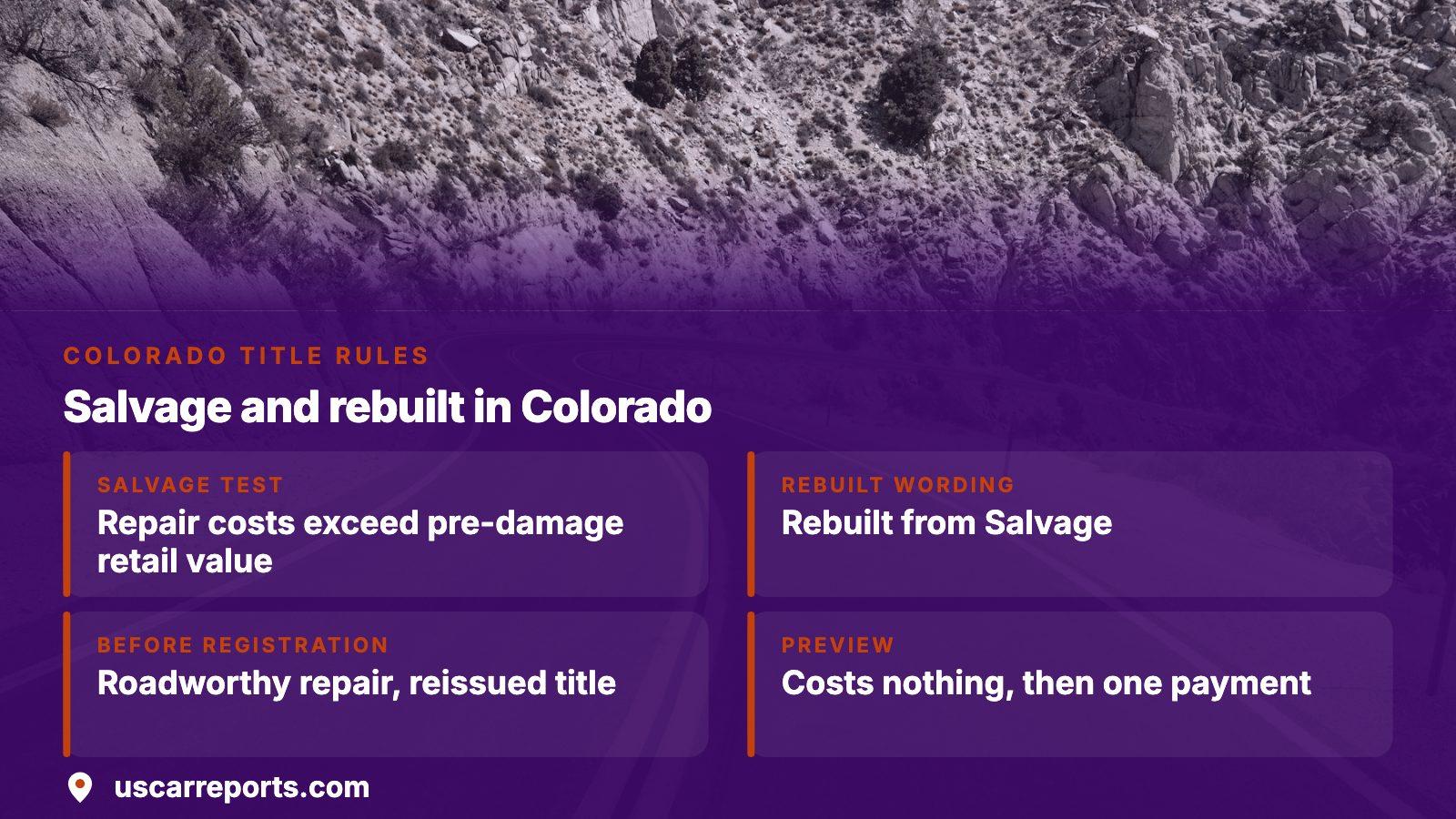
- Salvage test
- Repair for safe road use costs more than pre-damage retail value
- Rebuilt wording
- Rebuilt from Salvage
- Before registration
- Roadworthy repair plus a reissued title
- Preview
- Free, then one payment per report
What a Colorado title check shows that the paper title does not
A title is one state's note on one date. A check keyed to the VIN reaches further back, which matters most for a car that lived elsewhere before it came to Colorado. These entries carry the most weight on this kind of purchase:
| Entry in the report | Why it matters on a Colorado car |
|---|---|
| Title brands | Salvage, rebuilt, flood and similar labels. A brand applied in another state is kept in the national history, so it can surface even when the paper in your hand is silent. |
| Salvage and auction history, with photos | Pictures from before the repair let you compare the damage then with the car you are looking at now. |
| Odometer readings | Dated readings should climb in a believable line. A drop, or a long flat stretch, needs an explanation. |
| Liens and impounds | A lender can keep a legal claim on the vehicle, and an impound record can delay the transfer. |
| Theft and insurance records | Flags and insurer entries that never turned into a brand. |
How to run it, and what to compare the result with
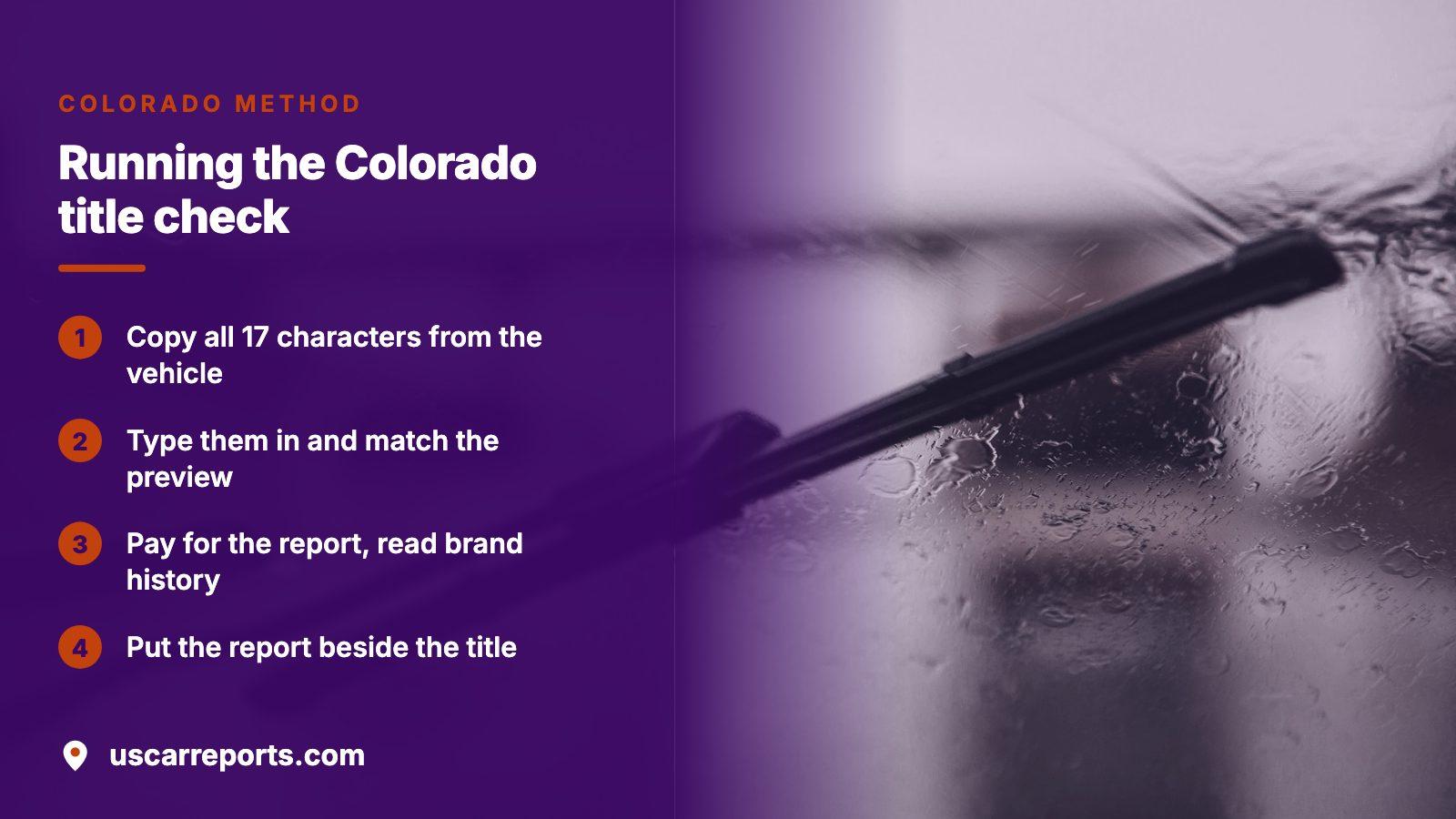
- Copy all 17 characters from the vehicle itself. Start with the label on the driver's door frame, then confirm it against the plate you can read through the windshield from outside.
- Type them into USCarReports. The preview should describe the same year, make and model as the listing, and if it does not, stop and ask why.
- When the details agree, pay for the report and go through the brand history, the damage entries and the odometer dates.
- Put the report beside the Colorado title the seller holds. The brand wording and the owner's name should line up.
If a seller stalls on handing over the VIN, treat that as your first finding.
Colorado's salvage line sits high, so a clean title proves less
A Colorado vehicle becomes salvage once the price of making it safe for the road tops what the car would have fetched at retail in the moment before the loss. Many states apply the brand at 70 to 80 percent of a car's value. Colorado waits until the repair bill passes the whole pre-loss figure, a standard it shares with Texas.
In practice a car can absorb serious damage and never earn a brand, because the bill stayed just under that line. An unbranded Colorado title tells you nobody branded the car. It says nothing about whether the car came through unhurt.
Check what a summary calls law
A 2016 bill, HB16-1293, proposed a separate total loss brand for cars tied to an insurance claim. The legislature's own page lists it as lost, after a Senate committee postponed it indefinitely. Be wary of any article that treats such a brand as current Colorado rules, and read the brand on the actual title.
Colorado's registration rule for salvage cars, in four situations
Colorado will not register a salvage vehicle on repair alone. Two things must both be true, and neither stands in for the other. The state's rebuild checklist ties the roadworthy definition to section 42-6-102.
| What the car's paperwork shows | Where that leaves a buyer |
|---|---|
| Salvage brand, repairs not finished | The car cannot be registered as it stands. |
| Repairs done to the roadworthy definition, no reissued title | Still not eligible, because the title step is missing. |
| Reissued title reading Rebuilt from Salvage, but the car fails the roadworthy standard | The new title does not repair the car. Judge the work yourself. |
| Both steps complete | The car can be registered. |
So when a seller says the work is finished, the real question is whether the title step happened as well.
Reading Rebuilt from Salvage and asking for the paperwork
Colorado spells the rebuilt brand out in full, with no code and no abbreviation, and the DMV's paperwork repeats the phrase. Sellers often say rebuilt without naming the state that issued the brand, so the exact words on the title make a handy test.
The state also publishes forms for the process, which means a proper rebuild leaves a trail. Ask to see:
- The title itself, read word for word for the Rebuilt from Salvage brand and the seller's exact name.
- The rebuild checklist, form DR 2415, and anything the seller filed with it.
- The rebuilder's statement of facts, form DR 2424.
- The name of any state that issued an earlier brand, so you can match it against the report.
Vagueness about these papers on a branded car is the moment to slow down. The state asked for a trail, and a seller who did the work properly can produce it.
Red flags to look for in a Colorado result
- A seller calls the car rebuilt, but the title wording differs or the brand came from another state.
- A salvage entry on a Colorado record with no rebuilt title behind it, given that the state wants both steps before registration.
- Auction photos showing structural damage the listing never mentioned.
- A mileage reading that drops, or sits unchanged for years.
- An open lien, an impound entry or a theft record.
A short record is not a clean car
The national record covers brands, total loss and salvage history. It leaves out repairs, recalls and maintenance, and the federal page behind it urges an independent inspection before you buy. Treat the report as a first filter, then have a mechanic start with the frame and the brakes.
What the national record keeps, and where it falls short
NMVTIS is the federal government's national store of title and brand records. Its consumer report is deliberately short and holds five things:
- Which state holds the title now, and the date it was last issued.
- The brand history, covering brands from any state, not just the latest one.
- An odometer reading.
- A total-loss history, if one exists.
- A salvage history, if one exists.
Reports come from the agencies that issue titles, from junkyards, salvage yards, auto recyclers and insurance carriers, and federal law requires them to report regularly. Repairs, recalls and routine maintenance are not part of it. That is why a Colorado paper title answers only the Colorado half of the question.
Cost, then the order of the steps
Opening the preview costs nothing. Past that, payment is a one-off, covering a lone report or a pack of 3, 5 or 10 once your list grows. No subscription starts. The pricing page has the figures.
- Run the preview with the VIN from the car, then buy the report if the details match.
- Read the brand history first, then the damage photos and the odometer line.
- Look up open recalls with NHTSA's tool, which costs nothing, and search NICB's database for theft and salvage entries.
- If the title says Rebuilt from Salvage, ask the seller for the rebuild forms.
- Have an inspector judge the car against the state's own test: was it repaired for safe use on the road?
Where this information comes from
- Colorado DMV: salvage vehicles — The salvage definition, the Rebuilt from Salvage brand and the registration block until repair and retitling.
- Colorado DMV: form DR 2415, rebuilt title established by salvage title — The state's rebuild checklist, which points to the statute defining roadworthy.
- Colorado DMV: form DR 2424, Rebuilt from Salvage statement of facts — The statement a rebuilder completes, part of the paper trail to ask a seller for.
- Colorado General Assembly: HB16-1293 — A proposed total loss brand, listed as lost after a Senate committee postponed it.
- US Department of Justice: understanding an NMVTIS vehicle history report — What the national title database holds, who reports to it and what it leaves out.
- NMVTIS: approved data providers — Consumers reach the national record through approved providers.
- NHTSA: recalls — Open-recall lookup by VIN, independent of title status.
Sources and photos: Facts checked against the sources above in November 2026. Photos by Richard R, Thibault Valjevac and Will Truettner on Unsplash; diagrams by USCarReports.
Keep reading
- Colorado VIN Check: Title Brands, Hail History and Winter WearHail history, emissions testing and the rest of buying a car in Colorado.
- Texas title check by VIN: brands, the 2003 cutoff and the 30-day clockAnother state where the repair bill has to beat the car's pre-damage value.
- Title status check: what the state lookup tells a car buyerWhat a title status lookup covers and where it stops.
- Registering a car in another state: deadlines, title and checksHow a title and its brands travel when a car moves to a new state.
Frequently asked questions
How do I do a Colorado title check by VIN?
Enter the vehicle's own VIN on USCarReports and compare the preview with the listing. If it matches the listing, buy the report and compare its brand history with the seller's Colorado title. Any wording other than Rebuilt from Salvage on a rebuilt car, or a missing brand, calls for a question.
Is there a free Colorado title search?
Only in part. USCarReports lets you open a preview without paying, and NHTSA's recall lookup costs nothing, yet neither gives a full title history. The national record is sold through approved data providers, and the Justice Department's page lists no prices for them. The complete report here is one payment and never renews.
What does Rebuilt from Salvage mean on a Colorado title?
It marks a car that was branded salvage, brought up to the state's roadworthy definition and then given a new title. Expect that phrase on a properly rebuilt Colorado car. Price the car as a rebuilt one, and ask for the forms behind the title.
Can a repaired Colorado salvage car be registered?
Not on repairs alone. The car must meet the state's legal definition of roadworthy and hold a title reissued as Rebuilt from Salvage, and only then can it be registered. Ask a seller for evidence of both steps. A mechanic can speak to the first, and the title and forms to the second.
If the Colorado title is clean, can I assume the car escaped serious damage?
No. Colorado brands a car only when the repair bill would exceed its retail value before the loss, so a car that took heavy damage but stayed under that line can carry no brand. A clean national record also says nothing about repairs, so pair the report with an inspection.
Now check the car itself
The guide explains what to look for. The report shows what this VIN has on record.