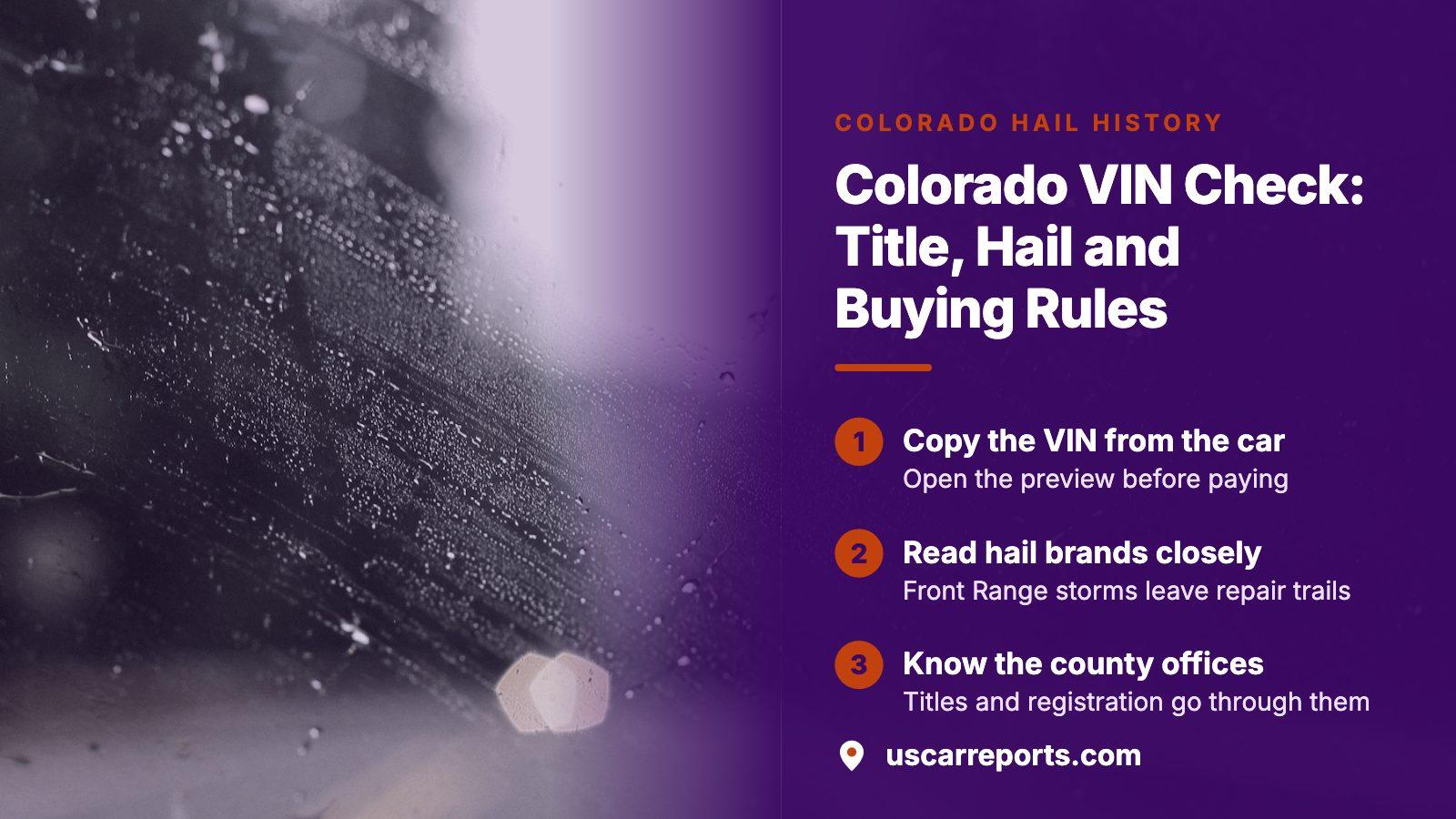
THE SHORT ANSWER
Copy the VIN off the car, type all 17 characters into USCarReports and open the free preview. The full report then shows the title brand history, crash and damage records, mileage readings, auction photos, liens, theft entries and recalls still open. On a Colorado car, read any hail brand closely: it moves the fair price far more than it changes how the car drives.
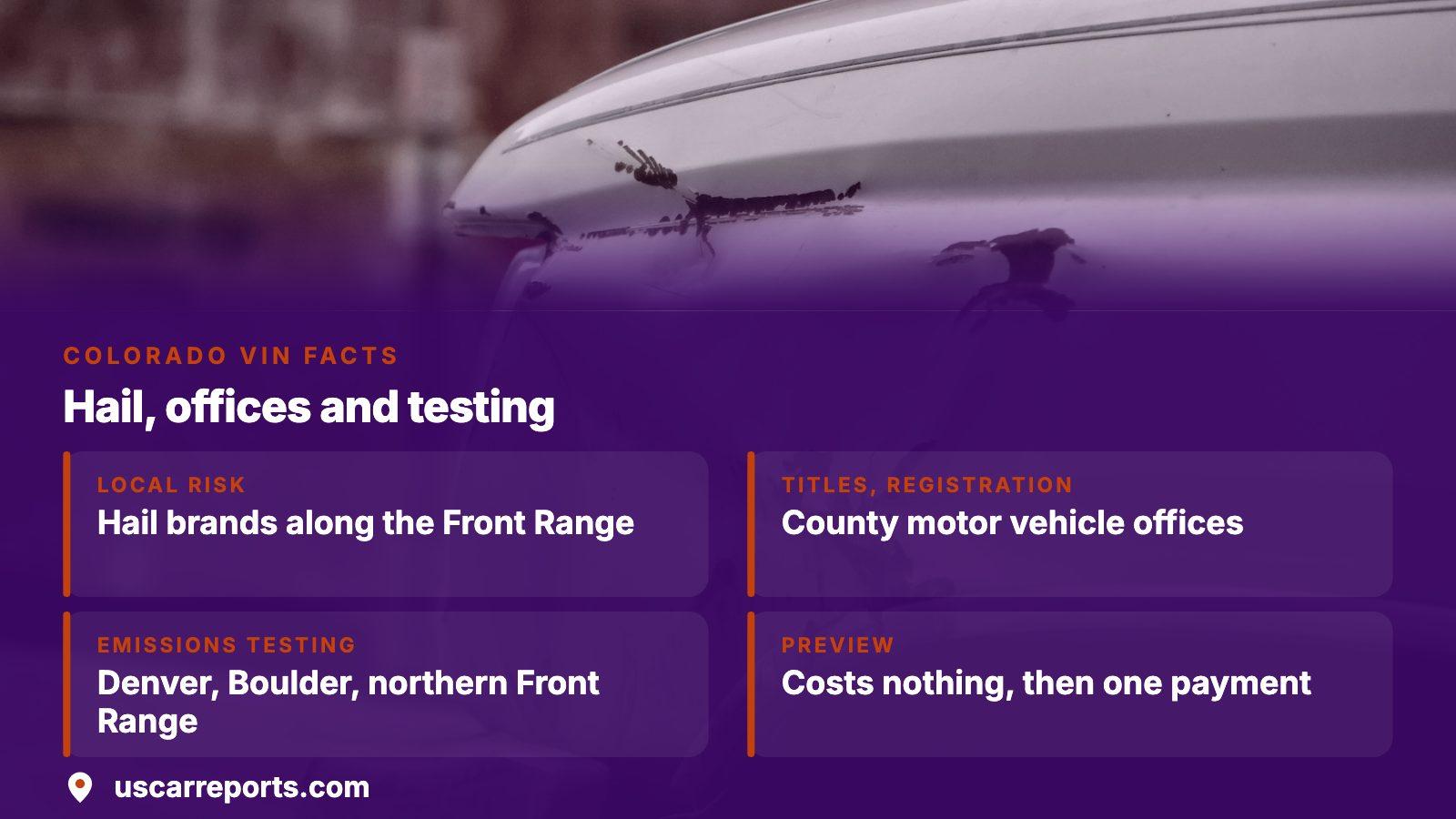
- Local risk
- Hail brands along the Front Range
- Titles and registration
- County motor vehicle offices
- Emissions testing
- Denver, Boulder and the northern Front Range
- Preview
- Free, then one payment per report
What a Colorado VIN check shows about the car in front of you
Records are filed under the VIN rather than the state, so the report follows the car back through every place it was titled before Colorado. Each line below matters a little differently on the Front Range.
| Record | What it tells a Colorado buyer |
|---|---|
| Title brands | Hail salvage, collision salvage and flood lead to very different cars, so the type of brand sets the price. Brands from any reporting state carry over. |
| Accident and damage records | They show whether a repaired panel came from hail work or from a crash. |
| Salvage and auction history, with photos | Sale photos catch the car before repair, dents and any deeper damage included. |
| Odometer readings | A steady climb fits an ordinary life. A drop, or years with no movement, needs an explanation. |
| Liens and impounds | A lender may still hold a claim, and it should be cleared before money moves. |
| Theft and insurance records | Theft flags and insurer-reported events that never reached the title. |
| Recalls, owners, use type, value and factory specs | Open recalls, owner count, how the car was used, a value to price against, and the factory build to compare with the listing. |
How to run it, and where to find the VIN
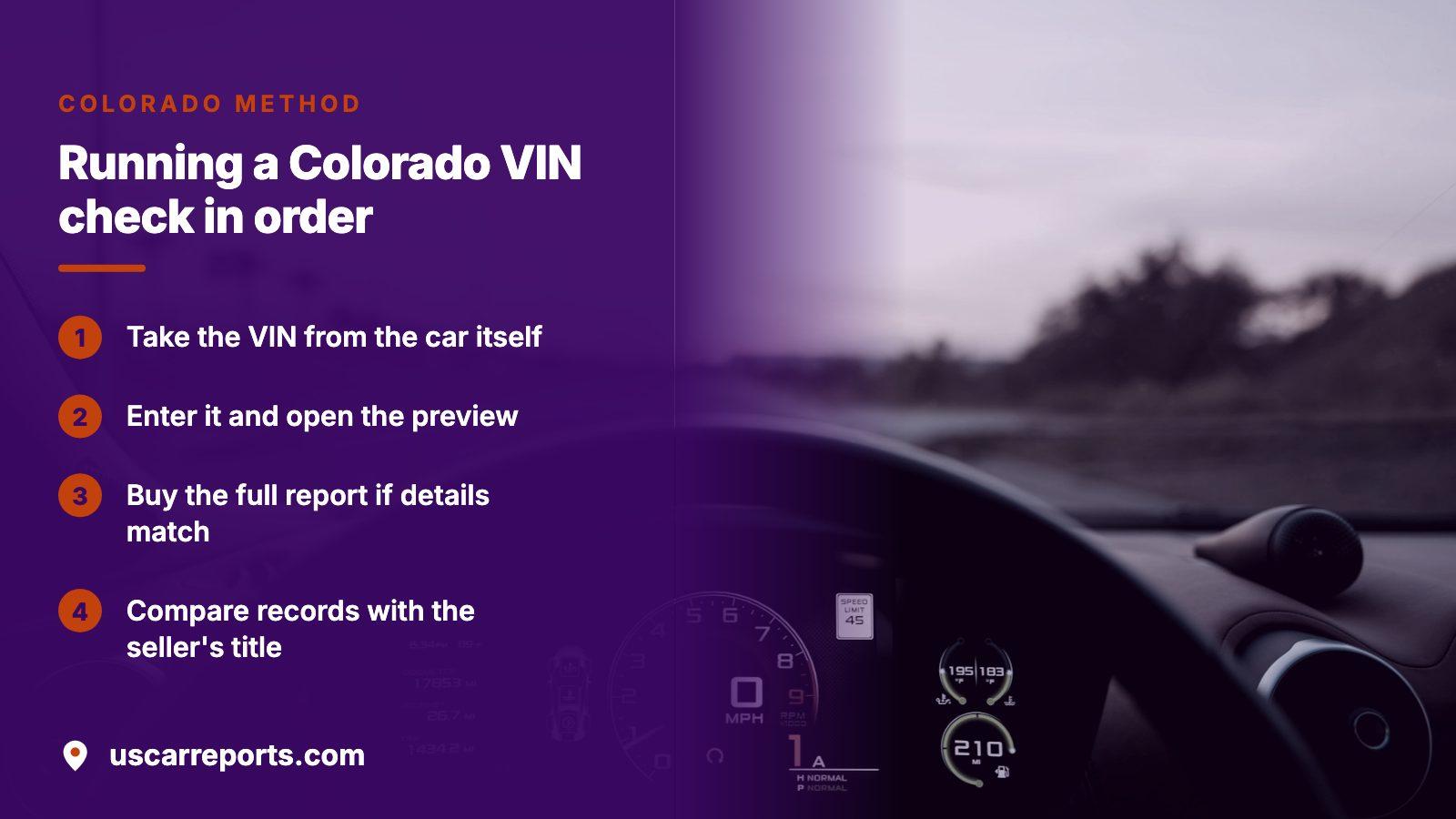
- Take the VIN from the car itself: through the windshield from outside, on the label in the driver's doorway, and on the title. A single mismatched character means a different car or a doctored document.
- Enter it on USCarReports and open the preview. It names the year, make, model and trim, shows how many recalls are open and tells you how many title and auction records exist.
- If those details match the listing, buy the full report to open each record.
- Compare the records with the title the seller is holding, then inspect the car.
A seller who dodges the VIN has already answered part of your question. A plate number cannot stand in for it, since privacy law keeps private buyers from turning a plate into an owner's name.
Reading a hail brand in the results
The Front Range sits in hail alley. In a bad season a handful of storms can write off thousands of vehicles, and the story does not end at the write-off. After it come the brand, the auction, repairs of uneven quality and a new listing, often not far from where the storm hit. Hail seldom touches structure, drivetrain or electronics, which makes it the mildest reason a title gets branded.
- Confirm what the record calls the brand. Hail salvage and crash salvage lead to very different cars.
- Price the car against other branded cars. A clean-title asking price on a branded car is a seller hoping you will not look.
- Set the auction photos beside the car today. Check panel gaps, paint under direct sun, and the glass and trim for cheap replacements.
- Call your insurer first. Some carriers cover hail-branded titles fully and others restrict them.
- Plan to resell at the same discount, because the brand stays on the title.
Colorado buying rules at a glance
A state check does two jobs. It reads the national record, then measures the car against the rules where you will register it. Colorado's vehicle agency is the Division of Motor Vehicles, and the counter work for titles and registration happens in county offices.
| Your situation | What applies |
|---|---|
| Titling and registering the car | County motor vehicle offices handle it. |
| Registering around Denver and Boulder or up the northern Front Range | Periodic emissions testing comes with the registration. |
| Registering in the mountains or a rural county | Mostly exempt from the testing program. |
| Finding an owner from a plate | Closed to private individuals by the federal Driver's Privacy Protection Act. |
| Finishing the sale | The seller's name must match the title exactly before you pay. |
A lit warning light belongs in your offer
If the car will be registered in a testing area, a check-engine light on the dash means a repair estimate should shape what you offer.
Red flags to look for in the results
- A flood or collision salvage brand on a car sold as a hail car. Read the brand type and the state that issued it.
- Sale photos with dents or deeper damage the listing skipped, particularly under fresh paint.
- A mileage reading that falls, or stays flat for years.
- An open lien, or an impound entry nobody can explain.
- A theft record, or recalls still open.
A quiet record is not a clean car
The report lists what reached a title office, an insurer or an auction. Damage that reached none of them leaves no entry, so the report and the inspection work as a pair.
What no record shows: winter road treatment underneath
Buyers assume a dry state means clean metal. Colorado treats winter roads, mountain corridors especially, with liquid magnesium chloride. It works where rock salt gives up, then lingers as a film that gets into seams and connectors and holds moisture long after the pavement dries. A Denver commuter and a Summit County weekend car can share a model year and still be very different purchases.
- Ask whether the car wintered in town or on the mountain corridors.
- Look at it on a lift: brake and fuel lines, fasteners, wiring connectors and subframe seams.
- Chalky deposits on aluminum parts are the typical sign.
- Green corrosion inside connectors, under the car or in the engine bay, is a warning.
- A regularly washed underbody counts in the car's favor, so ask about winter washing.
The Michigan guide on this site covers the full salt-state underbody inspection. A Colorado car with mountain winters behind it deserves the same.
Mountain miles and the test drive
An odometer counts distance, not difficulty. Long grades and thin air load a car differently than flat commuting, so the test drive should include a climb.
- Brakes: long descents cook pads and rotors. Look for heat discoloration, warped rotors and replacements at odd intervals.
- Cooling: a climb on a hot day is the hardest job a cooling system gets, so watch the gauge under load.
- Transmission: repeated grade shifting ages fluid sooner, so ask for service history.
- Turbocharged engines: a turbo works harder in thin air for the same output, so ask for oil change records.
Cost and next steps
Open the preview without paying anything. After that you pay one time, either for a single report or for a set of 3, 5 or 10 to cover a shortlist, and no subscription starts. The pricing page shows the figures. Buy when the preview matches the car, before any deposit.
- Run the preview with the VIN from the car itself.
- Buy the report and read the brand type, damage entries and mileage history.
- Check recalls and theft through NHTSA and NICB, which cost nothing.
- Inspect underneath and drive a climb, then price in what you find.
- Complete the paperwork at your county motor vehicle office once the seller's name matches the title.
Where this information comes from
- Colorado DMV — The state vehicle agency, with titles and registration handled through county offices.
- NMVTIS: National Motor Vehicle Title Information System — The national title record where hail and other salvage brands show up.
- NICB VINCheck — A no-cost theft and salvage search fed by participating insurers.
- NHTSA: recalls — Open-recall lookup by VIN.
Sources and photos: Facts checked against the sources above in November 2026. Photos by Cole Keister, Dennis Eusebio and Everett Pachmann on Unsplash; diagrams by USCarReports.
Keep reading
- Colorado Title Check by VIN: Salvage Test and Rebuilt RulesThe title side of a Colorado purchase, including how salvage and rebuilt brands work.
- Michigan VIN check: salt, the Secretary of State and what a report can missThe full underbody inspection that road-salt cars, and mountain cars, need.
- Title status check: what the state lookup tells a car buyerHow to read a title's status once the VIN record is in hand.
- Sample reportSee a finished report before you run one.
Frequently asked questions
How do I run a VIN check in Colorado?
Type the VIN into USCarReports, open the free preview, then buy the report to read the title brands and the damage, mileage, lien and theft records. Add the recall lookup from NHTSA and the theft and salvage search from NICB, both at no cost. Colorado itself handles titling and registration through county motor vehicle offices.
Should I avoid a Colorado car with a hail brand?
Not automatically. Hail rarely reaches structure, drivetrain or electronics, so a hail-branded car can make sense when the price reflects the brand. The mistake is paying a clean-title price. Check the brand type, study the repair in daylight and ask your insurer about coverage first.
Can a plate number tell me who owns a Colorado car?
Not through anything a private buyer can use. Federal privacy law, chiefly the Driver's Privacy Protection Act, controls who gets to see the personal details in motor vehicle records, and sizing up a seller is not on the permitted list. Ask for the VIN instead. It is stamped on the car and opens every record a purchase needs.
Does a Colorado car need an emissions test?
That depends on the registration address. Cars registered around Denver and Boulder and along the northern Front Range face periodic testing, while mountain and rural addresses are mostly exempt. Ask the county office handling your registration before you buy, particularly if a warning light is on.
What will a Colorado VIN check not show me?
It cannot show winter-road corrosion underneath, brake and cooling wear from mountain driving, or damage that never reached a title office, insurer or auction. Treat the report as the first filter, then lift the car and drive a hill before any deposit.
Now check the car itself
The guide explains what to look for. The report shows what this VIN has on record.