
THE SHORT ANSWER
Get the VIN from the car's own plate and labels, check it against the title, and run the search before any money changes hands. Look for Salvage, Nonrepairable, Rebuilt Salvage and Flood Damage entries. A nonrepairable title printed after the September 1, 2003 changeover can never lead to registration, while an older nonrepairable certificate can be rebuilt. Put the title in your own name within 30 days of the sale.
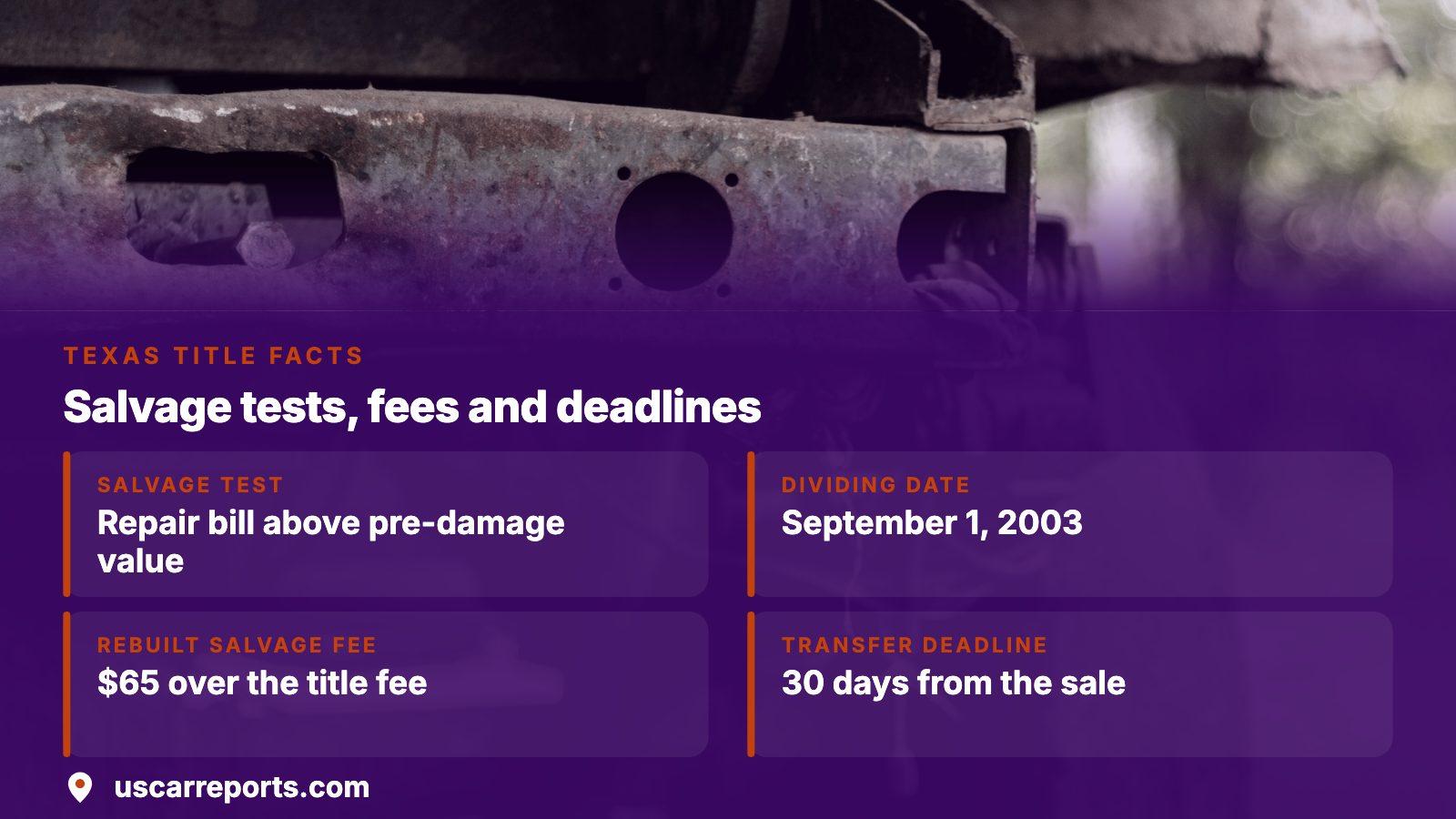
- Salvage test
- Repair bill above the car's pre-damage value
- Dividing date
- September 1, 2003 for nonrepairable paper
- Rebuilt Salvage fee
- $65 on top of the regular title fee
- Transfer deadline
- 30 days from the sale
What the record adds to the title in your hand
A Texas title states what the state knew on the day it was printed. The record behind the VIN reaches back further, including years spent in other states. USCarReports lays that record beside the paper, so a mismatch shows before you hand over a deposit.
- Brand history from every reporting state, so a salvage entry earned elsewhere still shows on a Texas-plated car.
- Total-loss records and auction listings, with photos when the auction took any.
- Odometer readings on several dates, which should rise steadily.
- Open liens and impounds, theft claims, insurance entries and open recalls.
How to run a Texas title check
- Start with the car, not the paperwork. Crouch on the driver's side and read the VIN where the dash meets the glass, then read the label inside the door opening. One mismatched character between plate, label and title is reason enough to stop and ask questions.
- Type that VIN into the box above and read the preview first.
- Pay for the complete report only when the preview leaves the car standing.
- Hold the findings against the paper: brand wording, owner's name, last odometer figure and any lienholder.
- Invite the seller to the county tax office. Staff will look at the title and say whether salvage or legal trouble is flagged before you file.
TxDMV's own Title Check page runs no search. It routes you to a Justice Department-approved vendor, at prices it says begin at a couple of dollars, and flags four providers that serve dealerships only.

Three Texas documents and what each allows
| Document | What it records | Road future |
|---|---|---|
| Salvage Vehicle Title | The bill to fix it would top its pre-damage value, or a major part is missing | Can be rebuilt, inspected and retitled; no registration until then |
| Nonrepairable Vehicle Title, post-2003 version | Worth only parts or scrap after a wreck or fire | Never registered, never retitled |
| Certificate of Title branded Rebuilt Salvage | A salvage car that was repaired and retitled | Can be registered; the brand is carried onto later titles |
Texas renamed its salvage papers on September 1, 2003. Older titles use the word certificate, so the label alone does not make a document suspect.
The 2003 line: the issue date outweighs the word
Read a Texas nonrepairable title and you can reach opposite conclusions depending on its date. Paper from before September 1, 2003 is treated as salvage, and the car may be rebuilt. Paper printed after the changeover closes the door for good: no repair, no regular title, no registration.
Under the earlier rules, from March 1996, a loss of 75% to 94% on a car under seven years old earned a salvage certificate, and 95% or more a nonrepairable one. Certificates of that era went to cars that would not qualify today, so an old one is weaker proof of severe damage.
A rebuilt car's new brand reads Rebuilt Salvage plus a phrase pointing back to the old document.
| Phrase after Rebuilt Salvage | Paper behind it |
|---|---|
| Loss unknown | A salvage certificate from before September 1, 2003 |
| Damaged | A salvage certificate of title from before that date, or a Salvage Vehicle Title from after it |
| 95% plus loss | A nonrepairable certificate of title from before that date |
| Issued by, then a state | Out-of-state salvage paper that allowed rebuilding |
How Texas decides a car is salvage, and what stays off the brand
The Texas test is arithmetic. A car becomes salvage when estimated repairs, parts and labor, exceed what it was worth the moment before the damage, or when it enters the state under out-of-state paper saying flood damage, accident damage or the like. Sales tax on the repair, repainting, hail and slow wear stay out of the sum. A car with only a hail claim, or a paid theft claim and no damage, normally stays unbranded.
Parts count as well as panels: a missing frame, transmission, truck cab or pickup cargo box can tip a car over the line. Because the bar is the car's full value, a truck with serious but smaller damage can carry a clean title. Treat an unbranded title as no finding, and pay a mechanic to look.
Flood remarks and owner-retained cars
Flood is not a brand of its own in Texas. It is a remark, added when water alone caused a salvage or nonrepairable loss, and it travels onto later titles.
Owner Retained is the quieter hazard. An insurer settles a total loss, the owner keeps the car, and Texas marks the record with a legal restraint and voids the registration. The owner must obtain a salvage or nonrepairable title before selling, and TxDMV's manual concedes some never do.
The county sees what you may not
When you file, the tax office checks the state record and the national one. If either shows an earlier salvage title or an owner-retained claim, it collects the $65 Rebuilt Salvage fee and brands your title, whatever paper you present. A car TxDMV classes as nonrepairable under the post-2003 rule stops at the counter.
Red flags in the paper and the record
- A drivable car whose record shows a post-2003 nonrepairable title. The paper and the car contradict each other, so walk away.
- Any title or record marked For Export Only. Texas will not retitle that car, whoever holds it now.
- A Salvage Vehicle Title with gaps in its assignments. Only a county hearing or a bonded title can cure that, and a post-2003 nonrepairable title gets neither.
- A record reading Owner Retained, or showing a legal restraint, with no salvage title in the seller's name.
- A salvage-type brand from another state beside a plain Texas title. TxDMV may write to you later; the cure is a statement on that state's letterhead.
- Mileage that falls between readings, or an Odometer brand.
Texas buying rules and the lien question
- Insist on the signed title showing the sale date and odometer reading, plus a signed Form 130-U that states the price.
- File in your own name within 30 days of the sale. Late filing can bring transfer penalties. Allow at least 20 business days for the document.
- Expect motor vehicle sales tax of 6.25 percent on the price or the state's standard presumptive value, whichever is higher.
- Bring proof of liability insurance, or ask for title only.
- On a weekend sale where the seller keeps the plates, a Vehicle Transit Permit covers five calendar days of driving.
Liens are a separate question. The federal page describing national title reports lists five sections, and liens are not among them. TxDMV notes that a recorded lien sends the title to the lender, who has 10 days after payoff to release it. Ask for the release letter, or confirm that an electronic title has converted to paper. A USCarReports report adds lien entries where they exist; the lender's letter remains the proof.
What the report costs and where to go from there
Opening the preview costs you nothing. If you go on to the report, you pay one time and nothing recurs afterward. Bundles of 3, 5 or 10 are listed at /pricing for anyone sizing up several cars.
If the car passes the preview, buy the report before paying a deposit, then bring it to the county tax office with the seller. A clean record does not replace a mechanic; TxDMV advises an inspection before you sign or pay a down payment.
Where this information comes from
- TxDMV: Title Check, Look Before You Buy — Supports the vendor gateway, the dealer-only warning, the brand list and the advice on out-of-state brands.
- TxDMV: Salvage and Nonrepairable Motor Vehicle Manual — Source for the salvage test, the 2003 cutoff, rebuilt brand wording, owner-retained rules and the fee.
- TxDMV: Salvage brands — Explains how Texas treats national salvage brands such as Owner Retained.
- TxDMV: Buying or selling a vehicle — Covers the paperwork, 30-day deadline, sales tax, transit permit and county office advice.
- TxDMV: Add or remove a lien — Shows the lender's release period and how electronic titles convert to paper.
- NMVTIS: Understanding a vehicle history report — Lists the five sections of a national title report and what it leaves out.
Sources and photos: Facts checked against the sources above in November 2026. Photos by Scott Graham, Cole Keister and Zoshua Colah on Unsplash; diagrams by USCarReports.
Keep reading
- Texas VIN check: what to run, Texas title brands and buying rulesThe VIN side of Texas buying, with flood-prone Gulf coast cars and border imports.
- Title status check: what the state lookup tells a car buyerHow to read a title's status wherever the car was last registered.
- Bonded title: what it means for a buyer, state by stateThe route for a car whose paper trail has gaps, and who qualifies.
- Registering a car in another state: deadlines, title and checksWhat a buyer faces when a car arrives from outside Texas.
Frequently asked questions
Is there a free Texas title search by VIN?
Parts of the picture cost nothing, such as NHTSA recall lookups. For the title record itself, TxDMV's Title Check page sends you to approved vendors, and their prices begin at a couple of dollars. The preview here is free; the report that follows is a single purchase.
Can a Texas nonrepairable title be made road-legal?
Not if it was printed after the September 1, 2003 changeover. Texas will not rebuild, retitle or register that car. A nonrepairable certificate from before that date is treated as salvage and can be rebuilt.
What does a Rebuilt Salvage brand cost the next owner?
The $65 fee falls on whoever first applies for the Rebuilt Salvage title. A later buyer of a car already carrying the brand skips the fee and the rebuilt statement, but the brand stays on later titles.
What is the deadline to title a car bought in Texas?
Thirty days after the sale date. Waiting longer can trigger delinquent transfer penalties, though TxDMV's page names no amount. Book the county tax office visit for the week you buy.
Does a clean Texas title mean the car was never wrecked?
No. A car with heavy damage below the salvage line can keep an unmarked title, and unreported repairs leave no entry at all. A mechanic's inspection fills that gap.
Now check the car itself
The guide explains what to look for. The report shows what this VIN has on record.