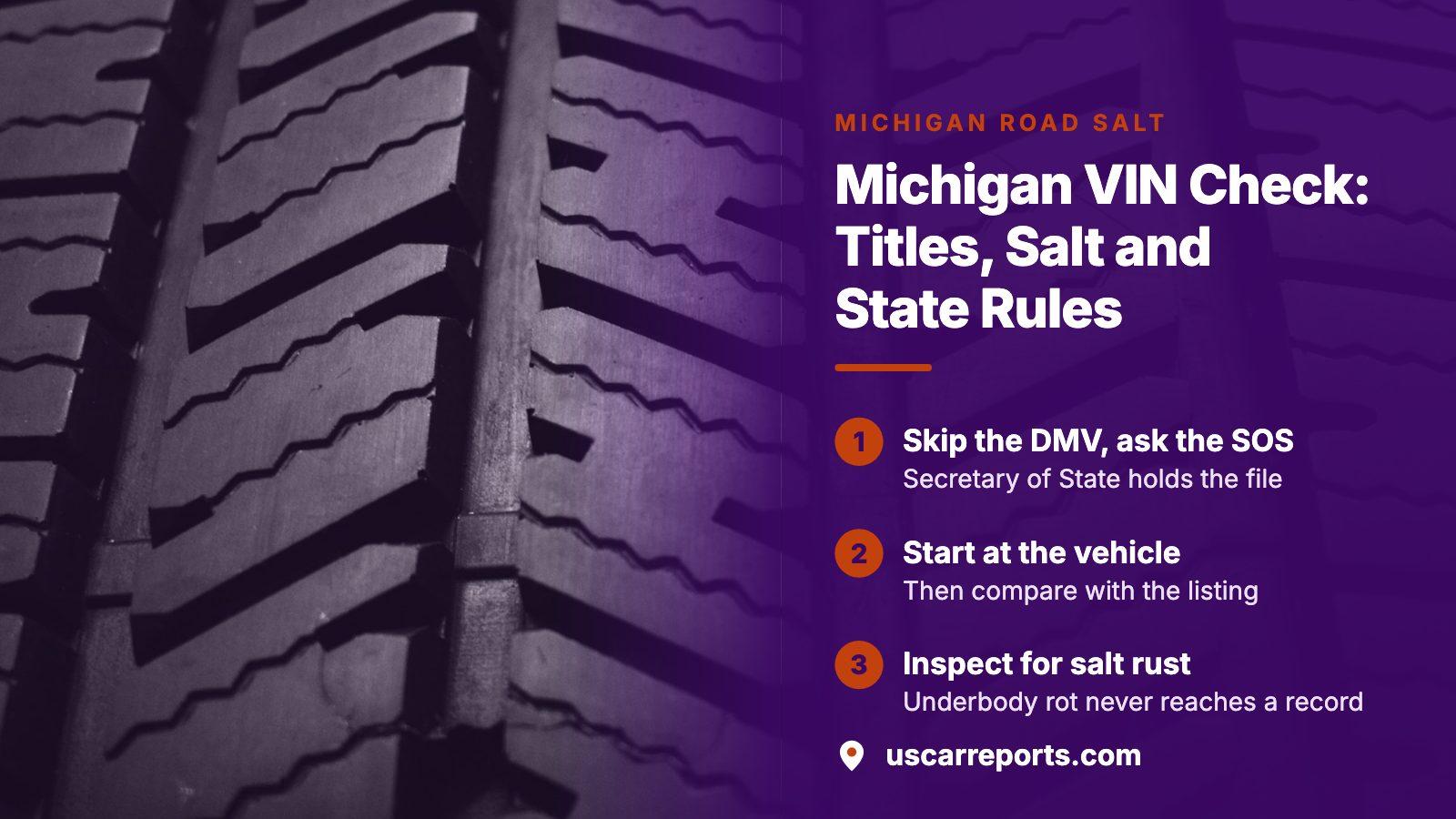
THE SHORT ANSWER
Type the VIN into the box on this page to open a free preview, then buy the report for odometer readings, liens, theft entries, auction photos and any title brand from every reporting state. On a Michigan car, add two steps no report covers: a lift inspection for frame and brake line rust, and a careful read of the paper title before you visit a Secretary of State branch.
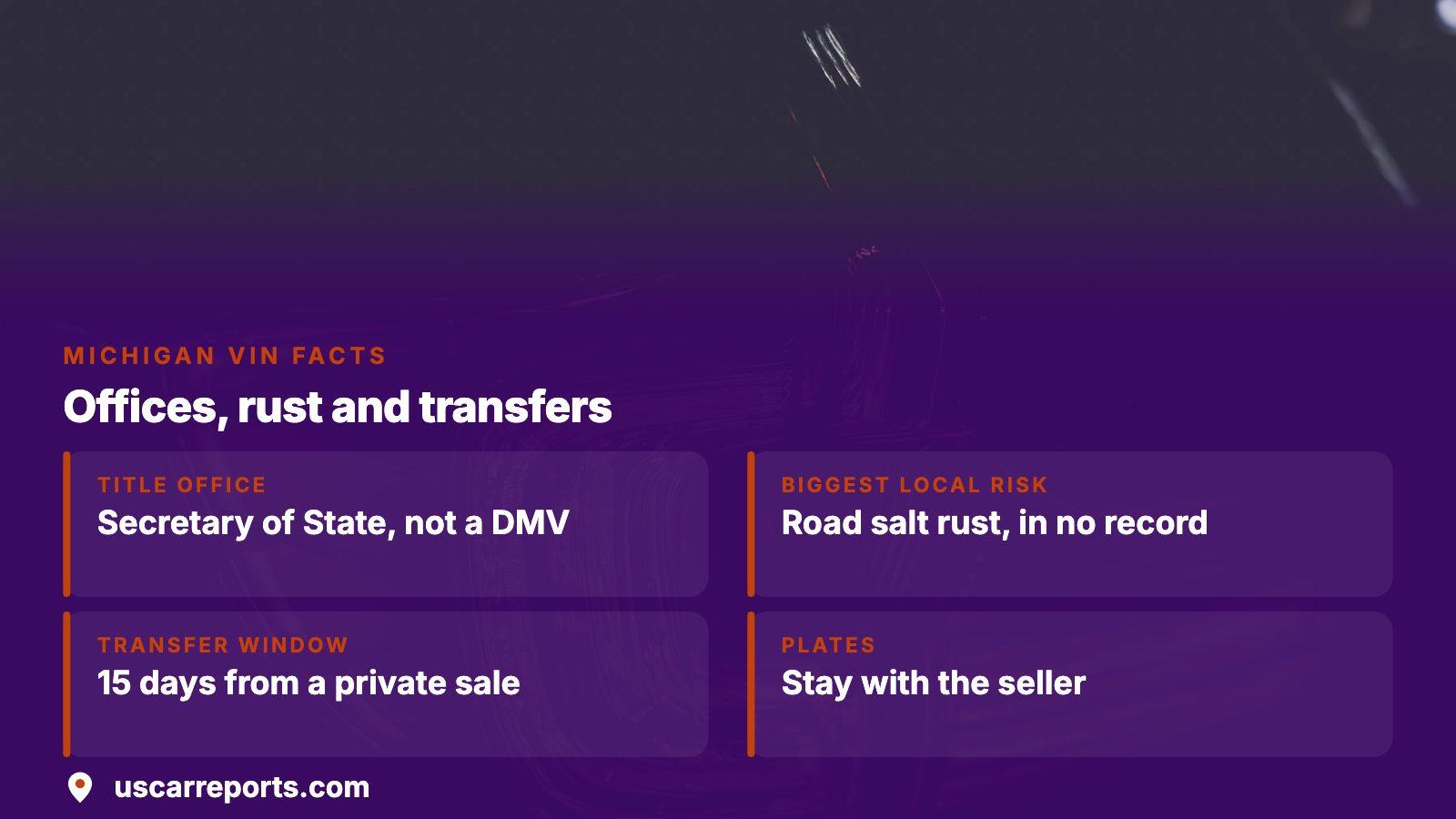
- Title office
- Secretary of State, not a DMV
- Biggest local risk
- Underbody rust from road salt, absent from every record
- Transfer window
- 15 days from a private sale if you skip the branch visit with the seller
- Plates
- Stay with the seller; no owner lookup by plate
What a Michigan VIN check finds before you drive out
The search follows the VIN, not the state line, and that matters in Michigan. Cars pass through auctions, dealers and private sellers in many states, so a local listing may carry a history written in Ohio, Florida or Texas. The report gathers what a buyer needs to test the seller's story:
- Each title brand along with the state that issued it, whether salvage, rebuilt or flood.
- Auction and salvage records, with sale photos to hold up against the car's panels.
- Odometer readings from several dates, to show whether mileage climbs in a sensible line.
- Liens, impounds, theft reports and insurance claims, any of which can stop a seller from signing over the car.
This is desk work, done before the drive to the seller's address. It cannot read a license plate or look under the car.
No DMV here: the Secretary of State holds the file
Out-of-state buyers sometimes lose an hour hunting for a Michigan DMV that does not exist. Titles, registration and plates belong to the Secretary of State, and Michigan residents call it the SOS. Its branch offices handle each transfer, and any question about what the Michigan paper says on one car ends there.
The federal title database sits beside it. Participating states report brands into that system, and approved providers build their reports from it. A brand stamped in Ohio or Indiana therefore reaches your report, while the SOS settles what the paper in the seller's hand states.
Run the check: start at the vehicle, then the listing
Read the number off the car itself. One copy sits on a small plate where the dash meets the glass, and another is printed on a label along the driver's door. The two strings should match one another, the title and the advertisement exactly. If they disagree, the negotiation is over.
- Photograph both spots and compare them with the title.
- Enter all 17 characters in the box on this page. The preview costs nothing and lists which kinds of records exist.
- Drop any car whose preview already looks bad.
- Once the car clears that cut, order the full report and read it against the title and the odometer.

Salt: the Michigan risk that never reaches a record
Winter salt eats a car from below. Frame rails, brake and fuel lines, spring seats and bolts corrode for years before the paint shows a hint. No claim follows, no brand lands on the title, and no report lists it, so a car rotting underneath can come back looking spotless.
A tired engine is a bill you can price. A scaling frame usually is not, since repair seldom pays. Corroded brake lines are a safety fault. Pay a shop for this inspection:
- Raise the car on a lift; a phone light in a parking lot shows too little.
- Accept surface rust, but press the frame steel. Flaking, scaling or holes mean walk away.
- Trace the steel brake and fuel lines along their whole length.
- Inspect strut towers and rear spring seats.
- Question brand-new undercoating on an older car; it can hide those spots.
Reading the results on a Michigan car
Lay the report beside the paper title and see whether they describe one car.
| What the report shows | What it can mean | What to do |
|---|---|---|
| Salvage or rebuilt brand, any state | An insurer wrote the car off and someone repaired it | Price it as damaged and ask for repair photos, or walk away |
| Scrap designation | Fit only for parts or metal | Walk away; a running car with this paper contradicts itself |
| Flood brand or time in a storm state | The car sat in water, often far from Michigan | Check for silt under the carpet and in the trunk well |
| Odometer that drops or stalls | A rollback or a swapped cluster | Compare pedal and seat wear with the miles |
| Lien with no release | The loan may not be paid off | Hold your money until you have a written release |
| Theft or impound entry | The car may be reported stolen | Stop and call the police |
Salvage, rebuilt and scrap: how Michigan treats each
A salvage title means the car was declared a total loss. It stays off public roads until a certified inspector signs off and the Secretary of State issues a title marked Rebuilt Salvage. That wording never leaves, so every later owner and every later report sees it. Scrap is the end of the line: a car fit only for parts or metal, never retitled for the road. Flood is the third brand to watch for. Water is a rarer local cause than on the coast, but flooded cars from elsewhere pass through Michigan sales.
What the rebuilt stamp does and does not tell you
Passing recertification makes the car legal to drive again. It does not grade the repair, and a straightened frame can hide poor work. For a rebuilt car, pay a body shop to measure the structure, and expect a lower price than a clean-title twin.
Buying from a Michigan private seller: the rules in order
Check that the VIN on every document matches the car and the report before anyone signs.
| Item | What Michigan expects |
|---|---|
| The title | The seller's name must match exactly. The VIN and mileage written on it must match the car, and any lien must be paid and released first. |
| Where to sign | A Secretary of State branch with the seller beside you is the cleanest route. If you do not go together, the title must reach your name within 15 days of the sale to avoid a late fee. |
| Tax | A 6 percent use tax applies, figured on the higher of the price paid or the car's fair market value. |
| Plates | They stay with the seller. You move a plate from a car you already own, or apply for a new one. |
| Written record | Put the sale on paper: VIN, price, date and both parties' names and addresses. |
| Freshly reissued title | Ask why before you pay. A new document on an older car deserves a question. |
Shopping south for a rust-free car: trading salt for water
Plenty of Michigan buyers search the South for older cars that never met a salted road, and the logic holds: a frame with no salt history is worth real money after a decade. The trade has a cost. A Gulf or Florida car skipped the rust and may have sat through storm surge or street flooding instead. Inspect for whatever the car really went through, which may not be the hazard Michigan trained you to expect. Read the title history state by state, and check for silt, damp carpet and corroded connectors.
Cost, and the order of work that saves the most money
Opening the preview costs nothing. A single payment covers the full report for one vehicle, and packs of 3, 5 or 10 exist for anyone comparing cars. Nothing renews. The pricing page has current figures. NHTSA's recall tool and NICB's theft and salvage search cost nothing either, so use them first.
- Open the preview and drop any car that looks wrong.
- Look up open recalls on NHTSA's site and any theft or total-loss record on NICB's.
- Buy the report for brands, mileage and lien records from every reporting state.
- Put the car on a lift, and add a water check if it came from the South.
- Match the paper title to the car, then finish at a Secretary of State branch.
Where this information comes from
- Michigan Secretary of State: Buying, selling, or leasing — Private-sale rules: the transfer window and late fee, use tax, plates and lien release.
- Michigan Secretary of State: Application for salvage vehicle inspection (TR-13A) — The inspection step that lets a salvage vehicle back on the road with a Rebuilt Salvage title.
- Michigan Secretary of State: Dealer Manual, Chapter 5 — How the state defines distressed vehicles, and why a scrap-titled vehicle cannot be rebuilt for road use.
- Michigan Consumer Protection: Beware of buying a flood-damaged vehicle — State advice to use a mechanic and an approved history report, and that a clean title does not prove a car is undamaged.
- NMVTIS: National Motor Vehicle Title Information System — The federal database that collects title brands from every reporting state.
- NICB VINCheck — A no-cost theft and salvage search fed by participating insurers.
- NHTSA: Recalls — A no-cost lookup of open safety recalls by VIN.
Sources and photos: Facts checked against the sources above in November 2026. Photos by fr0ggy5, Cole Keister and A n v e s h on Unsplash; diagrams by USCarReports.
Keep reading
- Michigan Title Check by VIN: Salvage, Scrap and Seller DutiesHow Michigan's salvage, rebuilt and scrap titles work in more depth.
- Ohio VIN check: records to pull, title brands and Ohio buying rulesThe neighbor to the south, where many Michigan cars change hands.
- Indiana VIN check: what to pull and the title rules that applyThe other land border, with its own buying rules and its own salted roads.
- Florida VIN check: title records, flood risk and Florida buying rulesThe water-damage checklist for the rust-free car you found down south.
Frequently asked questions
How do I run a Michigan VIN check?
Read the 17 characters from the car, enter them in the box on this page for the preview, and order the full report if the car makes your shortlist. Then read the paper title yourself.
Is there a free VIN search for Michigan cars?
Partly. The preview on this page is free, and the NHTSA and NICB tools cost nothing. The full report is one payment. None of them shows what a lift inspection would.
Can a VIN lookup show rust on a Michigan car?
No. Rust produces no claim, brand or record, so a frame can be scaling while the history reads clean. Only an inspection on a lift can judge the frame, brake lines and spring seats.
Should I buy a car with a Michigan rebuilt title?
Only at a clear discount and after an independent shop checks the structure. Recertification makes the car legal to drive but does not grade the repair, and the Rebuilt Salvage wording follows every later owner.
Can I look up a Michigan license plate to find the owner?
Not as a private buyer. A federal privacy statute restricts owner data in motor vehicle records, and a shopper's curiosity is not a permitted reason. Ask for the VIN; it opens the records that matter.
Now check the car itself
The guide explains what to look for. The report shows what this VIN has on record.