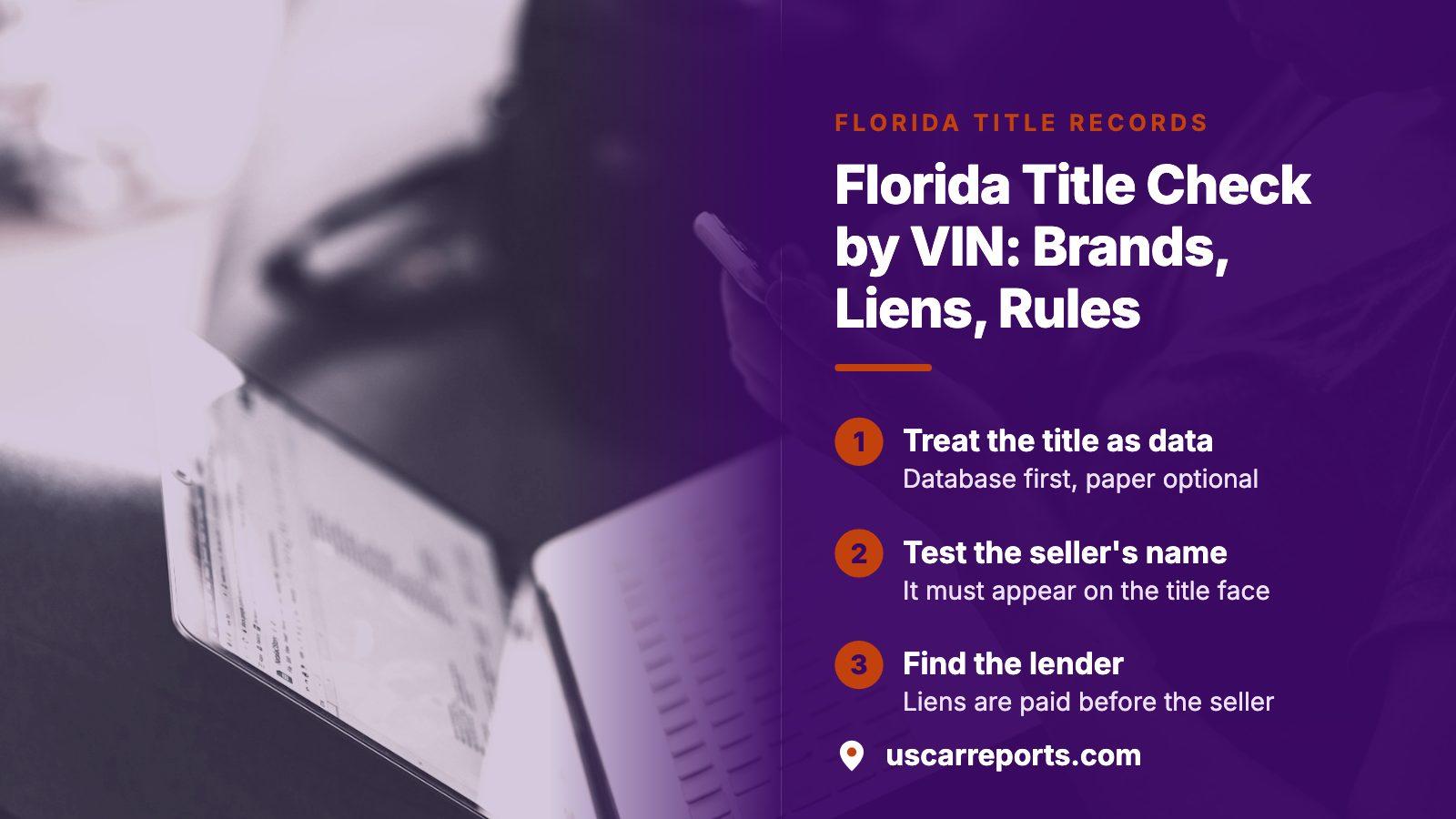
THE SHORT ANSWER
To check a Florida title, copy the VIN from the car, open the free preview, and pay for the full report only if the car passes that first look. Then hold the result against the title the seller shows you: the seller's name must be on its face, any lender has to be paid off, and Florida's own VIN lookup adds the state's view.
- Title form
- A database record, with paper optional
- Seller test
- Seller's name printed on the title's face
- Buyer's filing window
- 30 days after delivery, with a $20 late fee
- Preview
- Free, then one payment per report
What a Florida title check finds that the paper does not
A title is one state's note about one owner. A check keyed to the VIN reads the trail behind it, which counts most for a car that lived elsewhere first.
| Entry | Why it counts on a Florida sale |
|---|---|
| Brand history | A label written in another state can surface even when the Florida paper looks clean. |
| Total-loss and salvage entries | Pre-repair auction pictures show the damage as it looked before the body shop. |
| Odometer readings | Dated readings that run backward, or sit still for years, need an explanation. |
| Liens and impounds | A lender or tow yard with a claim can block clear title. |
| Theft and insurance entries | Flags that never produced a brand on any title. |
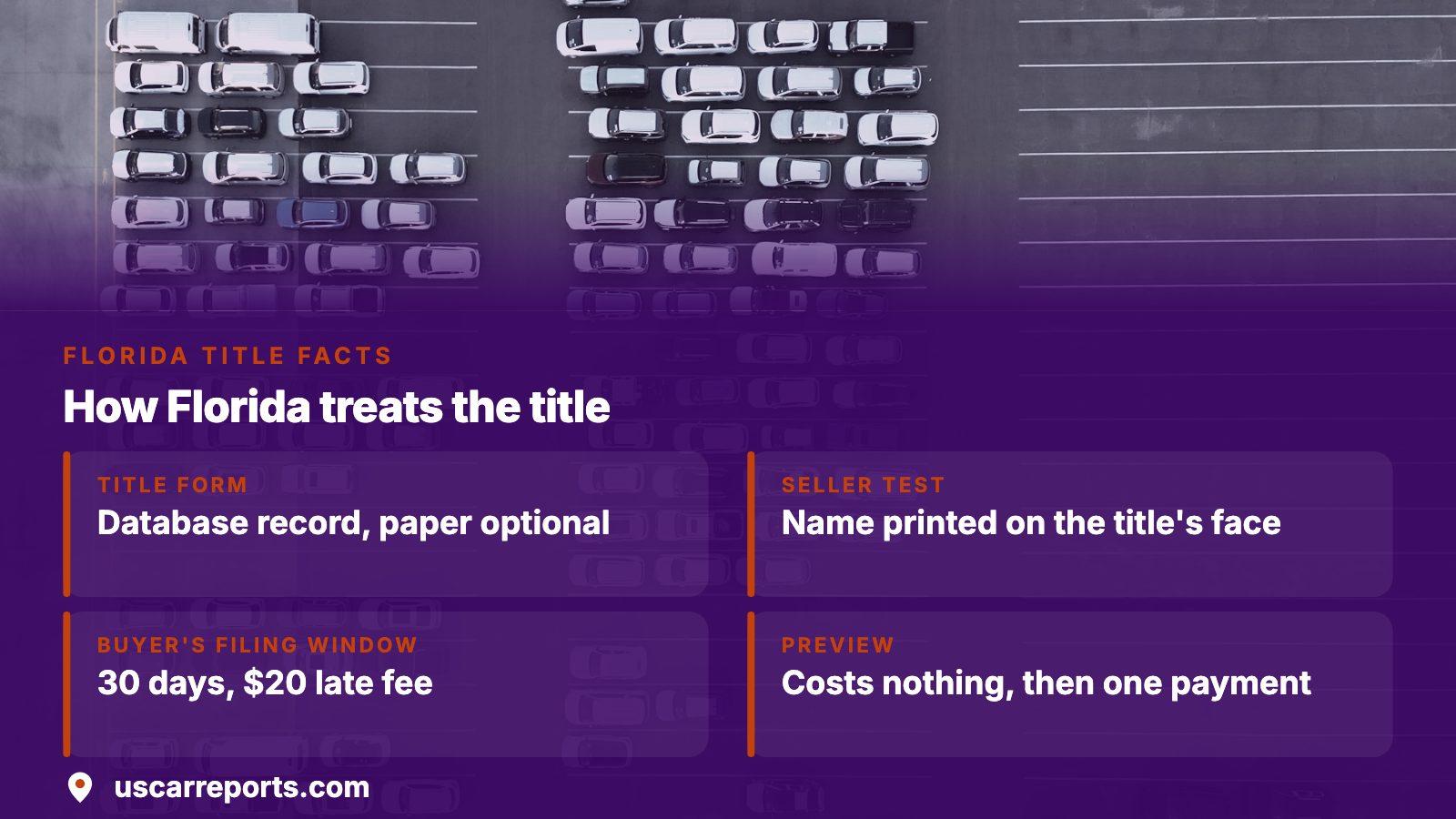
In Florida the title is a database record first
Florida law treats a certificate of title as the record that serves as evidence of ownership, and that record may be a printed certificate or an entry in the state's database. The state may issue an electronic title instead of paper, and the database entry serves as the duplicate. A seller who cannot produce a printed title may be telling the truth, particularly if a lender is involved.
The state agency, FLHSMV, also operates an online Motor Vehicle Information Check that works from a VIN. It covers Florida only, so read what it shows with that limit in mind. For brands from elsewhere, the federal NMVTIS database reaches further, yet gaps remain: the Justice Department's own figure is 87 percent of vehicles nationwide, with a majority of states reporting.
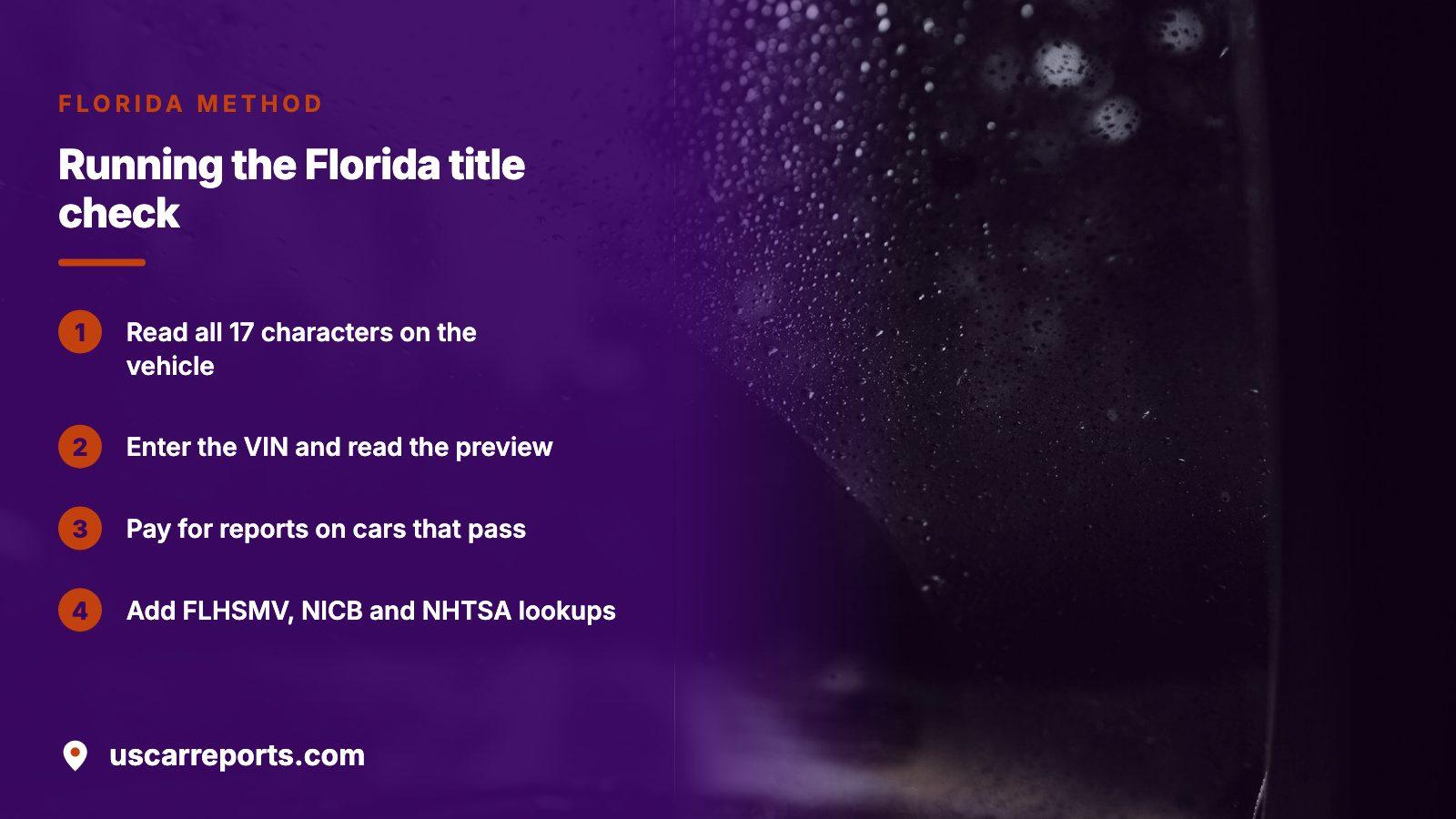
How to run a Florida title check, step by step
- Read all 17 characters on the vehicle, never the advertisement. The dashboard plate and the door-edge sticker should agree, and both should match the title.
- Enter the VIN in the box on this page. The preview opens at once, and the year, make and engine it names should fit the car you went to see.
- Pay for a full report only on the cars that pass the preview.
- Run FLHSMV's lookup, NICB's theft screen and NHTSA's recall search as extra layers.
- Set the report beside the title and compare the owner's name, the brand wording and any lien noted.
If a seller refuses to share the VIN, end the visit there.
Florida's private-sale rules, and how to test each one
Florida sets a few plain rules for private sales, and each one can be tested.
| Rule | What to do at the table |
|---|---|
| A title is accepted for transfer only with the seller's name on its face. | Compare the name with the seller's driver license, and decline a title made out to someone else. |
| A buyer has no marketable title until one issues in the buyer's name. | Do not treat the sale as complete until the state record lists you as owner. |
| Transferring a title that lacks the purchaser's name is illegal, and knowing fraud is a first-degree misdemeanor. | Do not accept a signed title with the buyer line blank. |
| Co-owners joined by or can sign alone, while and requires everyone. | Read the joining word and collect every signature required. |
| The seller has 30 days to tell the state about the sale. | Ask that it be filed, which protects the seller and records the sale. |
Liens: why the lender gets paid before the seller does
Florida requires every lien to be noted on the title, and the state's electronic titling program has lenders send liens and payoffs digitally. Under that arrangement the state may delay printing a paper certificate until the final lien clears and a clean title goes to the owner, so a seller with a loan often has nothing to give you.
Pay the lender first
If the report or the state record shows an open lien, route payment to the lender directly or through escrow. Florida allows a lender up to 30 days after a demand to supply satisfaction paperwork, so the record can trail the payoff. A promise that the loan is nearly cleared proves nothing.
Brands Florida writes on titles, and the rules that follow them
- Total loss: an insurer paying to replace the car, or paying a theft claim. With no claim, repair cost of 80 percent or more of replacement cost qualifies.
- Total Loss Vehicle: when owner and insurer agree to repair and the bill passes 100 percent of what a like car would cost, the owner has 72 hours from the agreement to ask the state for this brand.
- Rebuilt: a car made from salvage cannot be knowingly sold until the state inspects it, stamps the title and affixes a decal.
- Flood vehicle: Florida's term for a total loss caused by water.
A seller must disclose a rebuilt or flood status in writing before the sale closes, and an advertisement must state it. A brand on a Florida title is meant to follow the car through every later title. A repair paid out of pocket may leave no brand at all, so treat the report as a filter, not a verdict.
Cars from another state, and the mileage you sign for
A car last titled out of state needs more at the application stage: the old title and registration papers are surrendered, and the application names where and when the last title issued. The VIN must be verified, either by a sworn affidavit from seller and buyer or by a state form completed after the owner and a law enforcement officer, licensed dealer, license inspector or Florida notary examine the car together.
Apply for the title within 30 days of delivery. A late filing adds $20 to the other charges. The odometer statement belongs to the same step: the seller completes it at transfer, the buyer signs to acknowledge it, and the state can refuse a title if it is skipped. Weigh that number against the report's latest reading.
Red flags that should stop a Florida deal
- The name printed on the title is not the person selling.
- A lien shows up on the report or the state record, and no release exists.
- The report lists a brand the title omits, or the wording differs from the seller's account.
- The report's mileage is higher than the odometer.
- The VIN plate looks tampered with. Knowingly selling a car with an altered or defaced VIN is a felony in Florida.
A clean report is where inspection starts
Water damage that no insurer ever heard about gives a database nothing to record, and Florida's storm history makes that a live risk. Pay a mechanic, and check beneath the carpets and around the seat mounts for silt and corrosion.
Paying for the report, and the steps that come next
There is no charge for the preview. A report is bought once, with no plan to cancel, and buyers with several cars on the list can pick a pack of 3, 5 or 10. Current options sit on the pricing page.
- Run the NICB theft screen, which is free, along with FLHSMV's lookup.
- Book an independent mechanic, then complete the transfer within the 30-day window.
Where this information comes from
- Florida Statutes 319.22: transfer of title — The seller-name rule, the buyer's marketable-title point and the 30-day sale notice.
- Florida Statutes 319.24: duplicate certificates and electronic liens — The database record as the duplicate, electronic lien handling, lost-title duplicates and lien-satisfaction timing.
- Florida Statutes 319.23: title applications — The buyer's filing window and late fee, and VIN verification for cars from other states.
- Florida Statutes 319.30: total loss and salvage — What counts as a total loss and when the Total Loss Vehicle brand is requested.
- Florida Statutes 319.14: rebuilt and flood vehicles — Definitions of rebuilt and flood vehicles, written disclosure, the advertising rule and brand carry-forward.
- U.S. Department of Justice: NMVTIS for consumers — What a national title search shows, how many states report, and why the state's own title record is worth reading.
- FLHSMV: Motor Vehicle Information Check — The state agency's online VIN lookup, which gives Florida's own view of a car.
Sources and photos: Facts checked against the sources above in November 2026. Photos by Michal Biernat, Justin Cron and Iain on Unsplash; diagrams by USCarReports.
Keep reading
- Florida VIN check: title records, flood risk and Florida buying rulesThe VIN side of Florida buying, with the state lookup and storm-flooded cars.
- Salvage title registration in Florida: the rebuilt step comes firstThe inspection and paperwork steps that turn a salvage car into a registrable rebuilt one.
- Registering a car in another state: deadlines, title and checksWhat a buyer faces when a car crosses a state line.
- Title status check: what the state lookup tells a car buyerHow to read a title's status wherever the car was last registered.
Frequently asked questions
How do I run a Florida title check by VIN?
Read the VIN straight off the vehicle, enter it on this page, and order the report once the preview looks right. Compare the report with the paper title, starting with the owner's name and any lender. FLHSMV's own VIN lookup is a useful second source for Florida's record.
Is there a free Florida title search?
In part. The preview here is free, as are NICB's theft check and NHTSA's recall search, and FLHSMV publishes a VIN lookup. None of them combines multi-state brands, liens and mileage in one view, which is what the paid report adds.
Can a Florida title be electronic?
Yes. Florida lets the state issue an electronic certificate in place of paper, with the database entry serving as the duplicate. If a lender holds a lien, paper may not print until the last one clears. Verify the record and the payoff instead of demanding paper.
Does a Florida title show accidents or flood damage?
Only some. A title carries brands like rebuilt, and Florida applies the flood label to total losses caused by water. A crash repaired without a claim, or a flooded car dried out privately, can keep a clean title, so the report and an inspection both matter.
What if the seller has no title in hand?
Hold off on paying. Find out whether the title is electronic, whether a lender has a lien and whose name the record shows. A lost original can be replaced by a duplicate once evidence shows all liens are satisfied.
Now check the car itself
The guide explains what to look for. The report shows what this VIN has on record.