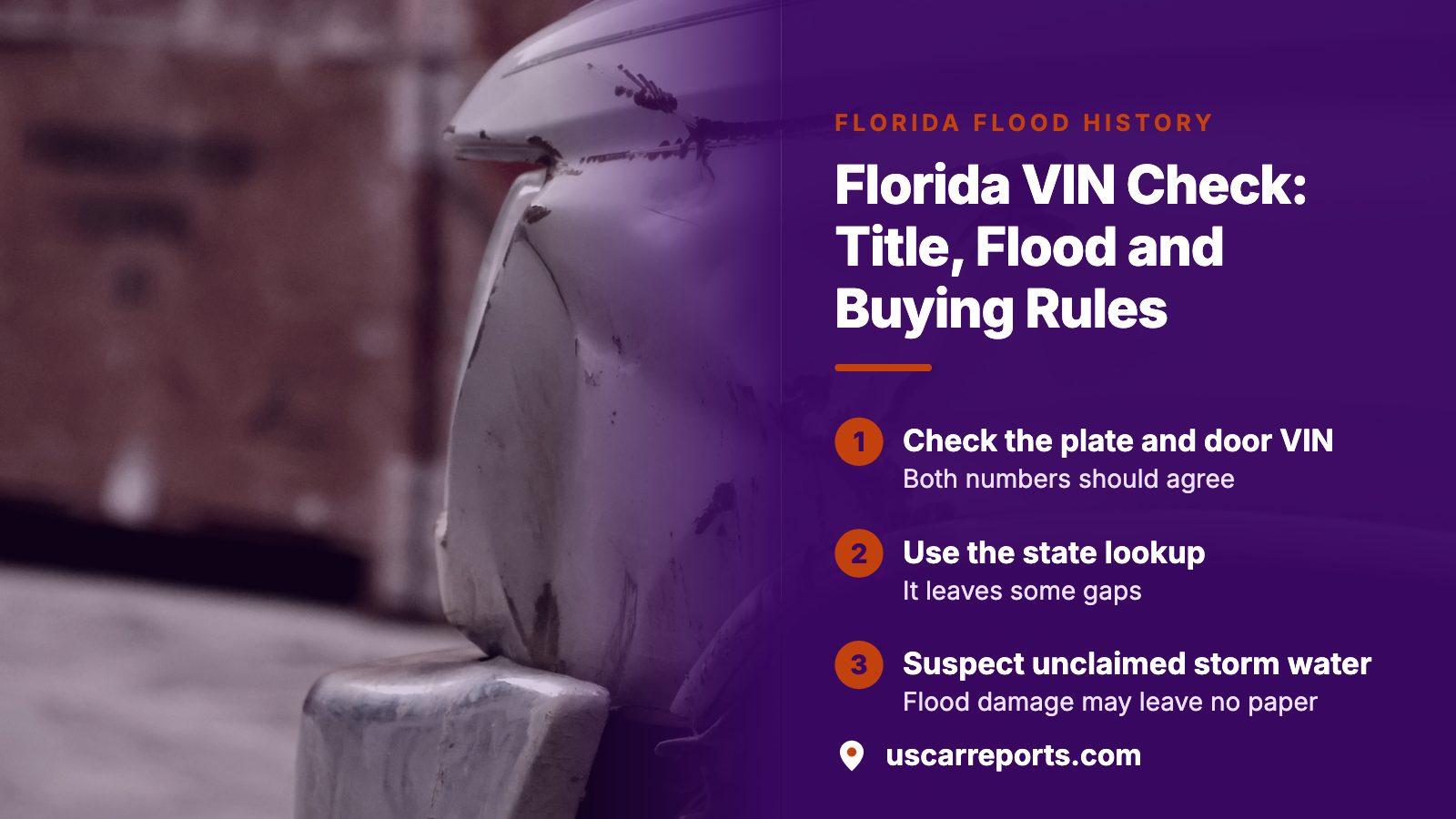
THE SHORT ANSWER
A Florida VIN check starts with the 17-character number on the windshield plate and the door frame. The preview is free, and the paid report adds title brands, crash and damage history, odometer history, auction photos of salvage cars, liens, theft entries and recalls. Florida buyers should also query the state's FLHSMV lookup and inspect for water damage, since unclaimed flood damage hides from every database.
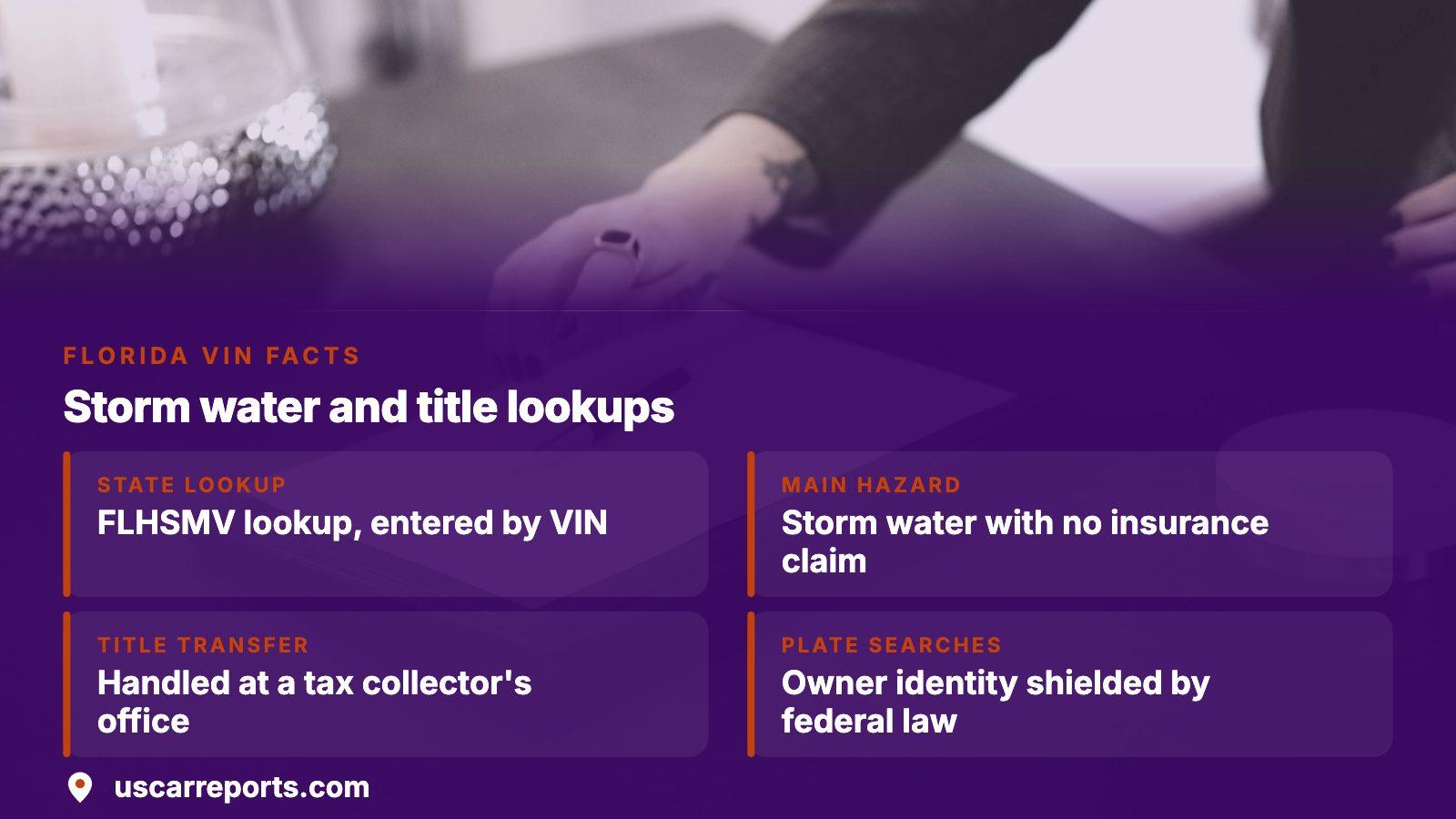
- State lookup
- FLHSMV motor vehicle information lookup, entered by VIN
- Main Florida hazard
- Storm water that never produced an insurance claim
- Title transfer
- Handled at a tax collector's office
- Plate searches
- Owner identity is shielded by federal privacy law
What the report pulls up, and how to read it on a Florida car
USCarReports checks a Florida car by VIN and reports odometer readings over time, title brands, crash and damage records, insurance and theft entries, liens and impounds, salvage and auction history with photos, open recalls, ownership and use type, market value and factory specs. Here is how to read the main findings.
| Finding on the report | What to do in Florida |
|---|---|
| A salvage or flood brand the ad never mentioned | Ask why it was left out, then price the car as branded or leave. |
| A certificate of destruction | Stop. The car cannot be titled for the road again and is worth parts only. |
| Odometer readings that fall between dates | Treat it as tampering until the seller proves otherwise. |
| A lien with no release | Hold the money until the lender confirms the payoff in writing. |
| Auction photos showing damage the seller denies | Bring the photos to the inspection, or walk away. |
| Titled in another state first | Read that state's rules and check the storm calendar. |
| An open recall | Book the repair. The maker pays for it. |
How to run the check: the VIN, then the lookups in order
Start with the car, not the listing. Photograph the VIN plate where the dashboard meets the windshield and the label on the door frame, then check both against the paperwork the seller hands over.
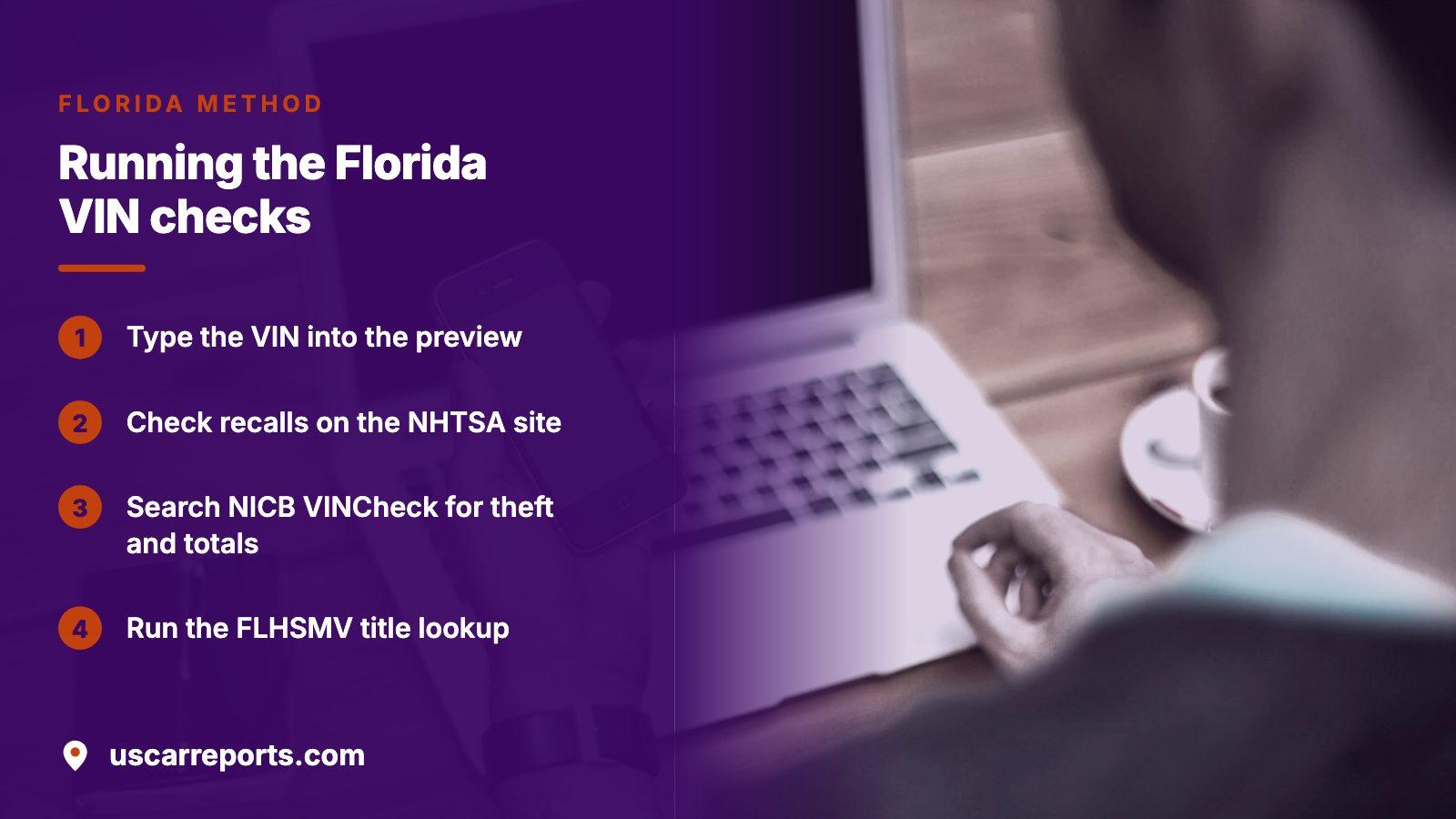
- Put the VIN in the preview and check that the year, make and engine match the listing.
- Check recalls on the NHTSA site. Repairs for open ones cost the owner nothing.
- Search NICB VINCheck, which allows five lookups a day, for insurer-reported thefts and total losses.
- Run the VIN through the FLHSMV lookup for Florida's record of the title.
- Order the full report, then inspect the car with the printout in your hand.
Plates are a dead end for private citizens. The Driver's Privacy Protection Act shields owner identity, which is why this site works from the VIN and why you should ask the seller for it.
Florida's own title lookup and the gap it leaves
The Florida Highway Safety and Motor Vehicles agency, known as FLHSMV, handles titles and tags in the state. Its public motor vehicle information lookup accepts a VIN and returns the title's status and what Florida has noted on it. Use it. It costs nothing and speaks for Florida's own file.
The gap is geography. Florida lots hold plenty of cars that were titled elsewhere first, such as vehicles that followed retirees south or were bought at auction, and their Florida file starts on arrival. Brands another state applied live in NMVTIS, the federal title database fed by reporting states, so a Florida-only search is never the whole check. Cars from northern winters also bring road-salt rust, so look at the underbody.
Four title brands you may meet in Florida
| Brand | What it signals |
|---|---|
| Salvage | Written off as a total loss. Florida treats rebuildable salvage and certificate-of-destruction cars as different cases. |
| Rebuilt | Once salvage, since repaired and cleared by the state inspection. Drivable, and branded for good. |
| Flood | Records water damage. In Florida a missing flood brand proves little. |
| Certificate of destruction | Terminal. It cannot be retitled for road use, so the car is parts and scrap. |
A brand is a resale problem as well as a price problem. A rebuilt discount looks generous until you try to sell the car on.
Flood damage that leaves no paper trail
Hurricane water produces two kinds of car. One was totaled and branded, which a report shows. The other was dried, cleaned and sold with no insurance claim, which no report shows. Florida's warm air speeds the drying and its salt air makes some corrosion look normal, so the second kind is easy to buy by accident. Take a flashlight and check:
- Sand or silt lodged under the spare-wheel cover, beneath floor mats and along the seat rails
- Orange rust on seat-mounting bolts that detailers skip
- A moisture line or haze behind the headlight and taillight lenses
- Green or white crust on connectors and bare metal beneath the dash
- Carpet or seat covers that look fresher than the rest of the cabin
- A damp, musty odor, or heavy air freshener covering one
- Warning lights and accessories that fail intermittently
Sea water is the worst case
Salt from storm surge keeps eating wiring and metal after everything dries, so a car that drives well on the lot can go wrong within months. Treat salt-water signs as a reason to leave.
Timing a purchase after a storm
Cars flooded in a hurricane reach lots and auctions gradually, starting a few weeks later and trickling on for a year or more, sometimes far from the coast. The areas around landfall see the most.
- Be suspicious of a spotless car listed below market value.
- Ask where the car was registered when the storm hit.
- Note any title that moved to a new state soon after landfall.
- Get the seller's answer about storm exposure by text or email, not just by voice.
- Spend longer on the inspection than you usually would.
How a Florida private sale should go
Dealers carry obligations that private sellers do not, so verification falls to you. Meet at a tax collector's office for the title transfer, since that is where Florida processes them and it keeps both parties covered. Before you get there:
- Make sure the seller's name matches the title letter for letter before paying.
- Match both VIN spots on the car to the title, digit by digit.
- Treat a title issued only days ago with caution, since reissues sometimes follow washing or flooding.
- Sign a bill of sale showing the VIN, price, date and each party's details.
File the dated report with the bill of sale. If a brand surfaces later, those papers show what you knew when you paid.
Liens, original titles and altered VINs
A financed car has a seller and a second party with a legal claim. The report lists liens and impounds, and the federal export regulation at 19 CFR 192.2 shows what proof looks like: the original title or a certified copy, plus a letter from the lienholder on letterhead. A buyer can borrow that standard. A usable release:
- Describes the car by VIN
- Names the lender with a phone number you can ring
- Bears an original signature and a recent date
- Was verified by your own call, not by the letterhead
The same regulation puts penalties of up to $10,000 on knowingly exporting a vehicle whose identification number was removed or altered. A plate with odd rivets or a cut door label is reason enough to leave. That rule covers exports, not Florida titles, and nothing in it appears on a report.
What it costs and where to go from here
Starting with the preview is free, and it tells you whether the VIN belongs to the Florida car in front of you. After that, you pay once per report, either for one vehicle or for a multi-report pack aimed at people comparing several cars, and no renewal follows. The pricing page has the rates. Run it before the deposit.
Walk away if
The seller will not show the title or VIN in person. One character differs between car and title. A brand appears that the ad skipped. A lender holds a lien and offers no written release.
Where this information comes from
- FLHSMV: Florida Highway Safety and Motor Vehicles — The state agency behind Florida titles, and the home of its motor vehicle information lookup.
- NMVTIS: National Motor Vehicle Title Information System — The federal title database that gathers brands from every reporting state.
- NICB VINCheck — A no-cost theft and total-loss search covering participating insurers.
- NHTSA: vehicle recalls — A no-cost open-recall search by VIN.
- eCFR: 19 CFR 192.2, requirements for exportation — The federal rule on titles, VINs and lienholder letters that the lien checklist borrows from.
Sources and photos: Facts checked against the sources above in November 2026. Photos by Everett Pachmann, Alejandro Escamilla and Annika Wischnewsky on Unsplash; diagrams by USCarReports.
Keep reading
- Florida title check by VIN: brands, liens and whose name is on itFlorida's title record and the state lookup, taken on their own
- Certificate of destruction by state: what the paper allowsWhat the final Florida brand means for a car you are considering
- Georgia VIN check: find liens and title problems before you buyFor a Florida car that spent time in Georgia, that state's checks and buying rules
- Sample reportSee each section of the report before you buy
Frequently asked questions
How do I check a VIN number in Florida?
Photograph the VIN plate at the windshield base and the label on the door frame, run the preview, then look it up with NHTSA, NICB and the FLHSMV lookup. Buy the full report for title brands and damage records, and finish with an in-person flood inspection.
Does Florida have a state VIN lookup?
Yes. FLHSMV offers a motor vehicle information lookup that takes a VIN and reports on the Florida title. It covers only records the state holds, so a car titled elsewhere first needs a national title check as well.
Is there a way to find a Florida car's owner from its plate?
Private citizens cannot. The Driver's Privacy Protection Act restricts owner details to permitted uses such as law enforcement and insurers. A seller can simply hand you the VIN, which also tells you more about the car.
Does a VIN check reveal flood damage?
It reveals recorded flood damage: a flood or salvage brand, or an insurer's total-loss entry. A car dried out without a claim carries no such entry, so silt, corrosion and moisture lines inside light housings become your evidence.
How much does a Florida VIN check cost?
The preview, the NHTSA search, NICB VINCheck and the FLHSMV lookup cost nothing. Paying for the full USCarReports report is a one-time charge that never rolls into a subscription, and rates sit on the pricing page.
Now check the car itself
The guide explains what to look for. The report shows what this VIN has on record.