THE SHORT ANSWER
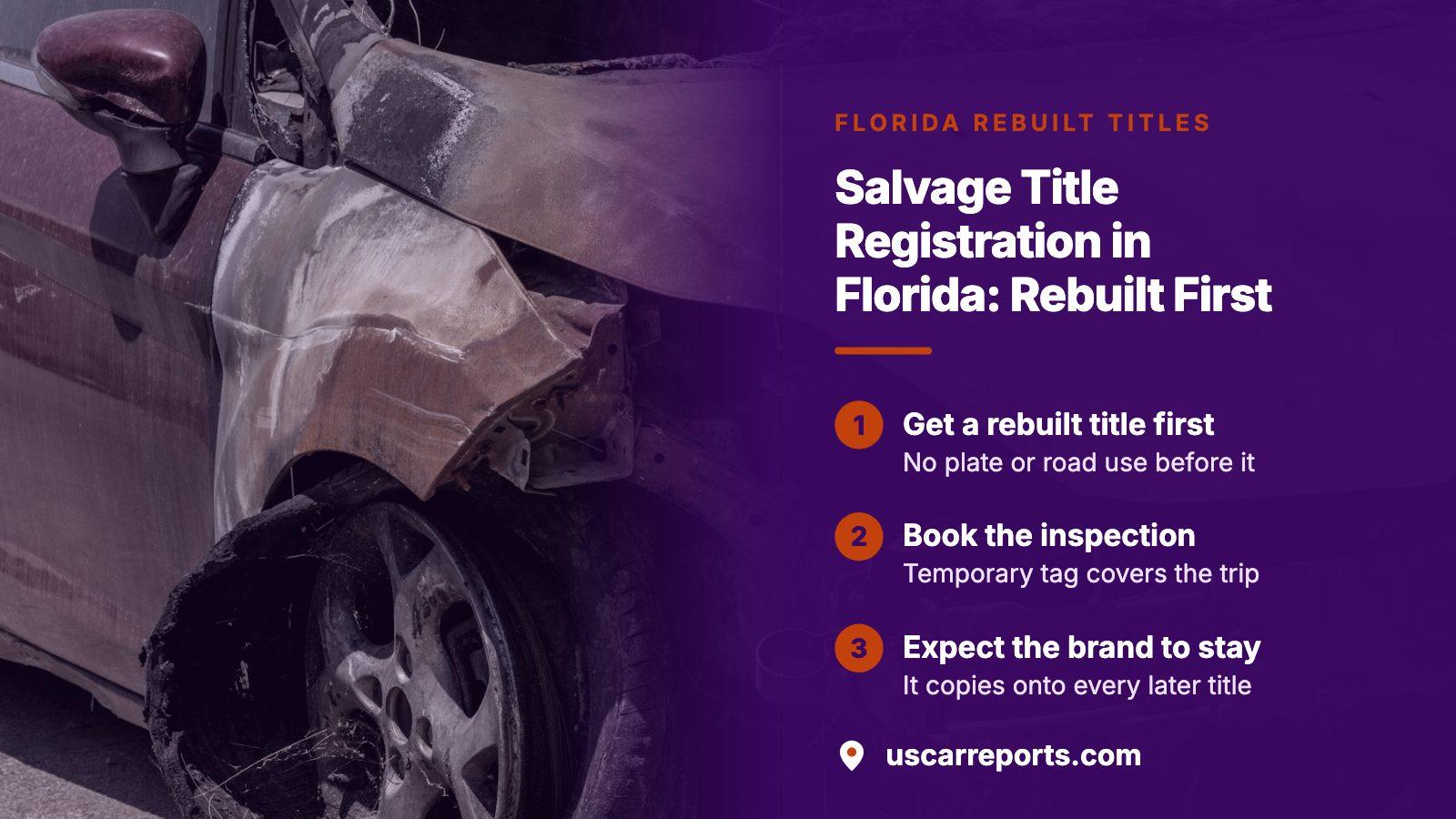
In Florida, a car that was declared salvage or junk cannot be titled, registered or driven on the road until it holds a rebuilt title. The path runs through a rebuilt inspection at a state regional office or an approved private facility, then to the county tax collector for the title and plate. A short temporary tag, issued against Florida insurance, covers the drive to the inspection. The rebuilt brand then stays with the car permanently.
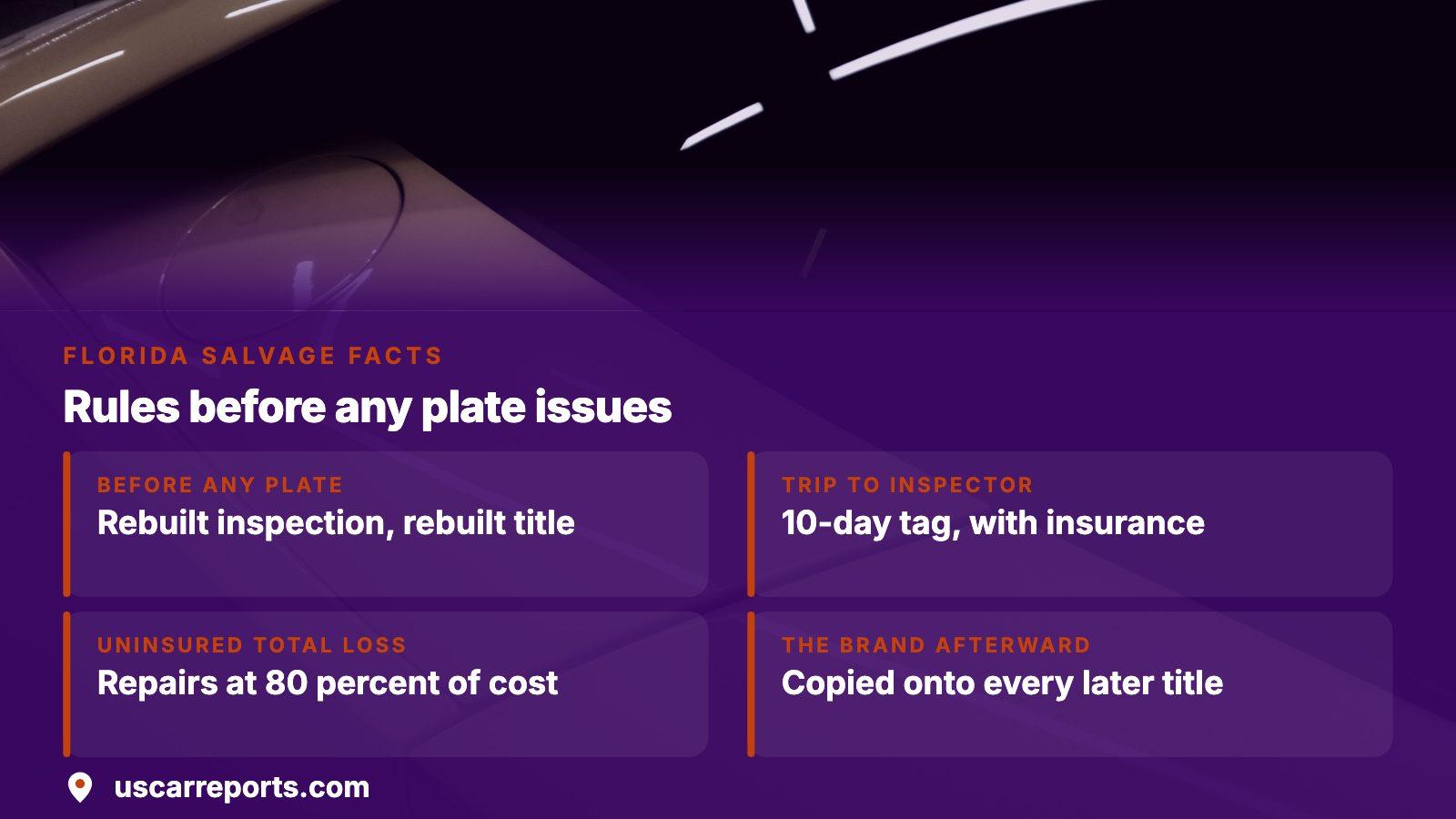
- Before any plate
- A rebuilt inspection and a rebuilt title
- Trip to the inspector
- 10-day temporary tag, with Florida insurance
- Uninsured total loss line
- Repairs at 80 percent of replacement cost
- The brand afterward
- Copied onto every later title and registration
What a salvage title records, and what it leaves out
Florida uses the word salvage for a total loss. The state counts one when an insurer pays the owner a replacement amount or settles a theft claim. For an uninsured car, the line is crossed once repairs would cost 80 percent or more of buying a like car. The title brand records that event and nothing after it.
So a salvage title is a snapshot of the worst day in the car's life, not permission to drive it. The owner has 72 hours from the moment the car becomes salvage to send in the title, and an insurer that pays out gets the same window after it holds the paper.
Check that the paper says salvage, not destruction
Some wrecks never get a rebuildable title. For a car of model year seven years old or newer that was worth at least $7,500 before the damage, Florida declares it unrebuildable when repairs reach 90 percent of retail value and prints a certificate of destruction. That paper allows dismantling or destruction only, so ask to photograph it.
The order of steps from salvage paper to a plate
County tax collectors process these transactions for the state, and their guidance follows one sequence.
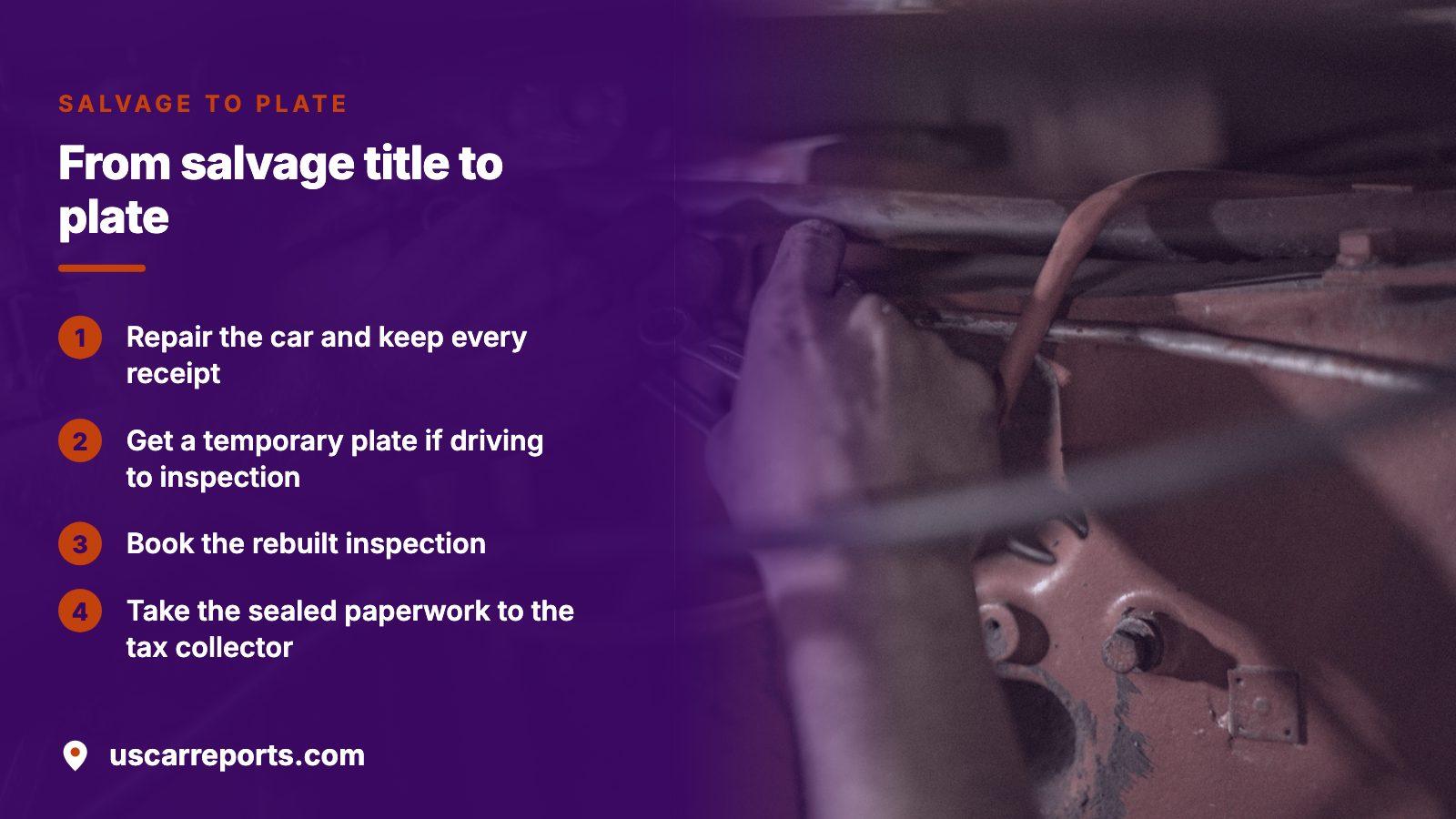
- Repair the car and keep every receipt, along with the photos covered in the next section.
- If the car must be driven to the inspector, ask the tax collector for a temporary plate good for 10 days. Proof of Florida insurance is required.
- Book the rebuilt inspection with a state regional office or an approved private facility. The tax collector's office does not inspect.
- Collect the paperwork the inspector hands over, still sealed, and leave it sealed.
- Take everything to the tax collector: the salvage title, the title application (form HSMV 82040), part receipts, photo ID and the fees. Title and registration are completed at that counter.
Skipping ahead does not work: until the rebuilt title exists, the car cannot be registered or lawfully driven, apart from the tag trip.
What the inspector reviews, and which parts count
The inspection combines a physical identity check with a document audit. Florida's rule lists the file: the endorsed title paper, a rebuilt-title application, a rebuilder's affidavit, a before-repair photo of the wreck if one exists, interior photos where airbags were replaced, itemized receipts for parts and repairs, and proof the rebuild was reported to the national title database.
| Vehicle | Parts the rule treats as major |
|---|---|
| Cars | Engine, transmission, frame, floor pan, catalytic converter, airbags, doors, hood, trunk lid, decklid, fenders, bumpers, cowl and rear quarter panels |
| Pickups | The car list, plus any truck bed |
| Electric and hybrid vehicles | The car list, plus items such as the traction battery pack, drive motor, charge port and onboard charger |
The inspector also confirms who owned the major parts, so proof of ownership for replacements belongs in the folder. A failed car can be rechecked only by the state or the facility that failed it.
Registration once the rebuilt title exists
Registration follows the title, with one difference: the brand rides along. A vehicle that runs on Florida roads has to be registered in the state. The applicant shows proof of a Florida address plus identification, meaning a REAL ID license or card or a passport, and the agent must refuse the registration without proof of the required insurance.
Under the same statute, a title brand is written on the registration certificate and copied to each later title and registration for as long as the vehicle exists. A rebuilt car does not graduate to a clean one.
Insurance comes before the inspection
Line up a Florida policy early. The temporary tag asks for proof of valid Florida insurance, and the registration counter wants proof of the required coverage. Ask your insurer how it treats a rebuilt car before you commit to the repair.
Bringing a branded car in from another state
Florida driveways hold plenty of cars titled elsewhere first, and the state treats their history as portable. A brand on a foreign certificate must be carried onto the Florida registration and every title after it. The application states that the car was titled outside Florida, with the time and place of the last title, and the new Florida title names that earlier state.
The VIN also has to be verified before registration: either a sworn statement from seller and buyer, or a state form completed after the owner and an outside witness physically check it. The witness can be a police officer, a dealer, a license inspector or a notary.
These sources do not say whether a car another state already branded rebuilt needs a second Florida inspection. Ask the tax collector before you pay, and get the answer in writing.
Buying or selling a rebuilt car: disclosure, ads and the decal
- The seller must give the buyer written notice that the car is rebuilt before the deal closes.
- Every ad for the car has to say so clearly. Leaving it out is a second-degree misdemeanor.
- Nobody may knowingly offer the car for sale until the state has stamped the title as rebuilt.
- After the inspection the state puts a rebuilt decal on the car, and removing it to hide the status is a third-degree felony.
A seller who skips the disclosure is breaking the rule. One carve-out cuts the other way: someone is not civilly liable under this section when the brand never showed on the title or registration handed to them, unless they hid it on purpose. The paper in your hand may not protect you, so check the history yourself.
Where a VIN check fits before you buy a branded car
Run the VIN before the deposit, because brand history decides whether the car is worth the rebuilt process at all. USCarReports opens with a free preview that checks the VIN against the listing. The full report is a one-time purchase, and prices sit on the pricing page. On a branded car, read the title brands and which state issued each, the salvage and auction photos, the odometer readings and any insurance entries.
Pair it with two public lookups. NICB's VINCheck looks a VIN up in theft, salvage and flood records filed by member insurers, with a cap of five searches per day per IP address. The federal NMVTIS site adds brand history, the latest odometer reading and any insurer total-loss determination.
A clean result is not proof of a clean car
The Department of Justice says 87 percent of the nation's vehicles are in NMVTIS, yet a search can still come back falsely clean. NICB says its tool is not a full history report. States also set their own damage thresholds, so a car one state brands salvage may carry no brand in another. Treat a brand as real and a missing one as unconfirmed.
Where this information comes from
- Florida Statutes 319.14: rebuilt vehicles — Supports the sale ban before the rebuilt stamp, written disclosure, ad wording, the decal and brands carrying forward.
- Florida Statutes 319.30: salvage and total loss — Supports the total-loss test, the 72-hour title rule and the certificate-of-destruction thresholds.
- Florida Statutes 319.141: rebuilt inspection program — Supports the inspection file, who may inspect and how a failed car is rechecked.
- Florida Statutes 320.02: registration — Supports the identification, insurance and VIN verification requirements at registration.
- Indian River County Tax Collector: applying for a rebuilt title — Supports the temporary tag, the three-step process and the documents to bring.
- NMVTIS for consumers (U.S. Department of Justice) — Supports what a federal title search shows, permanent brands, state differences and the false-negative warning.
- NICB: VINCheck — Supports what the insurer-record lookup covers, its daily search limit and its stated limits.
Sources and photos: Facts checked against the sources above in November 2026. Photos by engin akyurt, Nina Mercado and Franck V. on Unsplash; diagrams by USCarReports.
Keep reading
- Florida VIN check: title records, flood risk and Florida buying rulesFlorida's title lookup, storm-flood risk and private-sale rules in one place.
- Florida title check by VIN: brands, liens and whose name is on itHow to read the state's own title record before a Florida purchase.
- Certificate of destruction by state: what the paper allowsWhat the destroy-only paper allows, and how it differs from salvage.
- Registering a car in another state: deadlines, title and checksThe registration steps when a car arrives from outside the state.
Frequently asked questions
Can I register a car that has a Florida salvage title?
Not for road use. County tax collector guidance says anything declared salvage or junk must first be issued a rebuilt title, because without it the car cannot be titled, registered or lawfully driven. The path is repair, rebuilt inspection, then the title and registration transaction, and the registration carries the rebuilt brand.
Can I drive a salvage-titled car to the inspection?
A temporary plate exists for that one trip. Indian River County's tax collector issues a 10-day plate for driving to the rebuilt inspection, after you show proof of valid Florida insurance. Other offices may differ, so call yours. Do not drive the car for any other purpose until the rebuilt title is issued.
Will the rebuilt brand ever come off a Florida title?
Florida law carries a brand forward to each later title and registration, for as long as the vehicle exists, and that covers a brand from another state's certificate. The federal title database also keeps a state-applied brand permanently. Expect any later buyer to find it, and price the car accordingly.
Who performs the rebuilt inspection in Florida?
Only the state or a participant it authorizes: a regional office of the highway safety department, or a private facility in the program, which covers 12 counties including Miami-Dade, Broward and Orange. A car that fails can be rechecked only by the state or the same facility, so choose with that in mind.
What does a VIN check show on a car with a Florida salvage brand?
It lists the state behind each title brand and when it was applied, salvage or auction records with photos where they exist, odometer readings and insurance entries. It cannot show repair quality or how thorough the inspection was, so hire an independent mechanic before you pay.
Now check the car itself
The guide explains what to look for. The report shows what this VIN has on record.