THE SHORT ANSWER
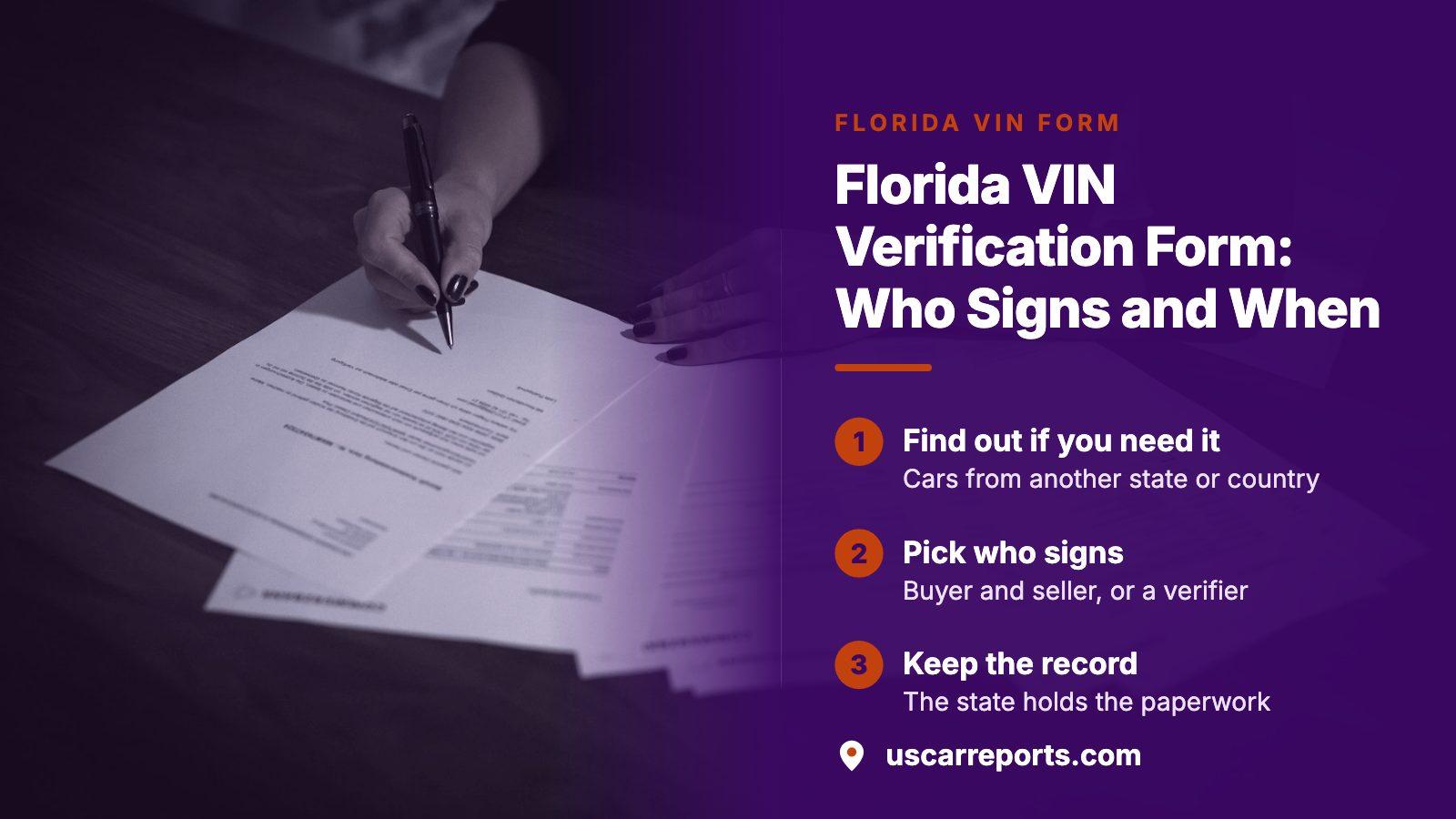
Florida asks for a VIN verification when a vehicle was previously titled or registered somewhere else. Either the buyer and seller inspect the number and sign Part A of HSMV 82042, or an official signs Part B after a physical look: a tax collector employee, a notary, or a police officer from any state. Brand-new vehicles and small trailers are exempt. The form says nothing about the car's history.
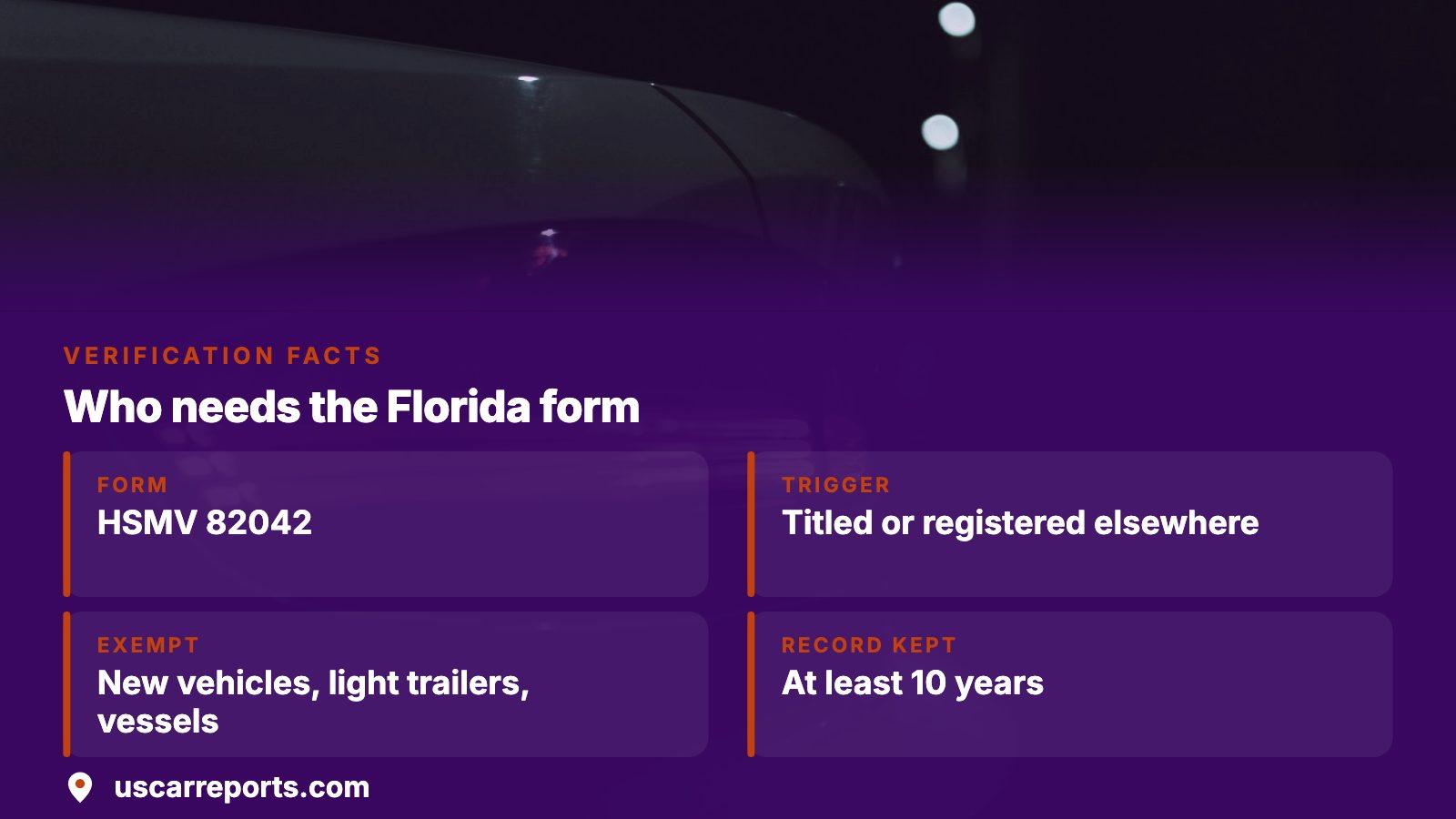
- Form
- HSMV 82042, or Section 8 of HSMV 82040 MV
- Trigger
- Titled or registered in another state or country
- Exempt
- New vehicles, trailers under 2000 lbs, vessels
- Record kept
- State holds the paperwork at least 10 years
What the form proves, and what it leaves out
HSMV 82042 is a witness statement. Somebody stands next to the car, reads the VIN on the vehicle itself, matches it against the VIN written on the title application, and signs to say the two are identical. That is the whole claim. The form does not say whether the car was wrecked, whether a lender still holds a lien, or whether the odometer was rolled back.
USCarReports covers the state-by-state rules for buyers, so this page sticks to Florida's paperwork. The practical point is simple: a signed form shows the car and the papers agree with each other. It does not show that the car is a good purchase. Those are two separate questions, and Florida only asks the first one at the counter.
Which cars need a verification in Florida
Under the title statute, a car that has never held a Florida title must come with proof that its VIN was checked against the vehicle. The registration statute repeats the requirement for a vehicle registered outside the state. In practice a county tax collector, such as Lee County, applies it whenever the ownership papers were issued by a different state, a territory or another country.
| Situation | Verification needed? |
|---|---|
| Used car titled in Georgia, now moving to Florida | Yes |
| Car with only a foreign registration or title | Yes |
| Brand-new vehicle never titled before | No |
| Travel, camp or fifth-wheel trailer | No |
| Trailer weighing under 2000 lbs | No |
| Off-highway vehicle or vessel | No |
Ask your own tax collector before you go, because counties explain the rules in their own words and the state's procedures TL-10 and TL-72 are the underlying references.
Two ways to get it signed
The statute gives two routes. The first is a sworn affidavit from both seller and purchaser stating that the VIN on the affidavit is the VIN on the car. The second is the department's own form, completed after a physical examination by the owner together with an authorized verifier.
Counties have turned this into a two-part form. In Part A, the buyer and seller inspect the number at the time of sale and both sign. In Part B, an outside official signs after looking at the car. Lee County says the buyer-and-seller option is allowed, so an ordinary private sale can finish the paperwork in the driveway.
Do it at the sale
Part A only works if both people are standing at the car. Once the seller has gone home with the money, you are looking for a tax collector, a notary or an officer instead.
Who may sign as the outside verifier
The statutes name police and sheriff's officers from any state, licensed dealers, license inspectors, and notaries. Lee County's own list reads a little differently and adds practical names. Because wording differs between the statute and a county page, treat your tax collector's list as the one that decides.
- A tax collector employee, usually at the service center when you title the car
- A Florida notary
- A law enforcement officer from any state
- A Florida DMV compliance examiner or inspector
- A military police officer
- A licensed dealer, named in the statutes but not on the county list
Nobody on the list may be the seller. The signature has value only because the person signing gains nothing from the sale.
Vermont cars and other special cases
Lee County flags one state by name. Lee County says a Vermont car older than 15 years that comes with just a registration, and no title, must be seen by a DMV compliance examiner or inspector, and it asks you to phone ahead for an appointment. Bring a Vermont title instead and the usual verifiers will do.
Two more cases come from the title statute. Odometer paperwork rides along with it: for a used car entering Florida's title system, the owner also swears that the mileage written down is the mileage on the dash. And if the seller has no title passing along the earlier owner's rights, the department may take a bond and an affidavit that folds in the VIN verification. That route is slower and belongs with a title agent.
What happens at the tax collector's counter
If you want a tax collector employee to do the inspection, drive the car there when you apply for the title. Lee County notes that its offices cannot carry out VIN inspections in bad weather, so a rainy day can cost you a second trip. Bring the signed bill of sale, the previous title, and the car itself.
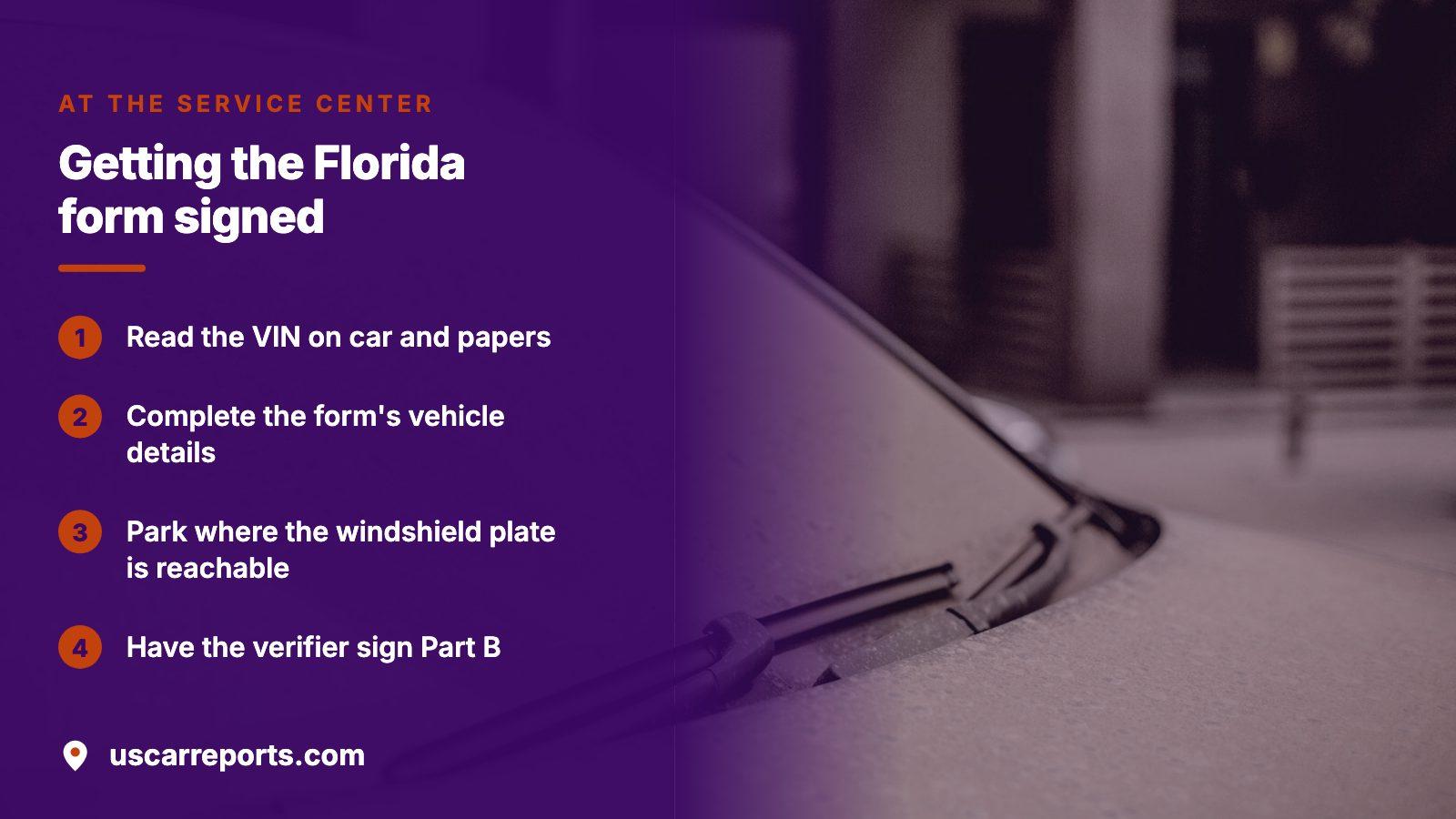
- Read the VIN on the car and on your papers before you leave home.
- Fill in the form's vehicle details so they are complete on arrival.
- Park where an employee can reach the windshield plate.
- Have the verifier sign Part B, or sign Part A with the seller earlier.
- File the form with the title application. The state keeps such records for at least 10 years.
That retention period matters if a VIN is ever questioned later: the record of who looked, and when, stays on file.
What a signature cannot tell you
A verified VIN can still sit on a car with a troubled past. The federal title database describes cloning as a theft trick: a thief fits a stolen car with a VIN lifted from another vehicle sharing its make, model and year, and nobody downstream can tell it is stolen. That page cites a federal operation that recovered about 250 cloned vehicles. A clone can pass the visual match, since the plate and the clone's papers carry one and the same VIN.
Title history is the other gap. The same federal page warns that a clean result guarantees nothing, that coverage is incomplete, and that brands follow each state's own rules, so a car that was once salvage in spirit may never have received the brand. It also omits much of what a state's own title file holds. That is why a VIN check is worth running before the verification, while the money is still in your pocket.
Run the VIN before anyone signs
Put the VIN into the USCarReports preview first. The preview costs nothing, and it shows whether the year, make and engine match the ad. If it looks right, the report is one payment (see the pricing page) and goes through brands, wrecks, mileage readings, liens and theft entries for that number.
Order of operations
Check the history, then inspect the car, then sign the verification. Signing first makes the paperwork look settled while the real questions are still open.
Where this information comes from
- Lee County Tax Collector: VIN verification requirements — A county office's plain-language list of who signs, what is exempt and the Vermont exception.
- Florida Statutes 319.23: application for certificate of title — The affidavit and physical-examination routes, the exemptions and the retention period.
- Florida Statutes 320.02: registration — The same requirement stated for vehicles registered outside Florida.
- NMVTIS: information for consumers — Describes VIN cloning and why a clean title report is not a guarantee.
Sources and photos: Facts checked against the sources above in November 2026. Photos by Dimitri Karastelev, JavyGo and Johnathan Kaufman on Unsplash; diagrams by USCarReports.
Keep reading
- Florida VIN check: title records, flood risk and Florida buying rulesThe history lookups to run on a Florida car before you buy it
- Florida title check by VIN: brands, liens and whose name is on itChecking the state title record, which a verification never touches
- Registering a car in another state: deadlines, title and checksThe wider steps for moving a car's registration between states
- Sample reportSee each section of the report before you buy
Frequently asked questions
Is the Florida VIN verification form free?
I did not find a fee for the form itself on any page I could open, and the state's own site refused my requests. Tax collector offices may charge for the title work around it, so ask your county for the current amount before you drive over.
Can I verify my own car's VIN?
Not on your own. The owner takes part in the inspection, but the signature that matters comes from the other party to the sale in Part A, or from an outside official in Part B. The seller counts as a party to the sale, not as the independent verifier.
Does a notary have to be from Florida?
Sources differ. The title statute says a notary commissioned by this state, the registration statute says any state, and Lee County lists a Florida notary. Choose a Florida notary and you satisfy all three.
Does the verification tell me if the car was in a flood?
No. It only lines up the plate against the number on the papers. Flood or salvage brands live in title records, which is why a separate history check and a hands-on inspection are worth doing.
What if the car has no title from the seller?
The department may accept a bond and an affidavit that includes the VIN verification, instead of an assigned title. That path has more steps, so talk to the tax collector or a title agent before paying for the car.
Now check the car itself
The guide explains what to look for. The report shows what this VIN has on record.