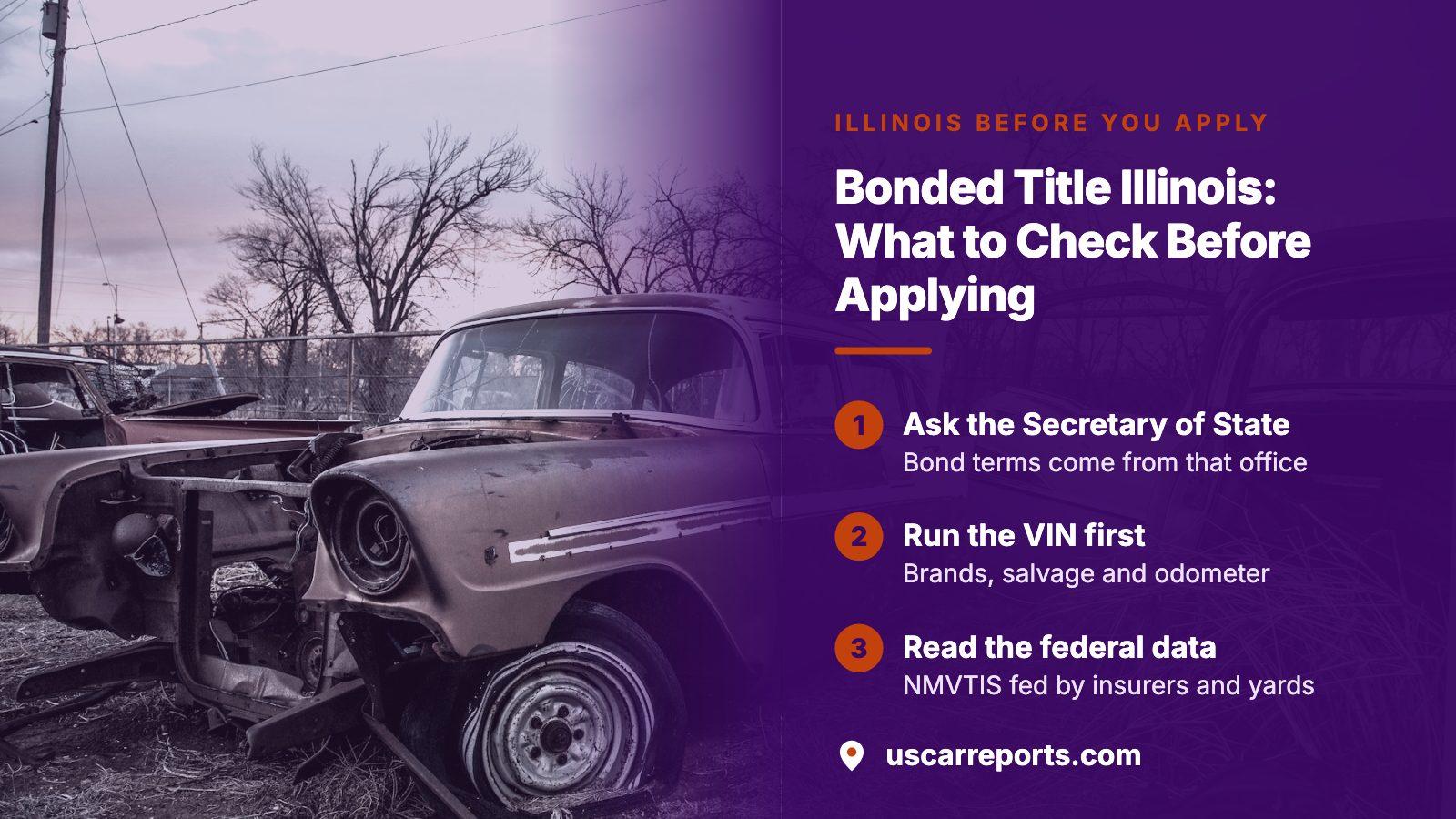
THE SHORT ANSWER
Illinois bonded title applications go through the Secretary of State's Vehicle Services side, and the current bond amount, length, form and fee should come from that office, not from a bond seller's page. We could not load the agency's pages while writing this, so we print no figures. What you can do today is run the VIN, because a bond protects against ownership claims, not against a branded car.
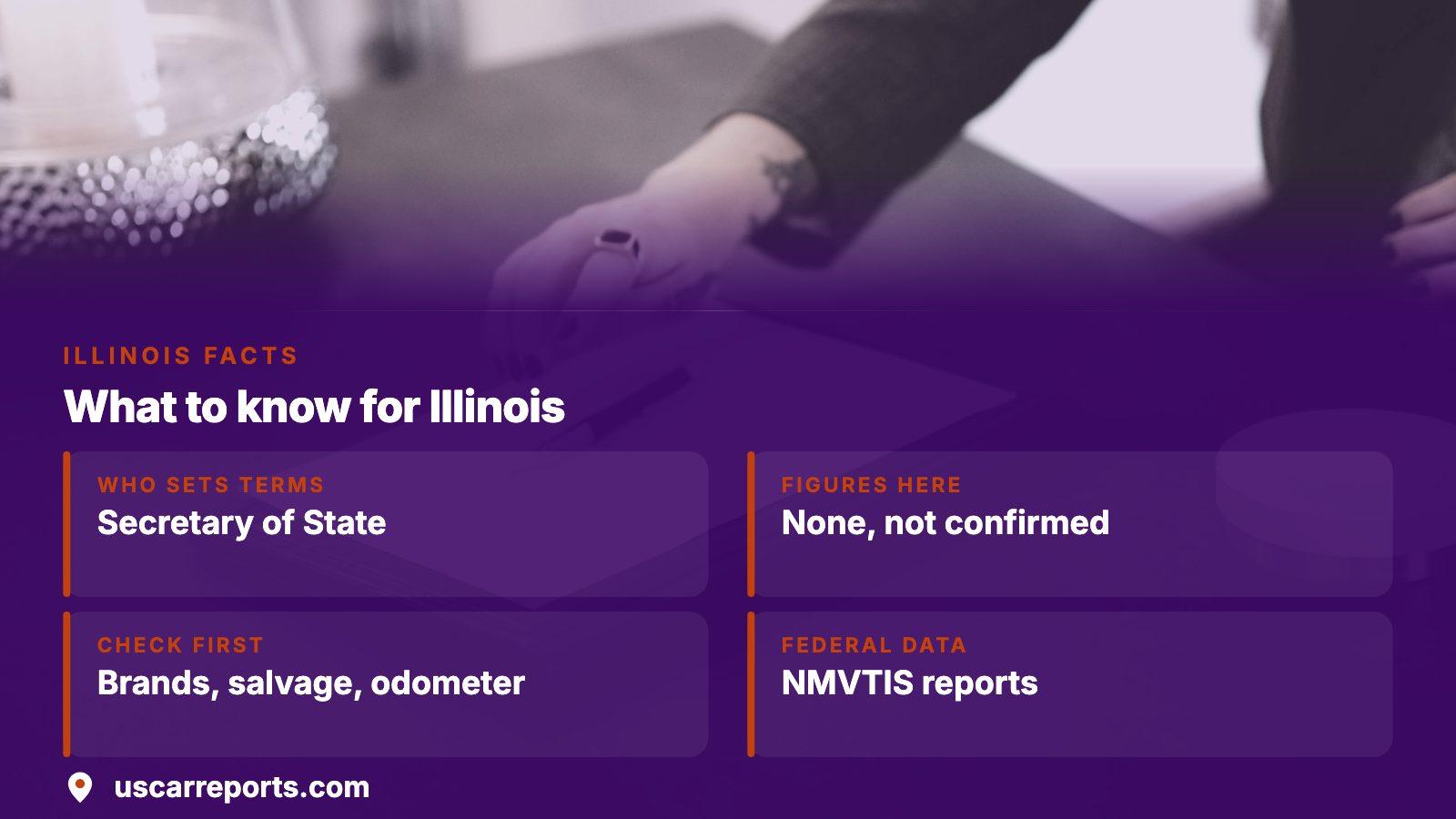
- Who sets the terms
- Illinois Secretary of State
- Figures on this page
- None, by design: not confirmed
- Check first
- Title brands, total loss, salvage, odometer
- Federal data
- NMVTIS, reported by insurers and salvage yards
What we could confirm, and what we could not
While preparing this page we tried the Illinois Secretary of State's vehicle pages, the state's statute and administrative code sites, and the Department of Revenue's vehicle forms. The Secretary of State returned an access denied response, and the others would not connect. That means we never saw the official text on Illinois bond amounts, how long a bond stays in place, which application form applies, or what it costs.
Search results are full of surety company pages that state those numbers with confidence, and some disagree with each other. We left them out. A figure you cannot trace to the agency is a figure that can cost you money when it turns out to be stale.
How to read this page
Where a rule would normally appear, you will find the question to put to the Secretary of State instead. The vehicle history material below comes from federal pages we did read.
What a bonded title is for, in plain terms
When paperwork is missing, a titling office has a problem: it cannot be sure the person applying is the true owner. Some states let the applicant post a bond, a financial promise backed by a surety company, so that anyone who later proves a better claim has money to draw on. If a claim is paid, the surety turns to the applicant for repayment.
Typical cases: the seller vanished after the sale, a relative left a car with no title, or a dealer closed before delivering the paper. The car may be fine, and only the ownership chain has a gap.
What the bond does not do is vouch for the vehicle. A bond says nothing about whether the car was totaled, flooded, or rolled back on the odometer. That part is your job, and it comes before you pay for anything.
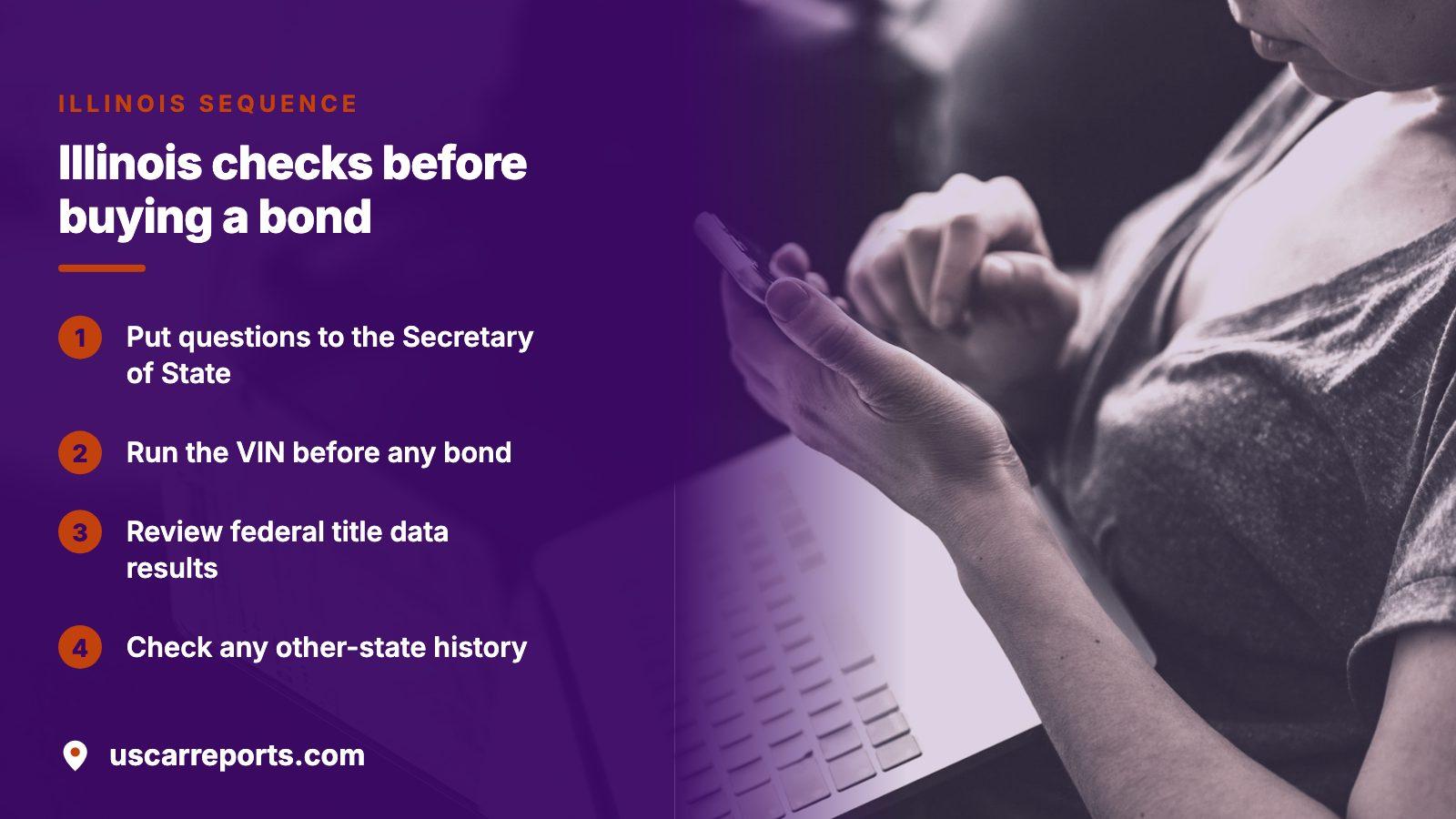
Questions to put to the Secretary of State
Because we could not confirm Illinois's rules, treat this as the list to take to the agency, by phone or at a facility, before you buy a bond. Write down the answers and the date you got them.
- Does Illinois issue a bonded title for my situation, or does it want a different procedure first, such as a duplicate title or a court order?
- Which application form and supporting documents does the office want for a car with no title?
- How is the bond amount worked out, and from whose valuation of the car?
- Can the bond be a surety bond, a cash deposit, or both?
- How long does the bond stay in force, and what happens to it at the end?
- What are the current title fees, and is any tax owed on the transfer?
Ask whether the answers differ for a car that came from another state, since the office treats out-of-state vehicles under extra checks, covered next.
Run the VIN before you buy any bond
A missing title calls for closer scrutiny of the car. Owners sometimes lose a title for innocent reasons, but a car with no paper trail is also how a salvage brand, a lien or a theft record slips through. Pull the VIN history first, and if it shows trouble, you may decide not to bond at all.
USCarReports starts with a no-cost preview of the VIN, and buying the report later is a separate step, with amounts on the pricing page. Read these report sections first: brands, then total loss and salvage, then mileage, then liens and theft.
Compare what the report says with what the seller told you. A seller who describes a clean one-owner car while the record shows a salvage auction sale is exactly the mismatch a check exists to catch.
What the federal title database shows
The Department of Justice runs the National Motor Vehicle Title Information System, and its public report is deliberately short. Its five indicators are title status with the latest title date, brands, odometer, total loss and salvage.
| Indicator | Why it matters for a no-title car |
|---|---|
| Current state of title | Shows where the car was last titled, so you know which state's records to ask about |
| Brand history | Labels such as junk, salvage or flood that any state ever applied |
| Odometer reading | Gives a reading to compare against the seller's story |
| Total loss history | Flags a car an insurer already wrote off |
| Salvage history | Shows handling by salvage yards and auctions |
Federal law obliges insurance carriers and scrapyards of every kind to send records to the system. A clean result is described by the program as a good sign, though it covers only those indicators.
If the car came from another state
Titling offices use the federal system when they title a car from out of state. They look for earlier junk or salvage reports, compare the odometer reading with earlier data, and test things like lienholder status. How the car is branded, and which title it gets, is up to the state doing the titling. The federal data only flags mismatches.
For you, that means a no-title car from elsewhere can be checked against the same records the office will see. If your report shows a brand from another state, expect the Secretary of State to raise it, and do not assume a bond will smooth it over.
Our Illinois title check page covers how brands and records line up for cars titled here, and the general bonded title page explains how the instrument differs across states.
Free checks that cost nothing to run
Two free tools are worth using alongside any paid report. The National Insurance Crime Bureau runs a VIN lookup that includes flood damage and other insurer-reported information, and federal safety recall lookups are free on the NHTSA site.
Free tools have limits. The NICB database depends on what participating insurers reported, and recall lookups say nothing about ownership or title brands. They are a quick first pass, not a replacement for the title records.
Order of operations
Run the free lookups, run the VIN preview, get the Secretary of State's answers in writing, and only then pay a surety company or apply.
Spending money safely on a no-title car
The federal buying tips page repeats advice from the Federal Trade Commission: hire a mechanic to inspect the car, test drive it on varied roads, check a trusted history database, and ask for maintenance records. With a no-title car those steps matter more, because you have less paper to lean on.
- Get a bill of sale with the seller's full name, the VIN and the date.
- Compare the number stamped on the car with any paper the seller does hold.
- Keep every document, text and receipt that shows how the car reached you.
- Do not pay the full price until the history comes back clean enough to justify the extra paperwork.
If the history is clean and the Secretary of State confirms a bonded route exists for you, you will be applying with eyes open. If not, walking away costs far less than a bond on the wrong car.
Where this information comes from
- Justice Department NMVTIS: what its report contains — what the public title report covers and who feeds it
- NMVTIS: For states — how titling offices use the data on out-of-state cars
- NMVTIS: Used car buying tips — inspection and history advice relayed from the FTC
Sources and photos: Facts checked against the sources above in November 2026. Photos by Leo_Visions, Michal Biernat and Annika Wischnewsky on Unsplash; diagrams by USCarReports.
Keep reading
- Bonded title: what it means for a buyer, state by statehow bonded titles differ across states
- Illinois Title Check by VIN: Brands, Rebuilders and Recordsbrands and records for Illinois cars
- Illinois VIN check: records to run and Illinois buying rulesrunning the VIN on an Illinois purchase
- Title status check: what the state lookup tells a car buyerconfirming where a title stands
Frequently asked questions
How much is a bonded title in Illinois?
Those Secretary of State pages never loaded for us, so there is no amount here. Bond sellers quote numbers, and they do not always agree. Ask the Secretary of State how the bond is calculated and from which valuation, get the answer in writing, and only then request a quote from a surety company.
Can I get a bonded title in Illinois if the seller will not sign?
That is the main reason people look at bonds, but whether Illinois offers it for your facts is the agency's call. Ask the Secretary of State which procedure applies when the seller is gone, and whether another step, such as a duplicate title request, must come first.
Does a bond fix a salvage brand?
No. A bond addresses competing ownership claims. A salvage or flood label is a record of what happened to the car, and it follows the vehicle. Run the VIN before you apply so you know about any brand before you spend money.
What should I run on a car with no title?
Run the VIN for title brands, total loss and salvage entries, odometer readings, liens and theft records, and use the free NICB and NHTSA lookups too. Compare every result with the seller's story, then match the VIN on the car to your paperwork.
What does USCarReports charge?
The VIN preview carries no charge. Buying the full report is one payment, never a subscription, and the amounts sit on the pricing page. Many buyers read the preview first and then decide.
Now check the car itself
The guide explains what to look for. The report shows what this VIN has on record.