THE SHORT ANSWER
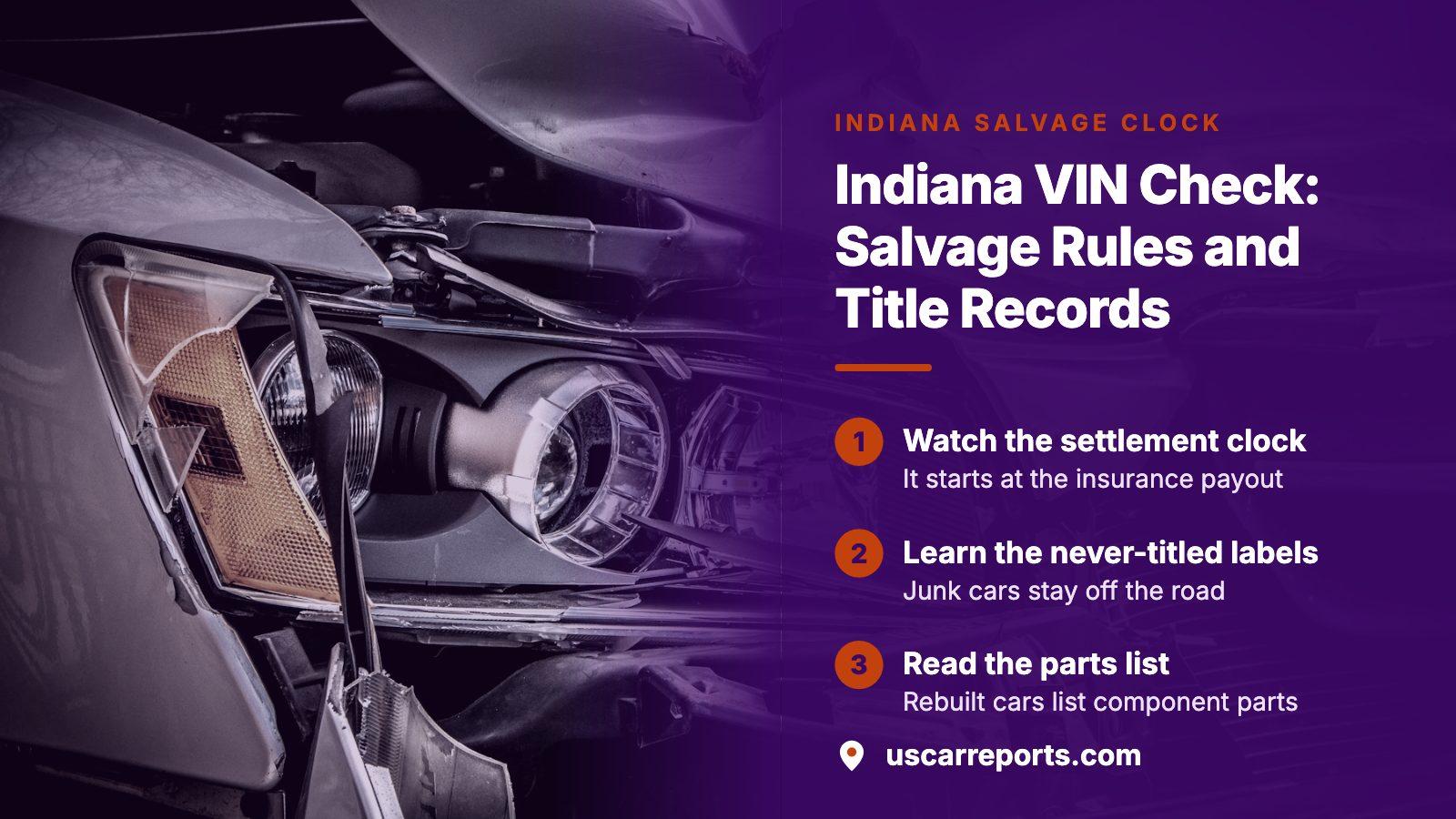
Read the VIN off the car, compare it with the seller's title, then run NHTSA's recall search and NICB's VINCheck before pulling the national title record. Indiana changes what that record can show in two ways. A written-off car that its owner keeps needs a salvage title application within 45 days of the insurer's settlement, and junk or non-repairable vehicles cannot be titled in the state. Every Indiana VIN gets a free preview here.
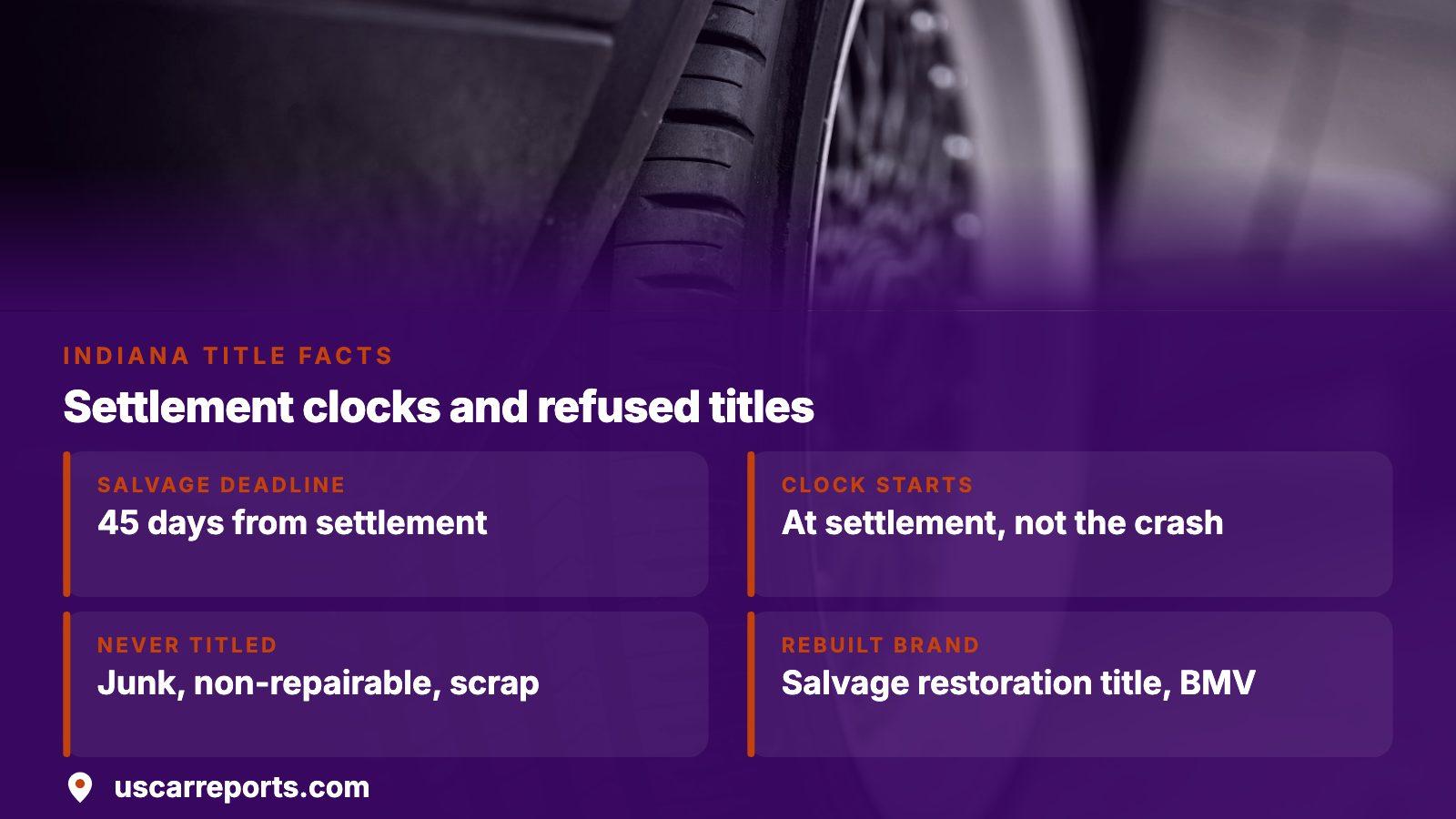
- Salvage deadline
- 45 days from settlement, when the owner keeps the car
- When the clock starts
- At the insurance settlement, not on the day of the crash
- Never titled
- Junk, non-repairable and scrap designations
- Rebuilt brand
- Reached through a salvage restoration title at the BMV Central Office
What an Indiana VIN lookup can and cannot tell you
A VIN search in Indiana gets you two separate things. One is the national record attached to the number, wherever the car has been. The other is Indiana's own set of titling rules, which decide what the paper in the seller's hand can and cannot mean. USCarReports covers every state in this pairing, so an Indiana buyer reads the history and the state's rules side by side.
| Source | What it answers | Cost to you |
|---|---|---|
| NHTSA recall search | Open safety recalls on that VIN | Free |
| NICB VINCheck | Theft records and total losses that participating insurers have filed | Free |
| NMVTIS-approved provider | Title brands from every state that reports into the federal system | Paid |
| USCarReports report | Brand history, damage entries, mileage readings, auction photos and open liens | Free preview, then one payment |
The free tools never read the title history, and a state document only shows what that state recorded. Neither one can see damage that nobody ever reported.
Indiana's salvage clock starts at the insurance settlement
Indiana ties salvage paperwork to the insurer's payout rather than to the crash. When the owner of a written-off vehicle keeps it, that owner has 45 days from the settlement to apply for a certificate of salvage title. A wreck in spring that settles in late summer starts its clock in late summer.
So an Indiana record can trail the real event by months. Nothing official exists until an insurer declares the loss, and the title application is the first trace the state sees. A car listed today may have been wrecked long before any paper existed.
Where owner-kept write-offs hide
When the insurer pays and the owner keeps the car, no dealer, auction lot or salvage yard ever handles it. Years later it can be listed as an ordinary private sale by someone who sounds entirely honest. The national title record is what shows the earlier loss, which is why the seller's manner should never decide whether you run it.
Junk and non-repairable cars cannot be titled in Indiana
Many states will put a title on almost any car that can be made drivable again. Indiana is stricter. A vehicle labeled junk, non-repairable, scrap or anything similar cannot be titled in the state.
| Designation | How Indiana treats it |
|---|---|
| Salvage | Issued as a salvage title; repair is dealt with later through a separate application |
| Rebuilt | Reached only through a salvage restoration title |
| Junk | Refused outright |
| Non-repairable or scrap | Refused outright |
For a buyer, the gain is real. A car branded junk in another state cannot show up in Indiana and be reissued clean, because the state has nowhere to file it. The protection only works once a brand already sits on a record, though. A car whose damage was never reported passes through untouched.
From salvage to rebuilt: a central-office process
A repaired salvage car does not turn rebuilt by itself. For the rebuilt brand on a car previously branded salvage, the owner has to request a salvage restoration title. Indiana's BMV processes salvage and salvage restoration applications at its Central Office, not over a branch counter.
That says something about timing. These are queued transactions, not same-visit ones, so a seller who says the paperwork will be done this week is describing a line at the state, not a certainty. Only the title you are handed at delivery counts. Put these questions to the seller:
- Is the title already in the seller's name and in hand, or described as in progress?
- Which brand does the current title show, salvage or rebuilt?
- If it still reads salvage, has a restoration application been filed, and can you see the paperwork?
- Does the VIN on the car match the title digit for digit?
Why Indiana's component parts list helps on a rebuilt car
Indiana defines major component parts by their numbering: the assemblies that usually carry the maker's VIN, a number based on it, or one issued by an authorized government agency. Rebuilders replace exactly these assemblies, so the definition doubles as an inspection list.
| Part | What to look for |
|---|---|
| Engine and transmission | An identifier that is present and fits the model and year |
| Frame | An identifier that is intact, with no grinding, odd welds or a freshly stamped surface |
| Doors and fenders | Identifiers in place, and any paint or panel-gap difference explained |
| Differentials | An identifier that is present and readable |
| Front assembly and rear clip | Identifiers in place, with seams that look factory or are documented |
Missing or mismatched numbers across these parts are the physical counterpart of a paperwork story that does not add up. Indiana is salt-belt country, so a lift also shows rust in the frame rails. Tell the shop the car was rebuilt before it goes up.
An Indiana VIN search in the order that protects your money
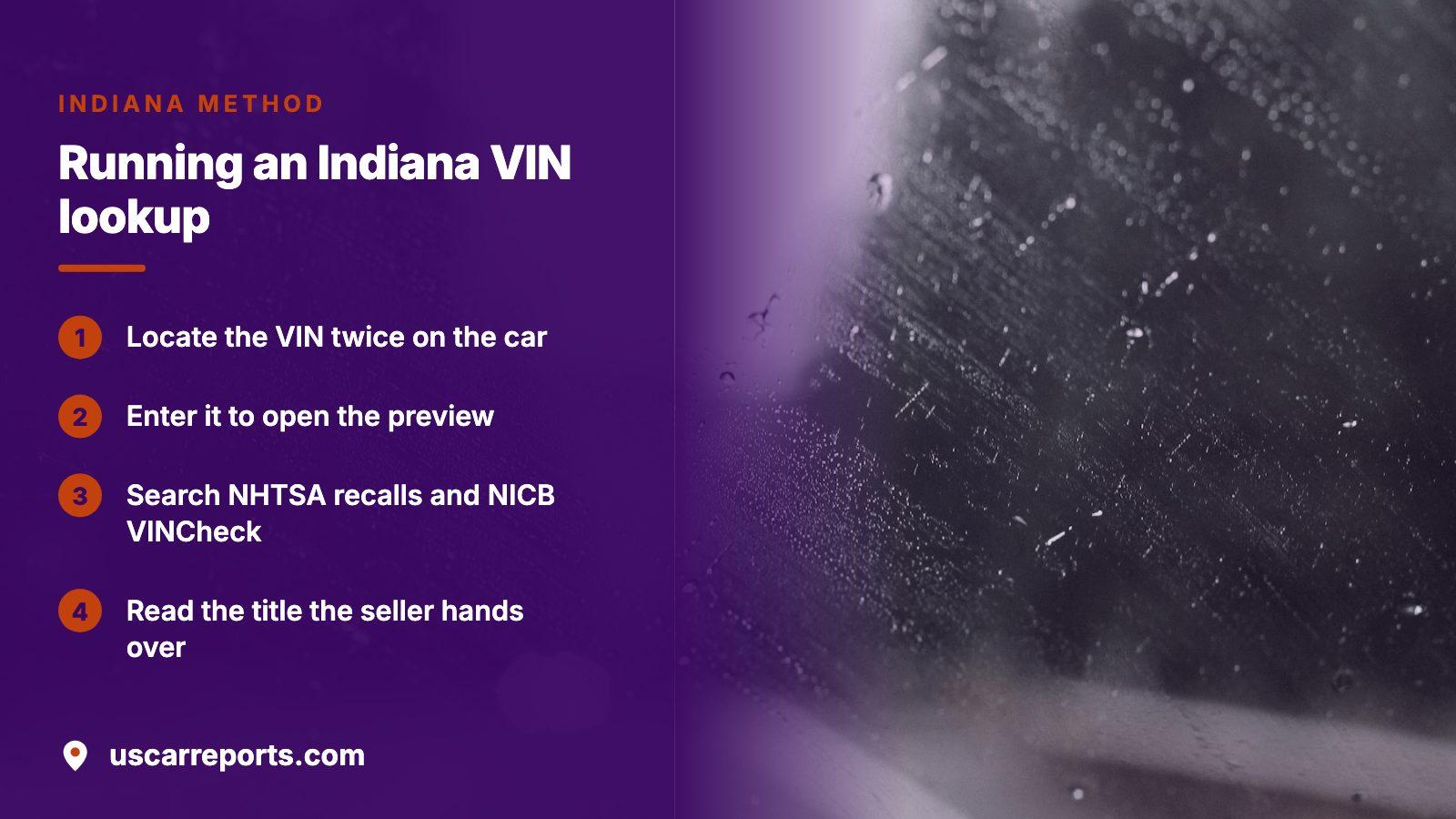
- Locate the VIN twice on the car, once on the dash plate visible from outside and once on the sticker in the driver's doorway, then compare both against the title character by character.
- Enter the VIN on this page to open the preview. You pay nothing for it, and it tells you whether the full report is worth the money.
- Search the VIN in NHTSA's recall tool and NICB's VINCheck. Both are free, and neither reads title history.
- If the car still looks right, buy the full report: one payment, no subscription.
- Read the title the seller actually hands over, not the one described by phone. Check the brand line, the seller's name and any lienholder listed.
- Before any deposit changes hands, have a mechanic you chose put the car up on a lift.
What should stop you when the Indiana report comes back
A report is a sequence of dated events, so read the dates first and the brands second.
- A salvage brand with no sign that a restoration title followed
- A brand from another state under a recently issued Indiana title
- A long gap between a total-loss entry and the next sale
- Auction photos showing damage the seller says never happened
- Mileage that stalls or drops between entries
- A lien or theft entry the seller never mentioned
One oddity deserves a question. Two together justify walking away, and so does any junk or non-repairable designation, which Indiana itself treats as final.
Cost, and what to do next
The preview costs nothing. The full report that follows is bought once, with nothing renewing; if more than one car is on your list, a bundle of 3, 5 or 10 brings the price per VIN down. Amounts are on /pricing.
Use the preview before you travel to look at a car, and buy the full report before any deposit moves. A clean report still cannot replace a mechanic's eyes, and that gap matters most on a rebuilt car. If the report shows a brand, a long silence in the record or a lien, get the seller's explanation in writing before you go any further.
Where this information comes from
- Indiana BMV: special titling circumstances — The salvage deadline, central processing and the designations Indiana will not title.
- Indiana BMV: salvage restoration packet — The route from salvage to a rebuilt brand.
- NMVTIS: National Motor Vehicle Title Information System — The federal title record and the list of approved providers.
- NICB: VINCheck — Free theft and total-loss lookup drawn from participating insurers.
- NHTSA: Recalls — The free open-recall search by VIN.
Sources and photos: Facts checked against the sources above in November 2026. Photos by Clark Van Der Beken, Cole Keister and engin akyurt on Unsplash; diagrams by USCarReports.
Keep reading
- Illinois VIN check: records to run and Illinois buying rulesThe neighboring state with its own rebuilt-title rule.
- Ohio VIN check: records to pull, title brands and Ohio buying rulesAnother Midwest state read the same way: records first, then local rules.
- Kentucky VIN check: sheriff inspection, brands and buying rulesCars cross the Indiana line often, so check the southern neighbor too.
- Title status check: what the state lookup tells a car buyerHow to confirm what a title says before you hand over money.
Frequently asked questions
How do I run an Indiana VIN check?
Check the number first, then work outward. Compare the VIN on the car with the title, run the free federal and insurer lookups, and buy the national title record. After that, read the title you will actually be handed and have the car lifted. An Indiana car can carry a loss that no local paper shows.
Can I do a VIN lookup in Indiana for free?
Partly. NHTSA's recall search and NICB's VINCheck cost nothing, but neither reads title history, which is the paid piece. USCarReports shows a free preview of any Indiana VIN, and the complete report is one purchase, so you can stop at the preview if the car looks wrong.
What is the deadline for an Indiana salvage title?
If the owner keeps the written-off vehicle, the application is due within 45 days of the insurance settlement. The crash date does not count. A car wrecked months before the settlement may only now be receiving its first official record, which is why a recent salvage entry for an older crash is normal.
Can a junk or non-repairable car be titled in Indiana?
No. Indiana will not issue a title to a vehicle labeled junk, non-repairable or scrap, and that holds when the label arrives from another state. A seller who promises an Indiana title for such a car is mistaken, so treat the offer as a reason to walk away.
Does a clean Indiana title prove the car was never wrecked?
No. A title shows what was recorded and when. An owner-kept write-off, a loss in another state or damage nobody reported can all sit behind a tidy document. The national record and a lift inspection fill in what the paper leaves out.
Now check the car itself
The guide explains what to look for. The report shows what this VIN has on record.