
THE SHORT ANSWER
To check a Kentucky VIN, copy the number from the car's dashboard, match it to the title and run the preview. Add NHTSA's recalls and the theft and total-loss entries NICB holds. Kentucky's public tools do not show title brands, so a national title record covers brands issued elsewhere. A passed sheriff's inspection proves identity papers only. USCarReports adds title, mileage, damage and auction entries after a free preview.
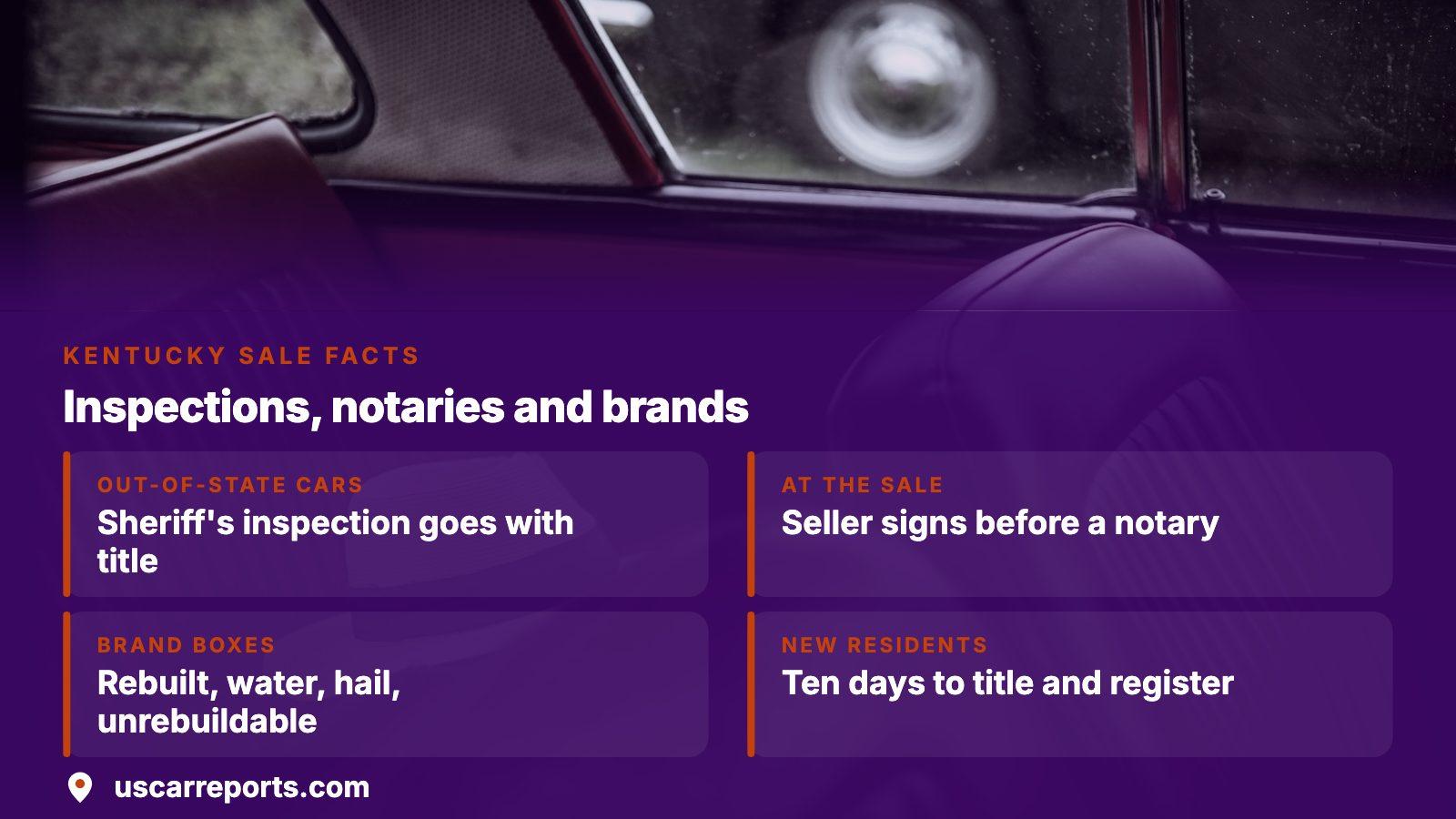
- Out-of-state cars
- A passed sheriff's inspection goes with the title application
- At the sale
- The seller signs the title in front of a notary
- Brand boxes
- Rebuilt, water-damaged, hail-damaged, unrebuildable
- New residents
- Ten days to title and register
What a Kentucky VIN lookup can see, and what stays hidden
A VIN search has two halves: the history attached to the number, and the Kentucky paperwork that follows a sale. Start with history, since it decides whether the paperwork is worth doing.
| Lookup | What it answers |
|---|---|
| Factory decode | What the maker reported: model year, body, engine |
| NHTSA recall search | Open safety campaigns on that number |
| NICB VINCheck | Theft reports and total losses that insurers pass along |
| Cabinet tax lookup | Vehicle tax paid in the year shown, nothing on the title |
| National title record | Brands issued by other states, gathered from reporting jurisdictions |
| USCarReports report | Title, mileage, damage, auction photo and lien entries together |
Kentucky's vehicle menu lists that tax lookup, paper title history requests and a fraud page, but no instant public title search. A car with years in Ohio or Tennessee needs a record that crosses state lines.
Running the search: start at the car, not the ad
- Match three things: the plate at the dash corner, the sticker on the door pillar and the number printed on the title.
- Enter it in the preview box here. No payment is needed to see whether records exist.
- Look up open recalls with NHTSA, then theft or salvage entries with NICB.
- Try the Cabinet's VIN box, which answers the tax question only.
- Buy the full report before leaving a deposit.
A seller who will not share the number, or a photo of both places it appears, has already answered a question.

The sheriff's inspection confirms identity, not condition
Kentucky treats a car from another state differently from one already titled here. An out-of-state title needs a passed Sheriff's Inspection, per the Transportation Cabinet, and its new-resident page says the same. For classic project cars it describes the step as verifying the VIN and ownership documents. Neither page mentions anyone examining brakes, tires or frames.
A passed inspection is not a repair opinion
A seller who says the sheriff signed off is probably honest about the paperwork: the number on the metal agrees with the documents. It says nothing about floods, collisions, a rolled-back odometer or a lender with a claim. A history record exists to show those.
A sale between two Kentucky parties skips the step and relies on a notary instead, so the checking rests mostly on you.
Kentucky's buying rules: notary, application and the clock
Every title change runs through the county clerk, and the Cabinet's pages separate a sale at home from a car arriving from elsewhere.
| Situation | What Kentucky asks |
|---|---|
| Private sale between Kentucky parties | Seller signs the back of the title before a notary; the new title is due within 15 days, or affidavit TC96-3 follows |
| Car titled in another state | Signed-over title, form TC 96-182 with notarized signatures, Kentucky insurance proof dated within 45 days, and the inspection proof |
| Car from a registration-only state | The registration or a bill of sale stands in for the title |
| New resident with a vehicle | Title and register inside 10 days of establishing residency; the registration application itself is due by day 15 |
The pages give more than one clock, so plan around the shortest. Transit tags serve non-residents buying Kentucky cars; a resident buying elsewhere is told the seller's state should issue temporary registration.
The brand boxes on Kentucky's application
Section 1 of form TC 96-182 asks the applicant to mark any brand that applies: rebuilt, water-damaged, hail-damaged or unrebuildable. If a box is marked but the title in hand does not print the brand, the applicant supplies the state and title number where the brand was issued. The form assumes somebody knows the car's past.
Know the answer before you sign
A title from another state can look clean while an earlier one carried a flood or hail brand. Read the brand history on your report first, so what you declare at the clerk's counter matches what the car went through.
Both parties also certify the sale price on this form, so write the figure actually paid.
Salvage and rebuilt cars: the paper a Kentucky seller should hold
A Kentucky rebuilt title is assembled from documents, so whoever did the rebuilding should be able to hand over each one.
| Paper | What it should show |
|---|---|
| Form TC 96-215 | Notarized affidavit for a car rebuilt from wrecked or salvaged parts |
| Form TC 96-353 | The repairs made, listed under KRS 186A.520 |
| Original parts receipts | Each part, plus the VIN of the donor vehicle, or a notarized note explaining why not |
| Insurer statement | Damage described on letterhead, when the car was not damaged beyond 75% of its value |
| Federal odometer statement | Needed for cars under 10 years old when mileage is missing from the application or title |
Parts bought from an individual carry that seller's name, address and phone, and the Rebuilt Section hands original invoices back after initialing them. Ask for those, and for photos from before the repair.
Mileage on a Kentucky transfer: only the seller can state it
The odometer statement sits in Section 2 of the application. It cites federal law at 49 USC 32705 and state law at KRS 190.300, and warns that a false statement may bring fines or imprisonment. Per the Cabinet, the seller alone discloses mileage when a title is updated. A wrong figure on a printed title is fixed by the seller on affidavit TC 96-322, which the clerk in the buyer's county processes.
- The figure the seller writes, set against every odometer reading on your report
- Either warning box (past mechanical limits, or not actual mileage), which flags a discrepancy
- White-out or overwriting, which clerks are told to refuse
Reading the results: red flags and where to take a problem
| Entry | What it may mean | Your move |
|---|---|---|
| A brand from another state, none on the paper | Something happened upstream that the seller's title does not repeat | Ask which state and title number; the application asks the same |
| Total loss, then a quick new title | Written off, repaired and returned to the road | Request repair bills and photos, then pay for a structural inspection |
| Mileage below an earlier reading | A rollback, a swapped cluster or a typing slip | Ask for a written account, and walk if it changes |
| Open lien | A lender still controls the title | Settle through the lender before money moves |
For a records dispute once you own the car, a Kentucky resident can order a title history on form TC96-16A; the Cabinet says it can help with odometer discrepancies, transfer dates and signature questions, and processes requests in 3 to 5 business days. Suspected vehicle fraud goes on complaint form TC 96-349.
What it costs and the next move
Running the preview costs nothing and tells you whether any records exist for the number. A report is a one-time purchase, with packs for shoppers comparing several cars, and the /pricing page lists the options.
- Run the preview and the free lookups on the number you read from the car.
- Buy the report if the car survives, before a deposit.
- Match the seller's name to the owner printed on the title, and line up a mechanic and a notary.
- Take the notarized paper to the county clerk with insurance proof, plus the inspection proof for a car from another state.
Where this information comes from
- Kentucky Transportation Cabinet: Vehicle Titling — The out-of-state title checklist, notary rules at sale, the transfer deadline and where the sheriff's inspection fits.
- Kentucky TC 96-182: Application for Certificate of Title or Registration — The brand disclosure boxes, the odometer statement and the sworn signatures.
- Kentucky Transportation Cabinet: Rebuilt-Salvaged Titles — The documents, parts receipts and damage statement behind a rebuilt title.
- Kentucky Transportation Cabinet: New to Kentucky — The deadlines for new residents and the sheriff's inspection for cars brought in.
- Kentucky Transportation Cabinet: Title History Requests — Who may order a title history, which form it uses and how long it takes.
- NMVTIS: National Motor Vehicle Title Information System — The federal title system that approved data providers draw on.
- NHTSA: Recalls — The no-charge search for open safety recalls by VIN.
Sources and photos: Facts checked against the sources above in November 2026. Photos by Sander Jeurissen, Tigran Shishmanyan and Nik on Unsplash; diagrams by USCarReports.
Keep reading
- Kentucky Title Check by VIN: Junked Titles, Rebuilds and Reassigned NumbersThe title side of buying in Kentucky, including brands and rebuilt cars.
- Ohio VIN check: records to pull, title brands and Ohio buying rulesAcross the river: how Ohio's title search and salvage inspection compare.
- Registering a car in another state: deadlines, title and checksWhat registering involves once you bring a car home from another state.
- Sample reportA look at how brand, mileage and lien entries are laid out before you pay.
Frequently asked questions
How do I run a Kentucky VIN check?
Start with the VIN on the car and hold it against the title. Then run a decode, a recall search and the NICB lookup, and open the preview here. If the car spent time in other states, add a national title record, since Kentucky's own tools do not report brands issued elsewhere.
Is a Kentucky VIN lookup free?
Parts of it are. A decode, the recall search, NICB and the Cabinet's tax lookup cost nothing, though none of them shows brands from other states. The USCarReports preview costs nothing either; the full report is bought once.
Is a sheriff's inspection required in Kentucky?
For a car titled elsewhere, yes: a passed Sheriff's Inspection is on the Cabinet's out-of-state checklist. The pages tie it to the VIN and ownership documents, not to safety or mechanical condition, so a mechanic still has to judge the car.
Does a Kentucky title sale need a notary?
Yes. When two Kentucky parties trade a car, a notary has to witness the seller's signature on the back of the title. A car from another state adds notarized signatures on the signed-over title and on form TC 96-182.
What is the deadline to title a car brought into Kentucky?
The Cabinet gives more than one figure. Its new-resident page allows 10 days from establishing residency to title and register, and puts the registration application at 15 days. A sale between Kentucky parties also carries a 15-day transfer window. Plan for 10 and confirm with the clerk.
Now check the car itself
The guide explains what to look for. The report shows what this VIN has on record.