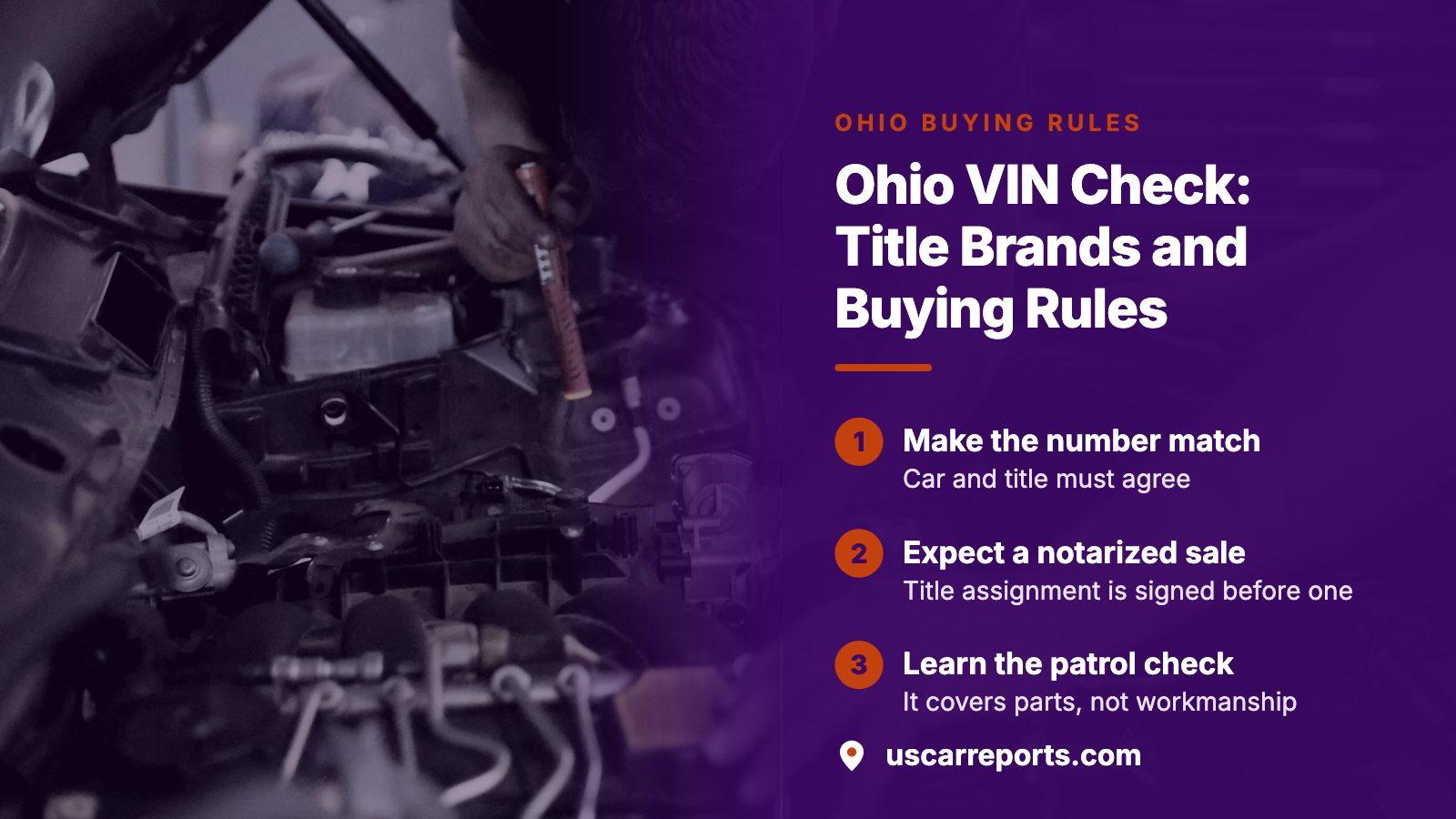
THE SHORT ANSWER
Start at the car: the number printed on it has to agree with the title. Run a decode, then pull NHTSA's open-recall list and NICB's theft and salvage records, all at no charge. Ohio's own title search covers Ohio titles only, so add the national record that an approved NMVTIS provider sells. USCarReports collects title, mileage, damage and auction records after a free preview. On a rebuilt car, the patrol inspection vouches for parts, not repairs.
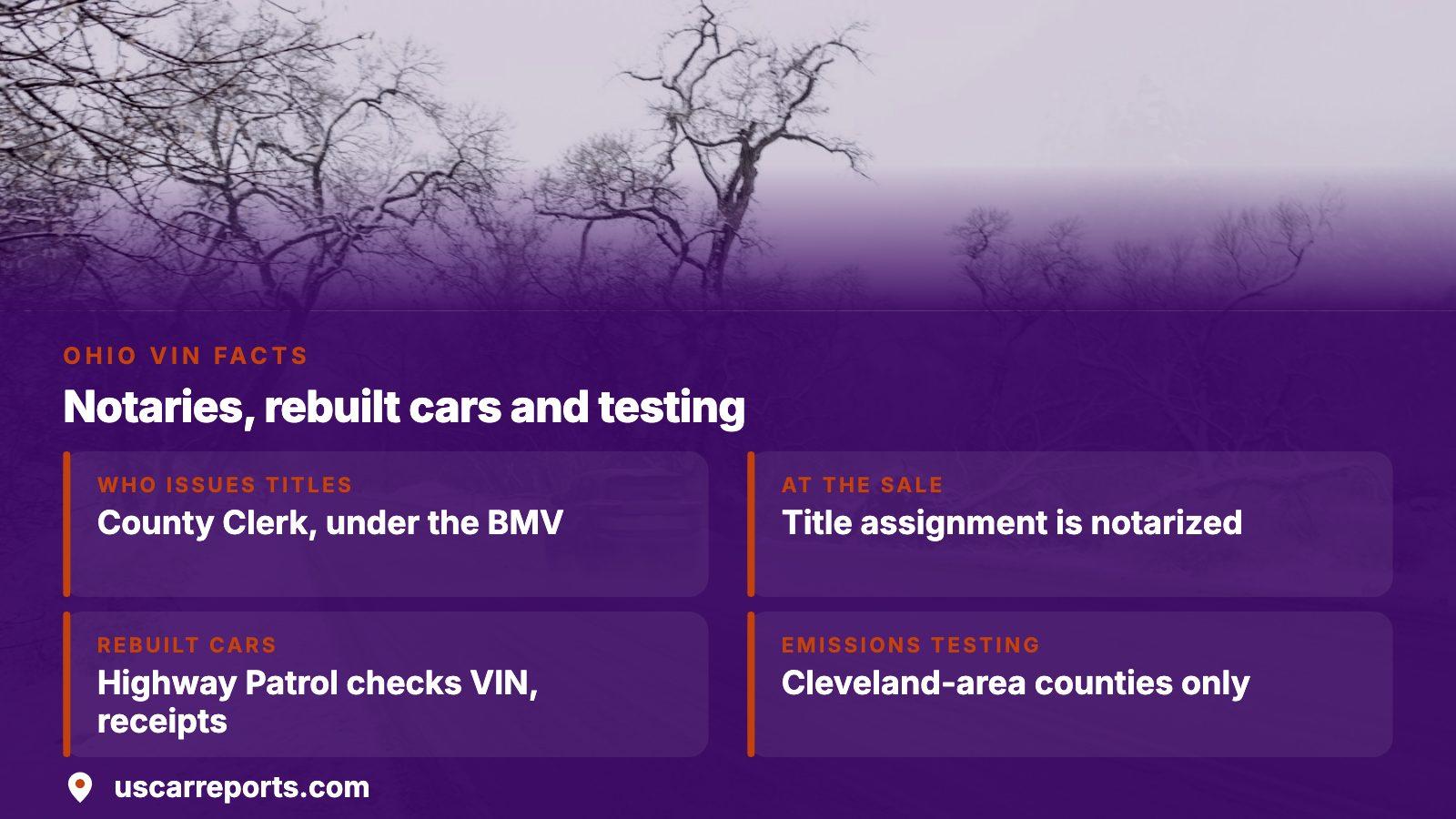
- Who issues titles
- A county Clerk of Courts, under the state BMV
- At the sale
- The title assignment is notarized
- Rebuilt cars
- Highway Patrol checks the VIN and the parts receipts
- Emissions testing
- Cleveland-area counties only
What an Ohio VIN lookup covers, and what each part costs
A state VIN check has two jobs: reading the national record attached to the number, and applying the title rules of the state where you live. Ohio adds three local points to the second job. Titles run through the courts, rebuilt salvage cars face a patrol inspection, and a notary witnesses the sale.
| Lookup | What it answers | Cost |
|---|---|---|
| VIN decode | What the factory built: engine, body, trim | Free |
| NHTSA recall search | Safety recalls still open on that VIN | Free |
| NICB VINCheck | Theft reports and total-loss records from insurers | Free |
| Ohio BMV title search | Details of titles Ohio itself issued | Free |
| USCarReports report | Title brands, odometer readings, damage, salvage and auction photos, liens and theft entries together | Free preview, then one payment |
None of the free lookups can see an accident that never reached an insurer.
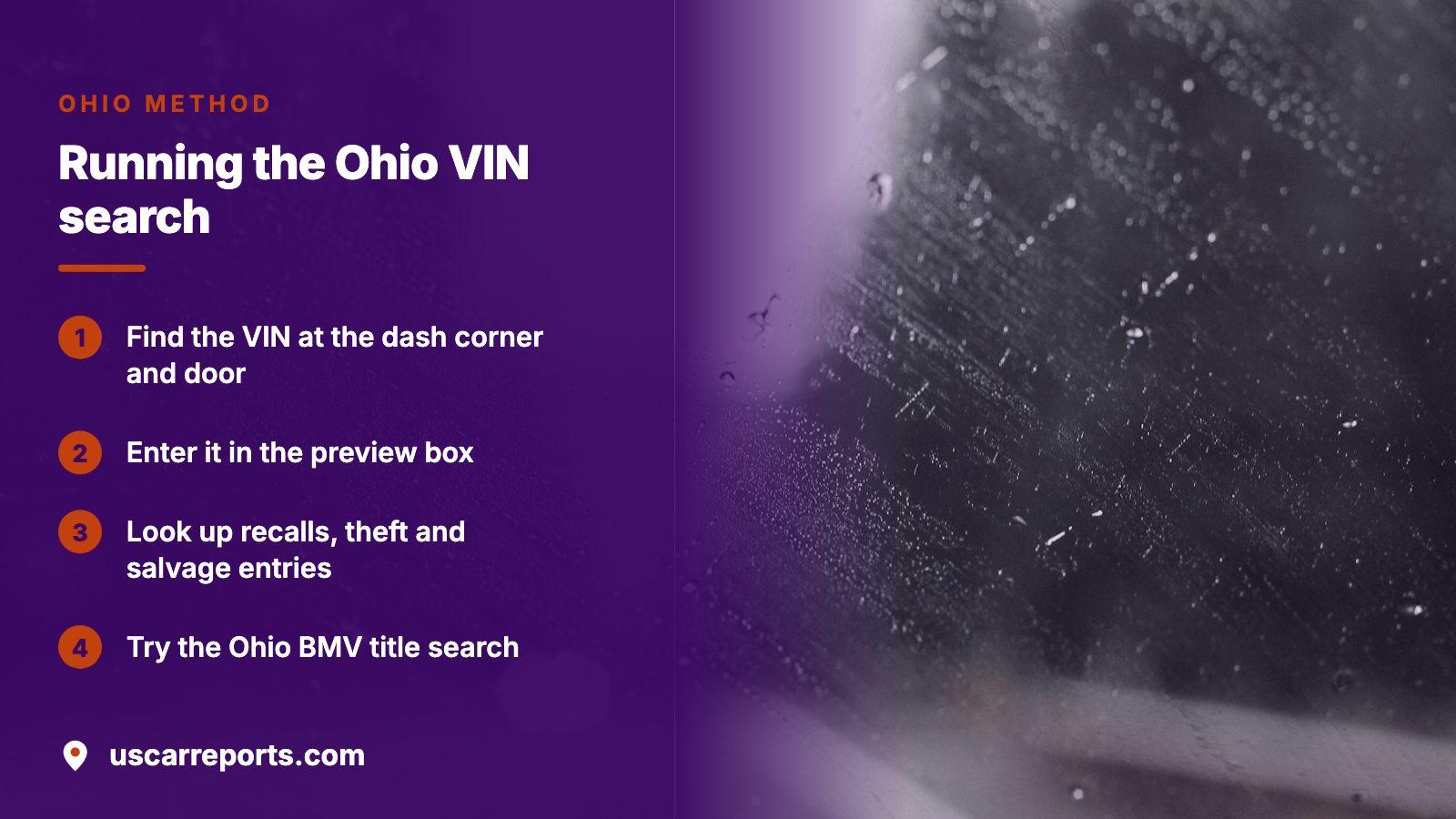
Running a VIN search in Ohio: the order that saves money
A lookup returns nothing useful when the VIN is mistyped or copied from an ad, so begin at the car.
- Find the number on the dash corner under the windshield and on the doorway label. Each should read exactly like the title.
- Enter it in the preview box on this page. The preview costs nothing and shows whether a record exists.
- Look up open recalls with NHTSA, then theft and salvage entries with NICB.
- Try the Ohio BMV title search, which shows Ohio titles only.
- Buy the full report before leaving a deposit on any car that has survived so far.
- Get an inspection, then close the sale in front of a notary.
What the Ohio BMV title search shows, and where it stops
The state runs a public title search that takes a VIN, an Ohio title number, or the hull and motor numbers used for boats and outboard engines. It answers one narrow question: does Ohio hold a title for this VIN, and does the description fit the car in front of you? Titles run through the county Clerk of Courts, so a stuck transfer is a courthouse question.
The BMV is frank about the limits. Its page calls the results limited information, says the search will not reveal whether the vehicle was titled elsewhere, and says NMVTIS brand history is withheld because government agencies may not share it with the public. For the full picture it points to approved data providers and endorses none.
A clean Ohio record can be a short one
A car that arrived last year can look spotless here while carrying a salvage brand from its previous state. Title washing depends on that gap, so a car with out-of-state years needs the national record.
The Highway Patrol salvage inspection checks parts, not workmanship
Before an Ohio salvage car is retitled for the road, the State Highway Patrol inspects it. The rebuilder presents the car, receipts for major parts and the paper trail behind the repair. The inspector confirms the VIN is real and tests the parts against theft records.
| What the inspection confirms | What it leaves open |
|---|---|
| Identity: the VIN is real and untouched | Whether the frame came back square |
| Parts: receipts exist and nothing was stolen | Whether airbags and sensors work as designed |
| Paper: the documents support the rebuild story | Whether welds and panels were done well |
Read "state inspected" as a statement about parts
A seller who leads with those words is telling the truth: the components were legitimate. It is not a repair opinion. Ask for the invoices and the photos taken before the work, then pay your own mechanic to check the car on a lift.
Signing at a notary, and what the title says about mileage
At an Ohio sale, the seller's assignment on the title has to be witnessed by a notary, a rule North Carolina and Pennsylvania share. Use a bank, not the seller's driveway. Without the notary the transfer is unfinished, it stalls at the Clerk of Courts office, and you are left chasing a seller who already has your money.
The notary matters for mileage too. The odometer regulation at 49 CFR Part 580 puts a titled owner's reading on the title, not on a reassignment form, together with the VIN, the transfer date and each party's name and address. In Ohio that statement is signed before a witness, so a later rollback has something solid to contradict.
- The seller's printed name is the person handing you the keys.
- The mileage box is complete and fits the odometer entries on your report.
- Any lender on the title has a payoff plan that is settled before money moves.
Where the car lived: E-Check counties and road salt
E-Check, Ohio's emissions test, is a northeast program: counties around Cleveland require it, and cars registered near Columbus or Cincinnati never take it. So a blank test history says where a car was registered, not how it runs. A car moving into a program county inherits the test, and if its dash warning lamp is on, assume it fails and price the repair into your offer.
Salt works on a gradient. A car that wintered near Lake Erie or Toledo has had a harder life underneath than one from the Cincinnati area. No VIN record has a field for rust, so someone has to look, in daylight and ideally in late winter.
- Brake and fuel lines along their full length
- Suspension mounts and subframe seams
- Sills and floor pans from underneath
- The trunk floor and spare tire well
- Exhaust hangers, an early warning sign
Reading an Ohio report: what each entry means for your offer
| Entry on the report | Possible explanation | Your move |
|---|---|---|
| Salvage or rebuilt brand | A total loss or major repair sits in the past | Request the repair bills and before-and-after photos, then pay for a structural inspection |
| Clean Ohio title, earlier years elsewhere | Ohio's record starts when Ohio's did, so brands may sit upstream | Pull the national record and compare every state |
| Odometer entry lower than an earlier one | Rollback, a swapped cluster or a typing error | Ask for a written explanation, and walk if the story shifts |
| Total-loss entry from an insurer | Written off, though the entry may not say flood or collision | Study the auction photos and look for water lines inside |
| Open lien | A lender still controls the title | Settle through the lender, or have the lien released first |
One entry rarely settles anything, so compare events: a total loss followed by a new-state title within months reads differently from a total loss followed by a rebuilt brand.
The price question and the next move
The preview carries no charge. Payment for the full report happens once and nothing renews. When you are weighing several cars, choose a pack of 3, 5 or 10 reports. Details sit on the /pricing page.
Run the lookups that cost nothing and read the preview first. If the car still looks right, buy the report before any deposit, get the car inspected and sign in front of a notary. Then take the notarized title to the county Clerk of Courts to finish the transfer.
Where this information comes from
- Ohio BMV: Motor Vehicle Title Search — What the state search accepts, that it covers Ohio-issued titles only, and the NMVTIS limits the page states.
- NMVTIS: National Motor Vehicle Title Information System — The federal title system behind the reports approved providers sell.
- 49 CFR 580.5: Odometer disclosure for title transfers — Where the mileage statement goes on a title and what it must contain.
- NHTSA: Recalls — The free search for open recalls by VIN.
- NICB: VINCheck — The free theft and salvage search fed by participating insurers.
Sources and photos: Facts checked against the sources above in November 2026. Photos by Mustafa Sheikhmouss, Cole Keister and Zoshua Colah on Unsplash; diagrams by USCarReports.
Keep reading
- Ohio title check: what the state search shows and what it leaves outHow Ohio's county title offices and the state record work, in more depth.
- Michigan VIN check: salt, the Secretary of State and what a report can missAnother Great Lakes salt state, for a car that wintered across the line.
- Pennsylvania VIN check: history report first, notary visit secondA neighbor with its own notary rule at sale.
- Sample reportSee how brands and odometer entries are laid out before you buy.
Frequently asked questions
How do I run a VIN check in Ohio?
Compare the number on the dash and the doorway label with the title, decode it, and check NHTSA recalls and NICB theft records. Then try the Ohio BMV title search, plus a national NMVTIS record if the car has lived elsewhere. Finish with an inspection and a notarized title.
Is there a free VIN lookup in Ohio?
Pieces of one. A decode, NHTSA recalls, NICB's theft and salvage search and the BMV title search cost nothing, but they miss other states' brands. USCarReports lets you open a preview without paying, and charges once for the full report.
Does a passed Highway Patrol inspection make a rebuilt Ohio car safe?
No. The inspection verifies the VIN and checks that major parts came with receipts and were not stolen. It does not certify frame work, airbags or welds. Treat it as proof of legitimate parts, then hire your own mechanic to judge the repair.
Does an Ohio title have to be notarized?
Yes. The assignment on the title is witnessed by a notary when a vehicle is sold, much as in North Carolina and Pennsylvania. Banks usually have one. An unwitnessed signature leaves the transfer unfinished at the Clerk of Courts office, and fixing it means finding the seller.
Can I look up an Ohio license plate to find the owner?
Not as a private person. The federal Driver's Privacy Protection Act keeps motor vehicle records closed to everyone without a permitted purpose, and curiosity about a stranger does not qualify. When buying, ask the seller for the VIN; hesitation is itself information.
Now check the car itself
The guide explains what to look for. The report shows what this VIN has on record.