
THE SHORT ANSWER
Begin with the VIN on the car itself and run it through the preview on this page. Spend on the report only when the car still seems worth chasing. On a Kentucky car, read for two things: a brand an earlier state applied, and whether the number is the factory's or one the state wrote. A reactivated junk title yields a rebuilt car with a state-issued number, so older records may sit under a different VIN. Ask the seller for that original number.
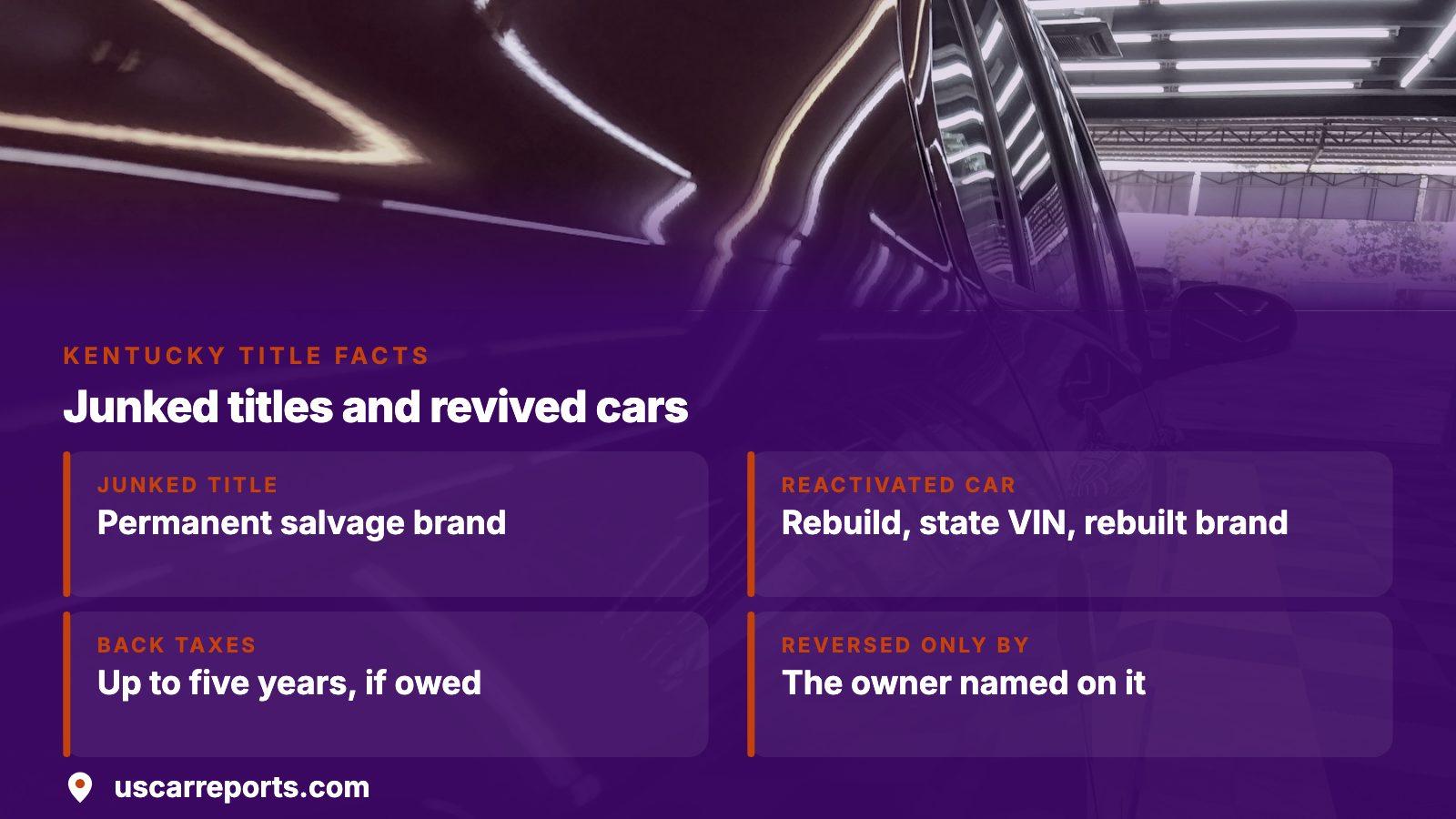
- Junked title
- Permanent salvage brand, reversible only by the owner named on it
- Reactivated car
- Rebuild, a state-issued VIN and a permanent rebuilt brand
- Back taxes
- A tax bill reaching back five years may come due, if owed
- Preview
- Free, then one payment per report
What a title check shows about a Kentucky car
A Kentucky title records what the clerk was told on the day one owner applied. A VIN check follows the car on both sides of that day. These entries do the most work on a title question:
| Entry | What it tells a Kentucky buyer |
|---|---|
| Brand history | Junk, salvage, flood or rebuilt labels, including any applied elsewhere before Kentucky printed its paper |
| Insurance and total-loss entries | A payout the seller skipped over, often the first step toward a salvage yard |
| Salvage and auction photos | Damage as it looked before repair, which a rebuilt label only summarizes |
| Odometer readings | Dated mileage showing whether the climb makes sense |
| Liens and theft | A lender's claim or theft entry that has to be cleared before the title is worth owning |
The federal NMVTIS record behind some of these entries is short on purpose: the state that last titled the car and when, brand labels, mileage on file, and any total-loss or salvage record. Repairs and maintenance are not part of it.
Before a deposit: running the check
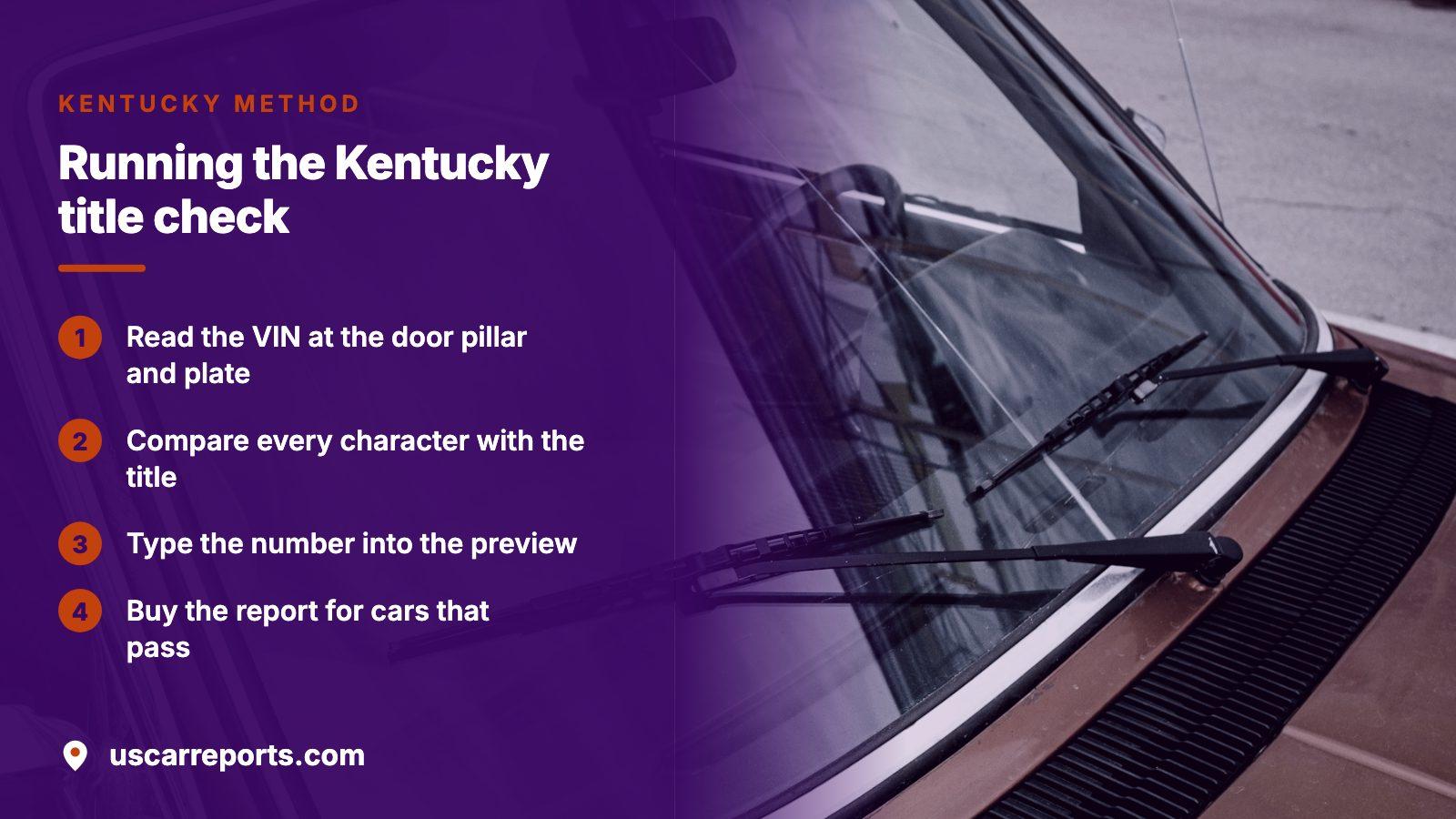
- Crouch at the driver's door. The VIN appears on a label at the door pillar and on a plate low on the windshield, and the two should agree.
- Lay the Kentucky title next to your notes and compare every character. A single mismatch suggests the document and the car lived different lives.
- Type the number into the preview on this page and check the decoded year, make and engine against what you are looking at.
- Buy the report for cars that make it through that check. Shortlisting several? Packs of three, five and ten exist, and nothing renews.
- Read the report with the title beside it before any deposit.
Junked Kentucky titles: a one-way door
Form TC 96-351, the Transportation Cabinet's junk application, exists for one situation: a car whose damage outweighs what it could sell for, bound for the crusher or kept as a parts donor. Signing puts a permanent salvage brand on the title. The Cabinet warns the brand can lower resale value and, in some states, rule out registration.
The form bars junking when an insurer has taken ownership, when a yard will resell the car for parts or rebuilding, when a sale was never fully transferred, or when the car is merely parked. In the last case taxes keep accruing, and a brand ends up on a car that might have been undamaged.
What a junk brand does and does not say
It records a paperwork decision, not the car's condition. Ask why the title was junked, then judge the car with a mechanic's help.
When the VIN on the car is one Kentucky wrote
This is the Kentucky detail that changes how you read any report. The Cabinet's junk form cites KRS 186A.090(1)(b) for what happens if a junked title is ever reactivated: the car goes through the rebuild process and comes out with a number issued by Kentucky instead of the factory, plus a rebuilt brand that is permanent. The metal is the same. The identifier is not.
For a lookup, that has a plain consequence. Records filed under the original number may not turn up under the new one, so a young state-issued number can return a short, quiet result for a car with a long past.
Run both numbers
A thin result on a reassigned VIN is not a clean one. Put the question to the seller directly: was this car junked or rebuilt at any point? Then get the original VIN and check each.
Documents behind a Kentucky rebuild
A properly rebuilt Kentucky car leaves a trail, and a buyer can ask to see it. The Cabinet's rebuilt-title page lists what an applicant supplies:
| Paper | What it should show |
|---|---|
| TC 96-215, notarized | An affidavit that the car was assembled from wrecked or salvaged vehicles |
| TC 96-182, notarized | The title and registration application itself |
| TC 96-353 | The repairs that were made |
| Original salvage title | The Cabinet takes the original, never a copy |
| Parts receipts | Where each part came from, plus the donor car's VIN for each one |
| Insurer or auction statement | Needed when damage stayed under 75 percent of the car's value |
| Odometer disclosure | Needed on cars under 10 years old when mileage is missing from the other papers |
A seller who did the work honestly can usually produce most of this. If receipts and TC 96-353 are missing on a car titled rebuilt, press hard on why.
Kentucky buying rules under the title
A clean check is half the job; the title still has to move correctly. The Cabinet's titling page describes a private sale and an out-of-state car this way:
- A notary must watch the seller sign the reverse side of the title. White-out and struck-through text are out; a notarized affidavit carries any correction.
- At the County Clerk's office the buyer presents that signed title, proof of Kentucky insurance, identification, and money to cover fees and tax.
- Where buyer and seller are both Kentucky owners, the transfer deadline is 15 days.
- A car coming from another state adds a completed TC 96-182, the signed-over title, and proof of a passed sheriff's inspection. If that state never issues titles, a registration or bill of sale with notarized signatures can stand in.
Fees and the usage tax change, so ask the clerk for current figures rather than relying on a seller's estimate.
Reading the result against the title
| What you find | What it can mean | What to do |
|---|---|---|
| Rebuilt brand, no parts receipts or TC 96-353 | The rebuild file is thin or gone | Ask for the papers, or cut the offer |
| Quiet history on a young number | The VIN may be state-assigned | Get the original VIN and run it too |
| A brand in the report, plain Kentucky title | Another state branded the car first | Price it as branded, or walk |
| Junked status | Nobody but the named owner can reactivate it | Learn who that is before paying |
| A lien nobody mentioned | A lender still has a claim | Written release before payment |
| Mileage that drops or stalls | A gauge swap or altered miles | Ask whether a TC 96-322 correction exists; compare service records |
A theft entry is a different matter. Stop, and call the police or the insurer.
Cost, and a sequence that works
Entering a VIN on this site costs nothing and returns the preview. The report is billed separately, once per purchase; no subscription is involved, and the pricing page has current options.
- Read the preview; drop any car that already looks off.
- Search NHTSA's recall database for open campaigns on the VIN, then NICB's VINCheck for insurer-filed theft and salvage entries. Neither costs anything, and each sees only a slice.
- Order the report for brand history, insurance entries, auction photos and cross-state mileage.
- Lay it beside the rebuild papers and the wording on the title.
- Hire a mechanic and ask for a written estimate showing the VIN; the FTC notes that a history report cannot replace that inspection.
- Check the paperwork with the County Clerk before paying.
Where this information comes from
- Kentucky Transportation Cabinet: Application to Junk a Vehicle Title (TC 96-351) — The junk brand, owner-only reactivation, the assigned VIN, the rebuilt brand, the tax warning and the barred reasons.
- Kentucky DRIVE: Rebuilt and salvaged titles — The forms, receipts, statements and odometer papers a rebuilt application needs.
- Kentucky DRIVE: Vehicle titling — Private-sale steps, the transfer deadline and the extra papers for a car from another state.
- NMVTIS: Understanding a vehicle history report — What the federal title record covers, who reports to it and what it leaves out.
- FTC: Buying a used car from a dealer — Why a history report does not replace an independent inspection.
Sources and photos: Facts checked against the sources above in November 2026. Photos by Carrie Allen www.carrieallen.com, Max Tokarev and Clarence Tioh on Unsplash; diagrams by USCarReports.
Keep reading
- Kentucky VIN check: sheriff inspection, brands and buying rulesThe same state from the VIN side, for the rules around registering and inspecting a car.
- Certificate of destruction by state: what the paper allowsHow a car meant for the crusher differs from one that can be titled again.
- Title status check: what the state lookup tells a car buyerWhat a state's own status lookup shows, and what it leaves for a VIN report.
- Sample reportA finished report, so you know what one payment returns.
Frequently asked questions
How do I run a Kentucky title search?
Match the VIN on the car to the one printed on the title, then enter it here to see the preview. Buy the report for a car you are still considering, before any deposit, and raise each discrepancy with the seller.
Is there a free Kentucky title check?
In part. This site's preview costs nothing, and so do NHTSA's recall lookup and NICB's VINCheck, though each sees a narrow slice. Brand history, mileage across states and auction pictures live in the paid report, so use the no-cost tools to thin the list before you spend.
What does a junked title mean in Kentucky?
A permanent salvage brand that, per the Cabinet, can lower resale value and block registration in some states. Undoing it means a rebuild, a state-issued VIN and a permanent rebuilt brand, and only the named owner can begin. Take it as a prompt for questions rather than a verdict on the car.
How soon must a Kentucky title be transferred after a private sale?
The Cabinet's titling page sets a 15-day limit for a sale between Kentucky owners. A notary witnesses the seller's signature on the back, and the buyer brings the title, insurance proof, ID and fee money to the County Clerk. Book the notary before the meeting.
Does a title check show repairs or mechanical problems?
Rarely. The federal title record is intentionally brief and omits repair and maintenance data, and the FTC says history reports typically do not list mechanical problems. On a rebuilt Kentucky car, the seller's repair form and a mechanic's written findings fill the gap.
Now check the car itself
The guide explains what to look for. The report shows what this VIN has on record.