THE SHORT ANSWER
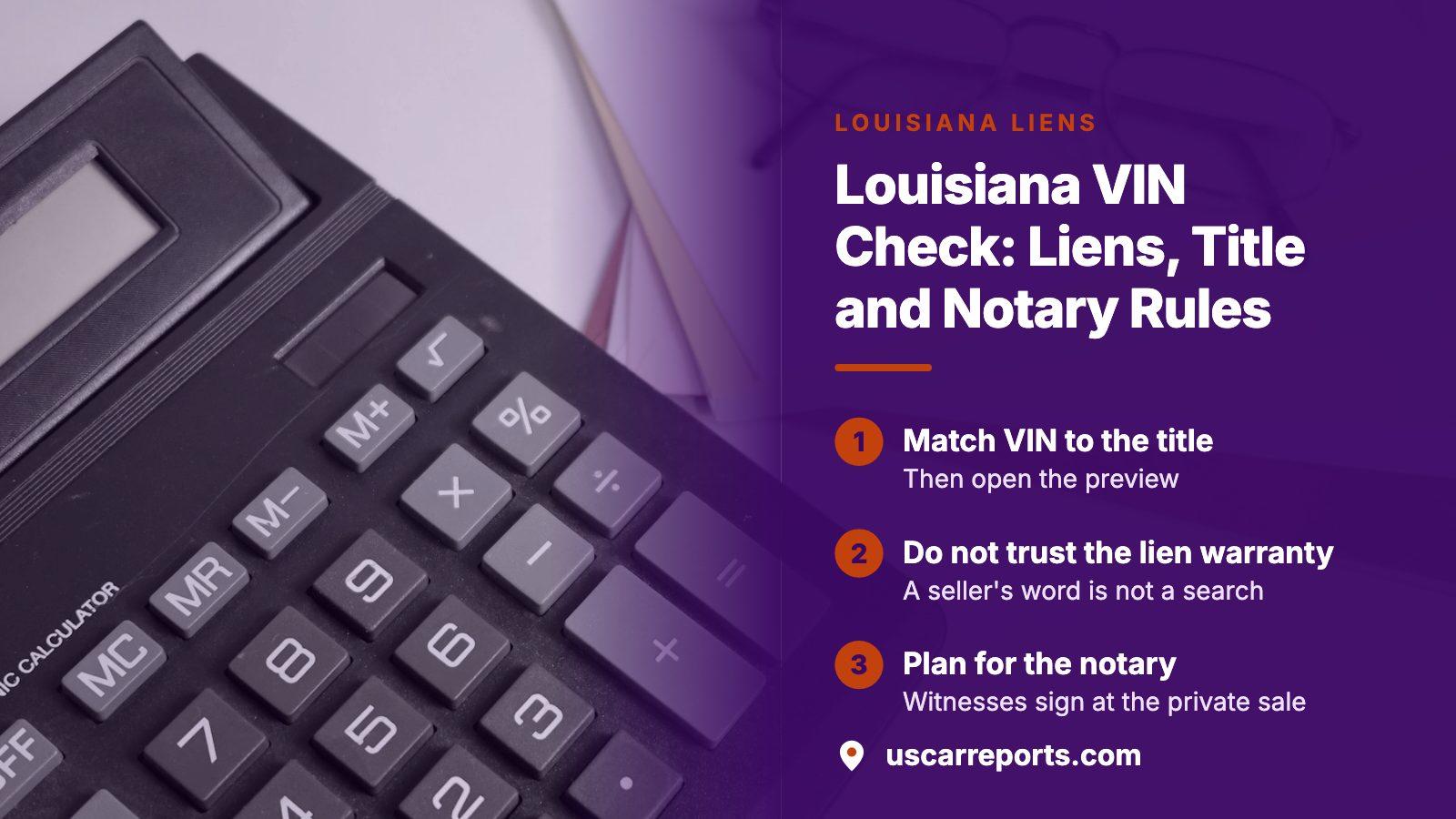
To run a Louisiana VIN check, copy the 17-character number from the car, confirm it matches the title, then open the free preview. Title brands, liens, damage, mileage and auction records come with the paid report. NHTSA's recall search and NICB's VINCheck can be used without paying. Notarized sale papers carry the seller's word that no lien exists, but no notary searches a lien record, so confirm that claim before signing.
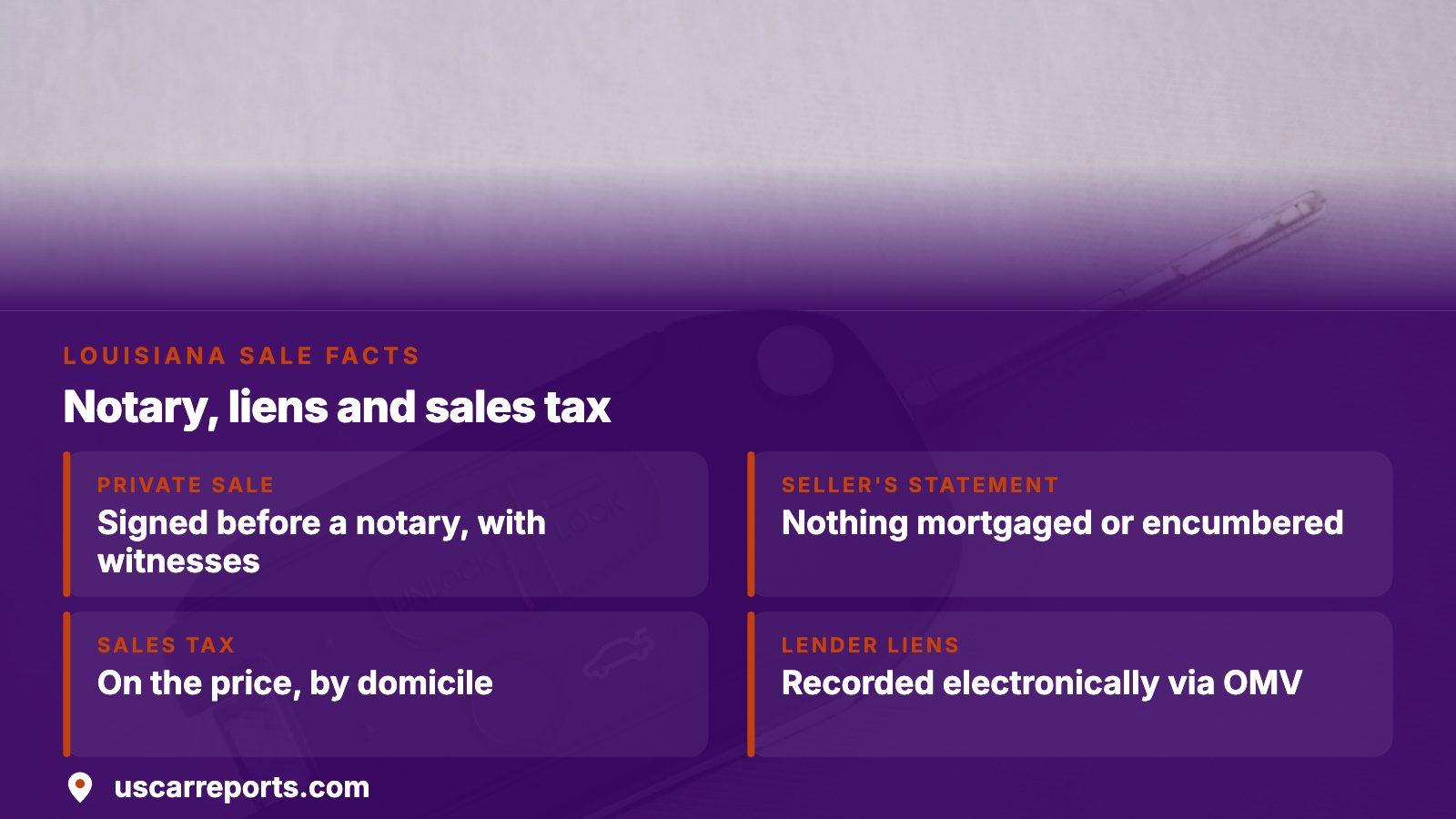
- Private sale
- Signed before a notary, with witnesses
- Seller's statement
- Nothing mortgaged or encumbered
- Sales tax
- Figured on the price, by the car's domicile
- Lender liens
- Recorded electronically through the OMV
What Louisiana's sale paperwork promises, and what it does not
Every state writes its own buying rules, and the VIN is the only thing that travels between them. In Louisiana a notary sits at the center of a private sale. The state's OMV offers a bill of sale form that is signed before a notary public and witnesses, and it lists the parish, both parties, the car's make, model, year and VIN, plus price and date.
The wording is more formal than the receipt a buyer gets in many states. The seller sells with full warranty of title and adds a statement that nothing is mortgaged or encumbered, accessories included. That is a real commitment, but still only a statement.
| Document | What it records | What it leaves out |
|---|---|---|
| Notarized bill of sale | Parties, VIN, price, date and the seller's lien statement | Condition, repair history, brands issued in other states |
| Title assigned before a notary | The seller handing ownership to you | Any lender claim recorded outside the paper title |
Why the lien warranty is not a lien search
A notary confirms identity and witnesses the signing. Nobody at that appointment phones a lender, queries a title database or reads the car's encumbrance history. A seller who is mistaken, or lying, can sign the warranty as easily as an honest one.
Liens follow the car. If a lender holds a recorded claim, it survives your purchase whatever the bill of sale says, and your remedy turns into a lawsuit against a seller who has already spent your money. Louisiana also makes lenders record liens through an electronic lien and title program run with the OMV, so a claim can exist as a database entry that nobody at the notary's table has seen.
Hold on to the original
Photograph the notarized papers and keep the signed original. If the sale is ever disputed, they are the best evidence of what you paid and what the seller swore.
What a Louisiana VIN lookup finds, and what each piece costs
| Lookup | What it answers | Cost |
|---|---|---|
| VIN decode | Whether the year, engine and body match the ad | Nothing |
| NHTSA recall search | Open safety campaigns on that exact VIN | Nothing |
| NICB VINCheck | Theft and salvage reports from participating insurers | Nothing |
| USCarReports preview | Whether the VIN matches the vehicle you are looking at | Free |
| USCarReports report | Liens, brands, damage, mileage, auction photos, theft and insurance entries | One payment, no subscription |
A decode confirms the build, not the history, and insurer databases miss damage that nobody claimed.
How to run a Louisiana VIN check before the notary is booked
- Before agreeing on a time, ask the seller to send photos of the title and the VIN tag. Doubts raised now cost nothing. Raised with a notary waiting, they feel rude, and buyers tend to swallow them.
- Locate the VIN on the car yourself: the metal tag at the dash corner, seen through the glass, and the sticker inside the driver's door opening. Read each one against the printed title, character by character.
- Put the VIN into the preview. A decode that disagrees with the listing ends the process.
- Look up open recalls at NHTSA and theft or salvage entries at NICB. Neither charges a fee.
- Buy the report to see liens, brands, damage and mileage from every reporting state, then hold each finding against the title.
- Book the notary once the title, the VIN and the report tell the same story.

Reading a VIN check result against the Louisiana title
| What turns up | What it suggests | Next step |
|---|---|---|
| A lien on the report, none on the title | The warranty may be wrong, or the title is out of date | Insist on the lender's signed release first |
| A brand on the report that the title lacks | The title may have been issued in another state first | Ask for the earlier titles; leave if the answer is vague |
| Mileage lower than an earlier reading | A possible rollback | Treat the odometer figure on the title as unproven |
| Salvage auction photos | The car was sold as damaged | Compare the photos with the listing, then inspect underbody and wiring |
| A theft entry | A stolen car, or one recovered after a theft | Stop and ask the seller to account for it in writing |
No single line is a verdict. A clean report lowers the risk, and it does not replace a mechanic.
Salvage, flood and total-loss cars in Louisiana records
The OMV tracks some wrecked cars closely. When an owner keeps a car after the insurer calls it a total loss, the insurer reports it, and the record stays flagged until the owner applies for a salvage title or a permit to dismantle. A car sold as scrap goes into an auto hulk database, after which its VIN can no longer be titled or registered anywhere.
Those controls reach only what passes through an insurer or a licensed yard. They miss a car that took on water, was dried out, repaired privately and listed with a clean title, and the bill of sale warranty speaks to debts, not condition. On any Gulf coast car, pull back the carpet, check the seat rails and seatbelt webbing, and trace the wiring under the dash, whatever the report says.
Out-of-state titles, sales tax and what the OMV asks for
A car arriving from a state with no notary requirement is a routine case. The OMV accepts a carbon copy of a bill of sale from such a state, and wants the original, notarized, when the sale happened somewhere that does require one.
Sales and use tax is figured on the price, less any qualifying trade-in and rebate, and it follows the vehicle's domicile, which is why the OMV points buyers to its parish tax table. The papers must state the price actually paid. A lower number saves tax at the cost of a notarized document that contradicts your payment.
- The title, assigned to you before a notary. A bank officer can witness instead when the seller is present and a lien is being recorded at the same time.
- The completed vehicle application form, plus an odometer statement if the title lacks one and the car is not exempt.
- Photo identification for each owner and proof of liability insurance, if you want a plate.
- A financing statement or other security agreement, if a lender is financing the purchase.
A seller can report the sale to the OMV online, which flags the record, but ownership does not legally move until you apply for the title.
Cost and what to do next
The preview costs nothing and shows whether the VIN belongs to the car you are viewing. Each vehicle's full report is bought a single time, and shoppers comparing several cars can buy multi-vehicle sets of 3, 5 or 10; nothing renews. Rates are listed on the pricing page.
Hold the notary if
The seller cannot produce a title in their own name. The VIN on the car and the VIN on the title differ by a single character. The report shows a lien and no signed release exists. The seller asks you to put a lower price on the papers.
A notary can witness a signature, but cannot tell you what it commits you to.
Where this information comes from
- Louisiana OMV: Bill of Sale of a Movable — The state form signed before a notary and witnesses, with the seller's warranty of title and statement that nothing is mortgaged or encumbered.
- Louisiana OMV: Used Title and Registration — Documents required for a private purchase, notary and bank-officer rules, out-of-state bills of sale, sales tax basis and plate requirements.
- Louisiana OMV: Electronic Lien and Title — Explains the paperless program through which lenders record liens and exchange title information with the OMV.
- Louisiana OMV: Insurance Salvage Retention — Supports the flag placed on a record when an owner keeps a total-loss car, and the salvage title or dismantle permit that follows.
- Louisiana OMV: Notice of Vehicle Transfer — Shows that a seller's report flags the record while ownership moves only when the buyer applies for title.
- U.S. Department of Justice: NMVTIS vehicle history — The federal title record and the list of approved providers that sell reports built on it.
- NHTSA: Recalls — The no-cost open-recall search by VIN.
Sources and photos: Facts checked against the sources above in November 2026. Photos by Cht Gsml, Jakub Żerdzicki and Shadow Photography on Unsplash; diagrams by USCarReports.
Keep reading
- Texas VIN check: what to run, Texas title brands and buying rulesThe neighboring state where titles arrive without a notary, and where flood history is the main worry.
- Title status check: what the state lookup tells a car buyerHow to read what a title says about its status before money changes hands.
- Certificate of destruction by state: what the paper allowsWhat a certificate of destruction is, and what it means for a car's records.
- Sample reportSee how the records are laid out before you decide to buy one.
Frequently asked questions
Can I run a Louisiana VIN lookup for free?
Partly. Free tools cover the VIN decode, NHTSA's recall search and NICB's VINCheck. The title and lien records are the paid part. A single purchase buys the full report, the preview carries no charge, and no subscription starts.
Is a notary needed to sell a car privately in Louisiana?
The OMV wants the title assigned from seller to buyer before a notary, and accepts the file if the title, bill of sale or invoice is notarized. No separate bill of sale is needed when the price is written on the title assignment. A bank officer can witness in one narrow case involving a lien.
Does the notarized warranty mean the car has no lien?
Not necessarily. It shows the seller has formally claimed so, nothing more. A notary vouches for the signature, not the statement, and a lender's recorded interest outlives the sale whatever the paper says. Read the title for a lienholder and run the VIN report.
What if the title comes from another state?
Louisiana treats it as routine. The OMV accepts a carbon copy of a bill of sale from a state that does not require notarization. Earlier brands follow the VIN either way, so run the check regardless.
Can a VIN check show flood damage on a Louisiana car?
Only when the damage left a record, such as an insurance total loss, a salvage auction or a title brand. A car flooded, dried and repaired without a claim shows nothing, so pair the check with a hands-on look at carpets, seat rails and wiring.
Now check the car itself
The guide explains what to look for. The report shows what this VIN has on record.