
THE SHORT ANSWER
Before you pay for a Maine car, confirm the title legend (salvage, rebuilt salvage, rebuilt, repaired or Lemon Law Buyback), the mileage trail, any lien still on the paper, and the sticker date. A dealer's car must show a sticker issued within 60 days of the sale. Run the free preview, then add a USCarReports report for brands, damage, odometer readings and auction photos.
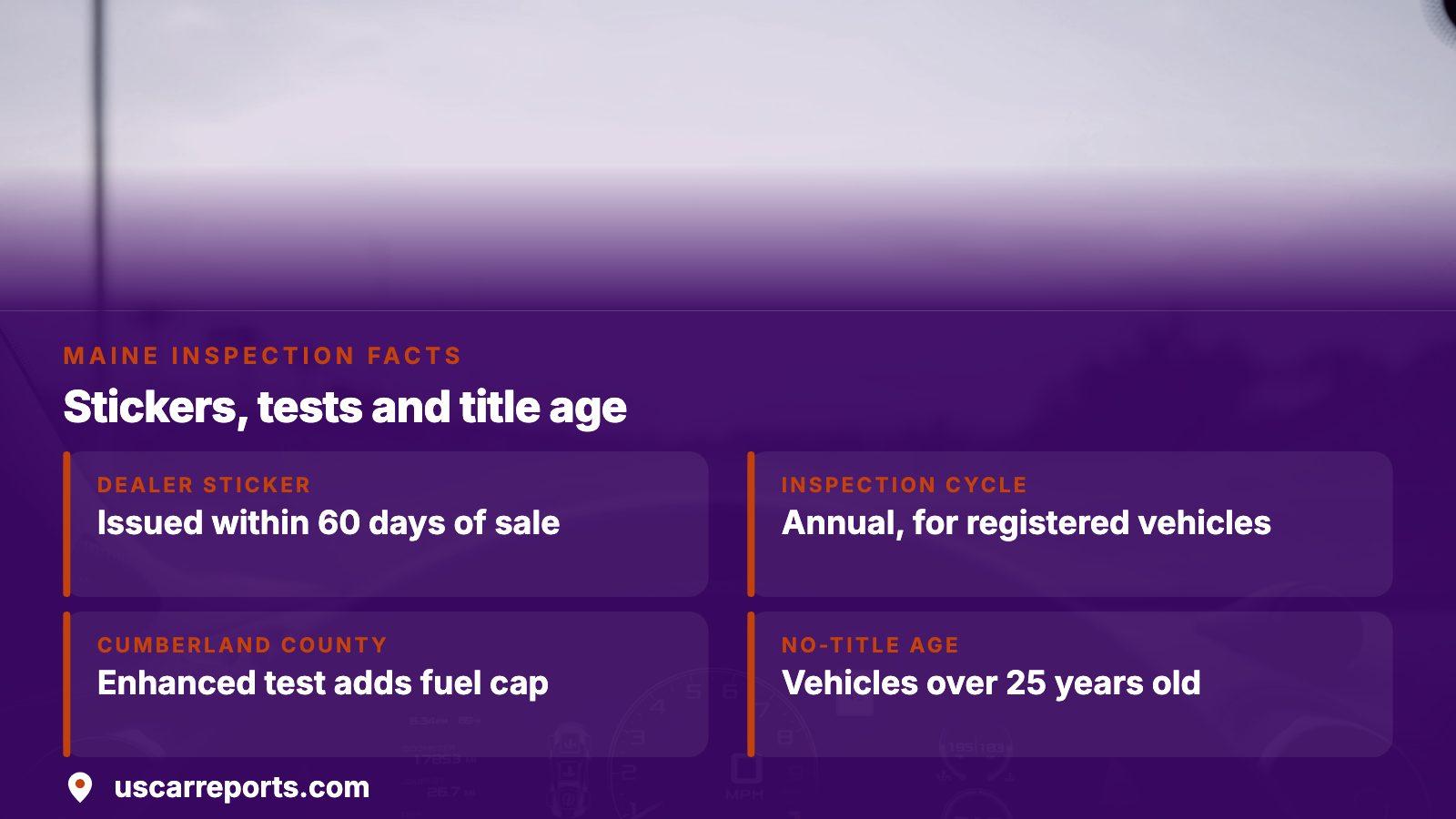
- Dealer sticker
- Issued within 60 days of the sale
- Inspection cycle
- Annual, for vehicles that must be registered
- Cumberland County
- Enhanced test adds fuel cap and diagnostics
- No-title age
- Vehicles more than 25 years old
What a Maine VIN check settles before you pay
Maine puts real rules around used cars: named legends on titles, a fixed sticker rule for dealers, and an inspection every year. A VIN lookup does not replace those rules. It shows what happened to the car before this seller owned it, which tells you which rule to press.
- Brands from Maine or any state the car passed through
- Mileage entries across time, where a jump or a drop stands out
- Crash damage, plus salvage and auction listings with photos
- Liens, impounds and theft, along with recalls still open
The 60-day sticker rule, and who it covers
Maine's inspection law puts a clock on dealers. When a dealer sells a car, the car must meet the inspection standard and carry a certificate dated no more than 60 days before the sale. A dealer who skips this commits a traffic infraction, risks up to $1,000 for each violation, and is also treated as engaging in an unfair trade practice. Not knowing the car would fail is no defense.
Keep the promise in proportion. The state calls it a warranty of inspectability, and it speaks only to the day of sale. Rust under the carpet, a slipping transmission and a repair history all sit outside it. The rule is also aimed at dealers and transporters, so a private seller is not bound by it, and a sticker on a private car shows only that someone once inspected it.
Reading the windshield: five sticker situations
| What you see | What it tells you | What to do |
|---|---|---|
| Fresh sticker on a dealer car | The 60-day rule applies, so the inspection should be recent | Compare the date with the sale paperwork |
| Sticker on a private car | An inspection happened, but no rule fixes how long ago | Read the date and budget for the next test |
| Expired sticker | The first month after expiry brings a warning, with 2 business days to get inspected | Ask when it lapsed and what the last test found |
| Out-of-state sticker on a Maine-registered car | Maine exempts the car for a year, counted from the day it was inspected elsewhere | Ask for the inspection date, since Maine has not tested it yet |
| No sticker at all | Unclear: newly bought, off the road, or failed | Ask whether it failed; Maine records a failure on an Unsafe Motor Vehicle certificate |
Maine allows two spots for a passing sticker: the windshield's lower-left corner, or the middle just behind the rearview mirror.
Annual inspection, and the Cumberland County difference
Every vehicle that has to be registered in Maine is inspected once a year by a certified mechanic at a licensed station. Brakes, steering, tires, lights, glass, exhaust and body components are all on the list, as are seat belts on 1966 and later models and the catalytic converter on 1983 and later ones.
Cumberland County adds a tougher version. It also looks at the fuel cap on gasoline cars from 1974 on and the on-board diagnostics on 1996 and newer cars, and stations in the county offer only that version. If the car will be registered there, an engine warning light is a red flag. Owners elsewhere may choose the enhanced test.
Failing still costs money
A station may charge up to $12.50 for the standard test. The enhanced test can run to $15.50 on cars older than 1996 and $18.50 on 1996 and newer. The fee is owed whether the car passes or not, so a seller's confidence counts for little until the sticker is on the glass.
Title legends: how Maine labels a damaged car
| Legend on the title | When Maine applies it |
|---|---|
| Salvage | Worth only its metal and parts, sold for parts alone, or arrived with a salvage title from before |
| Rebuilt salvage | Heavy repair: 5 or more parts swapped, two frames joined, a clip grafted onto a total loss, or an earlier rebuilt salvage title brought in from elsewhere |
| Rebuilt | Light repair: one to four parts replaced (airbags do not count), or an earlier rebuilt title brought in |
| Repaired | Damage fixed with no component parts replaced |
| Lemon Law Buyback | The maker repurchased the car under Maine's lemon law, and the brand stays on every later title |
These marks travel. Maine repeats its own legends if a car is titled in another state and returns, and the Secretary of State can copy a legend from an out-of-state title. Component parts means the big pieces: engine, transmission, frame sections, doors, hood, fenders and quarter panels. Before a rebuilt car can be titled, its VIN and part numbers must be inspected and verified, and the shop must disclose the salvage past and the repairs to you in writing. Ask for that document by name.
The paper trail at handover: title, mileage and liens
- Dealer sale: a valid, properly assigned title or salvage certificate has to be there when you buy.
- Private sale: the owner signs the title transfer and mileage statement first. You sign after, and no one may sign for both sides.
- Lender involved: ask for the released lien paperwork. Lenders have 14 days after payoff to sign the release, so a loan paid off weeks ago should not linger.
- Car from another state: Maine asks for the title or salvage certificate issued there, along with proof that the VIN was inspected and matches.
- Car over 25 years old: Maine requires no title, yet a dealer selling it still has to produce documents on who owns it and whether a lender has a claim. Private buyers should ask for those too.
Then set the odometer figure on the papers beside the report's readings. If the two disagree, put that to the seller first.
What the records miss: salt, and gaps in federal data
Salt is the Maine problem no database logs. The inspection standard rejects equipment that is unsafe or loose; it does not ask whether the car is worth buying. Have a shop lift the car and look at the rocker panels, subframe mounts, strut towers, and brake and fuel lines. The FTC still recommends an outside inspection after a clean report.
The national title database has holes of its own. It reaches about 87 percent of the country's vehicles, with over half the states contributing, so a search may show nothing against a car that has a salvage past. A brand can also be lost when a car gets a new title in a state that never consults other states' records. The Justice Department suggests pulling the state's own title record before buying.
Running the Maine check, and what it costs
- Have the seller send the VIN in writing, then match it to the number on the vehicle and on each document.
- Enter it for the preview, which is free and confirms year and build.
- Search NHTSA recalls and NICB's VINCheck; both are free lookups by VIN.
- If the preview holds up, buy the report: one payment covers one car, and packs for 3, 5 or 10 cars exist for comparing candidates. Nothing recurs. The pricing page lists the figures.
- Line up the sticker date, title legend and mileage with the report, then book the lift.
Treat any mismatch as a pause. A stale sticker on a dealer sale, an unmentioned legend or a lien still on the title can each be explained, and a seller who will not explain should lose the sale.

Where this information comes from
- Maine Revised Statutes 29-A, chapter 15: Inspection and repair — Source for the 60-day dealer certificate, annual inspection, Cumberland County enhanced test, sticker placement and fee caps.
- Maine Revised Statutes 29-A, chapter 7: Title to vehicles — Source for title legends, rebuilder disclosure, dealer title duty, odometer signing order, lien release timing and the 25-year no-title rule.
- Maine Revised Statutes 29-A, section 602: Definitions — Defines component parts and what counts as a repair, which decide the rebuilt and repaired legends.
- Department of Justice: NMVTIS for consumers — What the national title record holds, how much of the fleet it covers, and why a clean search is not a guarantee.
- FTC: Used cars — Advice to get a history report, the free recall and VINCheck lookups, and the point that a report cannot replace an inspection.
Sources and photos: Facts checked against the sources above in November 2026. Photos by Justin Cron, Anastasiia Nelen and Dennis Eusebio on Unsplash; diagrams by USCarReports.
Keep reading
- New Hampshire VIN check: titles, the 1999 cutoff and buying rulesThe state next door, for a car that has crossed the line.
- Massachusetts VIN check: the plate record, the seven-day clock and buying rulesAnother New England state with its own buying rules, useful if the car was last titled there.
- Title status check: what the state lookup tells a car buyerHow to read a title's status once you have the seller's paperwork in hand.
- Sample reportA look at how the records are laid out before you buy one.
Frequently asked questions
Is a Maine VIN check free?
Parts of it are. A VIN decode, NHTSA's recall lookup and NICB's VINCheck are free to anyone, and USCarReports adds a free preview on any Maine VIN. The full report is paid for once, per car.
Must a Maine dealer give me a current inspection sticker?
Yes. At sale the car has to meet the inspection standard and show a certificate dated within the previous 60 days. Compare the date with your paperwork and photograph it.
Is a private seller in Maine bound by the 60-day rule?
No. The rule is written for dealers and transporters. With a private seller, read the sticker date, ask what the last inspection found and budget for the next one.
What is the difference between rebuilt and rebuilt salvage in Maine?
Mostly how many parts were replaced. One to four earns rebuilt; 5 or more, joined frames or a clip earns rebuilt salvage. Either legend should appear in a history report.
Do old cars in Maine need a title?
Not once they are more than 25 years old, though the state may still issue a warranty title. Without one, the seller needs other papers proving ownership and lien status. A VIN check covers mileage and theft.
Now check the car itself
The guide explains what to look for. The report shows what this VIN has on record.