THE SHORT ANSWER
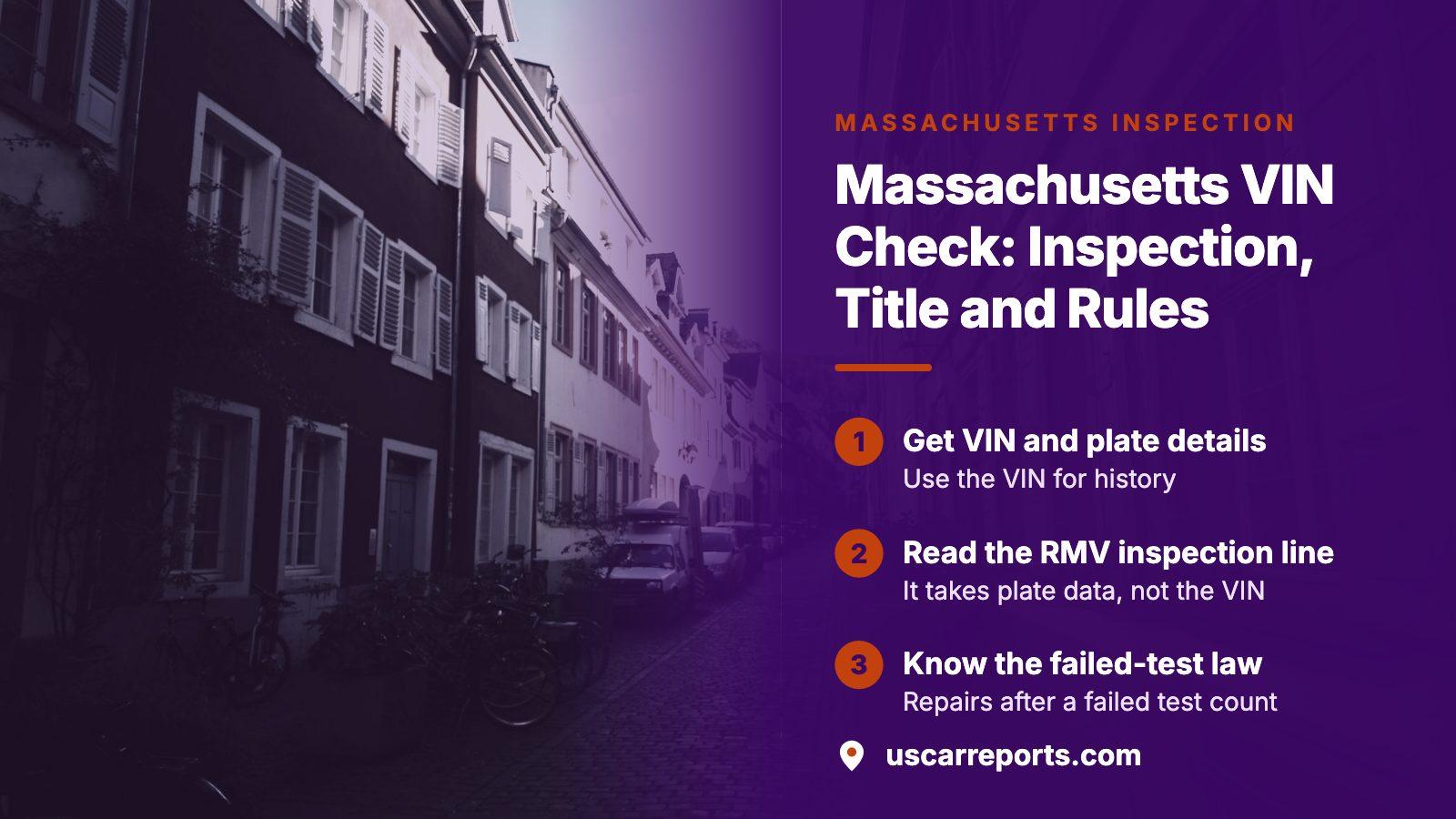
To run a Massachusetts VIN check, get both the VIN and the plate details from the seller. Use the VIN for history: title brands, damage, mileage and recalls. Use the plate type and registration number on the RMV's status page, which has no fee, for registration, insurance and the last inspection result. Once you buy, a seven-day inspection clock starts, so check first. Run the preview on the VIN, and pay for the report only if the car holds up.
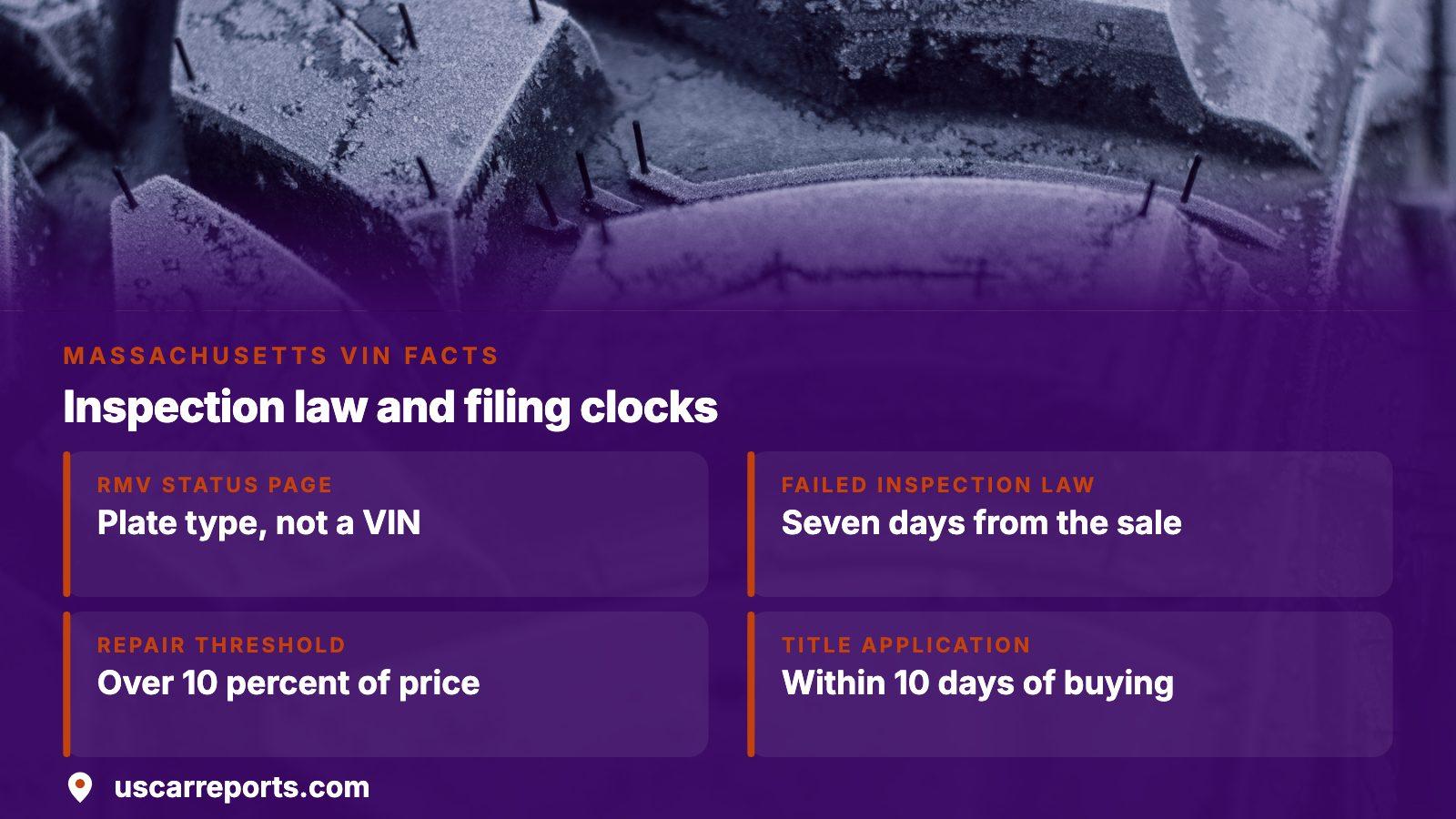
- RMV status page
- Takes a plate type and registration number, not a VIN
- Failed Inspection Law
- Seven days from the sale date, repairs over 10 percent of price
- Title application
- Within 10 days of buying the car
- Report preview
- Free, then one payment for the full report
Two records, two keys: why a Massachusetts check needs the VIN and the plate
Nearly everything a history report knows is filed under the VIN: brands on the title, insurer write-offs, auction sales, mileage readings. Massachusetts keeps one more record under the registration instead. The RMV's status page asks for a plate type and a registration number, never a VIN, and it answers with the date and the result of the car's last inspection.
That split changes how you shop. Ask the seller for the plate details and the VIN in your first message. Someone who advertises a car but will not share either number is asking you to buy blind.
What a Massachusetts VIN lookup finds, and what each one needs
| Lookup | What you enter | What comes back | Cost |
|---|---|---|---|
| RMV registration status | Plate type and registration number | Registration status and expiry, year, make and model, last inspection date and result, insurance details | No fee, says the RMV |
| NHTSA recall search | VIN | Safety recalls still open on that car | Free |
| NICB VINCheck | VIN | Theft and salvage flags | Free |
| USCarReports preview and report | VIN | Brands on the title, crash damage, mileage readings, auction photos, liens | Free preview, then one payment |
The first three cost nothing, yet none can say whether the car was wrecked in another state or had its odometer rolled back. That gap is what the history report fills.
Running the check before you drive anywhere
- Get the VIN, plate type and registration number from the seller in a text or email, so the details are on record.
- Check the VIN stamped on the car against the one in the ad and on the title. A mismatch needs an explanation first.
- Enter the plate type and registration number on the RMV status page and match the year, make and model to the ad.
- Put the VIN into the preview on this site, then look up recalls on NHTSA and theft or salvage on NICB.
- If the car still fits the seller's story, buy the report before you hand over a deposit.

Reading the inspection line on the RMV page
Registration lookups in most states settle one question: is the plate current. Massachusetts adds how the car's last state inspection ended, a small piece of history that no VIN database holds. Use it to frame questions rather than to pass judgment.
| What the RMV page shows | What to ask the seller |
|---|---|
| A failure, then a later pass | What failed, who repaired it, and where are the invoices |
| A last inspection years ago on a car advertised for daily use | Where has it been parked, and why does the story not match the sticker |
| No active insurance on record | Was it laid up for a season, and for how long |
| An expired registration | Why it lapsed, and who will handle the renewal or transfer |
One failed inspection proves little, since a minor defect can sink a car that a small repair then fixes. Repeated failures, or a record that goes quiet for years, deserve a harder look.
The seven-day clock that starts when you buy
Massachusetts gives a new owner little time. Inspection stickers do not transfer, so the car needs a fresh one, and the RMV requires it within seven days of the registration date. The Failed Inspection Law starts counting earlier, on the date of sale. If the car fails at a licensed Massachusetts station within seven days of the sale, and the estimate for the safety repairs is above 10 percent of the price, you can cancel the contract and get a refund.
- Use a station of your choosing, not the dealer who sold you the car.
- Get the reason for the failure in writing, plus a repair estimate from that same station.
- Tell the seller in writing that you are voiding the sale, then bring the car back with a witness.
- Finish all of it within 14 days of the sale to qualify for a full refund.
Count from the sale date
The law counts from the day you pay, not the day you register. A buyer who waits for registration day before inspecting can find the refund window already closed.
What neither state lookup can see: other states, salvage and floods
The RMV page describes where a car stands with Massachusetts today, not how it got here. Active plates, insurance and a fresh pass can sit on a vehicle rebuilt after a total loss in another state, or on one whose odometer was altered before it crossed the line.
A salvage title means an insurer treated the car as a total loss. The RMV says it cannot be registered until it is repaired and state-inspected, and then it carries a rebuilt or reconstructed title. States label these differently, and some flood brands never use the word flood, so an import calls for a report that follows the VIN across states.
After storms the RMV has warned buyers about cars arriving from other states, and about sellers who produce only a bill of sale or claim the title was lost. Look for:
- A sour smell, or a lot of air freshener
- Carpet that feels damp or holds dried mud
- A waterline or fogging inside headlamps and reflectors
- Milky engine oil, or rust on bare metal behind the dash
Massachusetts paperwork and duties in a private sale
- The seller hands over the certificate of title and states the mileage. Buyer and seller each print and sign their names and add the date.
- If the title has a space for the price, it must be filled in. If not, you need a bill of sale showing the price.
- A licensed Massachusetts insurance agent writes your policy and signs off the Registration and Title Application before the RMV visit.
- Apply for the title within 10 days of buying the car. Expect the paper title six to eight weeks later, or at the lender if there is a loan.
- Sales tax is due at registration, and an excise tax bill arrives every year.
Cars old enough to be exempt from titling are the one case where a registration and a bill of sale stand in for the title. Otherwise, treat a missing title as a serious warning.
A private seller owes you the truth about safety defects
Massachusetts obliges a private seller to tell you about known defects that affect safety or substantially impair use. If you can prove the seller knew and stayed quiet, you can cancel within 30 days. The seller need not repair the car afterward, and lemon law arbitration does not cover private deals.
Cost, and the order to work in from here
The preview costs nothing and needs only the VIN. The report itself is bought once, with no subscription attached, and bundles of 3, 5 or 10 exist for shoppers comparing multiple cars. Details are on /pricing.
Run the RMV lookup first, since it takes a minute, then the preview. If both match the seller's story, buy the report before any deposit. After the sale, book a licensed station inside the seven days and keep every receipt.
Where this information comes from
- Mass.gov: Check the status of your vehicle registration — Source for the fields the RMV lookup returns, the plate details it needs, the no-fee statement and the plate types it cannot check online.
- Mass.gov: Registration and title for a vehicle bought from an individual — Supports the private-sale documents, the insurance step, the title and inspection deadlines and the tax notes.
- Mass.gov: Guide to Failed Inspection Law — Explains the seven-day window from the sale date, the repair-cost threshold and the steps for a refund.
- Mass.gov: Private Party Car Sales — Covers a private seller's duty to disclose safety defects, the cancellation window and the lack of arbitration.
- Mass.gov: RMV cautions consumers about buying flood-damaged vehicles — Supports the salvage and rebuilt title rules, the label differences between states and the flood warning signs.
- NHTSA: Recalls — The free search for open safety recalls by VIN.
- U.S. Department of Justice: NMVTIS approved data providers — Where the federal title record comes from, for the brands a state lookup cannot reach.
Sources and photos: Facts checked against the sources above in November 2026. Photos by Karwin Luo, Michal Biernat and Joan on Unsplash; diagrams by USCarReports.
Keep reading
- Massachusetts title check by VIN: RMV lookup, brands and E-TitleHow Massachusetts titles work, including older cars that have none.
- New Hampshire VIN check: titles, the 1999 cutoff and buying rulesA neighboring state's rules, for a car coming in across the line.
- Registering a car in another state: deadlines, title and checksWhat changes when a car moves from one state's records to another's.
- Sample reportSee how the records are laid out before you buy a report.
Frequently asked questions
Can I run a Massachusetts VIN lookup for free?
Partly. The RMV's registration status page has no fee, but it takes a plate type and registration number rather than a VIN. NHTSA recall and NICB theft and salvage searches are free by VIN. The history report is the paid piece, after a free preview.
Does the RMV registration check work with a VIN?
No. The page asks for the plate type and the registration number. A buyer holding only a VIN from a listing cannot use it, which is why the seller's plate details matter. USCarReports works from the VIN alone and does not look up plates.
What does the last inspection result tell me about a used car?
It shows when the car was last inspected and whether it passed. A recent failure invites questions about repairs, and a stale date on a daily driver invites questions about storage. It says nothing about collision history, title brands or mileage tampering, so pair it with a VIN history.
Which Massachusetts plates cannot be checked online?
The RMV lists farm, repair, transport, owner contractor and dealer or manufacturer registrations as unavailable online and refers callers to its Section 5 department. Apportioned plates belong to the International Registration Plan department instead. Expect no online answer for a car wearing one of them.
How soon must a newly bought Massachusetts car be inspected?
The RMV wants a sticker within seven days of registration, and the Failed Inspection Law's refund rule counts seven days from the sale date. The old sticker does not carry over, so inspect right after you buy, at a station that did not sell you the car.
Now check the car itself
The guide explains what to look for. The report shows what this VIN has on record.