
THE SHORT ANSWER
Read the model year from the VIN first. A car from the 1999 model year or earlier has no New Hampshire title by design, so the seller's bill of sale, evidence of the VIN and your proof of residency do the work. A 2000 or newer car should have a title. Run the NHTSA and NICB searches, which cost nothing, then add a USCarReports report for title brands, damage, mileage, liens and auction photos after the free preview.
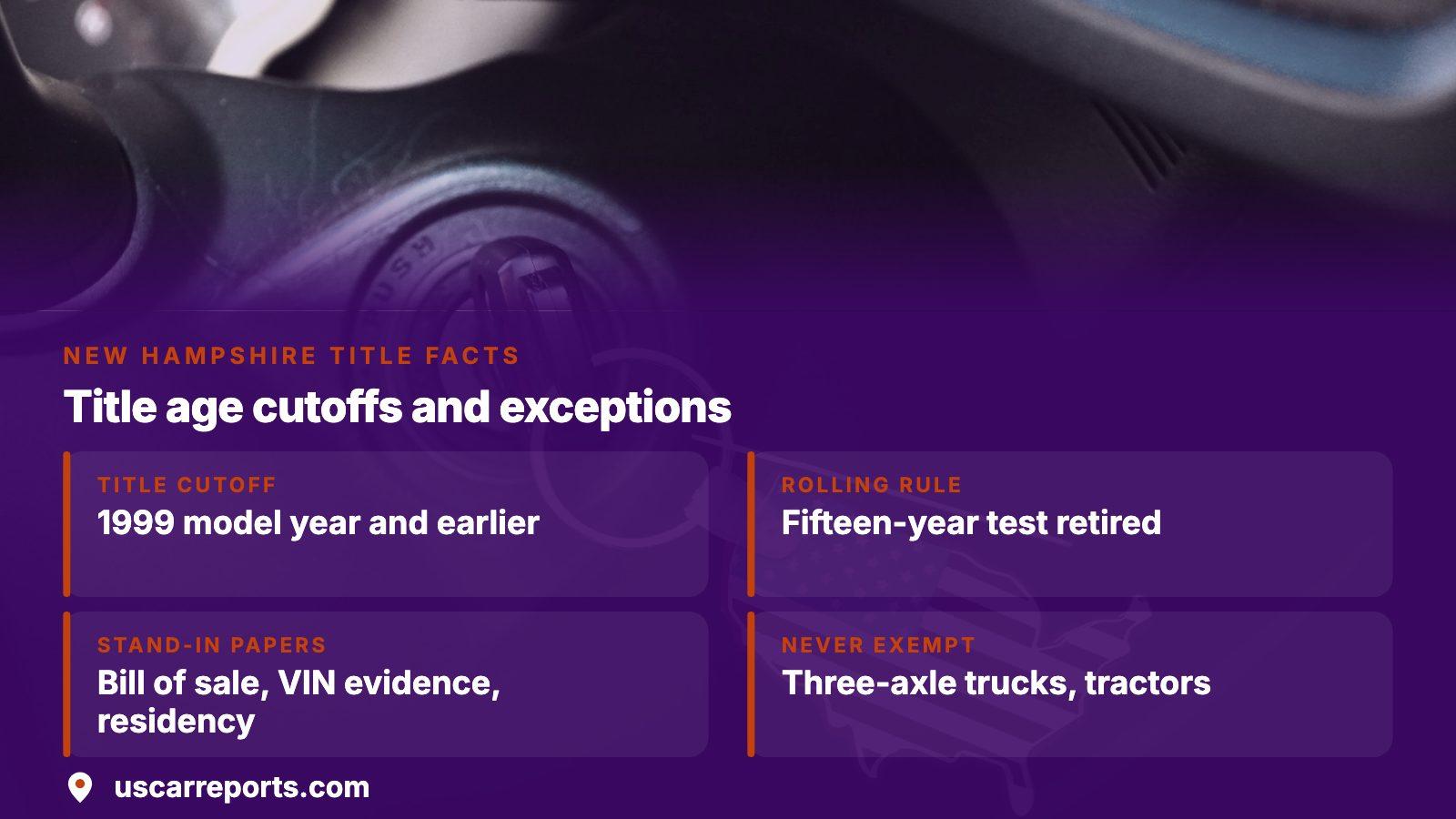
- Title cutoff
- 1999 model year and earlier: no state title
- Rolling rule
- The fifteen-year test is retired for a fixed year
- Stand-in papers
- Bill of sale, VIN evidence, proof of residency
- Never exempt
- Three-axle trucks and tractors over 18,000 lb
In New Hampshire the buying rule changes with the car's age
Most state guides on this site come back to the same advice: do not buy without the title. New Hampshire bends it. For cars up to the 1999 model year the state issues nothing, and a missing title is simply how the system works. From the 2000 model year onward the ordinary expectation returns, which is a title signed over by the person named on it.
The dividing line used to move. New Hampshire once applied a rolling fifteen-year test, so each year released another batch of vehicles from titling. That test was dropped in favor of a fixed model year. Nobody new joins the untitled group and the cars already in it only get older, so a seller who cites a fifteen-year rule is out of date. A New Hampshire VIN lookup settles the year in seconds, because the tenth character of the VIN is the model-year code.
Who needs a title and who does not
| Vehicle | Does the state title it? | What the seller should hand over |
|---|---|---|
| Passenger vehicle, 2000 model year or newer | Yes | A title signed by the owner, with a VIN that matches the vehicle |
| Passenger vehicle, 1999 model year or earlier | No, subject to exceptions | A bill of sale and evidence of the VIN |
| Truck with three or more axles | Yes, whatever its age | The title |
| Tractor unit rated above 18,000 lb gross weight | Yes, whatever its age | The title |
| Antique vehicle | Only if the owner asks | An answer on whether a title was ever requested |
Anyone shopping for old commercial equipment should skip the age shortcut altogether. A heavy rig with no title is a hole in the paperwork, and the seller owes you an explanation.
Running a New Hampshire VIN lookup before you visit the seller
- Ask the seller for the VIN in writing, along with photos of the windshield plate and the door-jamb sticker.
- Enter it for the free preview. The model year comes back first, and it tells you which papers to demand.
- Run NHTSA's recall search and NICB's VINCheck. Neither costs anything, and neither cares whether a title exists.
- Buy the full report once the preview looks sound. One vehicle, one payment, nothing to cancel.
- At the car, confirm that the VIN stamped on it matches the VIN on every document.
- Have a shop raise the car on a lift before you pay.

What a USCarReports report returns on a New Hampshire VIN
The preview confirms what the factory built. The report then covers the history that a listing leaves out:
- Title brands the vehicle has carried
- Crash and damage entries
- Mileage readings recorded over the years
- Auction and salvage records, photos included
- Lien and impound entries
- Theft and insurance entries
- Open recalls, plus ownership and use type
- Market value and the factory specifications
On an older car the mileage entries deserve the closest read. Lay them side by side and see whether they climb steadily, then ask about any stall or drop.
Handling the bill of sale on a car that has no title
When a car from the exempt years changes hands privately, the state looks for three things: a bill of sale, evidence of the VIN and the buyer's proof of residency. There is no title to fall back on, so these sheets are the ownership trail. A gap in that trail is hard to mend afterward, and rebuilding it once the seller has left town is slow.
- A typed or neatly written bill of sale, not a scribble on the back of an envelope
- The VIN on the paper checked against the car, one character at a time
- Both parties named on the sale document
- Your own copies, plus a dated photo of the VIN plate
Why an untitled car needs the national record more, not less
A title is where a brand lives. Salvage, flood and rebuilt marks are written onto it, so a car the state never titled has no New Hampshire document that could carry one. The result is a sparse local record on exactly the older vehicles most likely to have lived hard.
Other states do brand titles, and those brands sit in the federal NMVTIS record under the VIN. They stay there when the car crosses into New Hampshire. The title-brand section of a vehicle history report is the quickest way to see one, which makes it part of the baseline on any exempt purchase.
A blank is not a pass
An absent title tells you the car belongs to the older group. It says nothing about wrecks, floods or theft, so check those on their own.
Salt, winters and the seacoast: what to look at on a lift
Long New Hampshire winters mean treated roads for months, so underbody rust is the normal condition of an older car that lived here. One kept close to the short coastline picks up airborne salt on top of that. A history report records events, and corrosion is not an event.
- Brake and fuel lines, where rust works unseen until a line leaks
- Frame rails, rocker panels and subframe mounts
- Floor pans, wheel wells and the metal under the carpet
- Fresh black undercoating, which can mean care or can mean cover
An hour on a lift costs little next to a corroded brake line.
Plates, cost and the decision
A license plate will not give a private buyer an owner's name. Federal privacy law reserves owner details for approved purposes, which is why a plate search rarely returns a name. Work from the VIN.
Start with the preview, which costs nothing. Each report is paid for once per car, with no plan attached. Comparing a few cars? Bundles of 3, 5 or 10 are cheaper per VIN. See /pricing for amounts.
Line up three things: the model year, the paperwork and the report. When all three tell the same story, schedule the inspection. When one disagrees, ask the seller to explain it first, and be ready to walk away without a good answer.
Where this information comes from
- NH DMV: Exempt vehicles — Where the model year 1999 cutoff, the end of the rolling rule and the always-titled vehicles come from.
- NH DMV: Title frequently asked questions — Covers what a private buyer of a title-exempt vehicle must present instead of a title.
- New Hampshire RSA 261:3, exempted vehicles — The statute that lists which vehicles need no title.
- NMVTIS: National Motor Vehicle Title Information System — The federal title record that holds brands applied in other states.
- NHTSA: Recalls — The open-recall search by VIN, which works whether or not a title was ever issued.
Sources and photos: Facts checked against the sources above in November 2026. Photos by Linus Belanger, Alejandro Escamilla and Jake Kling on Unsplash; diagrams by USCarReports.
Keep reading
- Vermont VIN check: titles, rust inspections and buying rulesThe neighboring state's checks and buying rules, for a car that crossed the border.
- New York VIN check: flood, city-street and road-salt history before you buyAnother state that draws a title line by model year, at a different point.
- Title status check: what the state lookup tells a car buyerHow to read a title's status when one does exist.
- Sample reportSee how the records are laid out before you buy a report.
Frequently asked questions
Is a New Hampshire VIN check free?
Part of it is. Decoding the VIN is free, so are NHTSA's recall lookup and NICB's VINCheck, and USCarReports shows a free preview for any New Hampshire VIN. The full report, with title brands, damage, mileage and auction records, is a one-time payment.
Why does a New Hampshire seller say the car has no title?
If the car is a 1999 model or older, the state does not issue one, so the claim can be perfectly honest. Decode the VIN to confirm the year. If it is a 2000 model or newer, a missing title is a warning, and the seller has to explain it with documents before you pay.
What paperwork do I need for an older New Hampshire car?
A bill of sale, evidence of the VIN and your proof of residency. Check that the bill of sale is complete and legible, and that the VIN written on it matches the car exactly. Keep copies of every sheet, since no title exists to reissue if something goes missing.
Do heavy trucks follow the same no-title rule?
No. Trucks with three or more axles and tractor units rated above 18,000 pounds gross weight are titled at any age. If a seller offers an old heavy truck without a title and cites the age rule, treat the claim as wrong and ask for the title before you talk price.
Can a plate search show who owns a New Hampshire car?
No. Federal privacy law keeps owner names behind a short list of approved purposes, and a private buyer sizing up a car does not usually qualify. Ask the seller for the VIN instead, since a vehicle's history is attached to that number.
Now check the car itself
The guide explains what to look for. The report shows what this VIN has on record.