THE SHORT ANSWER
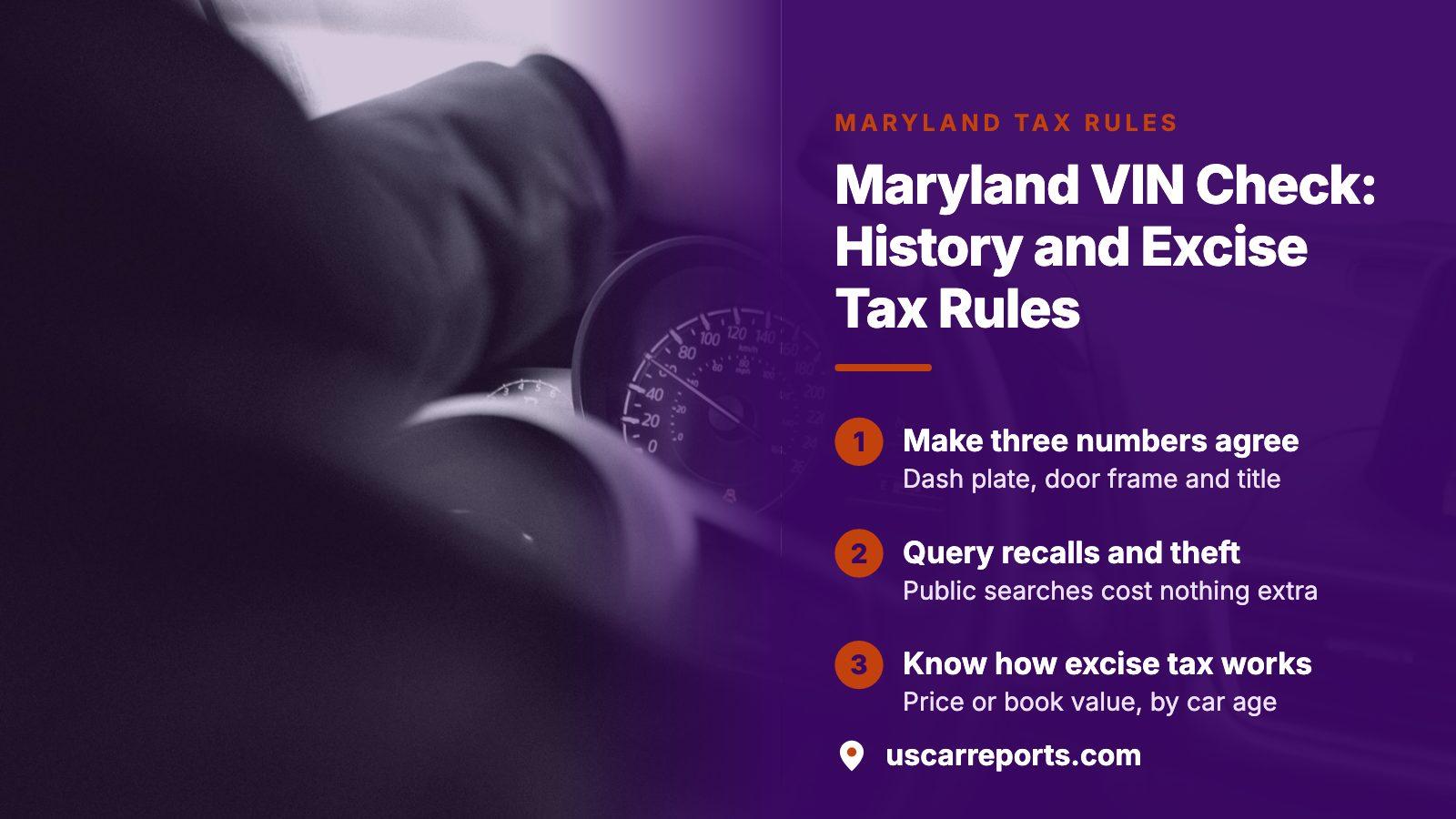
Read the VIN from the dash plate, the driver's door frame and the seller's title, and confirm all three agree. Decode it, then query NHTSA about open recalls and the insurer-fed NICB database about thefts and total losses; neither charges anything. Add a title record that shows brands from other states. Before paying, learn how the MVA will tax the sale: on a newer car, what you paid, unless the price trails published retail value by $500 or more.
- Newer private-sale car
- Taxed on what you paid, unless it trails published retail value by $500 or more
- Seven model years or older
- Taxed on the greater of your price or $640
- Notarized bill of sale
- Requirement repealed, effective October 1, 2026
- Free pieces
- VIN decode, NHTSA recalls, NICB screen and the USCarReports preview
Why a Maryland check pairs the VIN with Maryland's own buying rules
The VIN follows a car from state to state, but the rules for buying it stay behind at each border. A lookup tells you what has been recorded against the number anywhere in the country. Maryland then adds its own questions: what you will be taxed on when the title moves into your name, and what the transfer requires before the car can be registered.
The history half protects you from a car that is not what the listing says. The rules half keeps a good deal from growing into a larger bill at the MVA counter. Used inventory in Maryland crosses several state lines, so a car on a local lot may carry history that was recorded somewhere else.
What a Maryland VIN lookup finds, piece by piece
| Lookup | What it answers | Cost |
|---|---|---|
| VIN decode | Year, trim and equipment as built, the details that fix a car's published value | Free |
| NHTSA recall search | Safety recalls still open against that VIN | Free |
| NICB VINCheck | Theft and total-loss flags from participating insurers | Free |
| NMVTIS title record | Brands reported by every state, sold by approved providers | Paid, per report |
| USCarReports report | Brands on the title, crash and damage records, mileage readings, salvage-auction photos, lien and theft flags, current market value | Free preview, then one payment |
A decode says nothing about crashes, and insurer databases miss damage that nobody claimed. That gap is why a title and damage record belongs in the check before you negotiate, not after.
Running a VIN lookup in Maryland: where the number is and what to do first
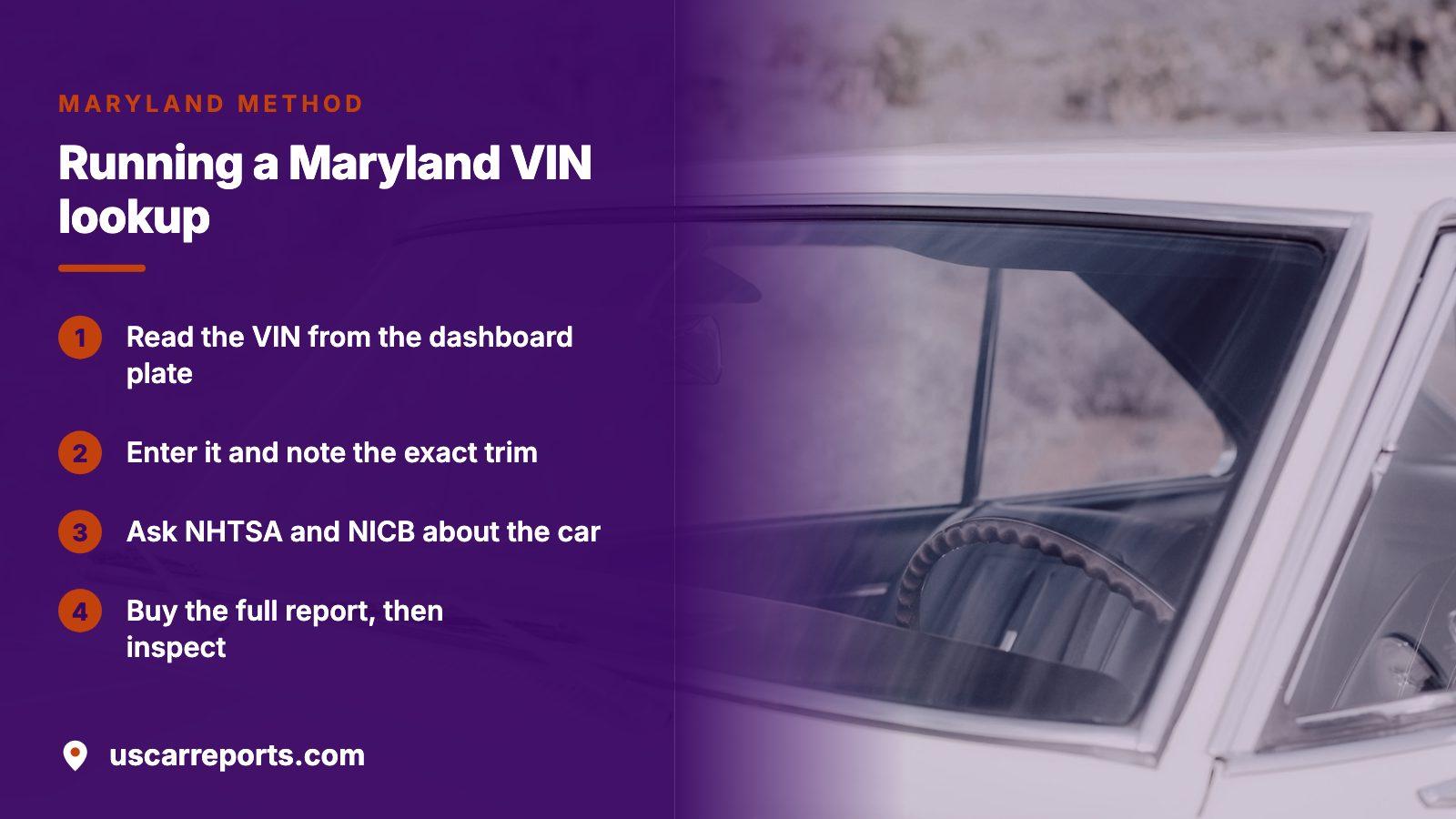
- Read the VIN from the metal plate at the dashboard corner, visible through the windshield, and from the label on the driver's door frame. Then check that the title the seller hands you prints the identical number. A mismatch needs a written explanation before anything else happens.
- Enter the VIN here to open the free preview. Note the exact year and trim, since both set the published value discussed below.
- Ask NHTSA about open recalls and NICB about thefts and total losses. Neither charges a fee.
- If the car still looks right, the full report comes next, paid once and never renewed.
- Have a mechanic look the car over, then settle the paperwork.
What Maryland taxes at titling: your price or the published value
Maryland charges an excise tax each time a title is issued, calculated on what the law calls the fair market value of the car. For a used car that is not always the number on your receipt. The state compares your price with a national used-car guide, and in a private sale the result depends on the car's age.
| Your purchase | What the excise tax follows |
|---|---|
| Bought from a licensed dealer | The total price the dealer certifies |
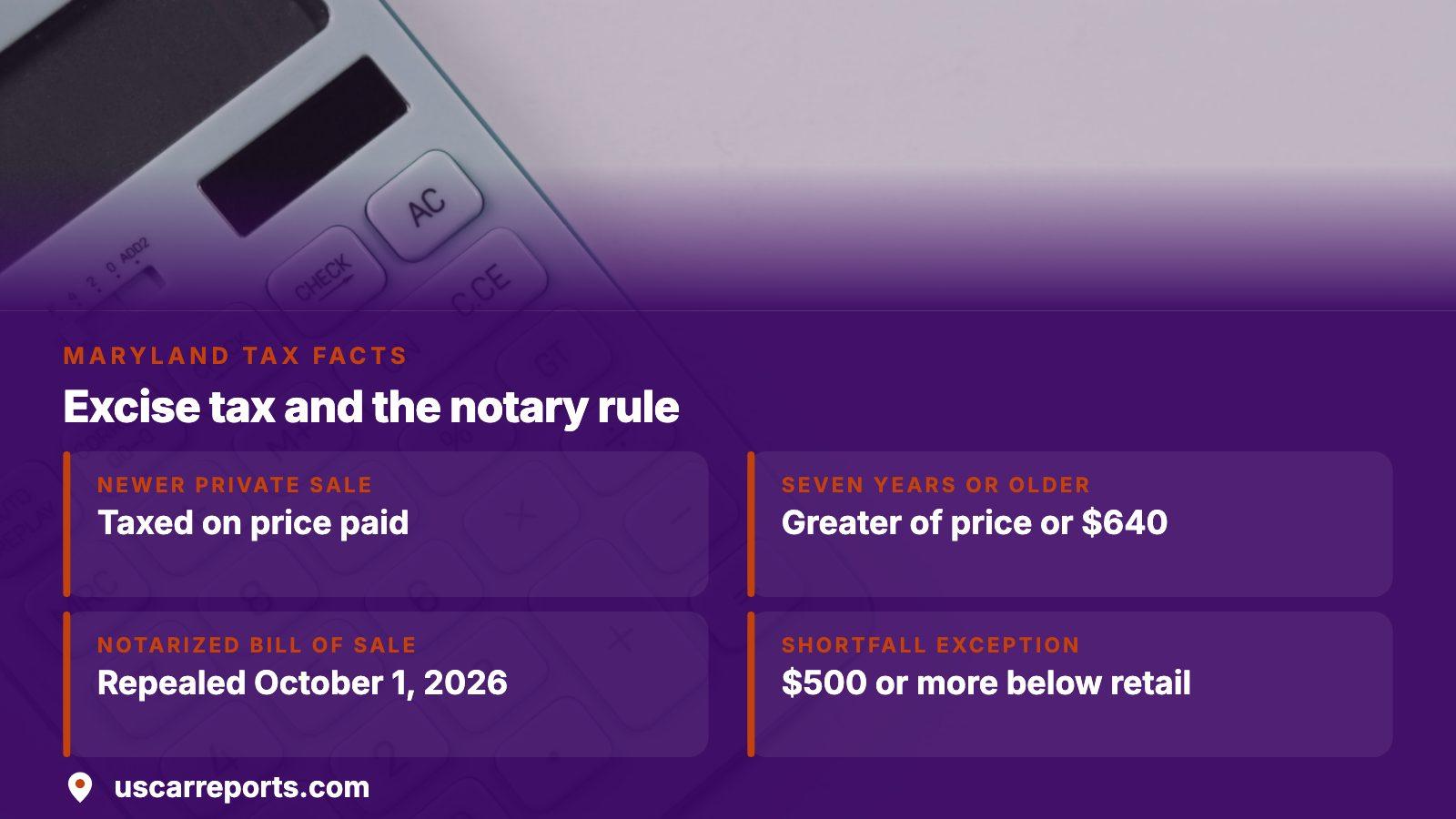
| Private sale, designated model year seven or more years back | The greater of your price or $640 |
| Private sale, newer car, price less than $500 under published retail value | The price you paid |
| Private sale, newer car, price $500 or more under published retail value | The published valuation |
The MVA uses the clean retail value from the National Automobile Dealers Association. Clean retail assumes a car in good shape. A worn interior, high mileage or a repaired fender can push a fair price well past $500 below it.
The notarized bill of sale is gone, but the old advice is still online
For years the way to hold the tax to your real price was a special MVA form: buyer and seller both signed it, a notary stamped it, and it explained why the price was low. A 2026 law repealed the requirement to submit that document, effective October 1. Guides written earlier, and some sellers, may still tell you to find a notary.
What governs now is the amended statute. On a newer car bought privately, a price $500 or more below the published retail value is taxed at the published value. The law still lets the MVA ask for records of what you paid, such as canceled checks, money order receipts or loan documents.
Confirm the current counter rules
The statute directs the MVA to adopt regulations to carry out the change, so its forms and counter practice can differ from this summary. Ask how it reviews a low price before you pay a deposit, and keep proof of payment either way.
A low price is a reason to look closer, not proof of a problem
A price under book proves little. Sellers move cars cheaply when they are rushed, when the paint is tired, or when the buyer is a neighbor. A car priced well under the published value will cost more to title, and it can still be a clean car. Tax and history are two separate answers.
The combination to worry about is a low price with a history gap the seller cannot explain. Judge the history first, then use the tax math to set your budget.
Reading the results: findings that change what you offer
| Finding | What to do |
|---|---|
| Salvage, rebuilt or flood brand on a title | Price it as a different car, pay for an independent inspection, or walk away |
| Mileage lower than an earlier record | Ask for paperwork that explains it; without that, treat it as a stop sign |
| Lien listed | Require a lender's release before any money moves |
| Theft flag | Walk away until the police and insurer have settled it |
| Open recall | Book the repair at a franchised dealer and confirm it has cleared |
A brand recorded in one state can be hard to spot on a later title from another state. That is the gap the national title record exists to close, and it matters on a corridor where cars change hands across state lines.
Maryland paperwork to line up before money changes hands
- The seller's signature on the title, the mileage written in, and a VIN identical to the car's.
- A lender's release if the title shows a lien.
- Proof of the price: a receipt, plus a trace such as a canceled check or money order receipt.
- A plan for the state inspection, which stands between a used-car purchase and its transfer in Maryland.
- The excise tax worked out against the published value, so the bill at the counter holds no surprise.
What the report costs and where to start
The preview costs nothing and shows what is on file for the VIN. The full report is paid once, and nothing renews afterward. Bundles of 3, 5 or 10 reports exist for a shortlist of cars. Current options sit on the pricing page at /pricing.
Run the lookup before you negotiate. The history changes what the car is worth, and its year and trim set the value the MVA will measure your price against. A clean report does not replace a mechanic's inspection.
Where this information comes from
- Maryland General Assembly: Chapter 118 of 2026 (HB 251) — Enacted text behind the fair-market-value tiers, the $640 floor, the $500 test and the October 1, 2026 repeal date.
- Maryland General Assembly: HB 251 fiscal and policy note — Explains why the notarized form was repealed and how the earlier rule worked.
- Maryland MVA: Excise tax — The agency's own explanation of the excise tax and the national used-car valuation it applies.
- NHTSA: Recalls — The free open-recall search by VIN.
- NMVTIS: National Motor Vehicle Title Information System — The federal title record that approved providers draw on, covering brands from every reporting state.
- NICB: VINCheck — The no-cost theft and total-loss lookup that uses participating insurers' reports.
Sources and photos: Facts checked against the sources above in November 2026. Photos by Miles Loewen, Wesley Tingey and Sasun Bughdaryan on Unsplash; diagrams by USCarReports.
Keep reading
- Virginia VIN check: salvage rules, title steps and inspectionThe neighboring state's buying rules, for a car that crossed the line.
- Delaware VIN check: title history, liens and the state's buying rulesAnother neighbor, and a state with its own take on used-car transfers.
- Title status check: what the state lookup tells a car buyerHow to read a title's status before money changes hands.
- Sample reportSee how the records are laid out before you buy a report.
Frequently asked questions
Can I run a Maryland VIN check for free?
Parts of it. Decoding the VIN, NHTSA's recall lookup and NICB's theft and total-loss lookup cost nothing. USCarReports adds a free preview for any Maryland VIN. The fuller history, with title brands and damage records, is the paid piece, bought once with no subscription.
How do I do a VIN lookup in Maryland?
Copy the 17-character number from the dash plate or the door-frame label, confirm it matches the title, and enter it in a lookup. Do the federal checks first, then add a title and damage record. Do all of it before you pay, and save the results with the seller's ad and your receipt.
Is the Maryland excise tax based on my purchase price?
Often, not always. A dealer's certified price governs a dealer sale. In a private sale of a car seven or more model years old, the tax follows the greater of price or $640. On a newer car the price governs, unless the price trails the published retail value by $500 or more, and then that value is used.
Do I still need a notarized bill of sale in Maryland?
The MVA no longer requires one to be submitted. A 2026 law repealed the requirement, effective October 1, 2026. A signed bill of sale is still sensible evidence of the deal, so write one, record the price and keep proof of payment in case the MVA asks to see it.
Will a VIN check show whether a Maryland car was flooded?
Sometimes. A flood brand on a title, or an insurance total loss, shows up in the national title record and the damage history. Flooding that nobody claimed leaves no entry anywhere, so also look for silt under the carpets, rust on bare metal below the dash and a musty cabin.
Now check the car itself
The guide explains what to look for. The report shows what this VIN has on record.