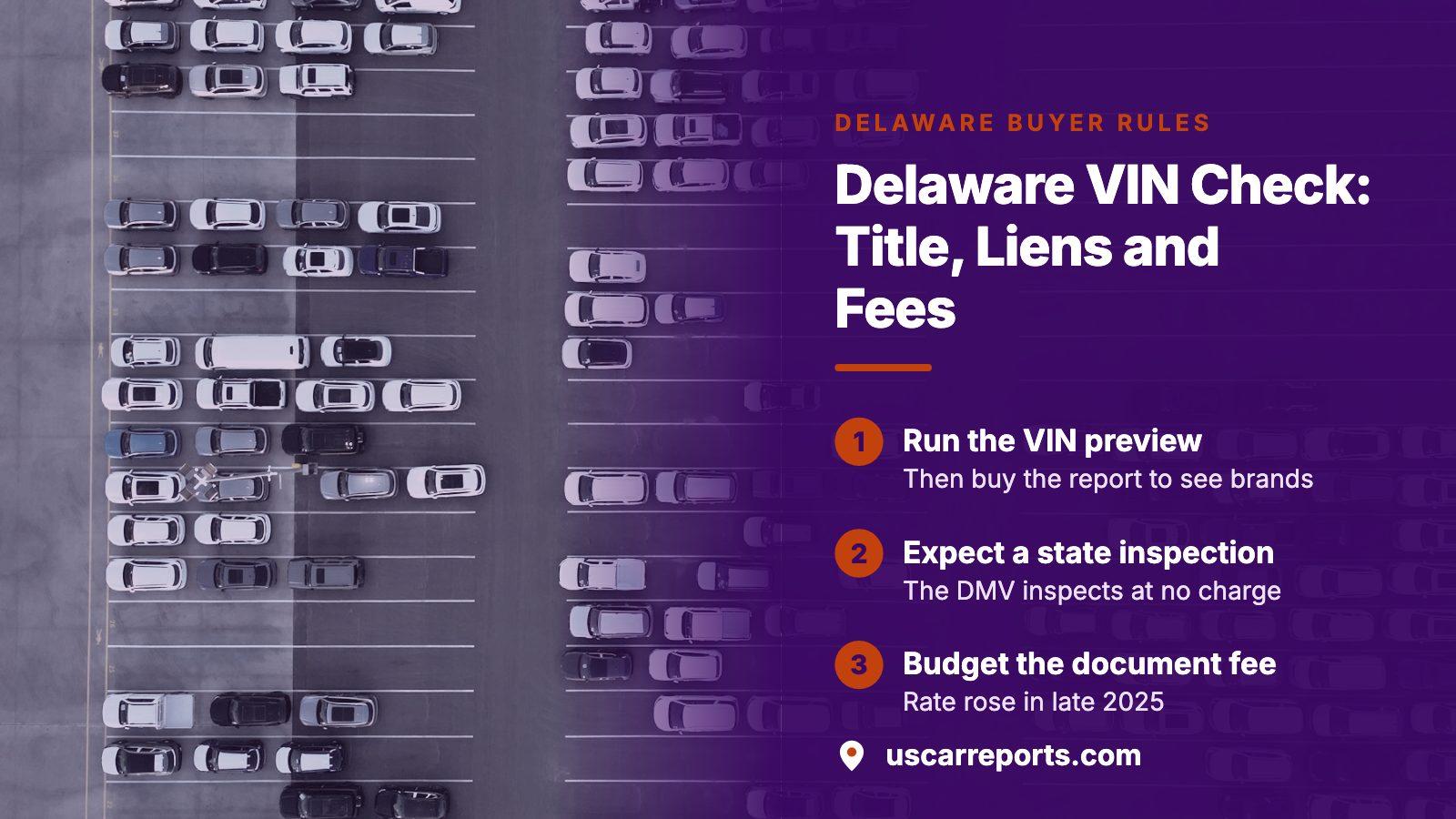
THE SHORT ANSWER
Type the VIN in for a free preview, then buy the report to see title brands from any state, crash and damage records, mileage history, liens, theft flags and open recalls. For a Delaware car, settle three local points too: whether it needs the DMV's no-fee inspection or only a VIN verification, what document fee you will owe at titling, and whether a neighboring state wrote part of its history.
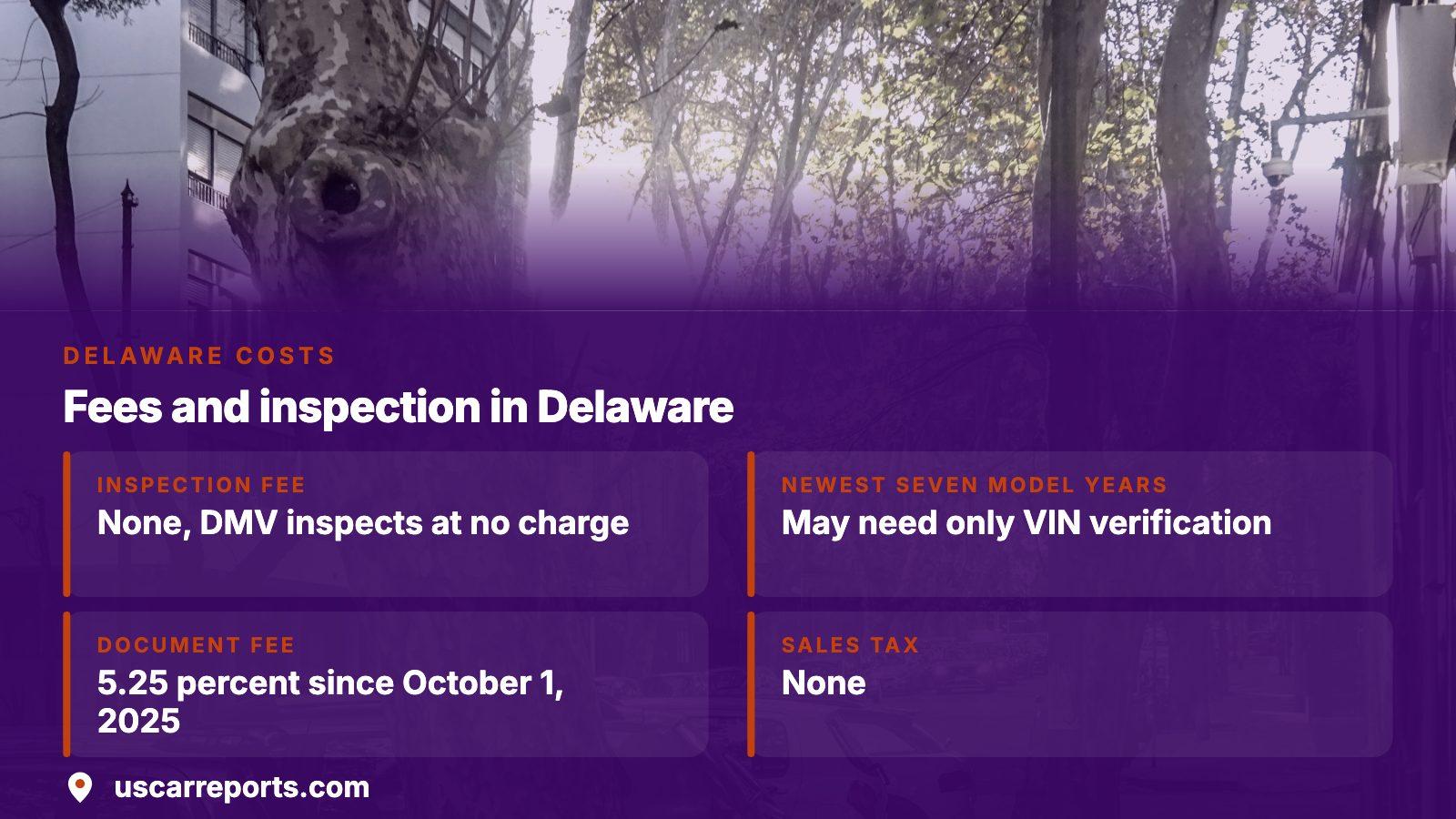
- Inspection fee
- None; the DMV inspects at no charge
- Newest seven model years
- 10,000 pounds or less: may need only a VIN verification at first titling
- Document fee
- 5.25 percent since October 1, 2025, up from 4.25
- Sales tax
- None
What a Delaware VIN lookup shows before any money changes hands
USCarReports builds VIN and title checks state by state, and the Delaware version turns one 17-character number into a record you can read before the test drive. The report gathers:
- Title brands tagged with the issuing state, so a salvage or rebuilt brand from elsewhere still shows on a Delaware-titled car.
- Crash and damage records, plus any salvage or auction sale with its photos.
- Mileage recorded on different dates, to test whether the odometer tells a believable story.
- Insurance entries, theft reports, liens and impounds.
- Any open recalls, an estimate of market value, the factory specs, and the car's owners and use.
It works from the VIN alone. A plate does not lawfully identify an owner for a private buyer, and Delaware lets owners retain their tags, so the plate on a car for sale tells you little.
Where to read the VIN and how to run it
Take it from the car, not the listing. Read the dashboard plate through the glass and the label inside the driver's door jamb, then compare both with the title. If the numbers disagree, stop there.
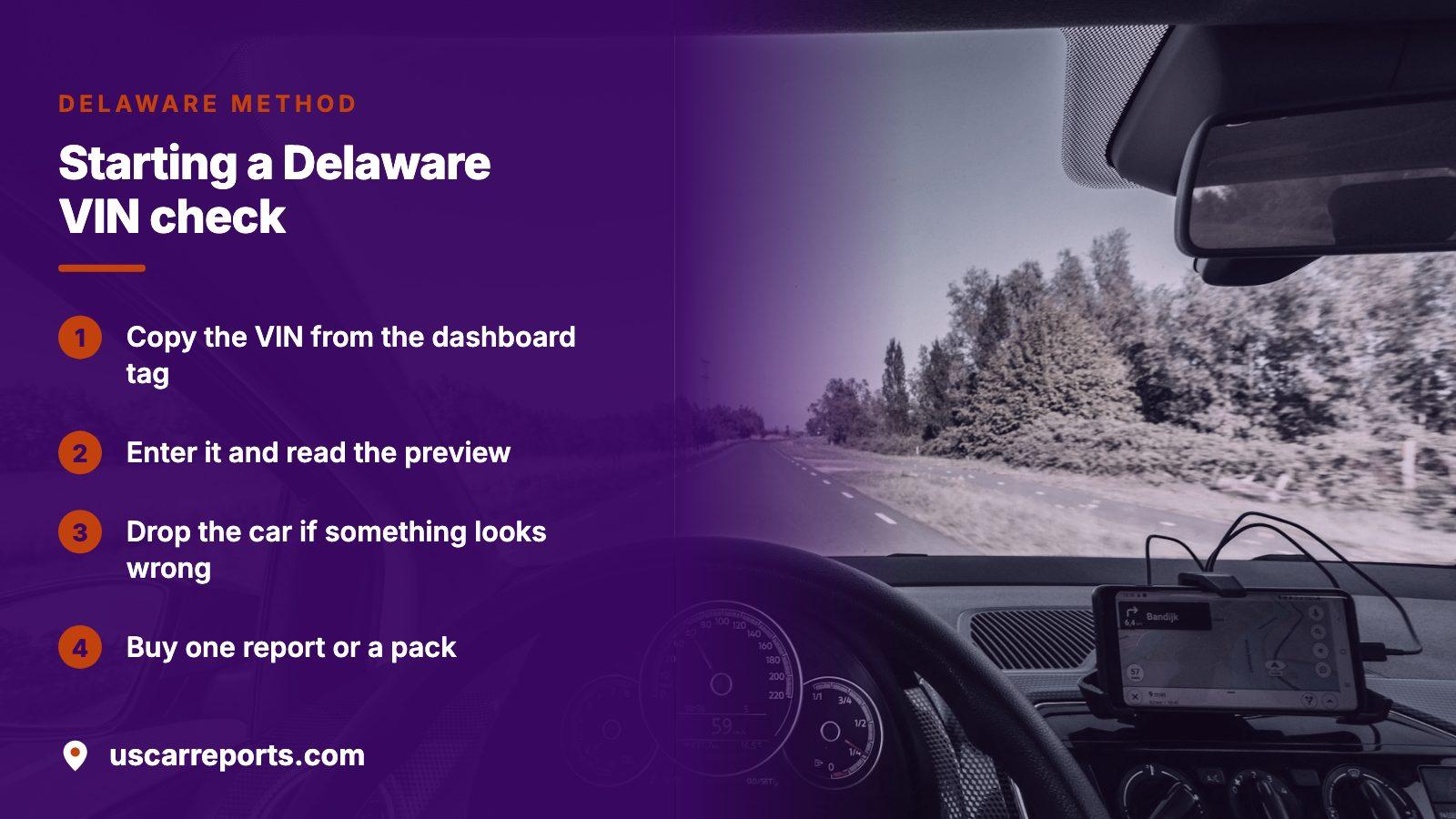
- Copy the VIN from the dashboard tag and confirm the door sticker agrees.
- Enter it in the box on this page. The preview costs nothing.
- Read the preview and drop the car on the spot if something already looks wrong.
- A single report covers one car; packs of 3, 5 or 10 cover a shortlist. Nothing renews.
Delaware's buying rules at a glance
Each page in this series opens with local rules, because they set what you pay and how long the paperwork takes. In Delaware the inspection is the cheap part. The money goes out at titling.
| Topic | How Delaware handles it | What it means for you |
|---|---|---|
| Inspection fee | None. The four DMV facilities inspect at no charge | A scheduling job, not a cost |
| First Delaware title | Most vehicles getting their first Delaware title have to pass inspection | A car arriving from out of state usually needs one |
| Newest seven model years, 10,000 pounds or less | May need only a VIN verification at first titling | Check the model year first; it sets your appointment |
| Brand-new, never titled anywhere | Exempt when the dealer supplies a Delaware title application | A dealer-sale rule, not a private-sale one |
| Number plate | One plate, on the rear (a truck tractor hitched to a trailer carries it on the front) | No front bracket expected on a car that started life here |
| Sales tax | None, but a document fee applies at titling | Budget the fee as its own line |
What the free inspection covers, and what it leaves out
A typical visit is a safety check of tires, brakes and windows, an exhaust emissions analysis and a fuel system leak test, with the emissions method depending on the vehicle's model year and weight.
That is a regulatory screen, not a buyer's inspection. It will not reveal a frame repaired last spring, a wound-back odometer or a lender still holding a claim. And because the state charges nothing, a car that has skipped it usually belongs to an owner who never took it, unless an exemption applies.
The document fee: higher since October 2025, and charged on the bigger number
Delaware has no sales tax, and shoppers from across the line sometimes expect a bargain at the counter. The state levies a document fee at titling instead. On October 1, 2025 the rate went up a full point, to 5.25 percent, where it had been 4.25 percent.
According to the DMV's fee page, the base is whichever is greater, the purchase price or the book value, and a minimum fee applies. A low negotiated price therefore does not shrink the bill: a car bought well under book is charged on book. Anyone who titled a car here years ago will quote a number that is now too low.
Price the fee before you price the car
The DMV publishes a fee calculator. Run the car's book value through it first, because in a private sale nothing in the haggling raises the subject unless you do.
Why a Delaware car's history is often written next door
Delaware is small, with Maryland, Pennsylvania and New Jersey on its borders and heavy traffic crossing it. Many used cars sold here were first sold, and sometimes first wrecked, in one of those states.
That makes the state paperwork thinner than it looks. A brand applied in New Jersey before the car crossed the river lives in the national title record, NMVTIS, and no Delaware document will repeat it. The report reads that record by VIN, so the neighbor's chapter appears beside the Delaware one. The related pages below cover the rules across each border.
Reading the results: what each finding should make you do
| What turns up | What it can mean | Your move |
|---|---|---|
| A brand from a neighboring state | A salvage or rebuilt history that began before the car reached Delaware | Weigh it against the price and the seller's story, or walk away |
| Mileage that stalls or falls | A rollback or a replaced instrument cluster | Ask for service records and compare pedal and tire wear with the miles shown |
| A lien or impound entry | A lender or tow yard may still hold a claim | Require a written release before paying |
| Salvage or auction photos | The car was damaged and sold at some point | Match the photos to the panels and paint in person |
| A theft record | The car may be reported stolen | Stop and call the police or the insurer |
| An open recall | A safety repair is outstanding | Ask the seller to fix it, or budget a dealer visit |
Red flags in a Delaware sale
- The seller says the inspection can wait. It costs nothing, so ask why it has not happened, after checking whether an exemption covers the car.
- Holes drilled in the front bumper, or a mounting point that has been filled in. A Delaware-native car wears one plate on the back, so a front bracket can point to an earlier life elsewhere.
- The title is in someone else's name, or the seller promises to mail it later.
- A VIN on the paperwork that differs from the VIN on the car.
A car outside the newest seven model years is not a worse car, and one inside that window is not a better one. The line is administrative. Condition is something only a mechanic can tell you.
Costs, and the order to do things in
The preview costs nothing and shows what the record holds. The report is a one-time payment, and the pricing page lists the current options.
- Open the preview and drop any car that already looks wrong.
- Check open recalls at NHTSA and run NICB's VINCheck for theft. Both cost nothing.
- Buy the report for brands, mileage history and liens across every reporting state.
- Meet the seller, read the title and match its VIN to the car.
- Work out the inspection position from the model year, and price the document fee.
- Have a mechanic look the car over, then title it at the DMV, with a bill of sale that records the VIN.
Where this information comes from
- Delaware DMV: Vehicle inspections — Supports the no-fee inspection, the first-titling requirement, the VIN verification option for the newest model years and what a typical inspection covers.
- Delaware DMV: Fees — Supports the document fee, its price-or-book-value base and the fee calculator.
- Delaware Code Title 21: Plates — The statute requiring a number plate on the rear of the vehicle, with the truck tractor exception.
- NHTSA: Recalls — A no-cost lookup of open safety recalls by VIN, separate from the state inspection.
- NMVTIS: National Motor Vehicle Title Information System — The federal title record where brands from other states are held.
Sources and photos: Facts checked against the sources above in November 2026. Photos by Iain, Sander Jeurissen and Nikolai Kolosov on Unsplash; diagrams by USCarReports.
Keep reading
- Maryland VIN check: the records to pull and what Maryland taxes at titlingThe neighbor to the south and west, with its own inspection and titling rules.
- Pennsylvania VIN check: history report first, notary visit secondThe state to the north whose cars often cross into Delaware.
- New Jersey VIN check: flood history, title brands and the buying rulesThe state across the Delaware River, another source of Delaware's used cars.
- Registering a car in another state: deadlines, title and checksWhat changes when a car you buy has to be titled in a different state.
Frequently asked questions
How do I run a Delaware VIN check?
Type the 17-character VIN into the box here for the preview, and buy the full report only if the car survives it. Before you pay the seller, read the title, confirm its VIN matches the car and search NHTSA for open recalls.
Is there a free Delaware VIN lookup?
Partly. The preview is free, and so are the NHTSA recall lookup and NICB's VINCheck. The full USCarReports report is a single payment. Delaware's own inspection costs nothing too, but it is a safety and emissions check and says nothing about a car's accident or title history.
Does Delaware charge sales tax on a car?
No, but a document fee applies when the vehicle is titled. It went up on October 1, 2025, to 5.25 percent after standing at 4.25 percent, and it is charged on the greater of the purchase price and the book value, with a minimum. Confirm the figure with the DMV's calculator.
Is an inspection required before a used car is titled in Delaware?
Most do, and the DMV performs it at no charge. The newest seven model years, at 10,000 pounds or less, may need only a VIN verification. Ask the DMV about your exact vehicle before you book a visit.
Can a license plate tell me who owns a Delaware car?
No. A plate does not lawfully identify an owner for a private buyer, and Delaware lets owners retain their tags, so the plate may not even stay with the car. Use the VIN on the car and the seller's title instead.
Now check the car itself
The guide explains what to look for. The report shows what this VIN has on record.