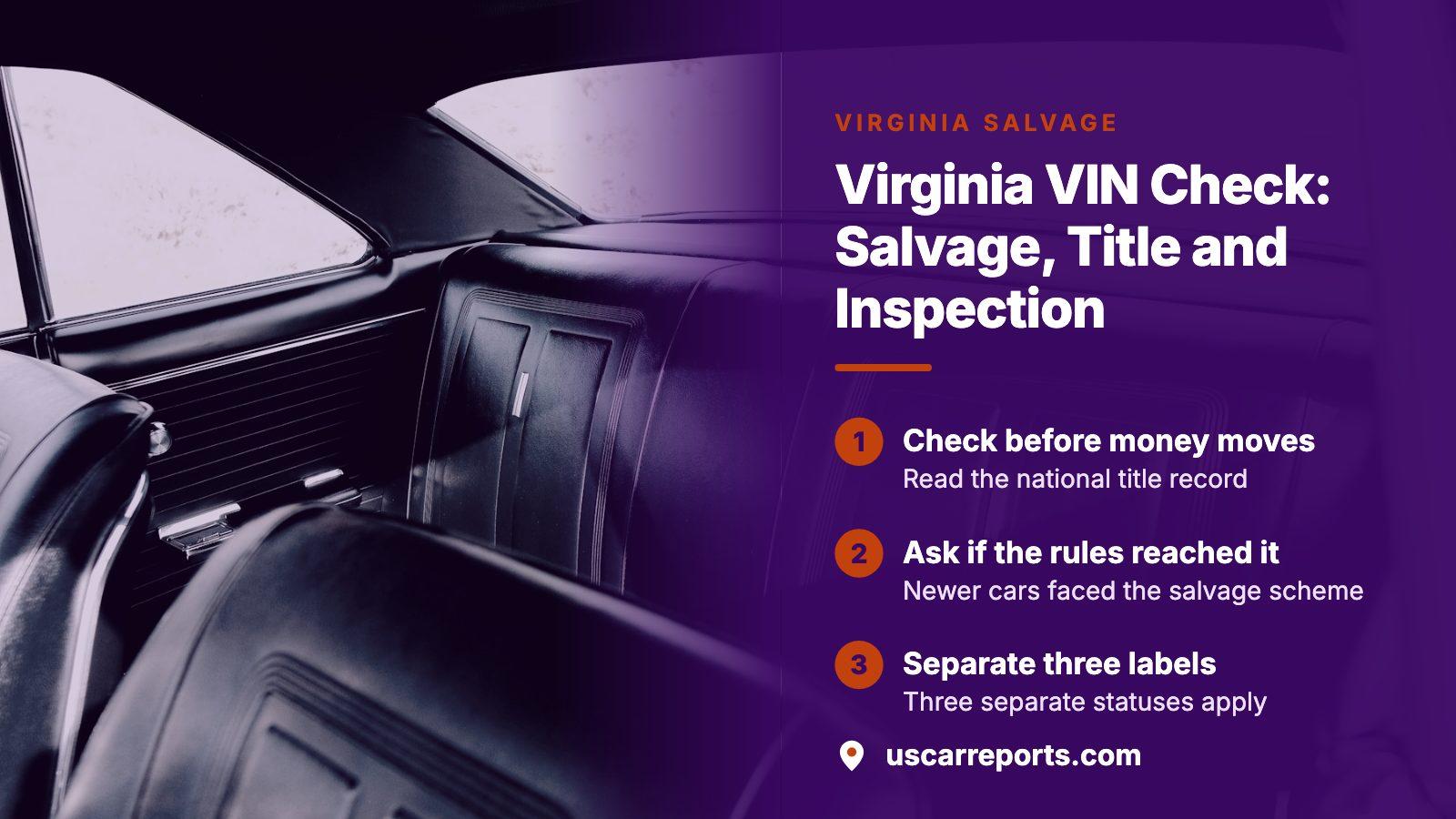
THE SHORT ANSWER
Copy the VIN from the car itself, run the preview, then read a national title record. Virginia's salvage scheme covers only some cars: the newest six model years and anything valued at $10,000 or more before it was damaged, so an older cheap wreck can look clean. Add NHTSA's recall search, read the sticker date and plan to title the car within 30 days.
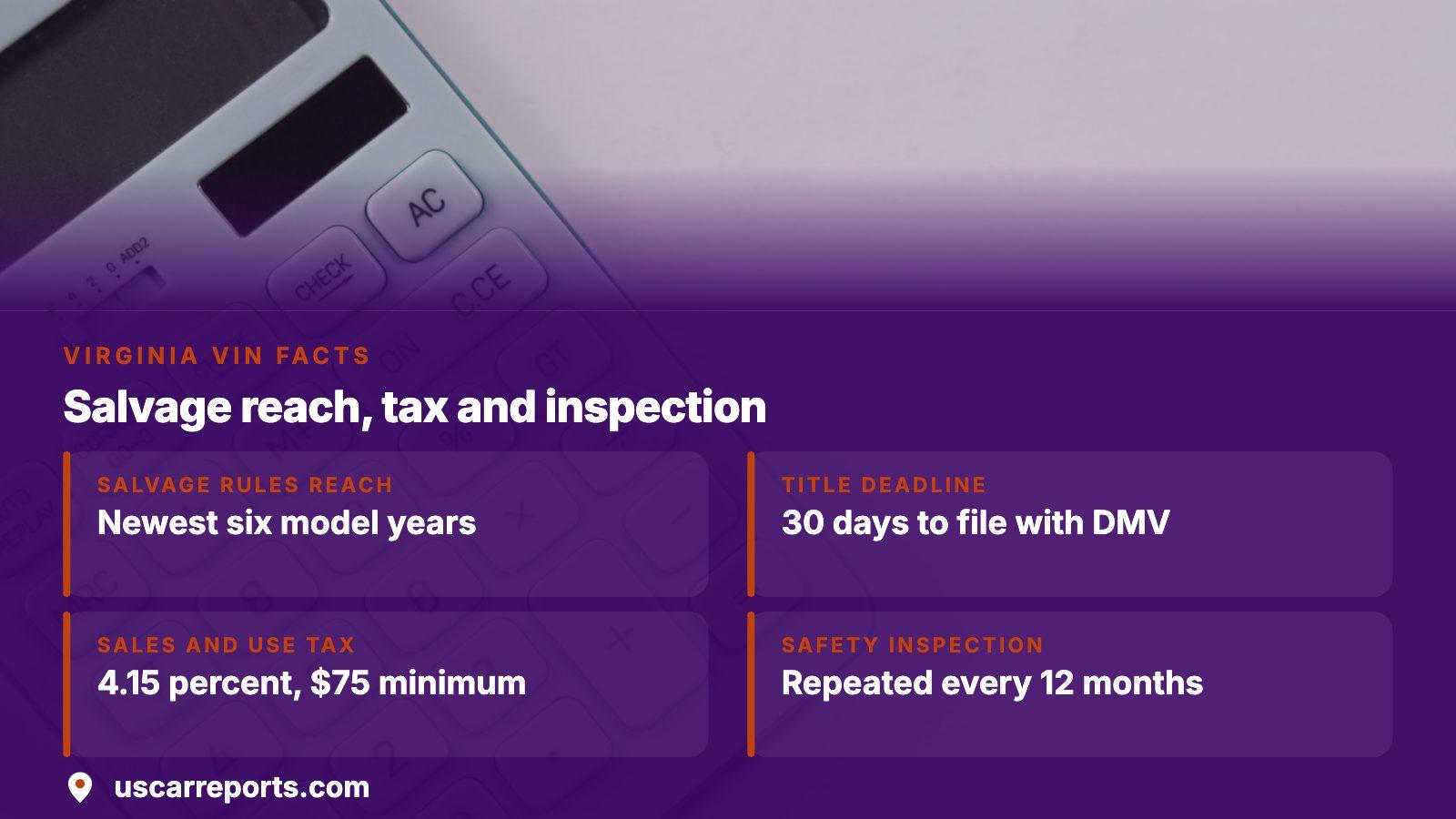
- Salvage rules reach
- Newest six model years, or $10,000 and up before damage
- Title deadline
- 30 days to file with the DMV
- Sales and use tax
- 4.15 percent of price, $75 minimum
- Safety inspection
- Repeated every 12 months
What a Virginia VIN check can and cannot tell you
One number opens several records, and none is complete alone. A decode shows the factory build. Federal and insurer databases add recalls, theft reports and total losses. The national title system holds brands from every reporting state, which matters here because Virginia's own salvage scheme skips some cars.
| Question | Where to look |
|---|---|
| Any safety recall left open? | NHTSA's search, using the VIN |
| Stolen or written off by an insurer? | NICB's database and the national title record |
| Junk, salvage or flood brand from any state? | The national title record |
| A repair that was done badly? | A mechanic's inspection, with the car raised |
The federal title system is deliberately brief and omits repair and recall data, so stack several lookups instead of leaning on one.
Running the check before any money moves
Start from the car, not the ad. A typo in a listing can pull up another vehicle or nothing.
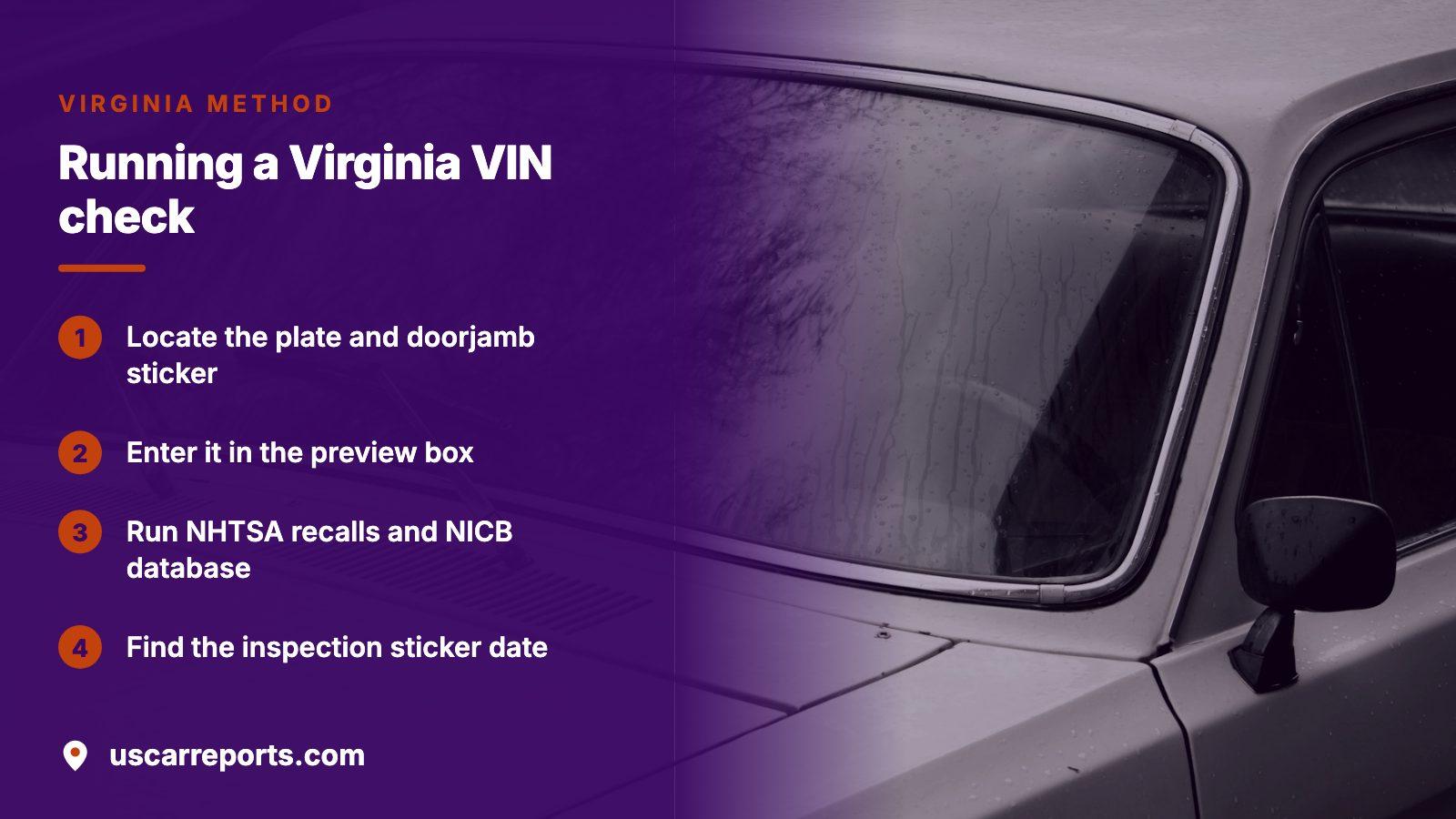
- Locate the VIN plate visible through the windshield and the sticker on the driver's doorjamb, then hold both up against the seller's Virginia title.
- Type it into the preview box here. It costs nothing and shows whether records exist.
- Run NHTSA's recall search and NICB's database on the same number.
- Find the inspection sticker date and ask for the last receipt.
- Purchase the full report ahead of any deposit and read it beside the title, then book a mechanic.
Look closely at the door label. Virginia's salvage chapter counts a door that carries a VIN as one of seven major components, so a swapped door with a missing or odd label calls for a direct question.
Which Virginia cars the salvage rules ever reached
Virginia does not brand every damaged car. Its salvage chapter targets late model vehicles, meaning cars from the newest six model years, plus any older car valued at $10,000 or more ahead of the loss.
| Car at the time of the loss | Salvage rules apply? |
|---|---|
| From the newest six model years | Yes, by age |
| Older, valued at $10,000 or above | Yes, by value |
| Older and valued below $10,000 | Only if the owner or insurer asked for a salvage certificate |
The value test looks back at retail value before the loss, determined by whichever insurer handles the claim, or by the DMV when none does, so no buyer can look it up. A clean Virginia record on a decade-old economy car therefore proves less than the same record on last year's model, because the scheme may never have engaged.
Salvage, rebuilt, nonrepairable: three separate statuses
Buyers read these as shades of wrecked. Virginia treats them as distinct legal states.
| Status | What it means for a buyer |
|---|---|
| Salvage | Taken in an insurance claim or damaged past the repair-cost test; no plates until retitled |
| Rebuilt | Back on the road after repair; a permanent brand rides on every later title |
| Nonrepairable | Worth only parts and scrap; not retitled for road use, apart from narrow exceptions |
A rebuilt title requires a safety inspection by an unaffiliated inspector, then a DMV review of photos, parts receipts and the VIN, odometer and major components. The statute labels that review an antitheft and antifraud step, not a safety certification, so the brand shows paperwork was examined, not that the repair is sound.
Ask what was replaced
The 75 percent rebuilt test leaves out engine, transmission and drive axle costs, so a car with an expensive powertrain repair can stay unbranded. Ask to see the invoices.
Cars titled in another state first
Many used cars on Virginia lots began under another state's title. The DMV may accept those salvage titles and carry their brands forward, so a brand does not vanish at the border.
If a car was rebuilt and titled out of state, and the national system or the earlier title carries a label like junk or parts-only, Virginia issues only a nonnegotiable title, which can change hands in narrow cases the Code lists. Compare every state's entries in the report with the paper title, not just the newest one.
Title paperwork, the 30-day clock and the sales tax
- The seller delivers the signed certificate of title at handover, with every lien listed.
- The seller enters the odometer reading. Without it no new title is issued, and a knowingly false entry is a Class 1 misdemeanor.
- The buyer adds name and address in ink and files the title with the DMV within 30 days.
- A lender named on the title should be paid and released before you take the car.
The Code sets the sales and use tax at 4.15 percent of the price, with a $75 floor. A car bought out of state but used here pays the same rate, assessed on market value at that point if it arrives six months or more after purchase.
The inspection sticker and the local car tax
Registered cars on Virginia roads need a safety inspection at an official station every 12 months, shown by a windshield sticker. A failed car gets a rejection sticker good for 15 days, and the State Police cap an ordinary car's fee at $20.
Check the date yourself. Officers cannot stop a car solely for an expired sticker until the first day of the fourth month after it lapses, so a recent lapse is common and may mean you inherit a failed inspection.
The car tax is local
Counties and cities tax vehicles as personal property, valued as of January 1, and each decides whether to prorate a mid-year purchase. Ask the locality where the car will live what you will owe.
Reading the results: red flags and your next move
| Entry | What it may mean | Your next move |
|---|---|---|
| Junk, salvage or flood brand, any state | A severe loss in the past | Get photos and invoices, then pay for a structural check |
| Rebuilt brand in Virginia | Passed inspection and a paperwork review | Price accordingly and ask who did the work |
| Mileage below an earlier entry | Rollback, swapped cluster or typo | Demand a written explanation |
| VIN on door or plate differs from title | Replaced part or tampering | Pause the sale until explained |
| Open lien | A lender still has a claim | Settle through the lender and take a clear title |
| No entries on an older, cheap car | The salvage scheme may never have applied | Rely more on a lifted inspection and service records |
Order matters: a total loss followed by a rebuilt brand tells a different story than one followed by a clean title in another state.
Cost and your next steps
Previewing a VIN costs nothing. After that, a report is a one-time purchase for a single car or a multi-car bundle, with no renewals. Amounts are listed on /pricing. Then follow the order: lookups, report, sticker date, mechanic, and a title with the mileage line completed.
Run the report before you drive out to see the car, so a branded title can end the trip early. An empty record on an old, inexpensive car is not clearance; it may only mean the state's scheme never applied, so lean on a mechanic's inspection and the seller's service records.
Where this information comes from
- Code of Virginia: definitions for salvage, rebuilt and nonrepairable vehicles — The late model class, the salvage and rebuilt tests, the certificates and the list of major components.
- Code of Virginia: vehicles rebuilt for highway use — The safety inspection, the DMV examination and its stated purpose, and the permanent rebuilt brand.
- Code of Virginia: titles issued by other states — How other states' salvage brands carry forward and when only a nonnegotiable title is issued.
- Code of Virginia: transfer and application for title — The buyer's 30-day deadline; neighboring sections cover the seller's signature and odometer duties.
- Code of Virginia: motor vehicle sales and use tax — The rate, the minimum and the treatment of cars brought in from elsewhere.
- Virginia State Police: vehicle safety inspection — What the inspection covers, the reinspection window and the maximum fees.
- NMVTIS: understanding a vehicle history report — The federal title system's indicators, its data sources and what it leaves out.
Sources and photos: Facts checked against the sources above in November 2026. Photos by Wesley Tingey, Tigran Shishmanyan and Sasun Bughdaryan on Unsplash; diagrams by USCarReports.
Keep reading
- Virginia title check by VIN: certificates, the late model rule and 30 daysA closer look at Virginia's brands and the title-side steps.
- North Carolina VIN Check: Run the Report Before You PayThe bordering state to the south, for cars that crossed the line.
- Maryland VIN check: the records to pull and what Maryland taxes at titlingAnother neighbor's buying rules if the car came from there.
- Sample reportSee how brands and odometer entries are laid out before you buy.
Frequently asked questions
What is the right order for checking a used car in Virginia?
Confirm the VIN stamped on the car agrees with the title, run the preview, then NHTSA's recall search and NICB's database. Buy the full report before any deposit, read the sticker date and pay for a mechanic's inspection. Virginia's salvage scheme skips some cars, so the national title record fills the gaps.
Is there a free Virginia VIN lookup?
NHTSA's recall search and NICB's database cost nothing, and USCarReports shows a free preview for any VIN. Neither free source holds national title brands and odometer entries from every state; that record is sold in a one-time report.
Does a current inspection sticker prove the car is sound?
No. It records one day's safety inspection of brakes, lights, steering, tires and similar equipment, and says nothing about accident or flood history. A fresh sticker can sit on a car with a salvage past.
What if the seller leaves the mileage line blank on the title?
Do not accept it. No new title is issued without the seller's reading, and a knowingly false entry is a Class 1 misdemeanor. Have the seller fill it in before payment, then compare it with the report's earlier readings.
Do flood cars show up in a Virginia VIN check?
Sometimes. A flood brand appears if a state agency or insurer recorded it, and the national record keeps flood brands from any state. A car never reported can still look clean, so look for silt under the seats, rusty connectors and water lines inside headlights.
Now check the car itself
The guide explains what to look for. The report shows what this VIN has on record.