
THE SHORT ANSWER
To run a Massachusetts title check, gather the VIN and the title number from the seller. Enter them on the RMV's title status page, which has no fee and shows the issue date, whether the title is paper or electronic, and any lienholder. That page lists no damage field, so also run the VIN through a history report for brands, total-loss entries and mileage from other states. The USCarReports preview comes before any purchase.
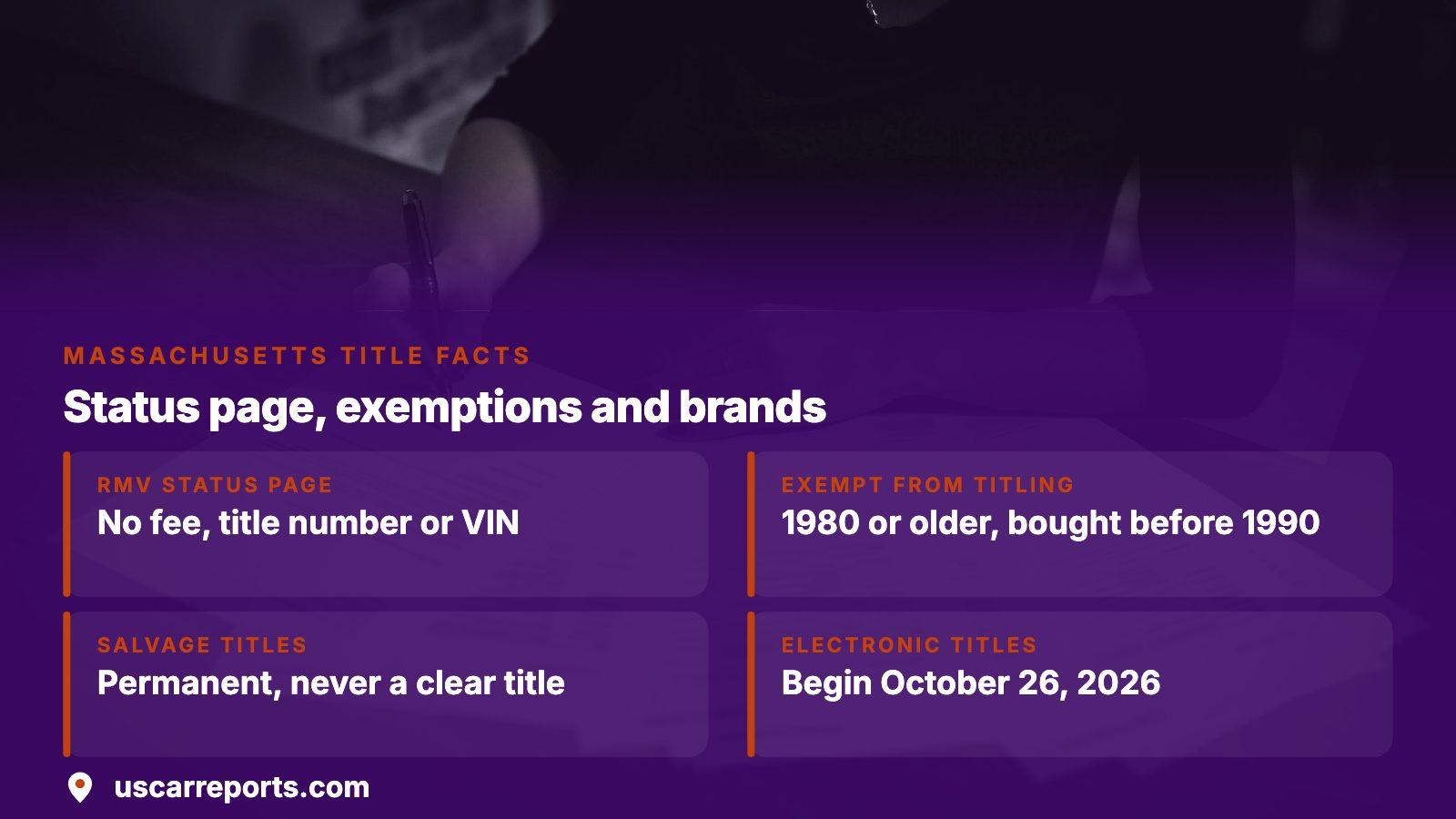
- RMV title status page
- No fee; needs a title number or the VIN
- Exempt from titling
- Passenger cars of 1980 or older bought before November 26, 1990
- Salvage titles
- Permanent; a salvage vehicle never gets a clear title
- Electronic titles
- Introduced in Massachusetts on October 26, 2026
Three records, three questions: what a Massachusetts title check covers
Think of the check as three records, each answering something the others cannot. The state record shows what Massachusetts holds on this exact title. The national record shows what any state has done to the vehicle. A history report puts mileage, auctions and loans on the same VIN.
| Record | What it settles | Input and cost |
|---|---|---|
| RMV title status lookup | Issue date, who received the title, paper or electronic, lender if any | Title number or VIN, no fee |
| Approved NMVTIS provider | Brand history from every reporting state, write-offs, odometer, latest title date | Sold by the provider |
| USCarReports | The VIN's full record, previewed before you pay | Preview at no charge, then one payment |
The RMV status page, field by field
Massachusetts runs a title lookup that most states do not. Enter the last 8 characters of the VIN with the title number, or the full VIN if you lack the number. The title number is printed on the registration, so ask the seller to photograph that document too.
- The date the title was issued, which should fit the seller's account of when they bought the car
- Where the title was, or will be, mailed
- Whether the current title is paper or electronic
- The lender's name when a lien exists, with a flag if that lender records liens electronically
The RMV describes no brand, damage or mileage field for this lookup. A tidy result shows the paperwork is in order, not that the car is.
Massachusetts title types and what each one tells a buyer
The RMV sorts titles into types, with sub-brands naming the event behind any damage.
| Title type | What the RMV says | What it means for you |
|---|---|---|
| Clear | Nothing salvage-related in its past | A good start, silent about other states |
| Salvage, repairable | A total loss that could be fixed | No registration until it passes a salvage inspection |
| Salvage, parts only | A total loss beyond repair | No Massachusetts title or plates, ever |
| Reconstructed | Former repairable salvage, now repaired and inspected | Keeps at least one damage sub-brand |
| Recovered theft | Former repairable salvage with a theft sub-brand | A theft story worth asking about |
| Memorandum | Out-of-state car whose lender holds the original | Cannot be passed on until that original turns up |
| Junk | Scrapped, record marked JUNK | Never titled or registered again |
Older cars and light trailers: when having no title is normal
Massachusetts does not title everything. A passenger car is exempt only when two tests are met together: model year 1980 or earlier, and a purchase before November 26, 1990. A 1975 car bought after that date should have a title. A trailer rated at 3,000 pounds or less gets no title either.
For an exempt car, the previous registration plus a bill of sale stand in for the title, both signed, with mileage recorded. A buyer who cannot assemble them can ask for an undocumented bonded title. The RMV decides case by case; the application can include a notarized history affidavit, a visual VIN inspection and bills of sale or cancelled checks, and the bond may be set at one and a half times the NADA clean trade-in value.
Paper or electronic: the E-Title question
From October 26, 2026 a Massachusetts title can exist in electronic form. Converting paper to electronic, or back, costs $25 each way. In a private sale of an eligible vehicle between two Massachusetts residents with myRMV accounts, a seller holding an electronic title releases ownership online, and the buyer completes the application online and pays the title fee and sales tax.
Ask about the format before you drive over
The RMV status lookup reports whether the title is paper or electronic, and an electronic title shows no lienholder. If the seller says the paper title is in a drawer, confirm the RMV shows paper too.
Liens, lost titles and the lender's letter
The status lookup names the lienholder, so a seller who calls the car paid off can be checked in a minute. Sellers also report lost titles, which asks you to accept a replacement on trust.
- A duplicate paper title costs $25 and can take up to 10 days by mail.
- For a paid-off loan, the RMV wants a signed letter on the lender's letterhead naming year, make, VIN and every titled owner.
- Faxes and photocopies of a lien release are refused.
- A lender's signature on the duplicate application is not a release.
Ask the seller to finish the duplicate or the release before any money moves. A car whose lender still holds an out-of-state title gets a memorandum title, and that title cannot change hands without the out-of-state original.
Running the check in order
- Ask the seller for photos of the title and registration, then match the VIN on the car to both documents.
- Put the title number, or the VIN, into the RMV status page and compare the issue date, format and lender with the seller's account.
- Enter the VIN on USCarReports and read the preview before spending anything.
- Look for brands from other states. A salvage brand anywhere becomes a Massachusetts problem, since the car needs the state's own salvage inspection.
- Buy the full report before leaving a deposit.
- Hire a mechanic to go over the car and write up what they find.

What the check costs and what the state bills after the sale
The USCarReports preview needs only the VIN and costs nothing. Nothing renews afterward: the full report is a single purchase. Shoppers comparing several cars can pick a multi-report pack of 3, 5 or 10, with details on the pricing page. After the purchase, the state's charges follow.
- Apply for the title within 10 days of the purchase.
- The title fee is $75, paid alongside any sales tax due.
- On a private sale, sales tax is figured on the price paid or the NADA book value, whichever is higher.
- Erasures, white-out and alterations on the ownership papers or the application are rejected, so keep the signed documents clean.
Where this information comes from
- Mass.gov: Check the status of your vehicle's title — What the RMV title lookup needs, what it returns and that it carries no fee.
- Mass.gov: Title types and definitions — The title types, sub-brands, memorandum titles and the bonded-title route.
- Mass.gov: Total loss and salvage vehicles — Salvage brands, the age exemption and the rules for out-of-state salvage cars.
- Mass.gov: Vehicle Certificate of Title — The titling exemptions, the deadline to title a purchase and the E-Title start date.
- Mass.gov: Apply for a paper certificate of title — The title fee, how sales tax is figured, accepted ownership papers and the E-Title options.
- Mass.gov: Replace your vehicle's paper certificate of title — Duplicate title cost and timing, plus what a lender's release letter must say.
- US Department of Justice: Understanding an NMVTIS vehicle history report — What the national record keeps, who reports to it and the advice to add an inspection.
Sources and photos: Facts checked against the sources above in November 2026. Photos by Alejandro Escamilla, Dylan Michaud and Dimitri Karastelev on Unsplash; diagrams by USCarReports.
Keep reading
- Massachusetts VIN check: the plate record, the seven-day clock and buying rulesThe plate lookup and the seven-day inspection clock that start once you buy.
- Bonded title: what it means for a buyer, state by stateHow a bond can stand in when the ownership papers are incomplete.
- Title status check: what the state lookup tells a car buyerConfirming a title's status in any state, not only this one.
- Sample reportSee how the records are laid out before you buy.
Frequently asked questions
Can I run a Massachusetts title check with just the VIN?
Yes. The RMV status page accepts the full VIN when you lack a title number and returns the issue date, title format and any lienholder at no fee. It cannot see damage recorded elsewhere, so run the VIN through the USCarReports preview as well before deciding on the full report.
Does a Massachusetts title search show accidents?
Not the RMV lookup, which has no accident or damage field. A salvage brand appears only if the car went through the salvage process, and passenger vehicles at least 10 years old at the time of loss skip it. A history report adds other states' records, though a crash nobody recorded will not show.
Is a Massachusetts salvage title permanent?
Yes. The RMV calls a salvage title permanent, so the car can never receive a clear title. A repairable car can be registered after passing a salvage inspection and is then titled as reconstructed. A parts-only car is barred from Massachusetts titles and plates for good.
Does every Massachusetts vehicle have a title?
No. Passenger cars of model year 1980 or older bought before November 26, 1990 are exempt, and so are trailers with a rating of 3,000 pounds or less. Boats, ATVs and snowmobiles are handled by the Environmental Police, not the RMV. Other motor vehicles need a title application within 10 days of purchase.
Is there a free Massachusetts title check?
Partly. The RMV lookup has no fee, and the USCarReports preview costs nothing. The full report is paid once, without a subscription, and packs sized for several cars are available. The pricing page has the details.
Now check the car itself
The guide explains what to look for. The report shows what this VIN has on record.