THE SHORT ANSWER
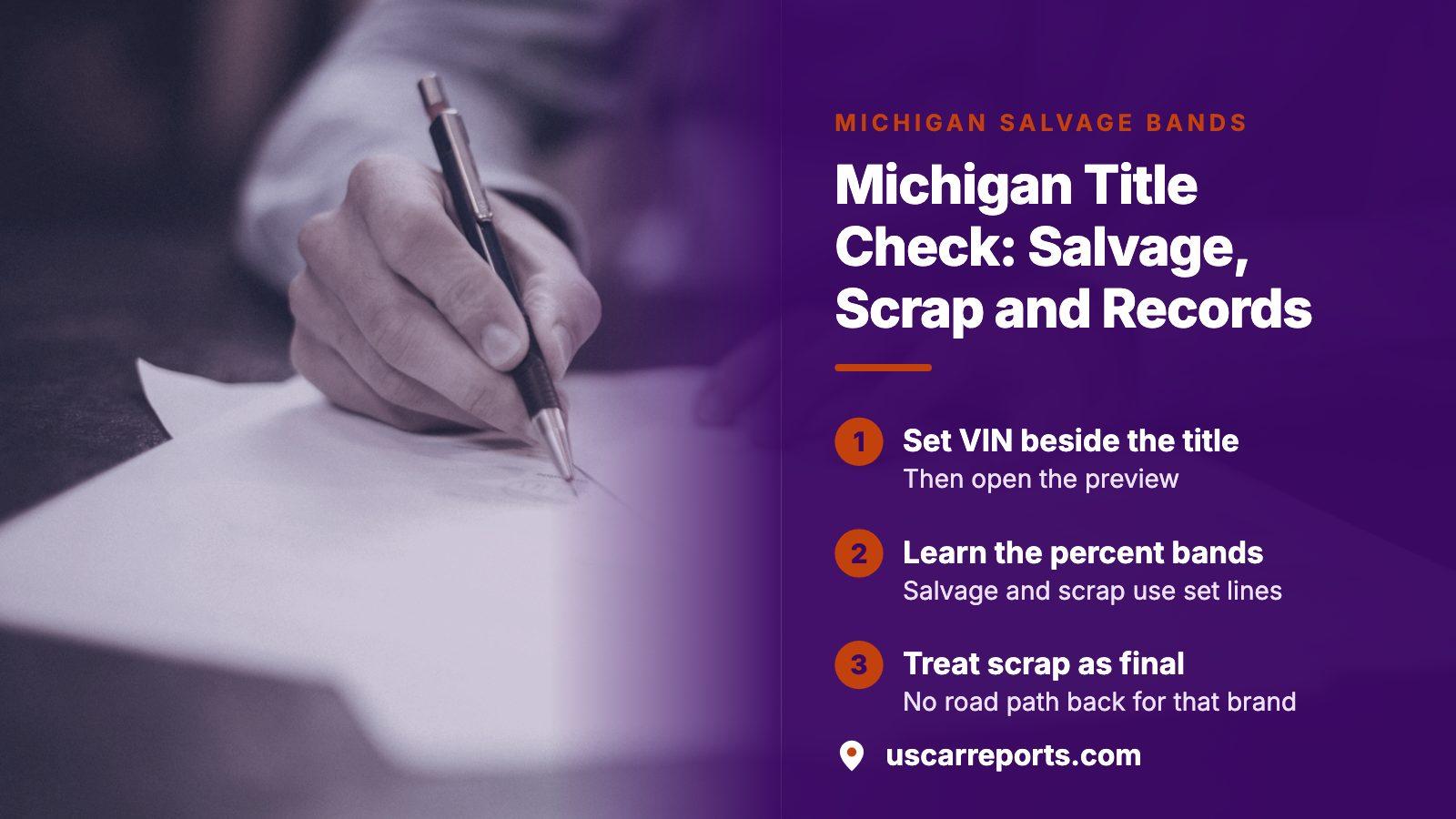
Put the VIN stamped on the car beside the seller's title, then open the USCarReports preview to see any brand on record. In Michigan, a late model car whose repair estimate reaches 75 percent of the value it had in cash before the damage, but stays under 91, gets a salvage title and can be rebuilt. At 91 percent or more it gets a scrap title, and the car can never return to the road.
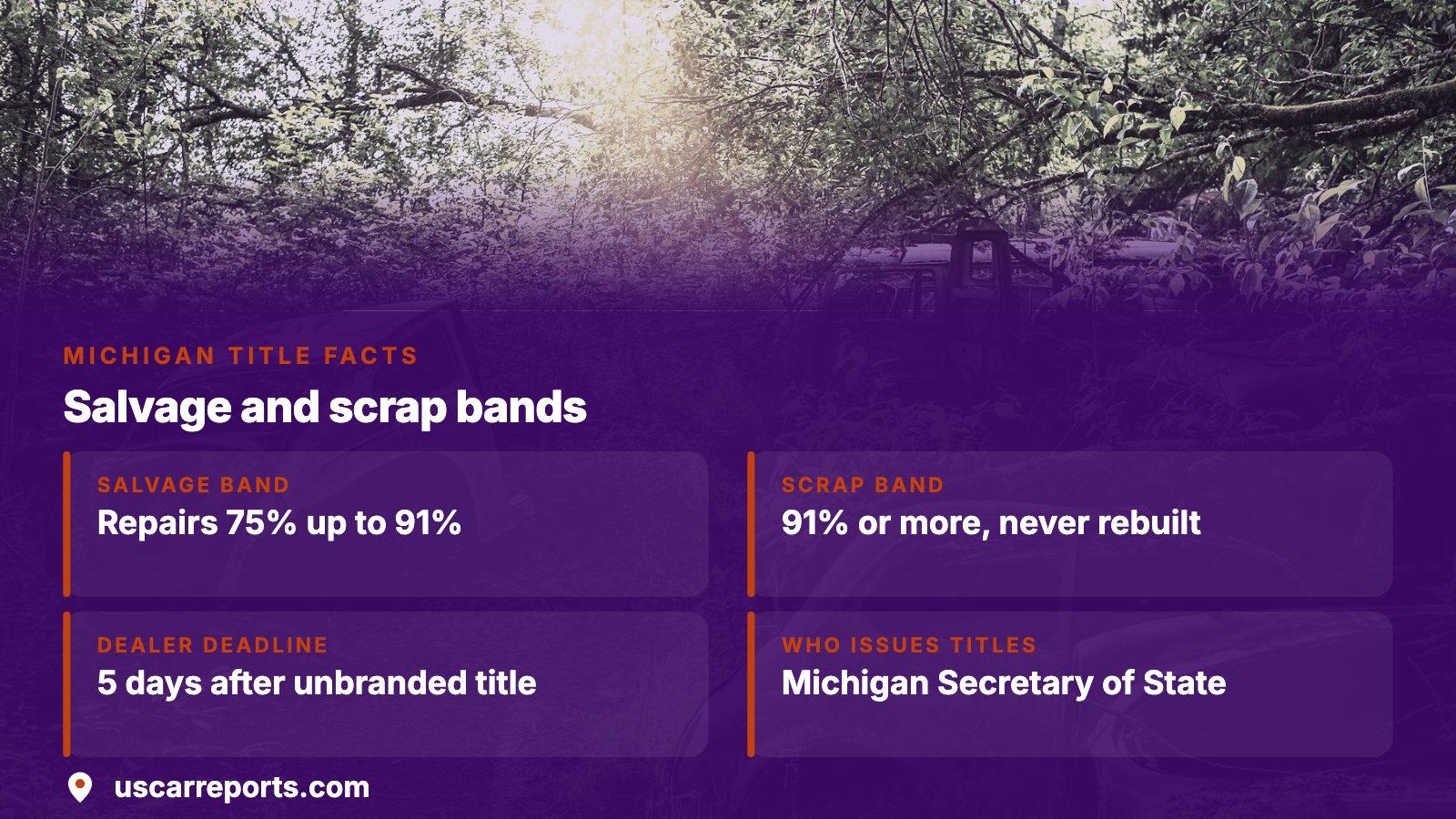
- Salvage band
- Repairs of 75% up to 91% of pre-damaged cash value
- Scrap band
- 91% or more, and never rebuilt for the road
- Dealer deadline
- 5 days to apply once an unbranded title arrives
- Who issues titles
- The Michigan Secretary of State
What a Michigan title check shows about the car
The title in a seller's hand is one document, written at one moment. A check by VIN asks the records behind it. Three questions matter: has any state branded the vehicle, was it written off or sold at a salvage auction, and do the odometer readings climb believably?
The federal title record that approved providers draw on rests on five indicators:
- The state holding the title now, plus the date of the last title action.
- Brand history, meaning labels such as junk, salvage and flood from any reporting state.
- Odometer readings taken on separate dates.
- Any total loss on file.
- Any salvage record on file.
The USCarReports report adds auction photos, liens, impounds, theft entries and insurance records around that core. An empty result means only that nothing was recorded there. Repairs, recalls and maintenance sit outside it.
How to run a Michigan title search before you buy
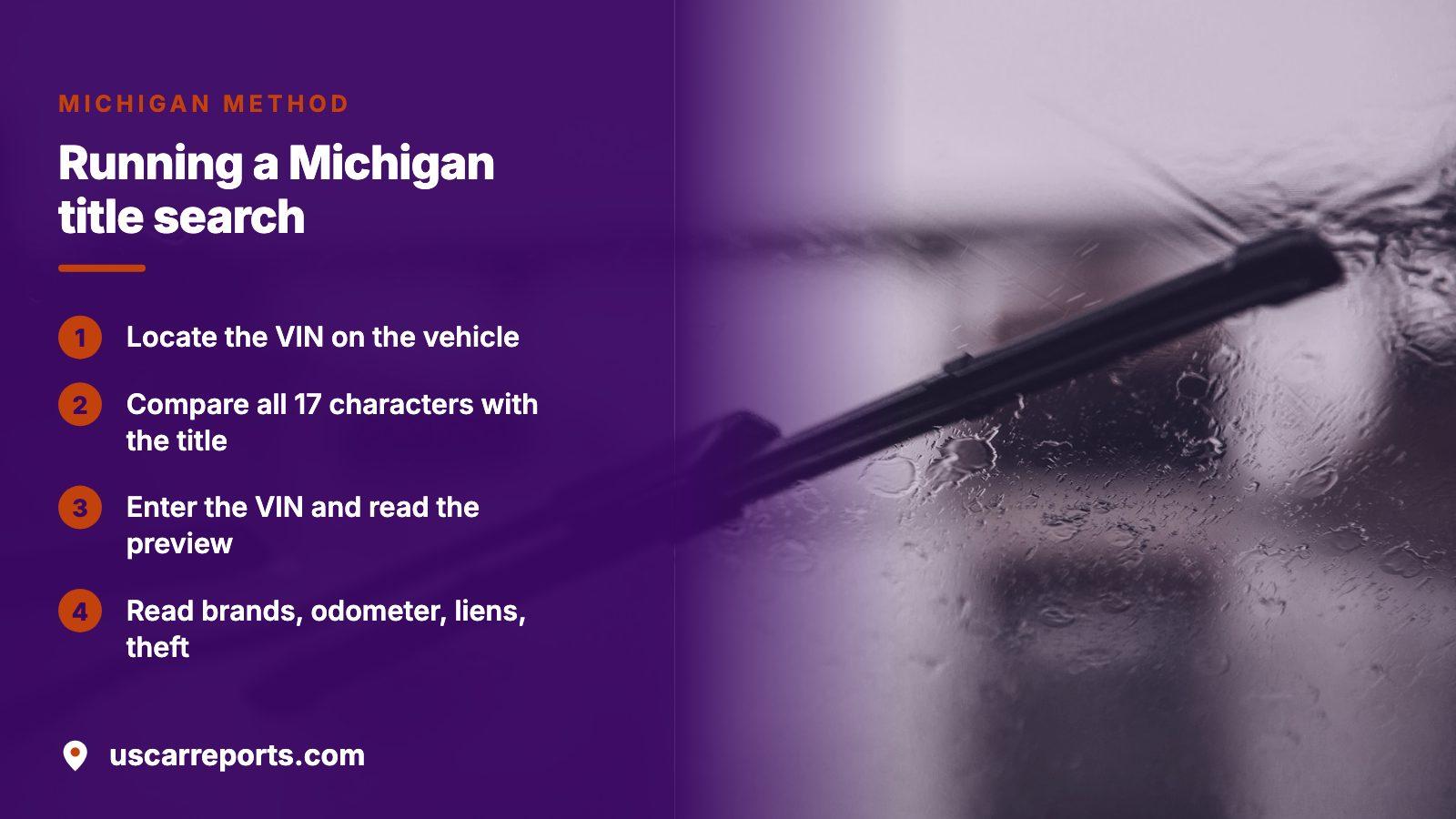
- Locate the VIN on the vehicle: one copy is visible from outside, low on the windshield on the driver's side, and another is on the label by the door latch. Photograph both.
- Hold the title beside your photos and compare all 17 characters. One mismatch stops the deal until explained.
- Enter the VIN on USCarReports. The preview costs nothing and lists the types of record on file for that car.
- Decide from the preview whether the car earns the full report.
- In the report, read the brand section first, then the odometer dates, then liens and theft entries.
Do all of this before the drive to the seller or any deposit.
Michigan's salvage and scrap lines are set by a percentage
Michigan does not leave the salvage question to an adjuster's opinion. Both brands hang on one ratio: the estimated repair cost, parts and labor included, against what the vehicle was worth in cash just before the damage.
| Repair estimate against pre-damaged cash value | Title result | What it means for a buyer |
|---|---|---|
| Under 75 percent | Not caught by this test | Look to the other records and inspect the car |
| 75 percent or more, but under 91 | Salvage title | The car may be repaired and titled again; price it as a damaged car |
| 91 percent or more | Scrap title | Spare parts or scrap metal, nothing else; the car cannot return to the road |
The state calls a car in either upper band a distressed vehicle. The percentages apply only to late model vehicles, so read the older-car section below.
A scrap title is the one brand with no way back
A salvage brand assumes a future: someone repairs the car and it returns to the road. A scrap brand assumes none. Michigan treats a scrap-titled vehicle as material for parts or metal and does not allow it to be rebuilt for road use.
A drivable car with scrap paper
When a seller offers a car that runs and the title says scrap, the car and the document disagree, and only the document has legal force. Do not buy it hoping the paperwork can be fixed later. Walk away, unless the VIN on the car and the VIN on that title prove to be the same.
A Michigan salvage brand is not always a crash story
The state's definition counts parts that were stolen or are gone, not only parts that were damaged. A car stripped after a theft can cross the 75 percent line without touching another vehicle. Two cars carrying the same brand can therefore need different inspections.
- After a collision: ask for repair records and have a body shop check the structure.
- After a theft or stripping: ask what was missing, who replaced it, and get receipts for the replacements.
Auction photos and theft entries in the report usually show which story applies. NICB's VINCheck, which carries no charge, matches a VIN against theft and salvage entries, so run it too.
Why a clean Michigan title proves less on an older car
The 75 and 91 percent bands only reach late model vehicles, and the law defines that phrase; it is not a loose word for recent. A vehicle outside the definition falls outside the bands, so an unbranded Michigan title on it carries less weight than the same paper on a newer car.
On an older car, treat the title as one input rather than the verdict. Pull the national record, which keeps brands from other states, weight the inspection more heavily, and ask a Secretary of State office if you cannot tell whether the car counts as late model.
The filing clocks Michigan puts on professional sellers
When a dealer takes in a car on a title that carries no brand yet, and the repair estimate falls into the salvage or scrap band, the dealer has 5 days from receipt to apply to the Secretary of State for the right certificate and turn in the title.
Other holders get no grace period: lessors, vehicle makers, insurers based in other states, repossession firms, self-insured owners, financial institutions and government agencies must file before the car is transported or resold.
What to ask the seller
If a heavily damaged car reaches you on a clean paper title, ask when the salvage or scrap application was filed and by whom. The report's brand history can often settle a vague answer.
Reading the results: red flags in a Michigan history
| Entry in the history | Likely meaning | Your move |
|---|---|---|
| Salvage brand, any state | A write-off that someone repaired | Ask for repair photos, price it as damaged, check the structure |
| Scrap brand | A car meant for parts or metal only | Walk away |
| Clean Michigan paper, brand elsewhere | Damage recorded elsewhere first | Trust the national record over the paper |
| Odometer reading lower than an earlier date | A rollback or a swapped cluster | Compare pedal wear with the miles, ask for service records |
| Lien with no release | A loan that may still be unpaid | Hold payment until you hold a written release |
| Theft or impound entry | The car may be reported stolen | Stop and call the police |
The FTC's guidance is blunt: a report lists what was recorded, and cannot hear an engine or feel a brake pedal, so a mechanic still needs to see the car. Written repair estimates also support a lower offer.
Cost, and what to do once the check is done
The preview comes first, at no cost. A single payment then covers one car's report, and bundles sized 3, 5 and 10 suit buyers weighing several. No renewal follows; figures are on the pricing page. NHTSA's recall search ignores title status, so treat it as a separate step.
- Open the preview and drop any car with a bad brand or mileage.
- Run NHTSA's recall search and NICB's VINCheck on the same VIN.
- Buy the full report for the survivors.
- Book a shop with no commission on the sale to go over the car, with repair estimates in writing.
- Complete the transfer at the Secretary of State once you agree on a price.
Where this information comes from
- Michigan Vehicle Code, MCL 257.217c — The statute behind the 75 and 91 percent bands, the salvage and scrap certificates and the 5-day dealer duty.
- Michigan Secretary of State: Dealer Manual, Chapter 5 — The department's own account of distressed vehicles, including that scrap-titled vehicles may not be rebuilt for the road.
- Michigan Secretary of State: form TR-12 — The application for an original scrap or salvage title.
- NMVTIS: understanding a vehicle history report — The five indicators in the federal title record and what an empty result leaves out.
- FTC: buying a used car — A history report does not replace an independent inspection, and written estimates help in price talks.
- NHTSA: recalls — The open-recall lookup by VIN, separate from title status.
- NICB VINCheck — A theft and salvage screen to run beside the title check.
Sources and photos: Facts checked against the sources above in November 2026. Photos by Scott Graham, Thibault Valjevac and Patrick von der Wehd on Unsplash; diagrams by USCarReports.
Keep reading
- Michigan VIN check: salt, the Secretary of State and what a report can missThe wider Michigan picture: salt damage, the Secretary of State and private-sale steps.
- Ohio title check: what the state search shows and what it leaves outThe neighbor to the south, where many Michigan cars change hands.
- Title status check: what the state lookup tells a car buyerHow to confirm what a title says in any state.
- Sample reportSee how the records are laid out before you buy.
Frequently asked questions
How do I run a Michigan title check by VIN?
Begin at the car: match its VIN to the seller's title, then enter it on USCarReports to open the preview. If the car still looks right, buy the full report for brand, odometer and lien records, and read the paper title yourself before money moves.
Is there a free Michigan title search?
In part. The USCarReports preview costs nothing, and NHTSA's recall lookup and NICB's VINCheck carry no charge, though neither one reads title brands. The full report is one payment. Use the no-charge steps first, then decide whether the car has earned the report.
Can I buy a Michigan scrap-titled car and put it back on the road?
No. Michigan allows scrap-titled vehicles to be used for parts or scrap metal only, never rebuilt for road use. As a donor for spares it is a different purchase. As a project to plate, it is a dead end.
If a Michigan title looks clean, was the car never wrecked?
A clean paper title proves less than it seems. The bands cover late model vehicles, so an older car can be damaged without them applying. A brand may also sit in another state's record, and the national title record covers only five areas. Repairs fall outside it, which is why inspection still matters.
Who applies for a Michigan salvage or scrap title?
It depends on who holds the car. A dealer has 5 days from receiving an unbranded title in a qualifying case. Lessors, out-of-state insurers, lenders and similar holders must apply before moving or selling the vehicle. The Secretary of State's form TR-12 is the application for an original scrap or salvage title.
Now check the car itself
The guide explains what to look for. The report shows what this VIN has on record.