THE SHORT ANSWER
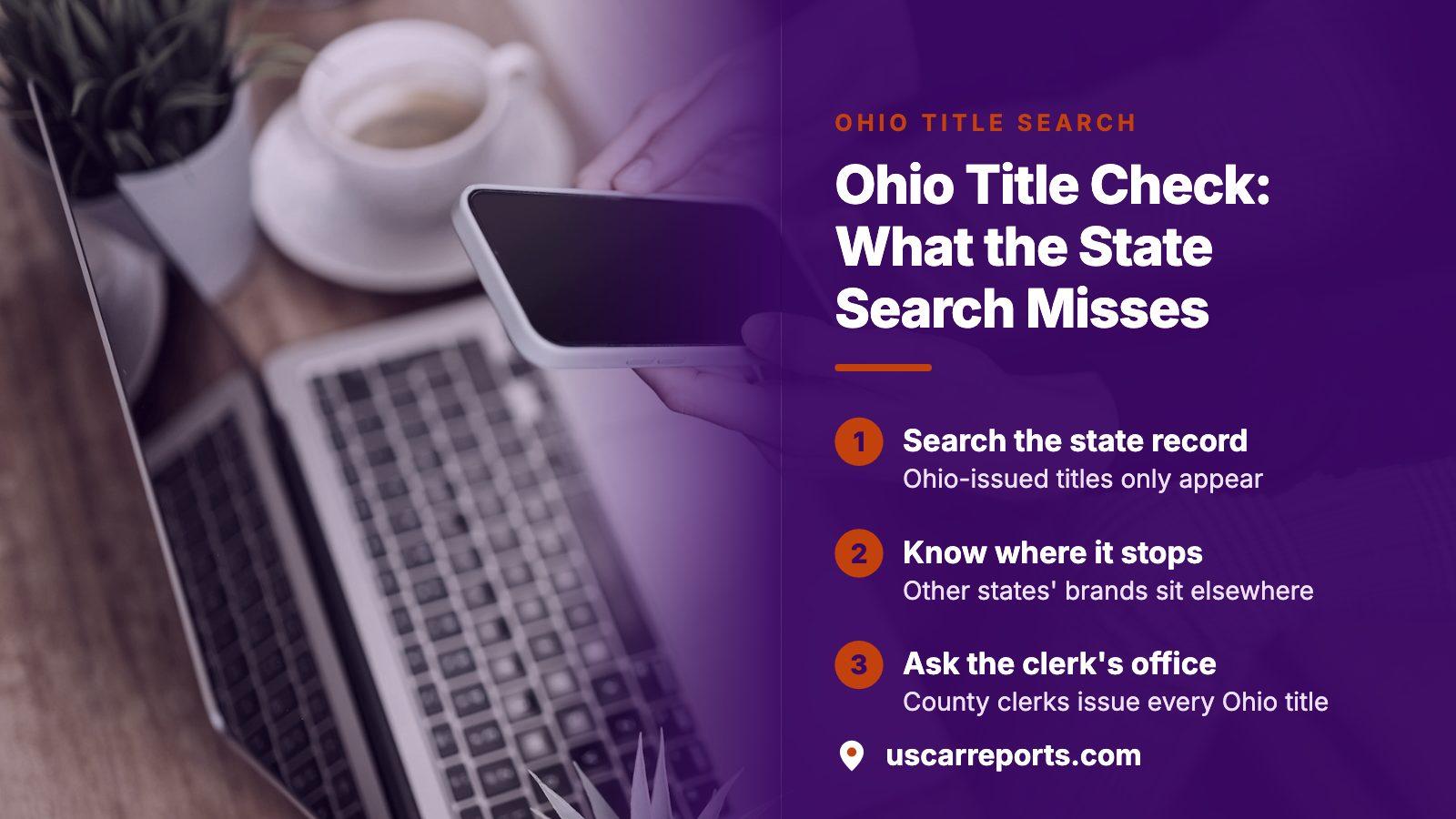
Search the VIN on Ohio's BMV title lookup, which costs nothing and confirms what Ohio holds for that number. Its coverage ends at the state line, and county clerks cannot hand over the brand history they receive from other states. A USCarReports report fills that gap with title brands, odometer readings, damage, salvage and auction photos, liens and theft entries for the same VIN.
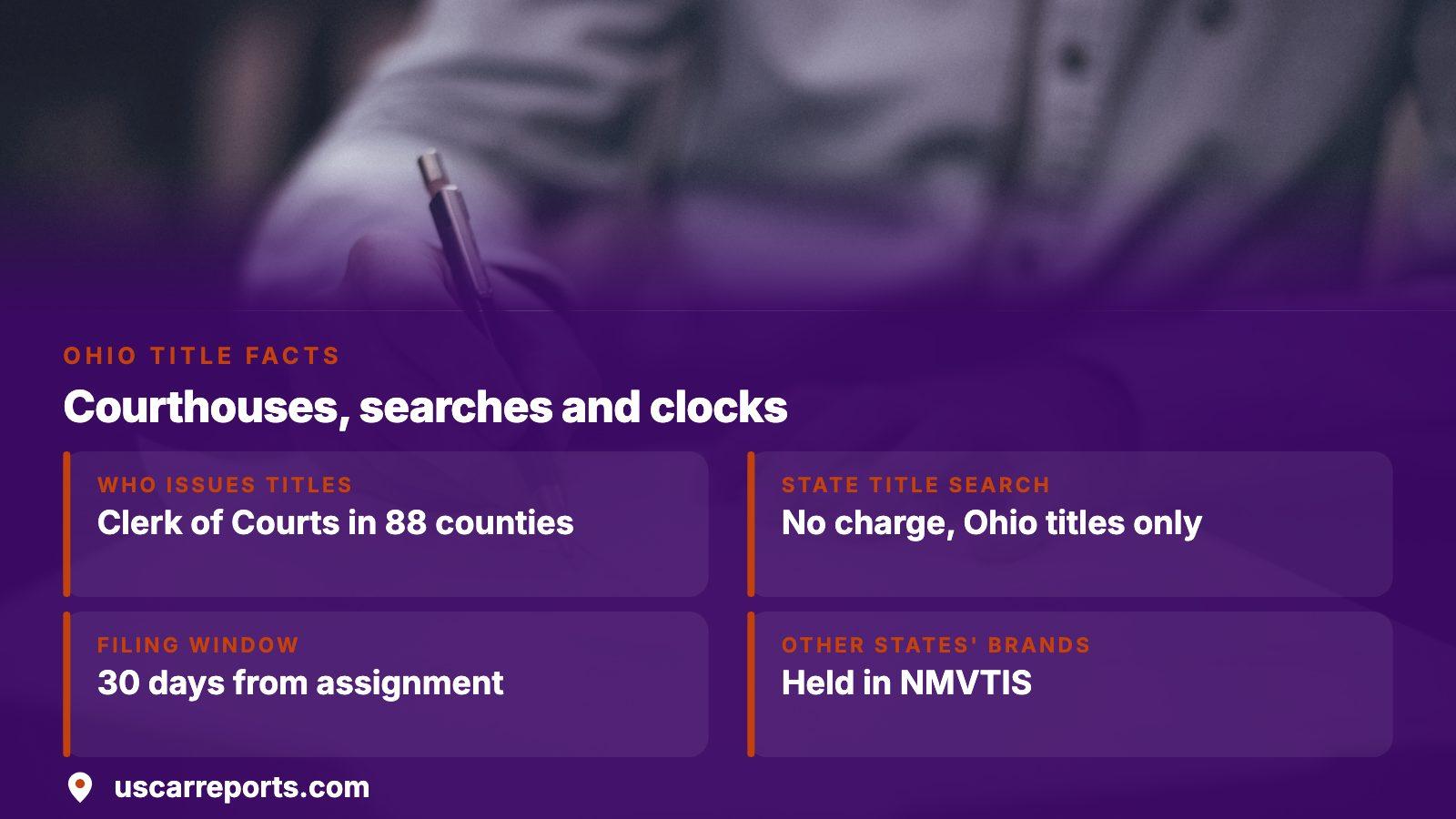
- Who issues titles
- A Clerk of Courts office in each of 88 counties
- State title search
- No charge, Ohio-issued titles only
- Filing window
- 30 days from the assignment
- Other states' brands
- Held in NMVTIS, not shared at the clerk's counter
Ohio titles come from the courthouse, so ask the courthouse
Plates and registration are a BMV matter in Ohio, but ownership paperwork takes another path. Each of the state's 88 counties has a Clerk of Courts office that processes title applications on an Automated Title Processing System, and Chapter 4505 of the Ohio Revised Code puts those applications in front of the clerk of the common pleas court. The person who can fix a misspelled name or explain a stuck transfer therefore sits in a county building, in the county where the filing happened.
Three Ohio purchases, three different checks
How you buy changes what the record has to prove.
| Purchase | What to confirm | Where to look |
|---|---|---|
| Private seller with a paper title | The VIN on the certificate fits the car, the seller is the named owner and no lender is listed | BMV search, then the preview and report |
| Dealer selling on an electronic title | The record names the dealer, and any lender's payoff is arranged, since no paper may exist yet | BMV search, then the report |
| A car that arrived from another state | Every brand and mileage entry from the states it passed through | The report, because Ohio's search cannot show them |
| A boat, an outboard or a trailer | A separate title for each piece of the rig | BMV search by hull or motor number |
What the BMV search returns, and where it stops
The state's title search is public and costs nothing. It takes a VIN, an Ohio title number, a hull number for a boat or a motor number for an outboard, and for a car the VIN box is the one to use. The page leads with a warning that it offers limited information: it discloses titles issued in Ohio and cannot tell you whether the car was titled in another state before arriving.
A record is only as old as Ohio's contact with the car. One that moved here last spring may show a spotless Ohio entry while an earlier state had branded the title. Title washing exploits that gap. The Ohio record is accurate; it is just local.
Short history, unchecked history
A recent first Ohio entry, or a seller who is vague about the car's earlier address, means nobody has checked those years yet.
What the clerk's office knows and may not say
A clerk handling an incoming car receives the brands and notations other states applied to it, delivered through NMVTIS, the federal title database. The BMV's search page states that government agencies may not release that information to the public, so the counter staff cannot read it to you. The data exists; this route is simply closed. The BMV directs buyers to an approved NMVTIS data provider and endorses none by name.
The federal program describes five things a consumer report covers:
- The title's current state, plus when it was last issued
- Brand history from any state, such as junk, salvage and flood
- Odometer readings
- Total loss history
- Salvage history
The same page calls the report intentionally brief. It carries no repair history or recall data, and it recommends an independent inspection.
A step-by-step Ohio title check
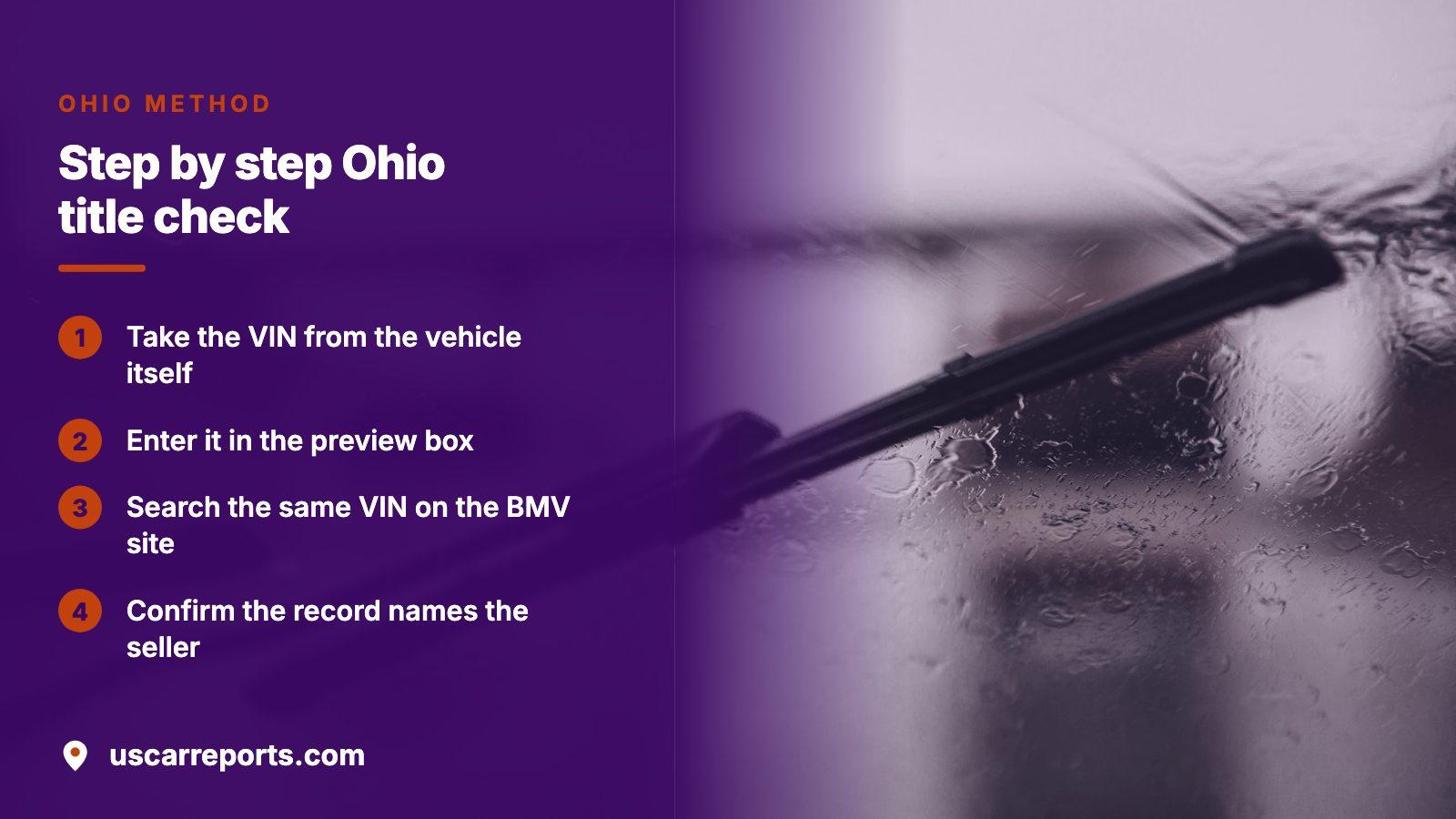
- Take the VIN straight off the vehicle rather than from the listing, then lay it beside the certificate.
- Type it into the preview box on this page. The preview costs nothing and shows what records exist.
- Search the same VIN on the BMV site and check that the year, make and body style describe the car you are standing next to.
- Make sure the record names the person selling, not just the paper they brought.
- Open the full report whenever the car has lived elsewhere or its Ohio history is short.
- Look up open recalls on NHTSA's site and theft or total-loss entries on NICB's, both at no cost.
- Settle in writing how any lender is paid before the money moves.
Red flags in the results and what to do about them
| Entry | Likely story | Next step |
|---|---|---|
| Ohio description does not fit the car | A copying slip, or paperwork from another vehicle | Stop until the VIN is verified |
| First Ohio entry is recent | Earlier years ran under another state's rules | Get the national record and compare states |
| A brand elsewhere, none on the Ohio title | Possible title washing | Ask for repair bills and hire a structural inspection, or walk away |
| Title assigned months ago, never filed | A stalled project, an estate delay, or a flipper dodging the paperwork | Ask who owned the car and why nothing was filed |
| Lender listed | The lender decides when the lien is released | Pay through the lender's payoff |
A stale assignment needs an explanation
Find out who purchased it, when, and what stopped the title from reaching a clerk. A genuine reason can be confirmed with a single call. Evasion from a seller in a rush fits the pattern curbstoners leave.
The 30-day clock and electronic titles
After an assignment, the new owner has 30 days to get the title application in front of a clerk. Past that point Ohio adds a late fee; ask the clerk what it is today, because amounts change.
Read the date on the title in your hand. One assigned to the seller long ago and never filed means the car has been parked outside the system, with earlier owners' obligations unclear.
Electronic titling is open to dealers, lenders and other high-volume filers who register with the Department of Public Safety. A car bought from such a dealer may not come with a paper certificate until the clerk produces one. Either way, the record is what counts: a printed certificate shows the day it was made, and a lien added or released afterward will not change the sheet in your hand.
Rebuilt and salvage status in the Ohio record
A salvage or rebuilt brand is recorded on the Ohio title itself, so a rebuilt car shows that in the state's record. What the record never carries is a verdict on the repair. The State Highway Patrol's salvage inspection is often read as one, and it is not; the separate Ohio VIN check page explains what that inspection catches and what it skips. The brand follows the VIN permanently, and the inspection is a single procedural step. Neither tells you how well the car was put back together, so pay a mechanic to answer that.
Cost and the next move
Opening a preview costs nothing. Paying for the full report happens one time, and no renewal follows. A pack of 3, 5 or 10 reports suits someone weighing several vehicles. Current prices sit on the /pricing page.
Run the BMV search, read the preview, buy the report before leaving any deposit, and have a mechanic look underneath. A preview that raises no alarms is a reason to keep going, not a reason to skip the inspection. After the sale, get the title to the county clerk inside the 30-day window.
Where this information comes from
- Ohio BMV: Motor Vehicle Title Search — The search inputs, the Ohio-only limit and the state's own wording on NMVTIS data.
- Ohio BMV: Vehicle titles — Clerk of Courts titling, the title processing system and electronic title programs.
- Ohio Revised Code Chapter 4505 — The statute that places title applications before the clerk of courts.
- NMVTIS: Understanding a vehicle history report — The five indicators a federal title report covers and what it leaves out.
- NMVTIS: Get a vehicle history report — Where approved data providers are listed for consumers.
- NHTSA: Recalls — The free recall lookup by VIN.
Sources and photos: Facts checked against the sources above in November 2026. Photos by Jakub Żerdzicki, Thibault Valjevac and Scott Graham on Unsplash; diagrams by USCarReports.
Keep reading
- Ohio VIN check: records to pull, title brands and Ohio buying rulesThe patrol inspection, the notary rule and the rest of Ohio's buying rules.
- Title status check: what the state lookup tells a car buyerHow to read a title's current status once you have the record.
- Pennsylvania Title Check by VIN: Brands, Theft and Flood RulesA neighboring state with its own title process, for cars that crossed the line.
- Sample reportSee how brand and odometer entries are laid out before you pay.
Frequently asked questions
Is there an Ohio title search by VIN?
Yes. Ohio's BMV runs an online title lookup you can search by VIN, by title number, or by the hull and motor numbers used on boats. It reports on titles Ohio issued. Run it first, then add a national record, because it cannot say what another state wrote on the title.
Does the Ohio title search show salvage or accidents from other states?
No. The page says it discloses only titles issued in Ohio and will not reveal whether the vehicle was titled elsewhere. Brand and total-loss history from other jurisdictions sits in NMVTIS, which agencies cannot share. A vehicle history report fills that part in, and USCarReports opens with a free preview.
Can the county clerk tell me a car's out-of-state history?
Not as a member of the public. Clerks receive brand and notation records from other states, but agencies are barred from passing that NMVTIS information along. If a clerk declines, that is the rule at work, not a sign of trouble. Order a history report instead.
How long does an Ohio buyer have to file the title?
The clock runs 30 days from the assignment date, and a late filing carries a fee. Take the signed title to the county Clerk of Courts promptly and keep the bill of sale. If the seller's own assignment is months old, expect questions about why it was never filed.
Does a salvage inspection make a rebuilt Ohio car sound?
No. The inspection is a procedural gate, and the brand stays on the title either way. Neither one is a mechanical opinion about how the car was repaired. Ask for repair invoices and before-and-after photos, then pay your own mechanic to look underneath.
Now check the car itself
The guide explains what to look for. The report shows what this VIN has on record.