THE SHORT ANSWER
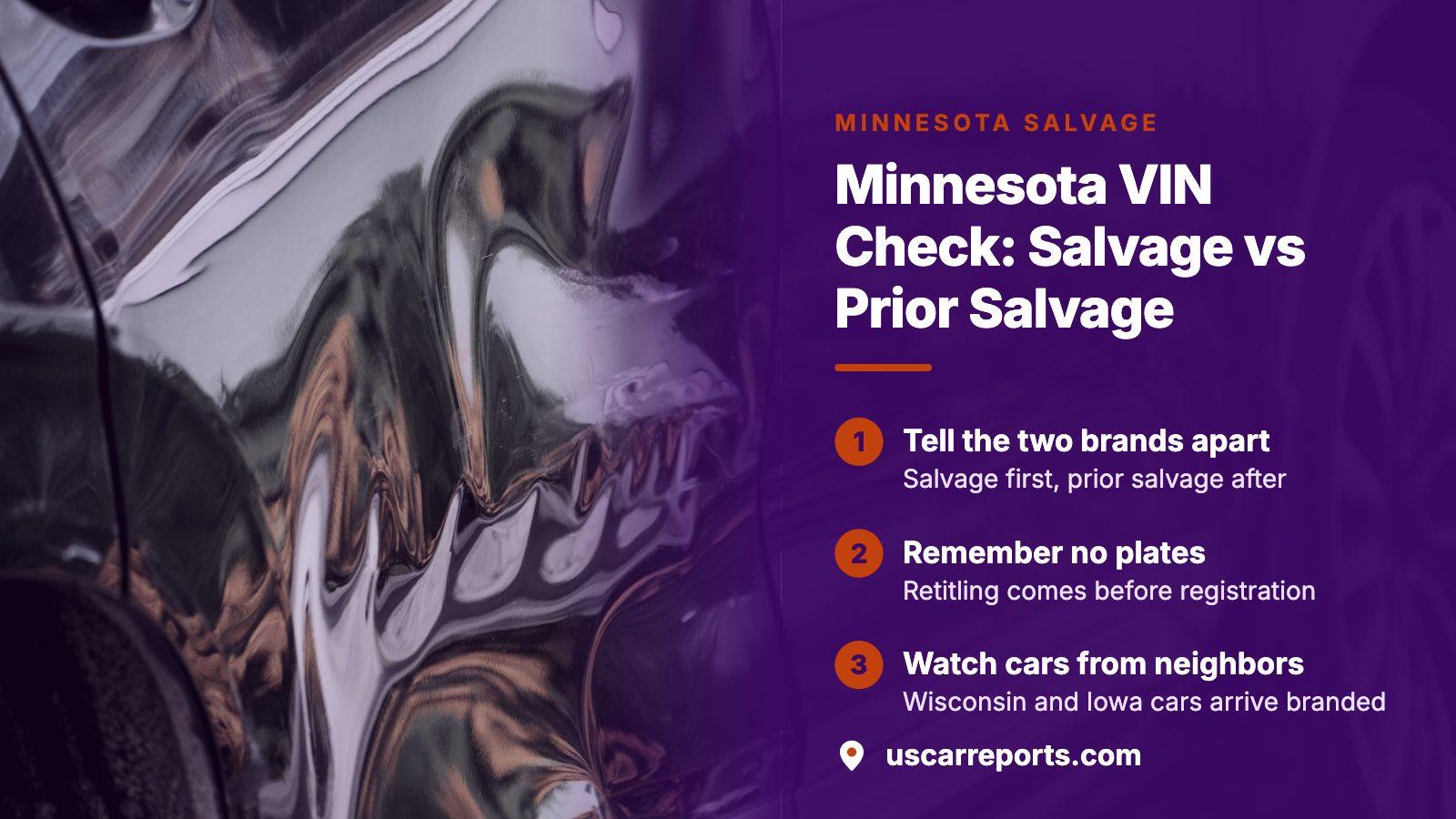
Take the VIN from the car, compare it with the seller's title, and run it here for the free preview. Add NHTSA's recall search and NICB's VINCheck. In Minnesota, a salvage title allows possession and sale but no registration. Prior salvage marks a car that cleared that step or never needed it, and the word repeats on later titles. Neither brand measures how bad the damage was.
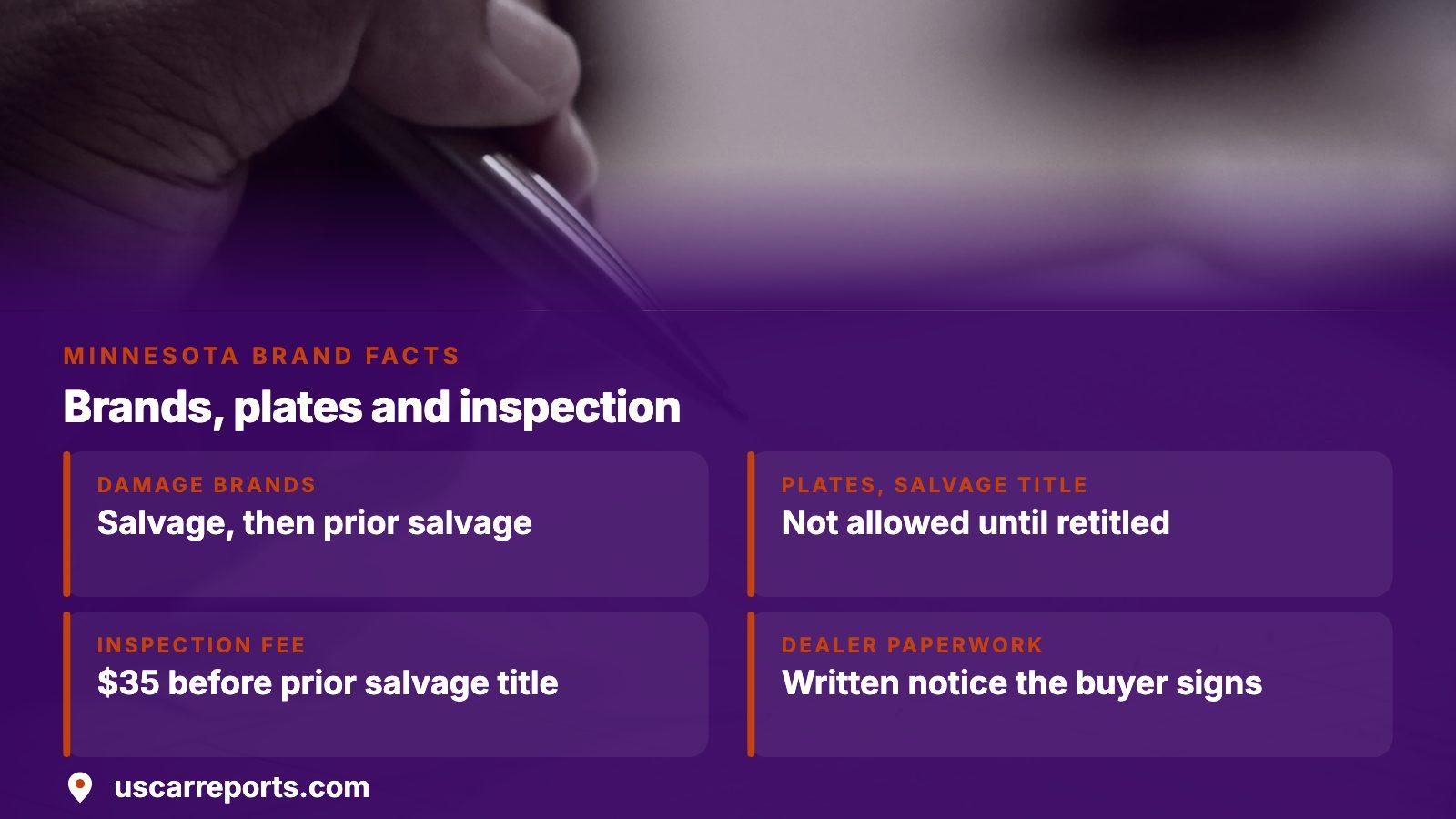
- Damage brands in use
- Salvage, then prior salvage
- Plates on a salvage title
- Not allowed until the car is retitled
- Inspection fee
- $35 before a prior salvage title on newer or pricier cars
- Dealer paperwork
- Written notice that the buyer signs
What a Minnesota VIN lookup shows before you spend more
The number on the car points to a record that follows it across state lines: title brands, insurance total losses, salvage auction entries with photos, odometer readings, liens, theft reports and any open recall. The lookup is half the job, because Minnesota gives its own meaning to the brands that turn up. USCarReports sets each record beside the buying rules of the state where the car will be titled.
- NHTSA's recall search lists any safety recall on that VIN that has not been repaired.
- NICB's VINCheck shows whether a participating insurer reported the car stolen or written off.
- This site's report adds title history, damage entries, mileage and auction photos behind a free preview.
- None of them sees rust, repairs that never reached an insurer, or a seller's story.
Salvage and prior salvage: two brands, one trigger
Both brands begin with a write-off. An insurer pays damages and takes the car, or a self-insured owner faces repairs above 80 percent of its value. What separates the brands is the class of vehicle. A late-model car, meaning a model year no more than five calendar years behind the current one, or any car worth above nine thousand dollars before the damage, gets salvage. Everything else gets prior salvage.
| Brand | Who gets it | What it means for you |
|---|---|---|
| Salvage | Late-model or high-value cars after a write-off, and damaged cars of that class that arrive on another state's salvage title | You may hold the car, haul it and sell it, but registration waits until it is retitled |
| Prior salvage | Other written-off cars, and any damaged car that held a salvage brand elsewhere at some point | The brand itself does not bar registration, and the word is recorded on every later title |
| Flood damaged | Cars with a water or flood total loss on record, or a similar brand on an earlier title | The wording carries onto this title and every later one |
So prior salvage is not the gentle one. A ten-year-old pickup and a two-year-old sedan can take identical damage and leave with different words on the title.
Why a salvage title cannot be plated
A title branded salvage lets its holder keep the car, tow it and sell it. Registration is a separate matter: under Minnesota Statutes section 168A.152 that title gives no right to register the car. A seller can hand you a vehicle that is legal to own and impossible to drive on the road.
For a late-model or high-value car, the commissioner may not issue the prior salvage title until the application carries a certification of inspection in the form the department specifies. A $35 fee is due before that title issues. Buying a salvage car means buying that step, with its cost and outcome.
Ask for the paper, not the promise
A salvage-titled car offered with no certification of inspection has not been through the step. Ask to see the branded title itself. Minnesota also bars a purchaser from keeping a salvage vehicle without a title carrying the salvage or prior salvage brand, so a bill of sale alone does not cover you.
Cars arriving from Wisconsin, Iowa and farther away
Minnesota does not treat a car's history as local. A damaged car whose record includes a salvage title or brand from outside the state, however long ago, needs the prior salvage brand here. On a late-model or high-value car, another state's salvage title brings Minnesota's salvage brand instead. The House's summary says in-state and out-of-state vehicles are treated the same.
A plain Minnesota title on a car whose national record shows a brand is a mismatch to raise with the seller before you pay. Cars cross the borders with Wisconsin, Iowa and the Dakotas regularly, and the federal NMVTIS record is where those states' entries show up.
What a Minnesota dealer has to put in writing
Section 325F.6641 sets disclosure duties for dealers. Each one goes on paper, you sign it as buyer, and the dealer keeps the signed copy in its sales file.
- Prior damage above 80 percent of the car's cash value just before the damage, when the dealer actually knows of it. The form asks the dealer to state whether the car has or has not sustained that much.
- Any existing or required title brand the dealer actually knows of.
- Flooding above the bottom dashboard while the car sat parked on the dealer's lot.
Dealers must also say it aloud, except on online sales, where the written notice still applies. Whoever is handed a flood disclosure must repeat it to the next buyer if they sell the car. The section speaks to dealers, so in a private sale the report and the title itself carry more of the weight.
Running the check in the order that saves money
- Read the VIN from the plate at the driver-side end of the dashboard, and from the label inside the door frame. Confirm the two agree, then compare all 17 characters with the title.
- Enter the VIN on this page for the preview. It costs nothing and shows whether the car deserves the full report.
- Put that VIN into two public tools as well: NHTSA's recall lookup and NICB's VINCheck.
- If the car still looks right, buy the full report: one payment, no subscription, nothing that renews.
- Find the brand line on the Minnesota title; the registrar must print it in a format unlike the surrounding text. Hold it against the national record.
- Book a mechanic for the underbody before you leave a deposit.
Do steps one to three before the trip to see the car, and finish all six before money moves.

Red flags, and the damage no Minnesota title records
- A write-off or salvage-auction entry in the report, with no later title carrying a brand
- A brand in another state's records that the Minnesota title leaves out
- A late-model car titled salvage and advertised as ready to drive
- Odometer readings that stall or step backward
- Auction photos of damage the seller says never happened
- A theft record, impound or lien nobody mentioned
Even a clean title leaves gaps. Damage repaired while it stays under the write-off lines can sit on a plain title, and a car an insurer paid out as stolen, then recovered with damage of no more than 80 percent of its value, counts as a recovered intact vehicle, which the salvage rules exclude.
Winter road salt is the other blind spot. No title anywhere records corrosion, so ask the shop to check the rocker panels, the subframe mounts and the steel brake lines on a lift.
Cost and the next move
You pay nothing to open the preview. You buy the report one time; nothing auto-renews. Minnesota buyers comparing more than one car can pick a 3, 5 or 10 set, listed on /pricing.
Open the preview before you plan the trip, and order the report before any deposit changes hands. If the title says salvage, price the inspection and the wait into your offer, or walk away. A clean report does not replace a mechanic.
Where this information comes from
- Minnesota Statutes 168A.151: salvage title and junking certificate — When an insurer or another buyer must apply for a salvage or prior salvage brand, including the rule for cars with out-of-state history.
- Minnesota Statutes 168A.152: use and certification of title — What a salvage title allows and does not allow, the inspection certification and the inspection fee.
- Minnesota Statutes 168A.01: definitions — The statutory meaning of late-model vehicle, high-value vehicle, salvage vehicle and recovered intact vehicle.
- Minnesota Statutes 325F.6641: disclosure of vehicle damage — The written dealer disclosures, the buyer's signature and the flooding rule.
- Minnesota Statutes 325F.6642: title brands — Which brands the registrar records on a title and on later titles, and how conspicuously.
- Minnesota House: new laws on salvage titles — A legislative summary of the prior salvage brand and the treatment of out-of-state vehicles.
- NMVTIS: vehicle history reports — The federal title record and its list of approved data providers.
Sources and photos: Facts checked against the sources above in November 2026. Photos by Maxim Tolchinskiy, Justin Cron and Masjid MABA on Unsplash; diagrams by USCarReports.
Keep reading
- Wisconsin VIN check: the seven-year salvage line and what a clean title missesThe neighbor to the east, read the same way: records first, then local brand rules.
- Iowa VIN check: how Iowa brands a car and what to run before you buyA border state with a different gate for repaired write-offs.
- Title status check: what the state lookup tells a car buyerHow to confirm what a title says before money changes hands.
- Registering a car in another state: deadlines, title and checksWhat moving a car's registration across a state line involves.
Frequently asked questions
How do I run a Minnesota VIN check?
Read the VIN from the car, check it against the title, and enter it here for the free preview. Add NHTSA's recall search and NICB's VINCheck, then buy the full report if the car still looks right. Last, compare the title's brand line with the report.
Can I do a Minnesota VIN lookup for free?
Partly. NHTSA's recall search and NICB's VINCheck cost nothing, but neither reads title history. USCarReports shows a free preview of any Minnesota VIN, and the full report is optional and paid once, so stopping at the preview costs you nothing.
How do Minnesota's salvage and prior salvage brands differ?
Both follow a write-off. Salvage goes on late-model or high-value cars, and that title cannot be registered until an inspection and a new title follow. Prior salvage goes on other written-off cars and on any damaged car with a salvage history elsewhere. Neither word tells you how severe the damage was.
Can I register a Minnesota car that has a salvage title?
Not on that title. Section 168A.152 lets the holder own, transport and resell the car, yet registration is off the table. A late-model or high-value car needs a certification of inspection and a $35 fee before the prior salvage title that allows registration can issue.
What must a Minnesota dealer tell me about a car's history?
In writing, which you sign: prior damage above 80 percent of cash value and any title brand the dealer knows of, plus flooding above the bottom dashboard while the car sat on its lot. The spoken version is skipped only for online sales.
Now check the car itself
The guide explains what to look for. The report shows what this VIN has on record.