THE SHORT ANSWER
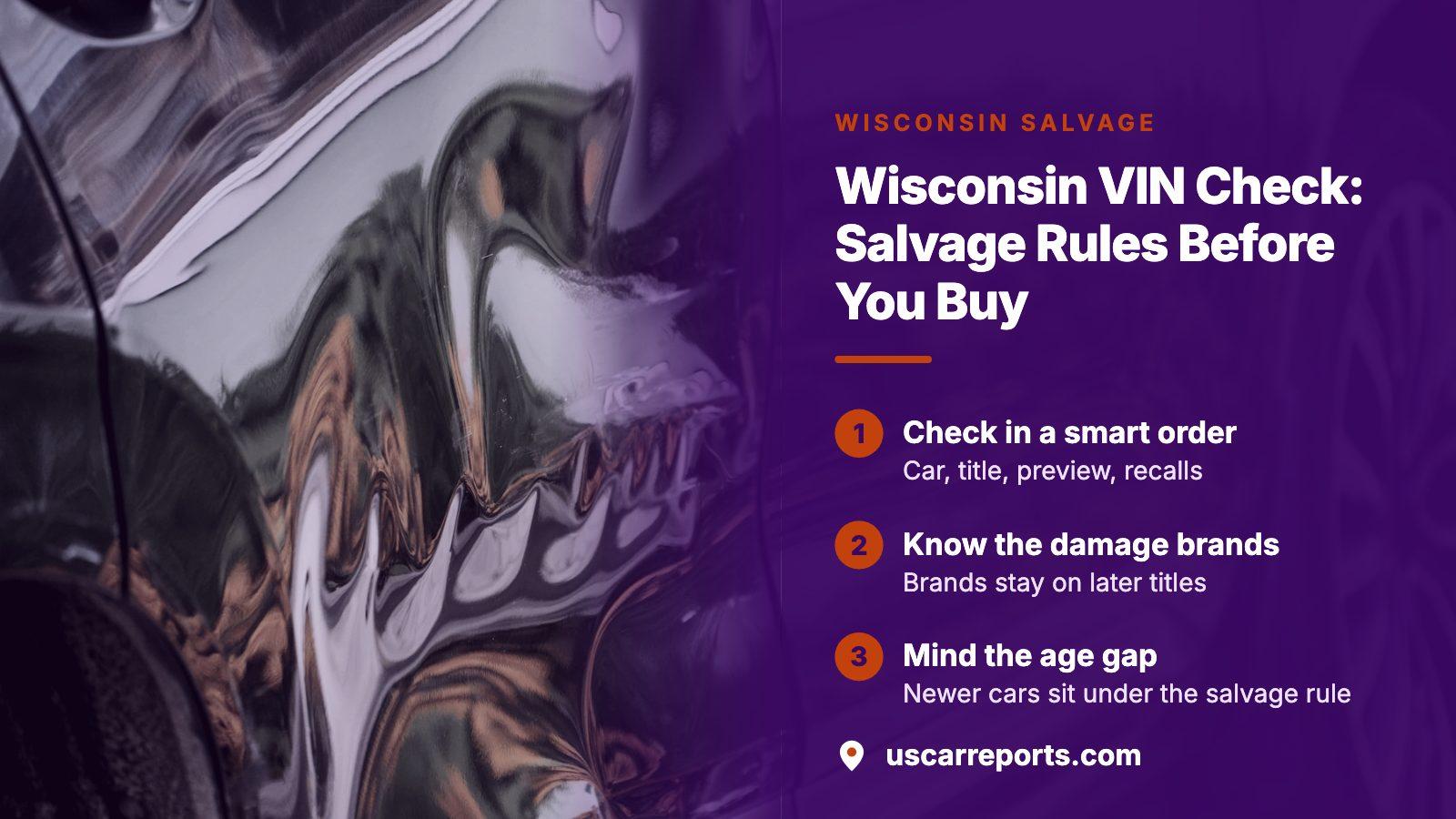
Copy the VIN from the car, match it to the seller's title, and enter it here for the preview. Add NHTSA's recall search. Wisconsin brands a collision-damaged car as salvage when repairs exceed 70% of its pre-damage value, but only on cars under seven years old, so an older car's plain title says less. A salvage car cannot get plates until it passes a state inspection.
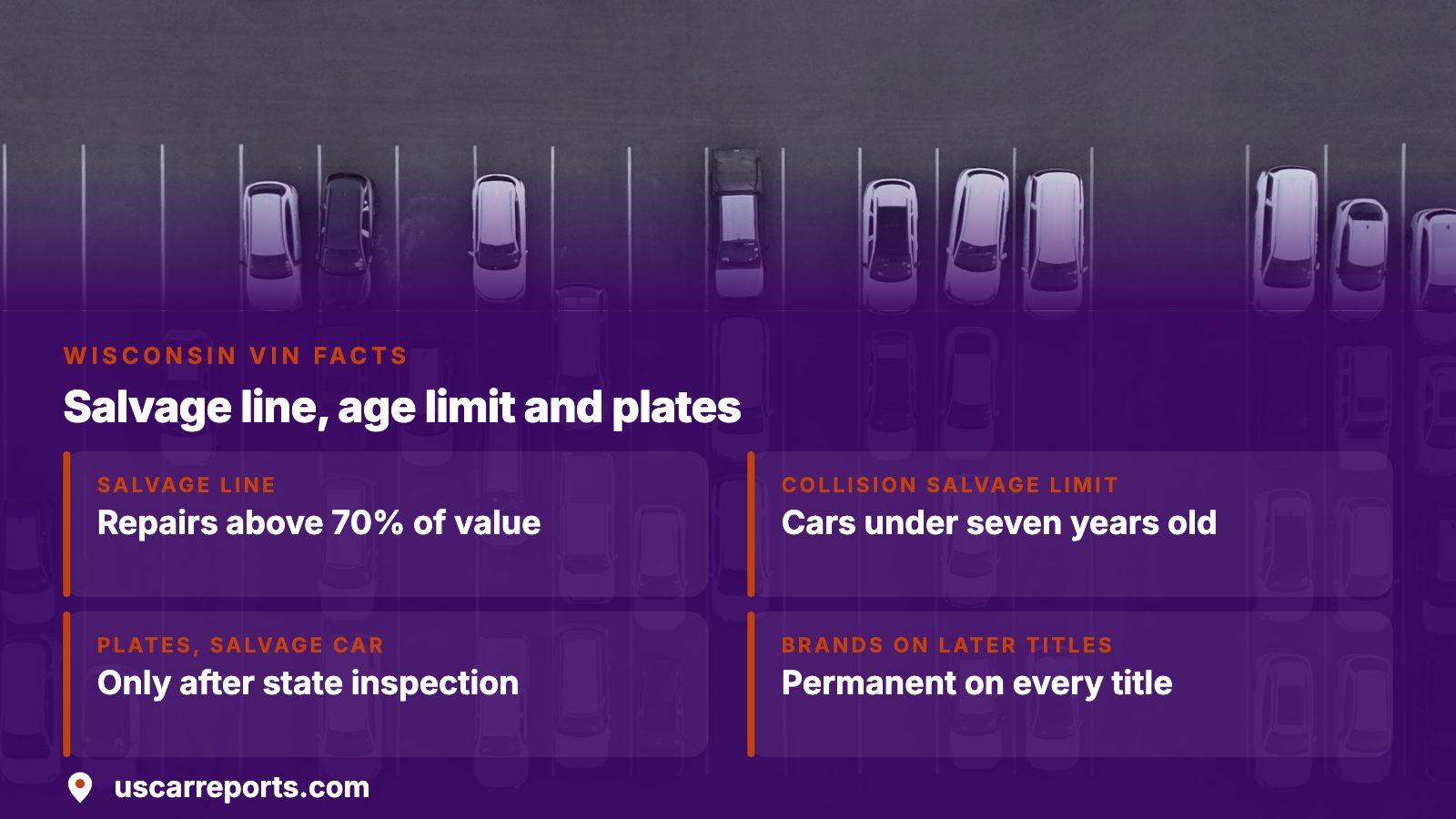
- Salvage line
- Repairs above 70% of pre-damage value
- Age limit on collision salvage
- Cars under seven years old
- Plates on a salvage car
- Only after a state inspection
- Brands on later titles
- Permanent on every Wisconsin title
What a Wisconsin VIN lookup turns up on a used car
Wisconsin's transportation department sends buyers to the federal NMVTIS database for title brands and odometer data, and says entries from other participating states show up there as well. That matters when a car arrives from Illinois, Minnesota, Michigan or Iowa with a past nobody mentioned. USCarReports reads the number against those title records, adds damage entries, salvage-auction photos, theft and lien flags and open recalls, then lines each finding up with the Wisconsin rules below.
- NHTSA's recall search lists safety recalls still open on that VIN, whatever the title says.
- NICB's VINCheck searches member insurers' records for thefts and total losses.
- This site's report adds brands, damage entries, odometer readings and auction photos, with a free preview ahead of it.
- None of the three sees rust, cash repairs or what a seller leaves out.
Running the check in an order that saves a trip
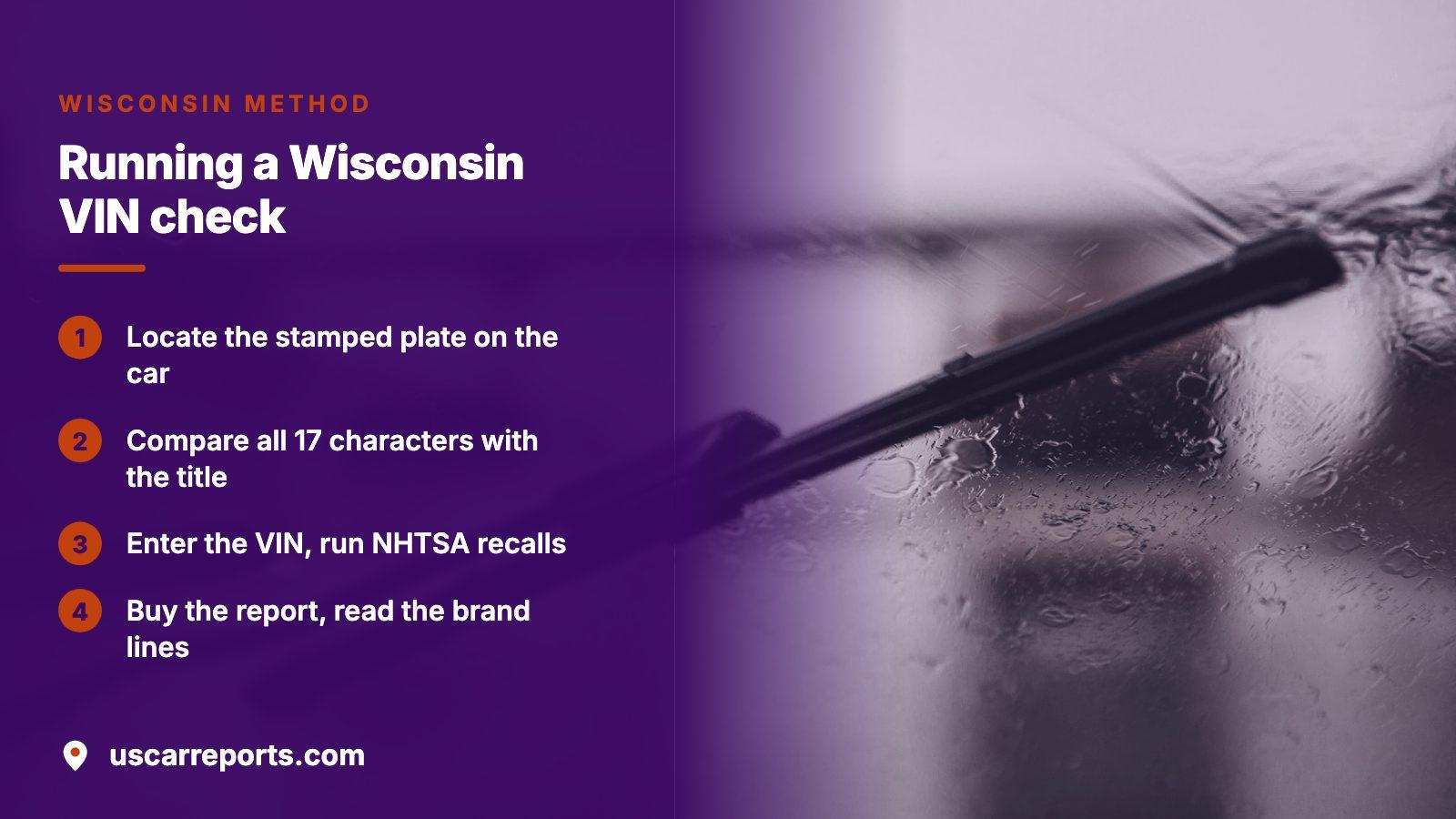
- Locate the VIN on the car itself: the stamped plate at the base of the glass on the driver's side, and the label on the frame when that door is open. Both must read the same.
- Compare all 17 characters with the title the seller shows you. A title in someone else's name, or no title, ends the visit.
- Enter the VIN on this page for the preview, then run NHTSA's recall search on the same number.
- If the car still suits you, buy the report. It is one payment, with nothing that renews.
- Read the brand lines on the Wisconsin title, which recent titles print on the lower half under Additional Vehicle Detail, and hold them against the report.
- Pay a mechanic or body shop to look underneath before you leave a deposit.
Steps one to three fit into a few minutes before you drive out. Steps five and six belong before money moves.
The damage brands a Wisconsin title can carry
A Wisconsin brand is permanent: it prints on every title issued for that vehicle afterward. The state sorts damage by cause as well as by cost.
| Brand | When Wisconsin applies it | What it tells a buyer |
|---|---|---|
| Salvage | Collision or other non-hail damage above 70% of value on a car under seven years old, or any car last titled elsewhere with a salvage brand | No plates until a state inspection |
| Rebuilt salvage | A salvage car that passed inspection by a certified state inspector | Legal to register, but the history stays |
| Flood damaged | Water damage above the 70% line, at any age; under seven years it also gets salvage | A serious water history |
| Hail damaged | Hail alone above 70% on a car under seven years old, repaired without replacing exterior panels | Replaced panels mean salvage instead |
| Claim paid | An insurer took a car under seven years old after paying a sizeable damage claim that stopped short of salvage | A real accident, not a write-off |
Other brands cover use and repurchase rather than damage: prior police, prior taxi and manufacturer buyback.
Where the seven-year line leaves a gap
The collision rule reaches only cars under seven years old. Past that age a wreck of any size can leave the Wisconsin title plain, and nobody has broken a rule. Two exceptions narrow the gap. Water damage has no age limit, and a car of any age that arrives already branded salvage by another state receives Wisconsin's salvage brand.
A plain title on an older car
No brand means no brand applied, not that nothing happened. A repair that never went through an insurer leaves no record anywhere. As the car ages, give more weight to the national record, the odometer history and what a lift shows.
Salvage to rebuilt: the inspection that comes before plates
A salvage car must pass a Wisconsin salvage inspection by a certified state inspector before it can be registered. The inspector confirms that neither the car nor any of its major parts is stolen, that required equipment is present and that it is safe to operate. Driving a salvage car is illegal except to or from the inspection site.
Passing changes the brand to rebuilt salvage. That wording repeats on each later title, which is one reason a repaired car is priced below an identical one that never needed the work.
Settle the tow before the price
If the car you want has not passed yet, someone must get it to the inspector, and someone carries the loss if it fails. Agree both in writing before you pay.
Buying from a licensed Wisconsin dealer
A licensed dealer posts a Wisconsin buyers guide on each used car. It states how the car was used, whether any warranty comes with it or the sale is as-is, and the permanent title brands already on the title or due on the next one. Dealers complete it from a visual check and a test drive, so it reflects what they know, not what a lift would find.
Signing the purchase contract binds you. The three-day cooling-off period many buyers expect covers only sales made away from the dealership, and a dealer may charge a cancellation penalty capped at 5% of the price. Run the VIN before you sign.
Buying from a private seller, or one posing as private
Private sales sit outside the dealer protections, so the report and the title carry the weight. An owner must disclose any brand not already printed on the title, and failing to do so can bring a fine. Finding the brand before you pay beats relying on a penalty afterward. Anyone selling more than five cars a year needs a dealer license, and the department lists the signs of one operating without it:
- Several vehicles offered at the same time
- A title naming someone else, or no title at all
- A car without plates
- A meeting spot that is not the seller's home, such as a parking lot
Red flags in the report, and what no title shows
- A salvage-auction or total-loss entry with no brand on the Wisconsin title
- A brand from another state that the Wisconsin title leaves out
- A car advertised as ready to drive while its title reads salvage
- Odometer readings that stall or step backward
- A theft record, impound or lien the seller never raised
- The brand St Farm not inspected, which marks an insurer's total loss that was never reported as salvage or checked by the state
Wisconsin winters add a blind spot no database covers. Road treatment eats rocker panels, subframe mounts and brake and fuel lines, and no title records corrosion. On an older car that falls outside the damage rule, the lift inspection matters as much as the report.
Cost, and the sensible next move
Nothing is charged to open the preview. The report itself is bought once and does not renew. When several cars are on your list, bundles of 3, 5 or 10 reports exist too, and /pricing has the amounts.
Run the preview while the car is still an ad, buy the report before any deposit, and book the underbody check last. If the title reads salvage, price the inspection and its risk into your offer, or walk away. A clean report narrows the questions but does not replace a mechanic.
Where this information comes from
- WisDOT: flood damaged vehicles and other title brands — Each Wisconsin brand, the 70% and seven-year tests, the seller's duty to disclose, and the salvage inspection before plates.
- WisDOT: salvage title inspection — What a certified salvage inspector confirms on a repaired car.
- WisDOT: vehicle history and recall information — The state's pointer to NMVTIS for brand and odometer data and to NHTSA for recalls.
- WisDOT: vehicle buyer's guide — What a used-car buyers guide lists, and how dealers fill it in.
- WisDOT: purchase cancellation — Why a signed dealer contract binds, where the cooling-off rule applies and the cap on a cancellation penalty.
- WisDOT: unlicensed car dealers — The dealer license threshold and the signs of a seller operating without one.
- NMVTIS: vehicle history reports — The federal title record that carries other states' brands into Wisconsin checks.
Sources and photos: Facts checked against the sources above in November 2026. Photos by Maxim Tolchinskiy, Thibault Valjevac and Iain on Unsplash; diagrams by USCarReports.
Keep reading
- Wisconsin Title Check by VIN: Brands, Liens and What a Clean Title MissesEvery Wisconsin title brand, read the way a title clerk would.
- Minnesota VIN check: salvage, prior salvage and what to confirm before you buyThe state to the west brands damage differently, which matters for cars crossing the line.
- Illinois VIN check: records to run and Illinois buying rulesA southern neighbor where a licensed-rebuilder rule and busy salvage auctions shape the check.
- Title status check: what the state lookup tells a car buyerHow to confirm what a title says before money changes hands.
Frequently asked questions
How do I run a Wisconsin VIN check?
Read the VIN off the car, check it against the seller's title, and enter it here for the preview. Then run NHTSA's recall search on the same number and, if the car still looks right, buy the report. Finish by holding the title's brand lines against the report's entries.
Is there a free Wisconsin VIN lookup?
Partly. NHTSA's recall search and NICB's VINCheck cost nothing, but neither reads a full title history. USCarReports shows a free preview of any Wisconsin VIN, and the report itself is paid once. The state notes that NMVTIS data is sold through third-party websites.
What makes a car salvage in Wisconsin?
Collision or other non-hail damage that would cost more than 70% of the car's pre-damage market value to repair, on a car under seven years old. A car of any age last titled in another state with a salvage brand also receives Wisconsin's salvage brand.
Can I drive a Wisconsin salvage vehicle?
Only to or from a salvage inspection site. Registration waits until a certified state inspector passes the car, and the brand then becomes rebuilt salvage. A seller offering a salvage-titled car as ready to drive is describing something the state does not allow.
Can a Wisconsin title be clean on a badly damaged car?
No. The collision rule covers only cars under seven years old, a repair that skipped insurance leaves no brand, and another state's history may sit only in the national record. Pair a clean title with the report and an underbody inspection.
Now check the car itself
The guide explains what to look for. The report shows what this VIN has on record.