THE SHORT ANSWER
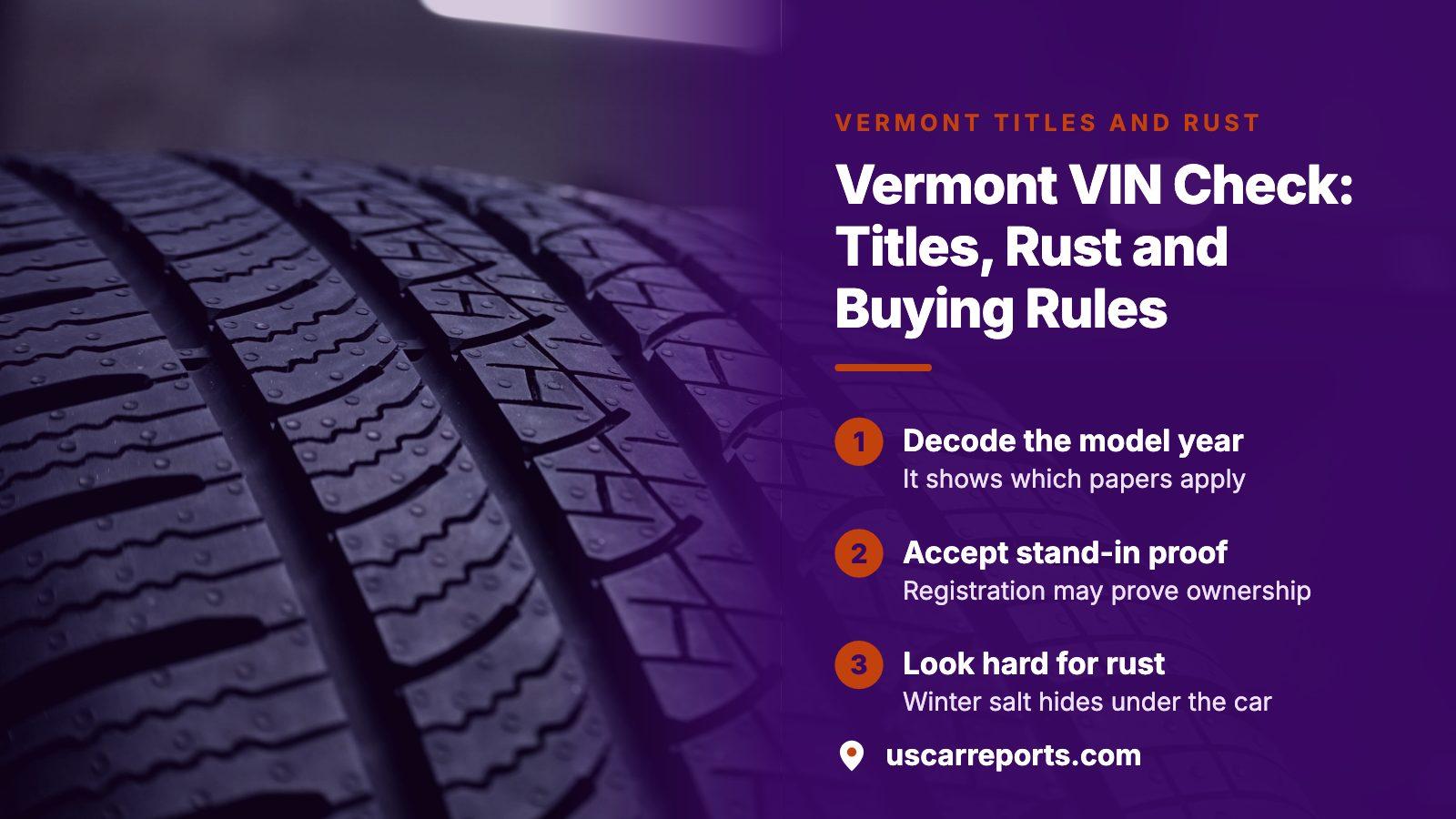
Start with the VIN, which gives the model year, then ask which document proves ownership. A Vermont car newer than model year 2009 should have a title, while an older one may be sold on its registration certificate. Look up open recalls with NHTSA, match the inspection sticker to the car, and run a USCarReports report for brands, damage and mileage recorded outside Vermont.
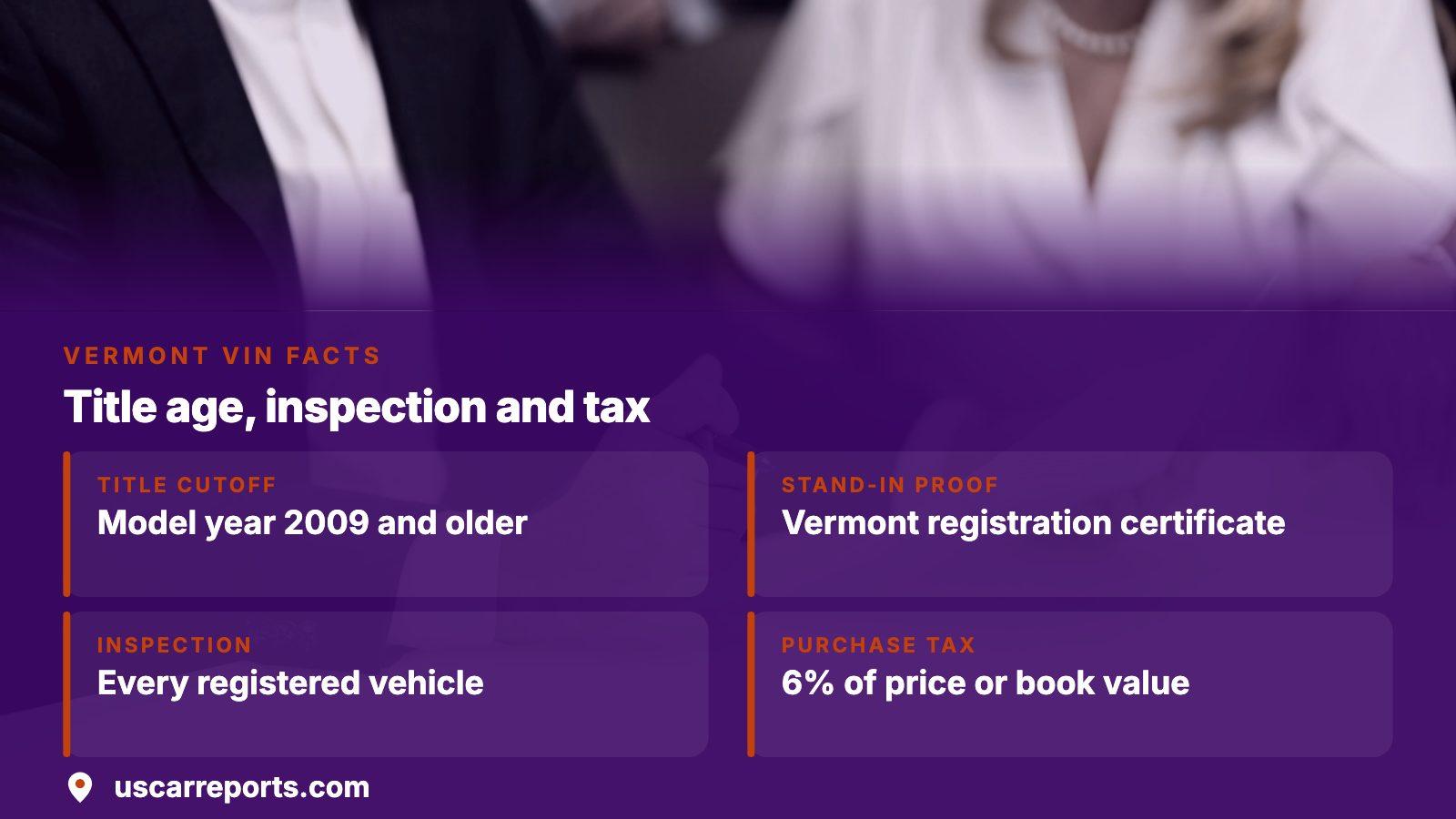
- Title cutoff
- Model year 2009 and older may have no title
- Stand-in proof
- The Vermont registration certificate
- Inspection
- Every registered vehicle, no grace period
- Purchase tax
- 6% of the higher of price or book value
In Vermont the model year decides which paperwork to ask for
Most states want a title in every private sale; Vermont does not. Registered here in the owner's name, a vehicle up to model year 2009 can be sold without one, and the registration certificate does the job of proving who owns it. Cars from 2010 onward should arrive with a title signed over by the person named on it. The DMV adds a tip: an owner selling to someone who will register in another state should get a title first.
The DMV says its title law changed on July 1, 2024 under Act 165. For a pre-2010 car sold inside the state, the buyer obtains the title while completing registration. An old Vermont car with no title can be honest; a newer one with none is a problem, and the VIN tells you which group you are in.
Which papers should come with which car
| Situation | Papers to expect | What to check |
|---|---|---|
| Model year 2010 or newer | A Vermont title signed over by the owner, with every lien released | No title means no sale; the DMV calls selling without one illegal |
| Model year 2009 or older, registered in Vermont | The registration certificate and a signed bill of sale | If only a bill of sale appears, ask what became of the certificate |
| Older car never titled in Vermont | The last registration certificate, original or certified copy, with all later sale documents | Each sale document should list make, year, VIN, price, mileage, signature and date |
| Car with no national title record | A chain of bills of sale, a notarized non-titled-vehicle affidavit and a VIN verification | Expect extra DMV steps before any title can be issued |
Photograph every page before money changes hands, while a gap in the chain is still easy to question.
Running a Vermont VIN lookup before you drive out
- Ask for the VIN in writing, plus photos of it taken at the dashboard and at the driver's door edge.
- Enter it for the USCarReports preview. The model year comes back first, and it sets which paperwork test applies.
- Run NHTSA's recall search. It costs nothing and does not depend on any title.
- Read the windshield inspection sticker and match the make, year and VIN on it to the car, as the DMV advises.
- Buy the report once the preview holds up. It is one payment for one vehicle.
- Book an independent mechanic and a lift before you pay.

What a USCarReports report adds on a Vermont VIN
Vermont paperwork describes Vermont. The report covers what happened elsewhere, and a few lines carry extra weight on a car that may have crossed a border.
- Brand marks on a title: salvage, flood, junk. The DMV warns a brand can vanish if a car is retitled somewhere that never consults the earlier state's records.
- Crash and damage entries. A clean title, the DMV notes, does not rule out a collision.
- Odometer readings over time, to hold against the seller's story and the signed disclosure.
- Auction and salvage records with photos, plus lien, impound and theft entries.
- Insurance records, open recalls, ownership and use type, market value and factory specifications.
The Vermont DMV itself points buyers to NMVTIS-based history reports for this reason.
Annual inspection and rust: what the sticker really proves
Every motor vehicle registered in Vermont must pass at a licensed station, and the DMV says there is no grace period. The pass sticker cannot be moved to another car, sits on the windshield and carries a number for its expiration month.
| Part | When it fails |
|---|---|
| Rocker panel | Rust, damage or cracks open through either skin of the panel; tape or foam is not a repair |
| Frame, cross members, engine mounts, cradles | Corrosion eats through, or cracks, tears, breaks or broken factory welds appear; patches must meet the maker's specifications |
| Floor pan | Cracks or holes that could admit exhaust fumes, or rust that leaves sagging areas |
| Brake rotors and drums | More than half an inch of pitting, cumulative per braking surface |
| Brake hoses and tubes, fuel system | Leaking, crimped, cracked or broken lines; fuel leaking through deterioration |
On rocker panels, frames and rotors, lesser corrosion is written up as an advisory, not a failure, so a car can pass while carrying rust you will pay for later.
A sticker is a snapshot, not a history
A pass shows the car cleared the test on the day it sat on the lift. It records nothing about a repaired crash, a flood or a rolled-back odometer. A sticker about to expire means a long gap, with a salted winter somewhere in it.
Brands, mileage and what a seller must tell you
Vermont puts disclosure on the seller. A car with a salvage, rebuilt or totaled past must be described to you by the seller, in conversation and again on the bill of sale, before the deal closes. The DMV puts a branded car at roughly half the book value of a clean-title twin. A car declared "True Mileage Unknown" takes the same rough discount, and one with a dead odometer cannot be inspected in Vermont at all.
For model year 2011 and newer, an odometer disclosure statement is required with the bill of sale. Set that figure beside the report's readings. A branded car priced like a clean one is the listing to leave alone.
Salvage, bonded and Canadian cars get an extra VIN step
Some cars cannot be titled until an official has looked at the VIN on the metal. Vermont law enforcement, staff working under an officer's supervision, or DMV employees named by the commissioner carry this out on form VT-010.
- Vehicles with salvage documentation
- Vehicles being titled under a bond
- Vehicles registered in any foreign country, Canada included
- Not needed when no title is issued
Vermont borders Quebec, so a Canadian registration is a realistic find. Run the VIN before the DMV does.
The state's purchase tax lands on top of the price
Vermont collects purchase and use tax when you register or title the car, at 6% for ordinary cars and trucks under 10,100 pounds curb weight. The base is whichever is higher: what you paid, or J.D. Power's clean trade-in figure for that car. A low number on the bill of sale does not shrink the tax. If the car is worth less than book, a dealer appraisal on form VD-012 can ask for a lower base. Dealer documentation fees are folded into the taxed price, and tax already paid to another state is a listed case for an exemption certificate, form VT-014.
Cost of the report, and the next move
The preview carries no charge, so you can look before you commit. A full report is bought once for a single vehicle, with no subscription attached, and a pack of 3, 5 or 10 reports covers a longer shortlist. Amounts are listed on /pricing.
Line up three things: the model year from the VIN, the papers in the seller's hand and the report. When all three agree, book the lift. When one disagrees, ask for a written explanation, and be ready to walk away without one.
Where this information comes from
- Vermont DMV: Vehicle title — Source for the model year 2009 title cutoff, the July 1, 2024 change and the papers needed for each kind of purchase.
- Vermont DMV: Tips for buying a used vehicle — Covers brand disclosure, the half-of-book value for branded cars, mileage declarations and checking the sticker against the car.
- Vermont DMV: Vehicle taxation — Where the purchase and use tax rate, the taxable base and the appraisal and exemption forms come from.
- Vermont DMV: Vehicle identification number — Lists which vehicles need an official VIN verification and who performs it.
- Vermont DMV: Vehicle inspections — Shows that the inspection has no grace period and links to an inspection history lookup by VIN.
- Vermont DMV: Periodic Inspection Manual (VN-113) — The rejection and advisory criteria for rocker panels, frames, floors, brakes and fuel lines.
- Vermont DMV: NMVTIS — Explains what the national title system records and how brands can be washed.
Sources and photos: Facts checked against the sources above in November 2026. Photos by Pablo Alvarez, Michal Biernat and Carrie Allen www.carrieallen.com on Unsplash; diagrams by USCarReports.
Keep reading
- New Hampshire VIN check: titles, the 1999 cutoff and buying rulesThe neighbor draws its title line at a different model year, which matters for a car that crossed the border.
- New York VIN check: flood, city-street and road-salt history before you buyAnother neighboring state, worth reading if the car came from New York.
- Title status check: what the state lookup tells a car buyerHow to read a title's status once the document is in your hands.
- Sample reportSee how a report is laid out before you pay for one.
Frequently asked questions
Is a Vermont VIN check free?
Parts of it are. NHTSA's recall lookup and NICB's VINCheck are free to use, and the USCarReports preview carries no charge. The full report, with title brands, damage, mileage, liens and auction photos, is a single payment for one vehicle.
Does every Vermont car need a title?
No. A car from model year 2009 or earlier that is registered to its owner in Vermont may have none, with the registration certificate standing in as proof of ownership. Newer cars should have one. If a seller says a 2010 or later car has no title, treat that as unresolved and ask for documents before you discuss price.
Can rust fail a Vermont inspection?
Yes, but where it sits and how far it goes decides the outcome. Corrosion that opens through a rocker panel, frame member or mount fails, as does a floor pan with holes or sagging areas. Lesser rust is only noted.
How do I check a Vermont car's history before buying?
Start from the VIN. Run the preview, NHTSA's recalls and the DMV's inspection history lookup, then buy a history report. Compare the VIN on the papers, the sticker and the car, character by character, since one wrong digit means the papers describe another vehicle.
Can a license plate show who owns a Vermont car?
No. Federal law, the Driver's Privacy Protection Act, keeps owner names in state motor vehicle files behind a short list of approved purposes, and a private shopper seldom has one. Use the VIN, which leads to the vehicle's own record and names no one.
Now check the car itself
The guide explains what to look for. The report shows what this VIN has on record.