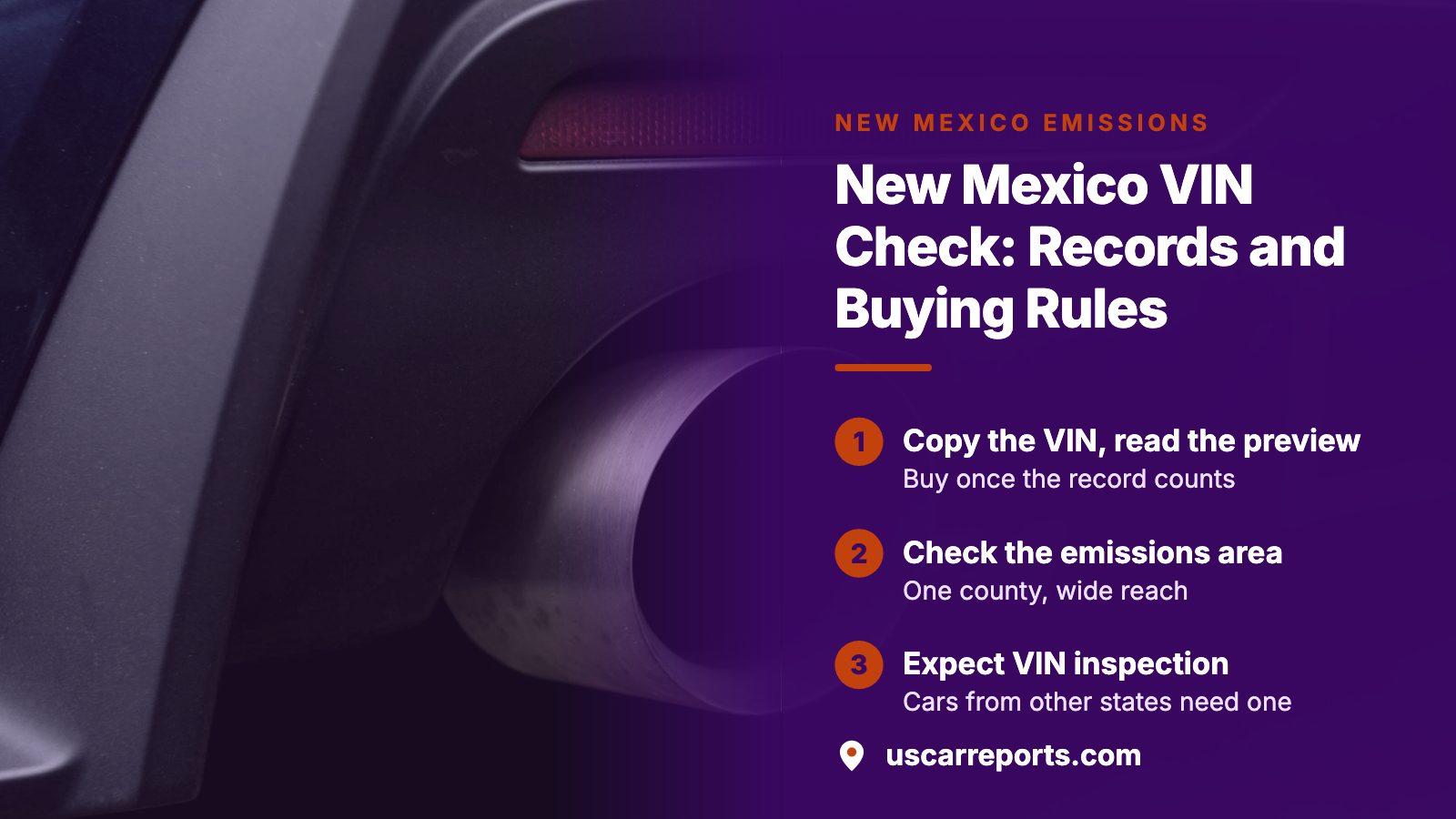
THE SHORT ANSWER
To run a New Mexico VIN check, pull the 17-character VIN off the vehicle, put it into the preview, and buy the report once the record counts agree with the seller. Read the title brands, damage, odometer and lien entries next to the paper title. Then deal with the state's own requirements: an emissions test tied to Bernalillo County, and a VIN inspection when the car arrives from another state.
- Emissions area
- Bernalillo County, plus drivers who commute in 60 or more days a year
- Sale effect
- A covered car needs a test when the title changes hands
- Cars from other states
- A VIN inspection is required
- Preview
- Free, then one payment per report
What a New Mexico VIN check finds on a used car
USCarReports builds each state page around that state's buying rules, and New Mexico's depend on where a car has been and who will drive it. The record answers the first part: cars reach New Mexico from Texas, Arizona and Colorado constantly, and whatever those states recorded can show up in one search.
| Record | What it tells a New Mexico buyer |
|---|---|
| Title brands | Salvage, flood or rebuilt status issued by any reporting state, which a local-looking title may not show. |
| Crash and damage history | Whether a fresh paint job covers a collision or only a baked clearcoat. |
| Mileage readings | A chain of readings across owners, so a sudden dip or a long flat stretch stands out. |
| Auction and salvage pictures | The car as it looked on the sale lane, before anyone repaired it. |
| Liens and impound stays | A lender who may still hold a claim, or a tow-yard stay that needs explaining. |
| Theft and insurer events | Things that reached an insurer but never reached the title. |
| Open recalls and build data | Repairs still owed, plus the factory details that pin the model year the emissions rule cares about. |
Running the check: copy the VIN, read the preview
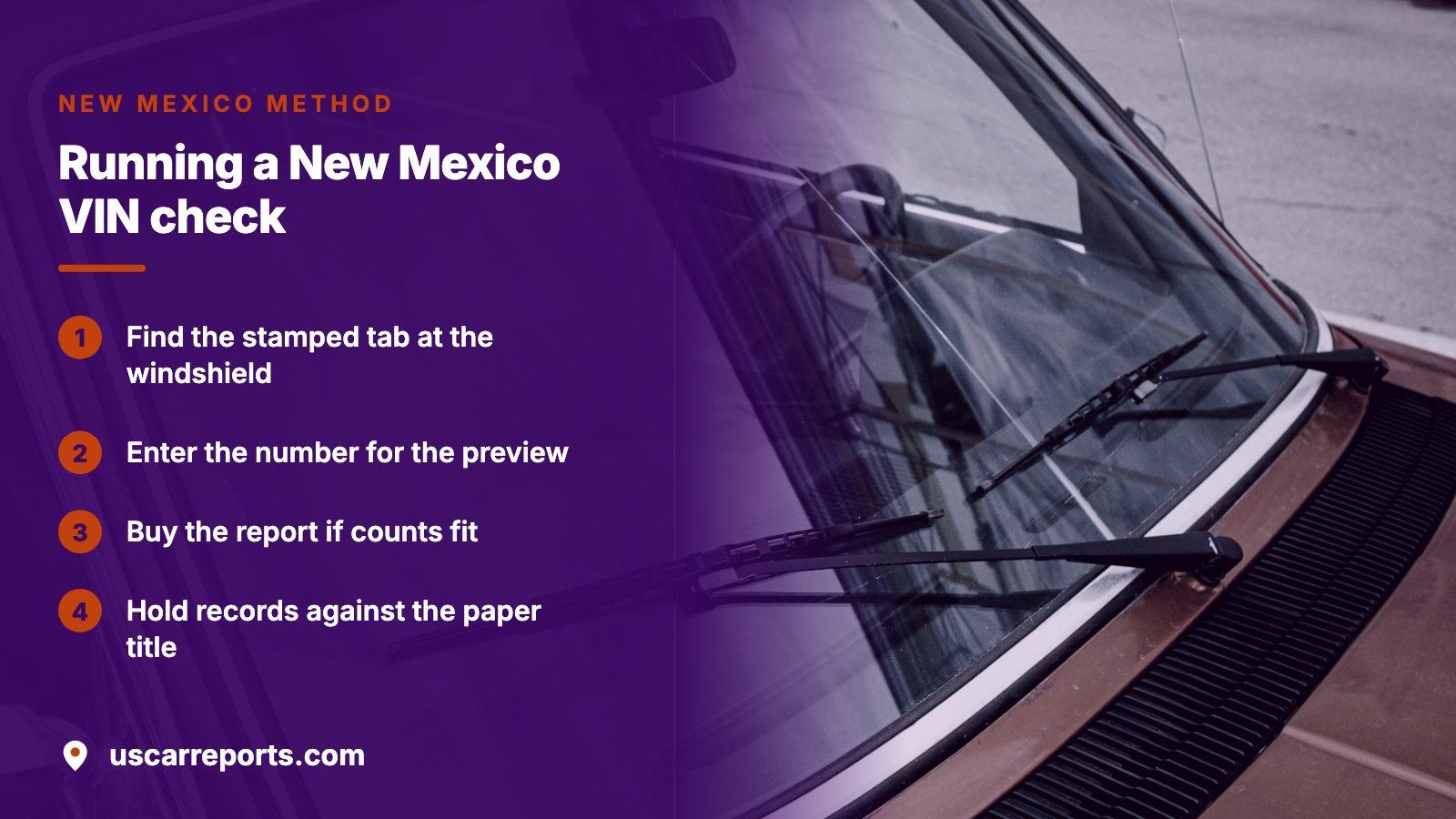
- Look through the windshield at the lower driver-side corner for the stamped tab, then find the sticker along the door edge. Copy both and compare them with the title and the ad.
- Enter the number on this site. The preview lists the year, make and model, any open recall count, and how many title and auction records are on file.
- If those counts fit the seller's account, buy the report so each record opens.
- Hold the records up against the paper title, then inspect the car before you pay a deposit.
A seller who dodges the VIN has answered a different question already. A plate number is no stand-in, since privacy law keeps private buyers from turning a plate into an owner's name.
Three New Mexico buyers, and the rule each one meets
The state's rules touch buyers differently. Find your row, then settle that item before the price is final.
| Buyer | Rule that applies | Settle first |
|---|---|---|
| Lives in Bernalillo County, buys from a private seller | The county's emissions requirement, with a test when the title transfers | Ask for the latest test result and agree who pays if the car fails |
| Lives outside the county, but work takes the car into it | The commuter clause: 60 or more days a year | Estimate your days honestly and treat the car as covered if it gets there |
| Buys a car in Texas, Arizona or Colorado and drives it home | A VIN inspection for any vehicle arriving from another state | Phone the field office, and run the history check before you travel |
The emissions rule: one county, wide reach
New Mexico confines emissions testing to one county, then widens the net to people who drive into it often. Bernalillo County residents, in the Albuquerque area, must hold an Emission Certificate of Inspection. So must anyone whose driving takes them there for 60 or more days a year. A registration address alone will not tell you which side a car falls on.
- Covered: gasoline vehicles from model year 1991 forward, up to 10,000 lb gross vehicle weight.
- Exempt: dedicated electric cars and diesels.
- Timing: every two years, and again when the car is sold.
Guides disagree about hybrids and about very old or very new cars. Ask the MVD about the specific vehicle before you rely on a listing's claim or a table in an article.
When the sale brings a test nobody budgeted for
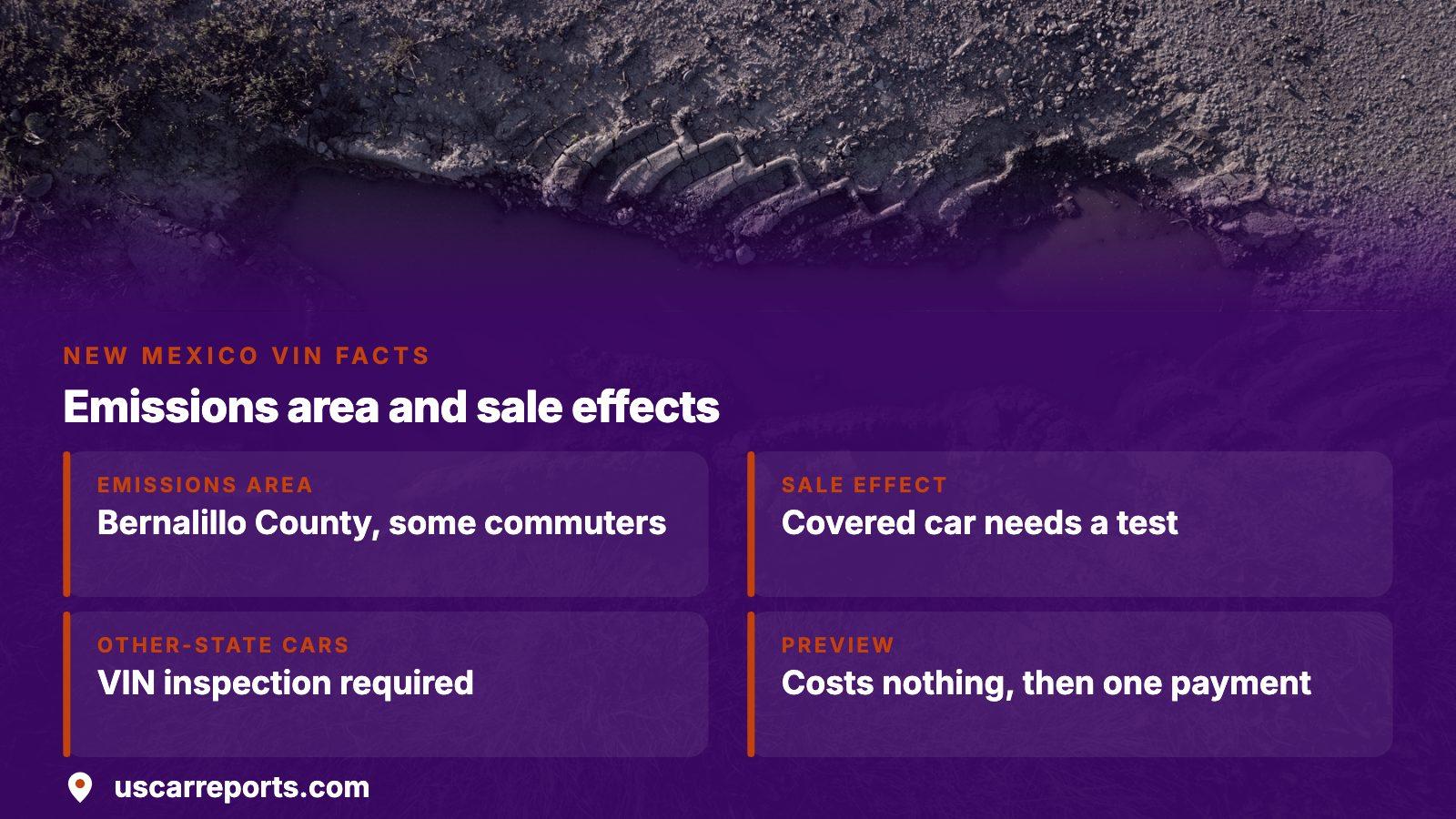
For covered cars, the test is tied to the transfer itself. A car can be midway through the biennial cycle and still need a new result because it has a new owner. Private sales feel this most. Nobody was thinking about exhaust when the price was agreed, and a failed test becomes a repair bill with no owner.
Put the test in the paperwork
Write one line into the bill of sale: who books the test, who pays, and what happens on a fail. Verbal reassurance that the car will pass carries little weight once an estimate lands on the counter.
Bringing a car in: the VIN inspection
Any vehicle arriving from another state needs a VIN inspection. Most often an agent at an MVD field office does the work, but some offices do not perform them, and some want a booking. A certified VIN inspector is the other route.
- Call ahead and ask whether that office does inspections and whether you need a time slot.
- Carry the out-of-state paperwork. The agent compares the stamped number with the one in those papers.
- Run the history check first. A mismatch costs less to discover on your phone than at a counter.
The inspection verifies the number on the metal. The history shows what the car went through. A car from out of state needs both.
Red flags to look for in the results
- A flood, salvage or rebuilt brand from any state. Note who issued it and when.
- Sale photos showing damage the seller skipped, especially beneath new paint.
- An odometer reading that falls, or stays flat for years.
- An open lien. Have the title cleared before you pay.
- A theft record, or an impound entry with no explanation.
- Title and car carry different VINs.
- A seller who gets vague when you ask when the car last passed emissions.
A clean record means nothing was reported
A car that was wrecked, never insured and never auctioned leaves no trail. Pair the report with a hands-on inspection.
Where New Mexico cars wear: sun, dust and altitude
Buyers from the salt belt see a clean underbody and relax. The punishment arrives elsewhere. Intense ultraviolet light at this elevation cooks paint, dash plastic, rubber seals and wire insulation, and airborne grit wears the parts that filter, slide or seal.
- Start with the roof lining, the dash surface and the window rubber, before you crawl underneath.
- Press the radiator hoses and look for hardened or split rubber.
- Open the air filter housing and see how much grit has packed in.
Fresh paint here may only mean the clearcoat chalked away. The damage and auction records show whether that is the whole story.
What the report costs, and what comes next
Opening the preview costs nothing. For the report, buy one, or choose 3, 5 or 10 at once; nothing renews. The pricing page shows what each option costs. Two free services from other organizations, NHTSA's recall search and NICB's VINCheck, work well as side checks.
- Copy the VIN from the car and open the preview.
- Buy the report if the counts fit the story.
- Compare each record with the title and what the seller told you.
- Decide whether the sale triggers an emissions test, and who pays on a fail.
- Book the VIN inspection if the car is coming from another state, then complete the title paperwork.
Where this information comes from
- New Mexico MVD: emission testing — The Bernalillo County requirement, the commuter clause and the test at transfer.
- New Mexico MVD: register your vehicle — The VIN inspection for vehicles arriving from another state.
- New Mexico MVD: vehicle titles — How the state titles vehicles and what an out-of-state application involves.
- NHTSA: recalls — Open recalls by VIN, at no cost to the buyer.
- NMVTIS: National Motor Vehicle Title Information System — The national title record that carries brands across state lines.
Sources and photos: Facts checked against the sources above in November 2026. Photos by Dain Lindo, Max Tokarev and Bernd 📷 Dittrich on Unsplash; diagrams by USCarReports.
Keep reading
- Arizona VIN Check: Title Brands, Heat Wear and Flood HistoryThe neighboring state's rules, and what heat does to a car in place of rust.
- Texas VIN check: what to run, Texas title brands and buying rulesMany cars arrive from Texas, where flood history is the main screen.
- Registering a car in another state: deadlines, title and checksThe next step when a car crosses a state line to be registered.
- Sample reportA finished report, to look at before you run one.
Frequently asked questions
What does a VIN check cover on a New Mexico car?
It gathers the car's title brands, crash history, mileage readings, auction photos, liens, theft and insurer events, and open recalls. The MVD handles titles and registration, while the national title record comes from outside providers. A report cannot show wear that nobody reported.
Is an emissions test due when I buy a used car here?
If the car is gasoline, from 1991 on, at or under 10,000 lb gross weight, and falls under the Bernalillo County program, a test comes due when the title changes hands, even midway through its two-year cycle. Agree in writing who covers a failed result.
My job is in Albuquerque but I live elsewhere. Do I need to test?
Possibly. The rule reaches people whose driving takes them into Bernalillo County for 60 or more days a year, not only those registered there. If your work puts the car in the county most weeks, assume the requirement is yours and confirm it with the MVD before you buy.
Where is the VIN inspection done for a car I bring in?
Usually at an MVD field office, by an agent, or through a certified VIN inspector. Not every office offers it, and some require an appointment, so call first. Bring the out-of-state papers, since the inspection matches the number on the car against them.
Why can't I find a New Mexico owner from a license plate?
The federal Driver's Privacy Protection Act restricts the personal details state motor vehicle files can release, and satisfying a buyer's curiosity is not a permitted use. Sites claiming otherwise rarely deliver. Ask the seller for the VIN, which unlocks the records a purchase actually depends on.
Now check the car itself
The guide explains what to look for. The report shows what this VIN has on record.