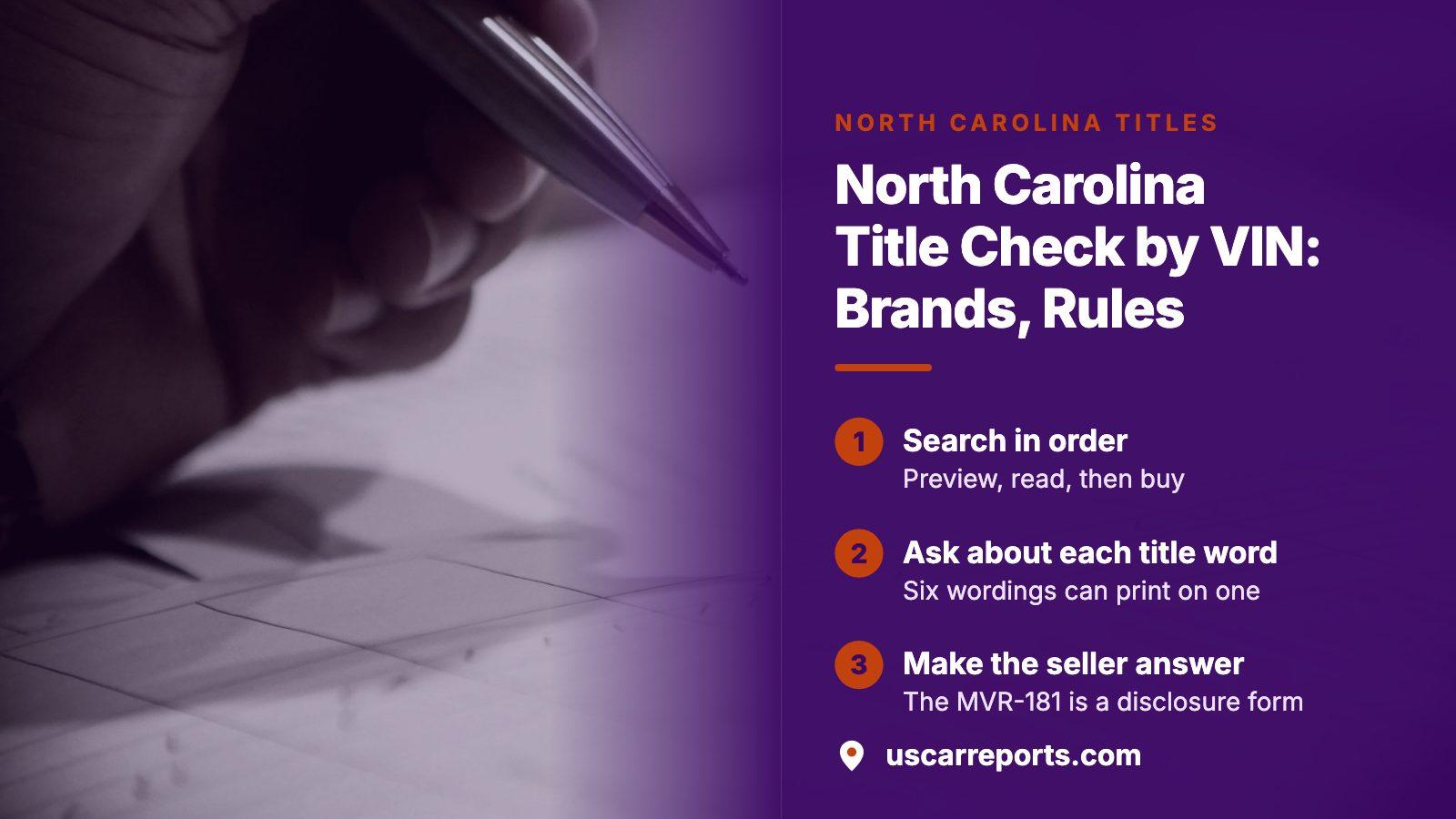
THE SHORT ANSWER
To run a North Carolina title check, enter the VIN in the preview box and read what comes back. If the car still looks right, buy the full report, then compare it with the wording on the title and the seller's signed MVR-181 form. Under state rules a car is salvage when repair cost, or an insurer's payout, would pass 75 percent of retail value.
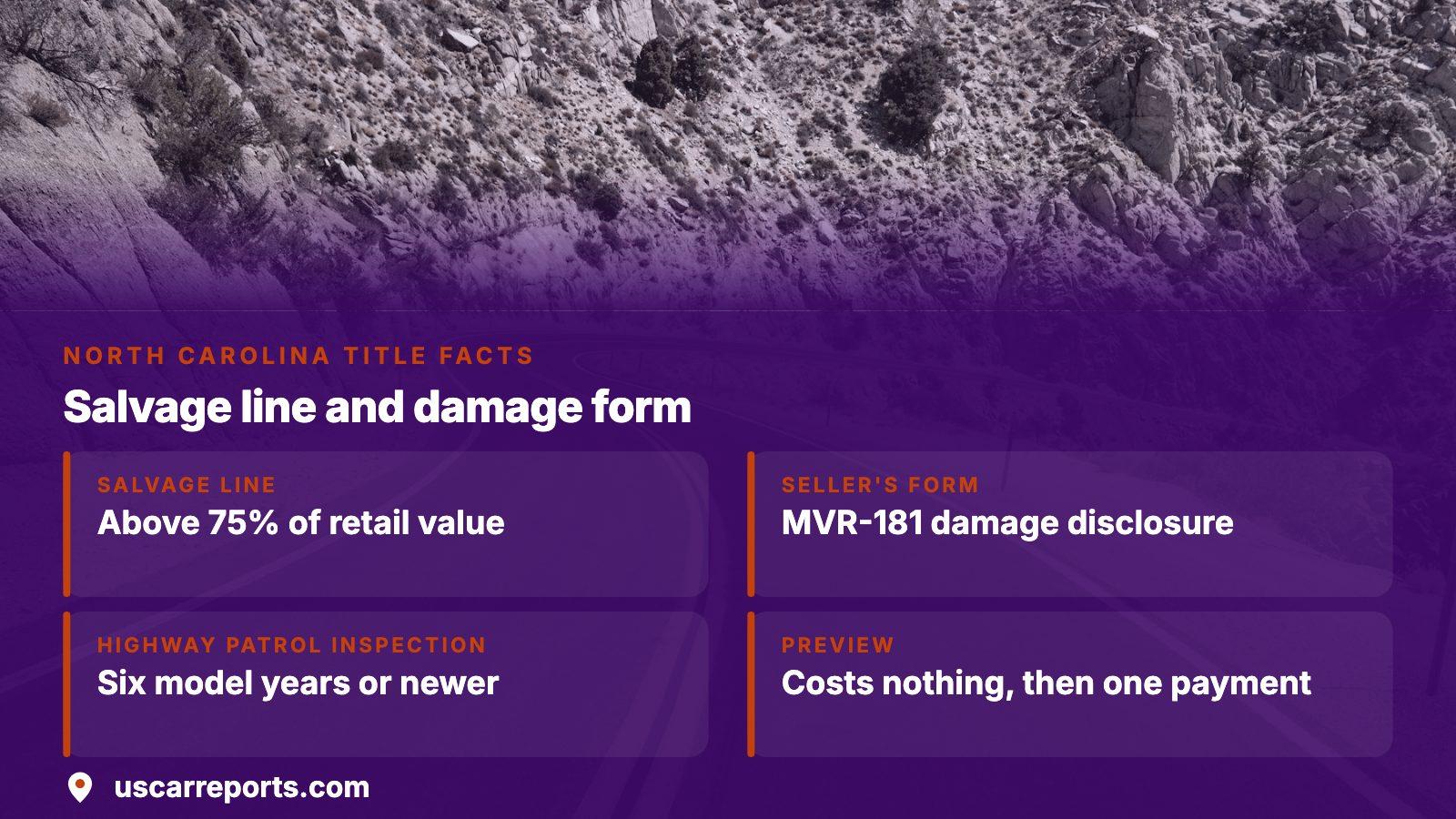
- Salvage line
- Repairs or an insurer's claim above 75% of retail value
- Seller's form
- MVR-181 damage disclosure on private sales
- Highway Patrol inspection
- Salvaged or damaged cars six model years old or newer
- Preview
- Free, then one payment per report
What a North Carolina title check shows that the paper hides
A title records one state's view of one owner. A VIN search follows the car, which matters because a North Carolina title can be issued for a car that was damaged, flooded or branded somewhere else first.
| Entry | Why it counts here |
|---|---|
| Brands | A salvage or flood label from another state can show up although this state's paper looks plain. |
| Auction photos | Pictures from before repair show the damage and can be held against what the seller declares. |
| Insurer payouts | A big claim can earn the salvage brand in this state with no repair estimate at all. |
| Mileage dates | Readings that drop or stall need an explanation. |
| Liens and theft | A lender's claim must be cleared before the title is worth anything to you. |
Steps for a North Carolina title search, in order
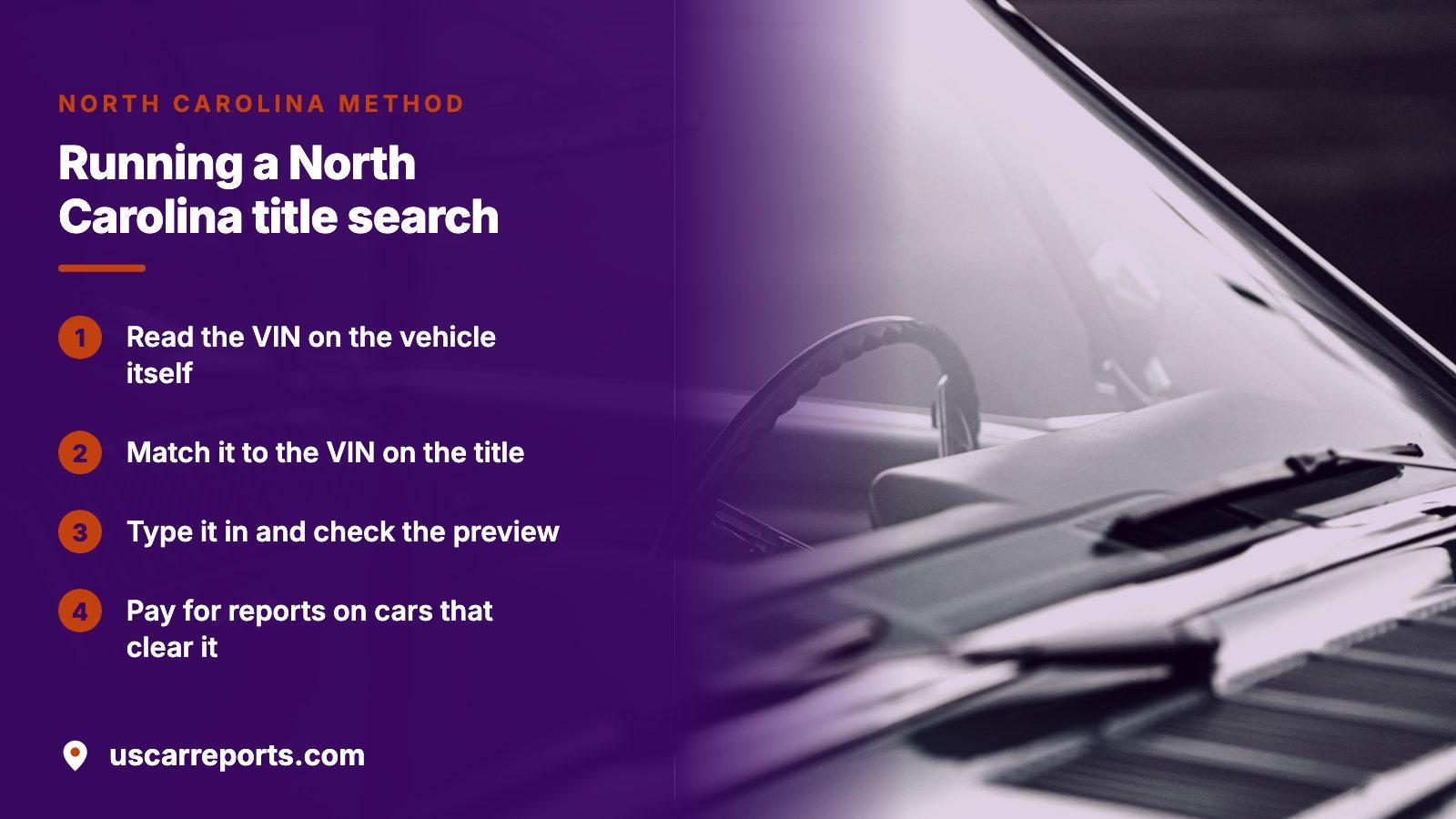
- Read the VIN on the vehicle itself, not in the listing: look through the windshield at the dash plate, then check the door frame for the matching label.
- Match both to the VIN printed on the title. A single differing character ends the visit.
- Type it into the box on this page; the year, make and engine shown should fit the car beside you.
- Pay for a report only on cars that clear that first look. A report covers one car, and bigger bundles (3, 5 or 10) are offered for a shortlist; nothing renews.
- Lay the report beside the title and the seller's damage form.
Do all of it before any deposit.
Six words North Carolina can print on a title, and what to ask about each
| Designation | What to ask |
|---|---|
| Salvage motor vehicle | Repairs, including making it road-safe, above 75 percent of retail value, or an insurer payout above that share: what was the estimate, and what was paid? |
| Salvage rebuilt | A car that was salvage and has since been repaired and retitled: who did the work, and are there photos from before it? |
| Flood vehicle | Water damaged the body, engine, transmission or differential: where, when and how high? |
| Reconstructed | Essential parts were added, removed or swapped, glider kits and custom builds included: what changed? A crash is not implied. |
| Junk | Cannot run on the highway, worth only parts or scrap, never titled or registered: a running car on junk paper does not add up. |
| Non-U.S.A. | Built outside the United States and not intended for sale here: how did it arrive? |
The value behind the 75 percent comes from the NADA Pricing Guidebook or a publication the Commissioner approves, and it is a retail figure. The repair test holds even if no insurer ever labeled the car a total loss.
Two questions for the seller
What did the repair estimate say? Did an insurance company pay on this car, and how much? Either answer can produce the brand.
The MVR-181: the form that makes the seller answer
Among the papers NCDMV lists for a private purchase is the Damage Disclosure Statement, MVR-181. A notice printed on it says each seller must disclose what he or she knows, and that skipping it can bring civil or criminal liability. Keep your copy, because you owe the same disclosure when you resell. It asks:
- Was damage over 25 percent of the car's value, with parts listed? Only cars within five model years.
- Has it ever been a salvage motor vehicle? If so, which state titled it?
- Is it a flood vehicle?
- Is it a recovered theft vehicle, with parts listed? Five model years or newer only.
- Has it been reconstructed?
The salvage, flood and reconstructed questions reach every model year. The five-year count starts with the year of manufacture, and erasures void the form.
Setting the report beside the paperwork
Treat the report and the paper as two witnesses. When they disagree, doubt the paper first.
| What you find | What it can mean | What to do |
|---|---|---|
| A salvage record, but the form says no | The seller is mistaken or hiding it | Ask for repair paperwork; walk if answers stay vague |
| Another state's brand on a plain North Carolina title | It was branded elsewhere before being retitled here | Price it as a branded car, or pass |
| A lien the seller never mentioned | A lender still holds a claim | Get the release in writing before any payment |
| A recovered-theft answer on the form | Stolen, found, possibly damaged | Ask which parts were repaired and inspect them |
When it is salvage or rebuilt: the Highway Patrol step
NCDMV tells buyers to be careful with salvaged cars and to have the State Highway Patrol's Investigative Services Unit inspect one before buying. Cars in the newest tier (six model years old or newer) that are damaged or salvaged also need that unit's anti-theft inspection before titling. Mind the mismatch: the form's age-limited questions use five model years, this inspection six.
Timing matters too. An insurer that pays on a salvaged car must notify the DMV within 10 days when the damage and the title transfer both happened here, and instant titles are not issued on blue titles, so expect the standard wait of 10 to 15 business days.
If the seller has no title
A bond can title a car with missing paper, but not one branded parts-only, non-rebuildable or junked, nor an insurer total loss never titled to the insurer or sold without a title. Do not accept a bond as the answer for such a car.
What the license plate agency asks for after a private sale
- The title assigned by the seller. A North Carolina one must be notarized; an out-of-state one follows its own state's rules.
- A lien release when the title shows a lien.
- The title application, MVR-1, notarized, every lien declared.
- The odometer statement, MVR-180, for cars under 10 years old, plus the MVR-181.
- Highway-use tax, with property tax paid then or deferred for 60 days.
A shared title needs every signature notarized and a copy of the other owner's ID, unless a power of attorney signs. Plates will not issue until continuous liability cover from an insurer licensed in this state is in force; a policy from another state is refused.
What it costs, and the sequence worth following
Opening a preview costs nothing. You pay once per report, or once for a pack, with no subscription; the pricing page shows what is offered.
- Run the preview and drop any car that already looks wrong.
- Add NHTSA's recall search, which lists unrepaired recalls only, and NICB VINCheck, which covers insurer theft, salvage and flood entries and caps searches at five per 24 hours per IP address. A clean NICB result does not guarantee a clean history.
- Buy the report for brands, mileage and liens across states.
- Get the MVR-181 filled in and compare each answer with the report.
- Inspect the car, adding the Highway Patrol step for any salvage history, then sign and title it.
NMVTIS, the federal record, gathers state brands plus reports from insurers, recyclers and salvage and junk yards, so a car can carry a brand North Carolina never issued. States word brands differently; read each by its issuing state's definition.
Where this information comes from
- NCDMV: Vehicle Titles — How a title transfer works, the notary step, instant-title exclusions, processing time and the insurance rule.
- NCDMV: Title documents and forms — The papers needed when buying from an individual, including the lien release and the odometer and damage statements.
- NCDMV: Title special cases — The salvage definition, the 10-day insurer notice, the Highway Patrol inspection and where a bond cannot be used.
- NCDMV: Damage Disclosure Statement (MVR-181) — The seller's five questions, the five-model-year count and the printed definitions of each designation.
- NMVTIS: Understanding a vehicle history report — What the national title record covers and who must report to it.
- NICB VINCheck — A no-cost theft, salvage and flood lookup from participating insurers, with its search limit and its limits.
- NHTSA: Check for recalls — A no-cost lookup of unrepaired safety recalls by VIN, and what it leaves out.
Sources and photos: Facts checked against the sources above in November 2026. Photos by Masjid MABA, Dylan Michaud and Will Truettner on Unsplash; diagrams by USCarReports.
Keep reading
- North Carolina VIN Check: Run the Report Before You PayThe notarized signing, annual inspection and flood cars from the coast.
- Title status check: what the state lookup tells a car buyerHow to read a title's status wherever the car was last registered.
- Bonded title: what it means for a buyer, state by stateWhat a bond can and cannot fix when the seller has no title.
- Sample reportSee how the records are laid out before you buy a report.
Frequently asked questions
How do I run a North Carolina title search?
Read the VIN off the car, confirm it matches the title, and run it through the preview here. If the car still fits, buy the full report before any money moves. The search runs on the VIN, so a plate number alone will not do.
Is there a free North Carolina title check?
Partly. The preview here is free, and NHTSA's recalls and NICB VINCheck carry no charge. Each covers one slice, so none shows brands from every state; that is what the single-payment report adds.
Does a North Carolina seller have to disclose damage?
On the MVR-181 the seller states what he or she knows, and the form warns of civil or criminal liability for skipping it. The salvage, flood and reconstructed questions cover every model year; the damage and recovered-theft questions cover newer cars.
What does reconstructed mean on a North Carolina title?
Essential parts, new or used, were added, removed or swapped, glider kits and custom builds included. Salvage rebuilt is the other label: a car that was salvage, then repaired and put back on the road under a new title. Ask the seller exactly what changed.
Does a clean North Carolina title mean the car was never wrecked?
No. A repair paid privately may never produce a brand, and a brand from another state can vanish from the paper if a later state retitled the car without checking. Weigh the report, the form answers and an inspection together.
Now check the car itself
The guide explains what to look for. The report shows what this VIN has on record.