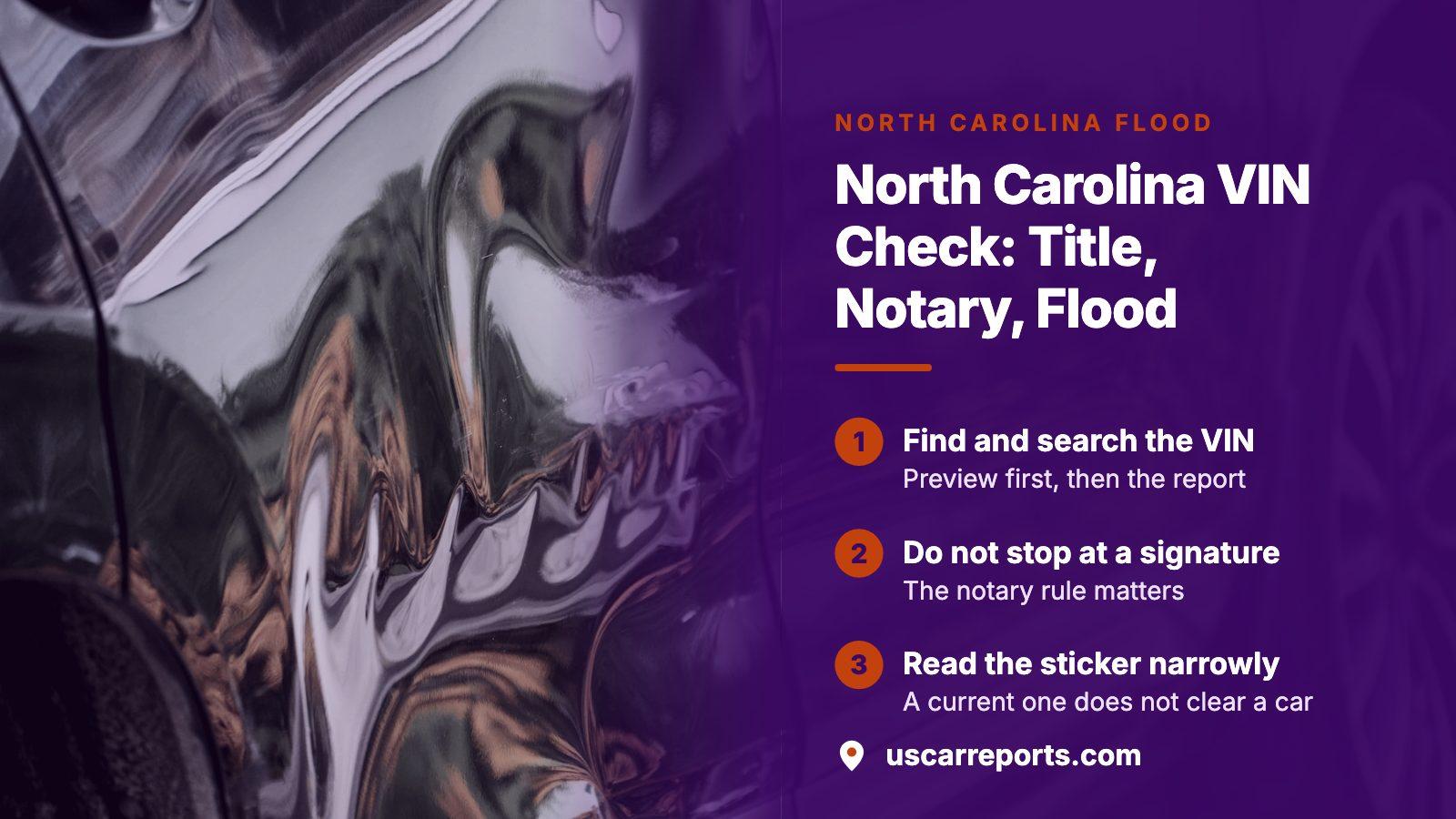
THE SHORT ANSWER
Enter the VIN to see a free preview, then buy the report to learn whether the car has a branded title, crash or auction history, odometer trouble, a lien, a theft record or an open recall. A North Carolina VIN search is only half the job. Before paying, make sure the seller's signature on the title is notarized, ask when the car last passed inspection, and give any eastern car a water-damage inspection.
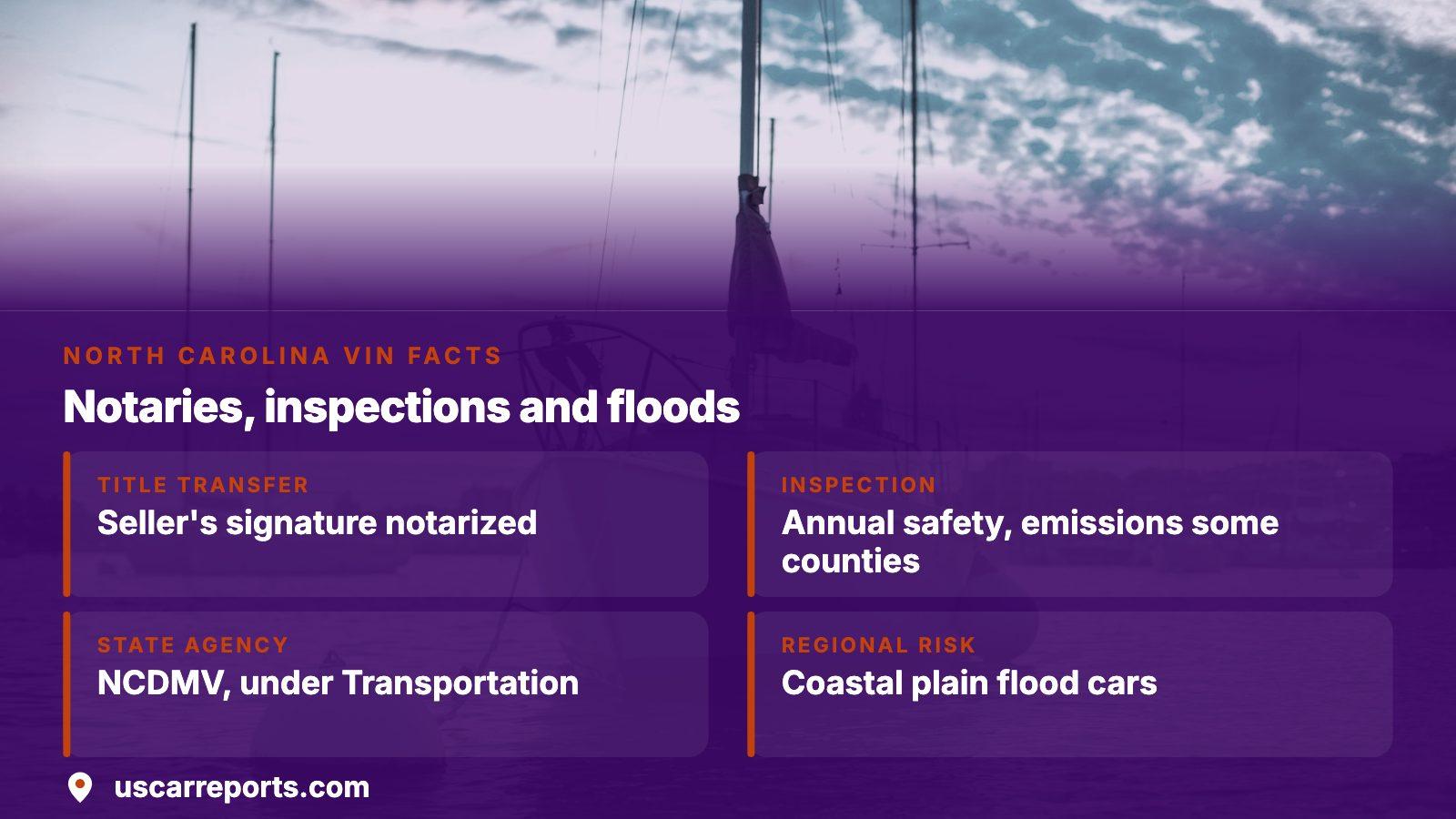
- Title transfer
- Seller's signature is notarized
- Inspection
- Annual safety check, emissions in some counties
- State agency
- NCDMV, under the Department of Transportation
- Main regional risk
- Flood cars from the coastal plain
What a North Carolina VIN check shows about the car
The report is built from the VIN, not from one state office, and that is the point. A car titled in North Carolina may have spent its early years elsewhere, and no single agency holds the whole record. Here is what comes back:
- Brands on the title: salvage, rebuilt or water damage, including any a previous state stamped on the car before it arrived here.
- Accident and damage entries, with any auction or salvage listing and the photographs taken for it.
- Odometer readings from different dates, so you can see whether the mileage climbs in a believable line.
- Lender liens, impound stays, theft reports and insurance claims.
- Recalls still unrepaired, the number of owners and how the car was used, and a market value estimate to test the asking price.
It does not run on a license plate, and it does not replace holding the title or seeing the car.
Where to find the VIN and how to run the search
Get the number off the car, never the ad. Check the stamped plate at the driver's end of the dashboard, visible through the glass, then the sticker inside the driver's door frame. Match both against the title letter for letter and digit for digit. One mismatch ends the sale.
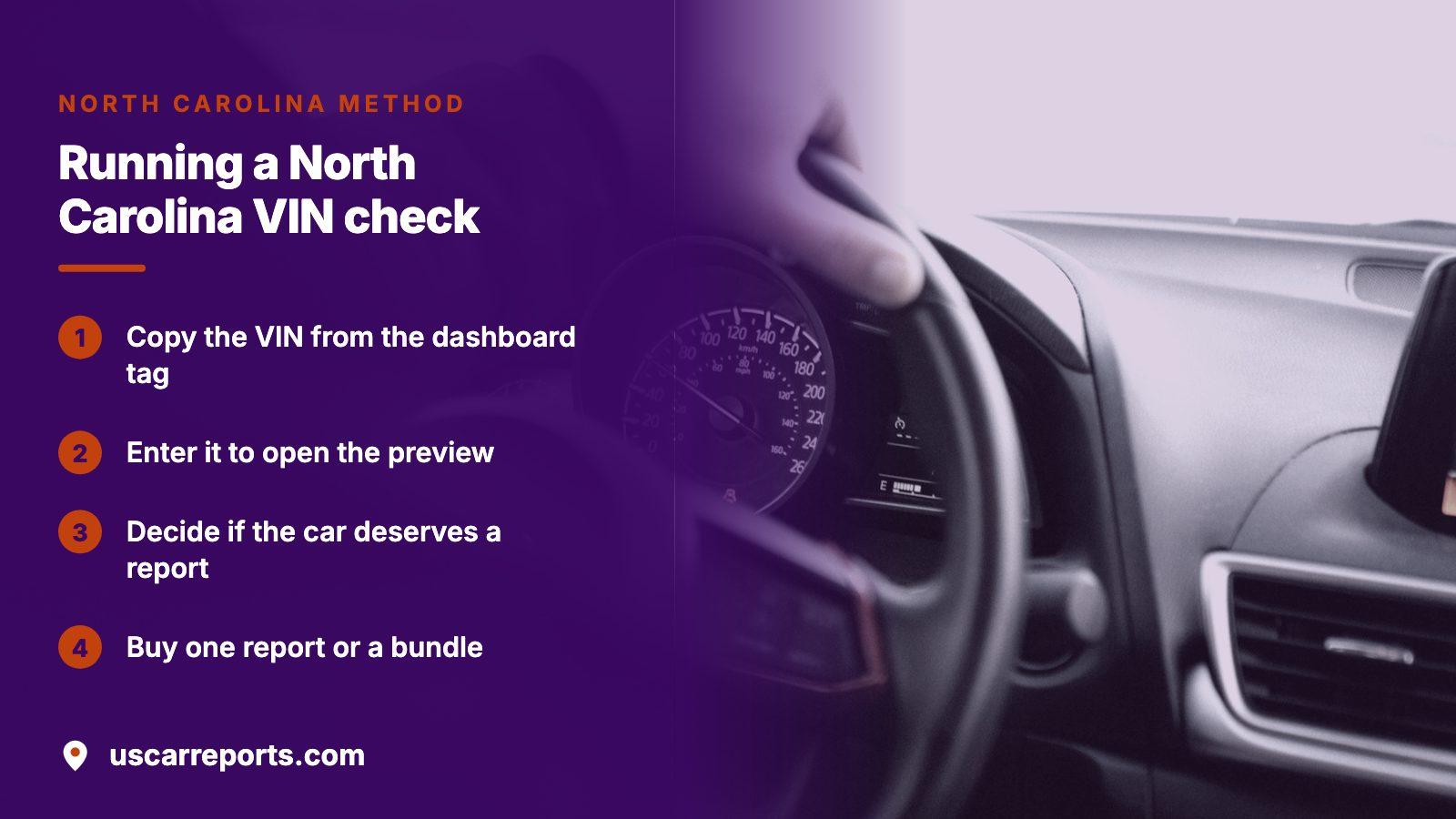
- Copy the 17 characters from the dashboard tag and confirm the door label matches.
- Enter them in the box on this page to open the preview. It costs nothing.
- Read the preview and decide whether this car deserves a full report.
- One report covers one car. Bundles of 3, 5 or 10 exist for a longer shopping list, and nothing recurs.
Run it before any deposit. A plate cannot replace the VIN here: the federal Driver's Privacy Protection Act keeps the owner behind a plate private, and a buyer sizing up a car is not among the permitted uses.
The notary rule: why a signed title is not enough
North Carolina wants the seller's signature on the title notarized, a step most states dropped long ago. Buyers moving in from elsewhere, and a fair number of local sellers, sign in a driveway and assume the sale is done. It is not. You end up holding a car you cannot register until the seller turns up again. Confirm the current requirement with the NCDMV before you schedule the sale.
Do not accept a title signed ahead of time
A notary certifies a signature made in front of them. A title signed last week at someone's kitchen table gives the notary nothing to vouch for.
- Meet at a bank or notary office, so the signing and the payment happen in one place.
- Compare the seller's ID with the name printed on the title before anything is signed. A notary confirms who is signing, not who owns the car.
- Check that the title's VIN is the one stamped on the car.
- Put the sale price, date, VIN and both names on a bill of sale.
What a current inspection sticker does and does not tell you
North Carolina requires a safety inspection every year before registration renewal, and some mostly urban counties add an emissions test. Few states still inspect every registered car annually, so a sticker is easy to find and easy to over-read.
| The sticker shows | It does not show |
|---|---|
| The car passed a set safety checklist covering brakes, lights, tires and steering | Anything about the engine, the transmission or the title history |
| In an emissions county, it also passed that test | How the car will behave next month, since a pass is a snapshot |
| Someone kept the car up to inspection standard at least once a year | Flood or frame damage, which sit outside what the inspection looks at |
Treat a current sticker as a small plus. If the inspection has lapsed on a car being sold, ask why. The harmless answer is that it sat in a driveway. The expensive answer is that it cannot pass.
Flood cars from the eastern part of the state
North Carolina behaves like two used-car markets. The coastal plain takes the hurricanes, while the Piedmont and the mountains mostly do not. Hurricane Florence stalled over the east in 2018 and swamped vehicles by the tens of thousands. Cars with insurance were branded and sold on at auction. Many uninsured ones were dried out and listed with a clean title, and later storm seasons have added more.
No record shows a flood that nobody reported, so the title history and your own inspection both matter. On a car that spent time in the east, look for:
- Grit or dried mud in the spare-wheel well and under the seat tracks.
- Crusty corrosion on the connectors behind the dash.
- A waterline or fogging inside the headlight housings.
- Electrics that misbehave only now and then.
Reading the results: what should slow the sale
Lay the report beside the paper title and see whether the two agree.
| What turns up | What it can mean | What to do |
|---|---|---|
| A brand from another state | The car was damaged or flooded elsewhere before it was titled here | Weigh the brand against the price, or walk away |
| Odometer readings that fall or stall | A rollback or a swapped instrument cluster | Ask for service records and compare pedal and tire wear with the miles shown |
| A lien with no release | A lender may still have a claim on the car | Get a written release before paying |
| Salvage or auction photos | The car was damaged and sold at some point | Compare the photos with the panels and paint in person |
| A theft record | The car may be reported stolen | Stop and call the police or the insurer |
| An open recall | A safety repair is still outstanding | Ask for it to be done at a dealer, or price in the visit |
North Carolina's paperwork, and what stays national
The NCDMV, the Division of Motor Vehicles inside the state Department of Transportation, handles titles, registration and plates. Take the notarized paperwork there to finish putting the car in your name.
The history checks sit on a national footing. Brands from every reporting state gather in the federal NMVTIS database. That is why a North Carolina car's record can carry a brand the state never issued.
Cost, and the order to do things in
Opening the preview costs nothing, and it hints at what the record contains before any money is spent. The full report is one purchase, nothing recurring; the pricing page shows today's options.
- Open the preview and drop any car that already looks wrong.
- Look up open recalls with NHTSA and theft and salvage records with NICB VINCheck. Both cost nothing.
- Buy the report for brands, odometer readings and liens from every reporting state.
- Meet the seller and match the name and VIN on the title to the person and the car.
- Have a mechanic inspect it, with a water check on anything from the east.
- Finish the signing with a notary present, then register through the NCDMV.
Where this information comes from
- NCDMV: North Carolina Division of Motor Vehicles — The state agency that handles titles, registration and inspections, and the place to confirm current transfer rules.
- NMVTIS: National Motor Vehicle Title Information System — The federal title database that collects brands reported by participating states.
- NICB VINCheck — A no-cost theft and salvage search, where claimed flood cars can also show up.
- NHTSA: Recalls — A no-cost lookup of open safety recalls by VIN.
Sources and photos: Facts checked against the sources above in November 2026. Photos by Maxim Tolchinskiy, Miles Loewen and Johnny killroy on Unsplash; diagrams by USCarReports.
Keep reading
- North Carolina title check by VIN: brands, the 75% line and the damage formHow North Carolina names salvage, flood and rebuilt titles.
- Florida VIN check: title records, flood risk and Florida buying rulesThe full water-damage inspection for storm-state cars.
- Sample reportSee what a finished report looks like before you buy.
- PricingThe current options for one report or a pack.
Frequently asked questions
How do I run a North Carolina VIN search?
Copy the VIN from the dashboard tag, confirm it against the door label and the title, then enter it on this page. The preview opens at no charge. If the car still looks worth pursuing, buy the full report before you pay the seller or sign anything.
Is there a free North Carolina VIN check?
Parts of one. The preview here is free, and both the NHTSA recall tool and NICB VINCheck are no-cost. The full history report is a single payment.
Does a North Carolina title have to be notarized?
The seller's signature is meant to be notarized at the sale, which is why a bank is a handy place to meet. Tell the seller beforehand so nobody signs early, and check the current wording of the rule with the NCDMV before you hand over payment.
Can I search a North Carolina car by license plate?
Not for owner details. Federal privacy law restricts that information, and a buyer weighing a purchase is not among the permitted uses. The report here runs on the VIN. When a seller offers just a plate, request the VIN, and read a refusal as a warning.
Will a VIN check show whether a North Carolina car flooded?
It shows a flood brand if one was ever recorded. It cannot show water damage that no insurer or agency reported, which was common after big storms. For a car with eastern history, pair a clean report with a hands-on inspection of the carpet, connectors and lights.
Now check the car itself
The guide explains what to look for. The report shows what this VIN has on record.