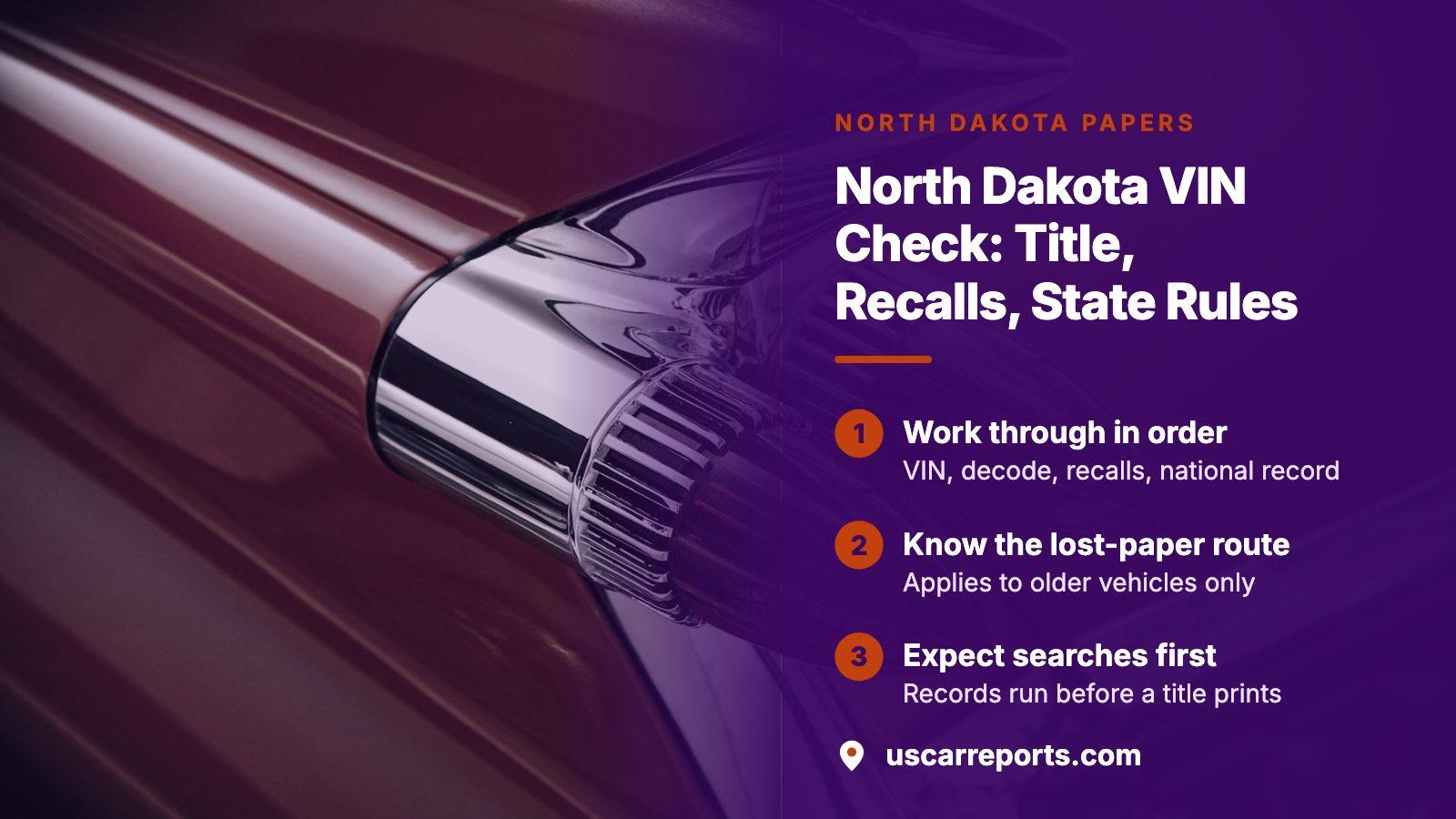
THE SHORT ANSWER
Read the VIN off the vehicle, match it to the title, then decode it and run the free NHTSA recall lookup. Add the national title record and the damage, mileage and theft entries that a full report gathers. In North Dakota, also ask how the title was issued: a vehicle over 40 years old can be titled on an affidavit, after the state searches every state's records and the NCIC.
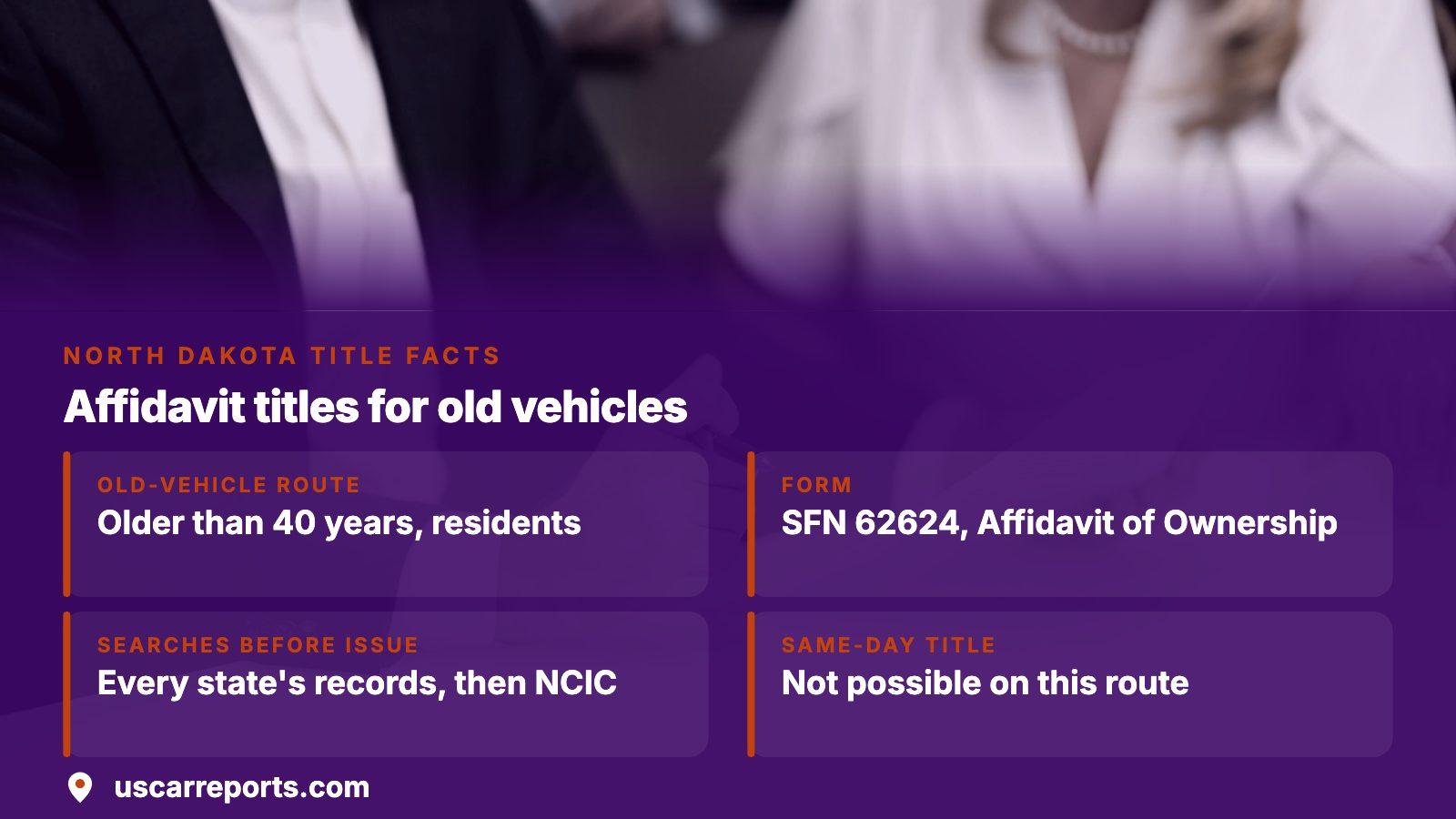
- Old-vehicle title route
- Vehicles older than 40 years, residents only
- Form
- SFN 62624, the Affidavit of Ownership
- Searches before issue
- Every state's records, then the NCIC
- Same-day title
- Not possible on this route
What a state-level check adds, and what each lookup costs
A VIN follows a car across state lines. Titling rules do not. Each state words its brands differently, asks for different paperwork at sale and keeps its own files, so a state VIN check does two jobs: it pulls the national history tied to the number, and it applies whichever state's rules govern the title you will hold.
| Lookup | What it answers | Cost |
|---|---|---|
| VIN decode | What the factory built: engine, body, model year | Free |
| NHTSA recall search | Open safety recalls on that VIN | Free |
| NICB theft and salvage screen | Insurer reports of a theft or a write-off | Free |
| Approved NMVTIS provider | Title brands reported by participating states | Paid |
| USCarReports report | Title brands, ownership and use type, odometer readings, crash and damage entries, salvage and auction photos, liens, theft and insurance entries, open recalls, value and factory specs | Free preview, then one payment |
A decode shows that the number is genuine. It cannot show whether the car was wrecked.
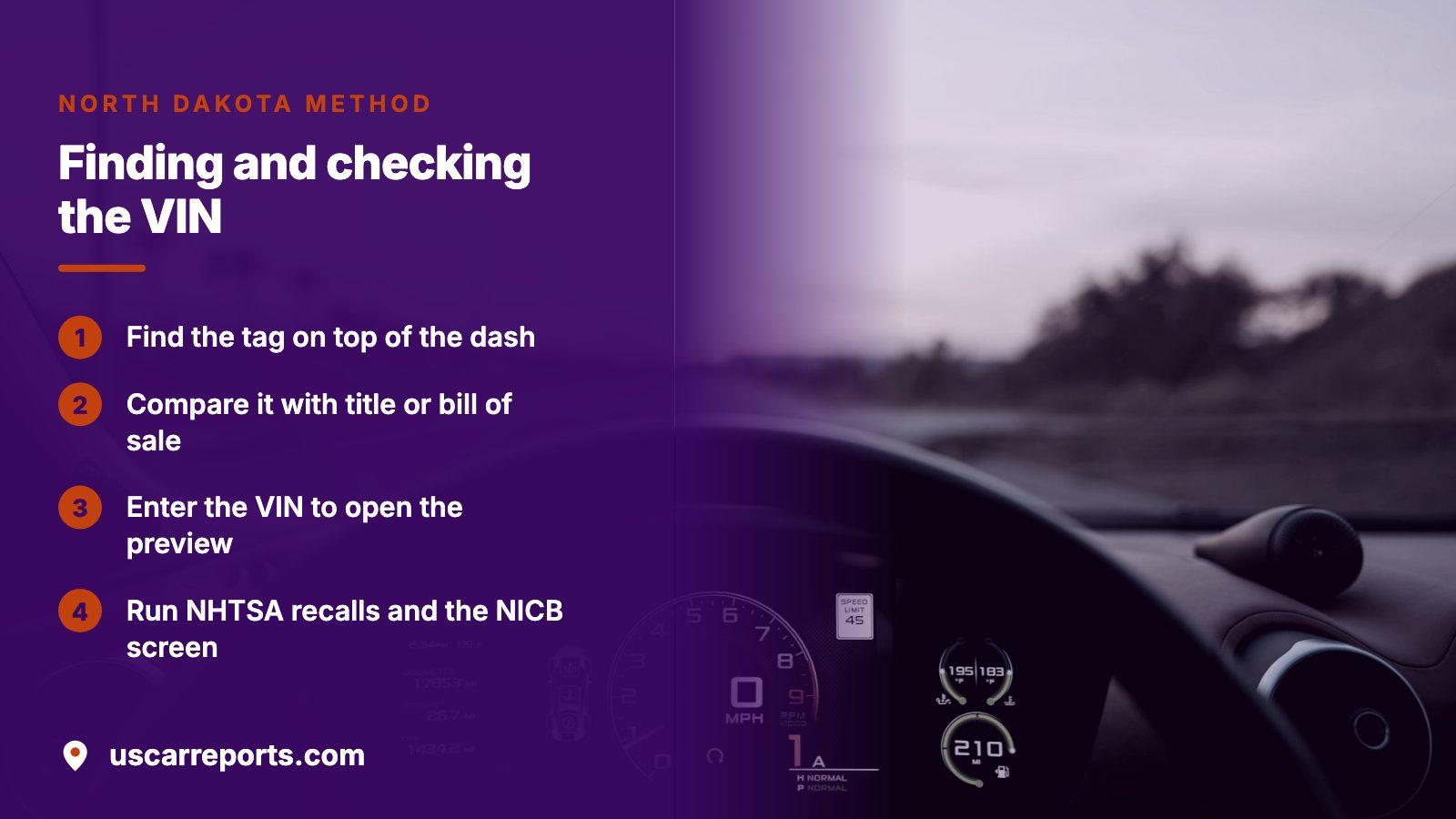
Where the VIN is and the order to work through the check
- Find the number on the vehicle itself: a metal tag on top of the dash, visible when you look through the windshield, and a printed label on the driver's door pillar.
- Compare it character by character with the title or bill of sale. One wrong digit is a stop sign.
- Enter the VIN here to open the preview.
- Run NHTSA's recall lookup and the NICB screen. Neither costs anything.
- If the car holds up, buy the report before paying any deposit.
- Pay a mechanic to inspect it, underbody first.
A plate number is a dead end for history, because the federal Driver's Privacy Protection Act shields owner details in state motor vehicle files apart from narrow exceptions. A vehicle too old for the 17-character standard may also carry a shorter serial that a decoder cannot read. On a classic, the comparison against the paperwork counts for more than the decode.
North Dakota's rule for vehicles whose papers are gone
Elsewhere, the owner of a paperless old car usually faces a bond, a court order or a dead end. North Dakota publishes a route instead. If a resident owns a vehicle past 40 years of age and can find no title, no origin statement from the manufacturer and no signed sale paper, the Motor Vehicle Division decides ownership from a sworn affidavit and the file behind it.
The form is SFN 62624. NDDOT limits it to vehicles past that age, so a modern car with a lost title still goes through the ordinary duplicate process. The age is a moving line, not a model year, so each calendar year pulls more vehicles into eligibility.
The searches that run before the title is printed
For a buyer, this is the part that matters. On this route the department checks the records of every state to confirm no one else holds a title or ownership record, and it checks the National Crime Information Center, before any certificate goes out.
- The all-states search is aimed at title washing, where a vehicle titled elsewhere reappears with a fresh start.
- The NCIC check is aimed at theft.
- An ordinary private transfer triggers neither.
So an affidavit title has been screened harder than a routine one, though only on those two questions.
Questions to put to a seller whose vehicle was titled this way
The state's checklist doubles as a script. Anyone who put a vehicle through this process can answer each of these:
- Was the title issued as an ordinary transfer or through the affidavit route?
- Can I see the notarized affidavit, including the explanation of why no earlier paperwork exists?
- Which national history report did you buy for the application, and what did it say?
- Do the photos filed with the state, including the VIN plate, match the vehicle today?
- Did the form name a lienholder?
The file goes to the Bismarck central office for review and comes back by mail, so a title cannot be issued the day someone applies. A seller promising one within days, with no application on file, is guessing.
Reading an affidavit title: what it settles and what it leaves open
| Settled by the screening | Left open |
|---|---|
| No other state shows a title or owner record for the VIN | What happened to the vehicle in earlier decades |
| The NCIC does not list it as stolen | Crashes, repairs, write-offs, flood exposure |
| The applicant is a North Dakota resident | The condition of the engine, frame and brakes |
| The state accepted the ownership claim as made | Who owned the vehicle before the affidavit |
Screened is not the same as documented
The state's own record on such a title begins the day the affidavit was approved. The national record can reach further back, and the state's checklist asks applicants to buy one. Pull it yourself before paying.
Red flags on a North Dakota purchase
- The VIN on the vehicle disagrees with the title or bill of sale, even by one character.
- An out-of-state buyer is told the affidavit route is open to them. It is for residents only.
- A title is promised that does not exist yet, on a vehicle with no other paperwork.
- The seller has no clear account of how they came to own it.
- A recent title sits on a vehicle that looks decades old, with nothing earlier in the national record.
- A lien goes unmentioned. The affidavit certifies the vehicle is free of liens except those listed, while a report shows liens and impounds.
One of these calls for questions. Two or more call for walking away.
What North Dakota does to a vehicle that no record shows
Plastics, seals, batteries and cooling systems take a beating in long winters. Winter road treatment eats at the underbody, and gravel covers much of the network away from the main corridors. With towns far apart, high mileage is normal here and not a warning sign by itself.
- Inspect the frame, brake lines, fuel lines and floor pans for corrosion.
- Check suspension joints and bushings for gravel wear.
- Read chipped glass and paint as local roads, not neglect.
- Test the battery and the cooling system before trusting a cold start.
Cost, and the sensible next move
The preview shows what the report holds for that VIN and costs nothing to open. After it, the report is bought once, with no renewal, singly or in bundles of 3, 5 or 10 for people shopping around. The pricing page at /pricing has the options.
If a North Dakota vehicle survives the free lookups and the preview, buy the report before a deposit, then have it inspected. On an older vehicle titled by affidavit, the report's title brands, damage entries, odometer readings, liens and theft records cover the years the state file does not.
Where this information comes from
- NDDOT: Vehicles more than 40 years old — Source for the residency rule, the all-states and NCIC searches, the applicant checklist and the review and mailing steps.
- NDDOT: Affidavit of Ownership, SFN 62624 — The form itself, including its limited scope, the notary requirement and the lien and false-statement language.
- North Dakota Century Code chapter 39-05 — The statute behind vehicle titling and the sections the old-vehicle process cites.
- NHTSA: Recalls — The open-recall search by VIN, which works the same way however the title was issued.
Sources and photos: Facts checked against the sources above in November 2026. Photos by Clem Onojeghuo, Dennis Eusebio and Carrie Allen www.carrieallen.com on Unsplash; diagrams by USCarReports.
Keep reading
- Bonded title: what it means for a buyer, state by stateHow states without a no-paperwork route handle a missing title.
- Title status check: what the state lookup tells a car buyerHow to read a title's status before money changes hands.
- Minnesota VIN check: salvage, prior salvage and what to confirm before you buyThe buying rules next door, for a car that crossed the border.
- Sample reportSee how the records are laid out before you buy a report.
Frequently asked questions
Can I run a North Dakota VIN check for free?
Part of it. A decode, NHTSA's recall search plus NICB's theft and salvage screen cost nothing, and so does the preview on this site. Title brands and damage history come from the full report, which is paid once with no subscription.
What is form SFN 62624?
It is North Dakota's Affidavit of Ownership. A resident signs it before a notary to claim a vehicle older than 40 years when no title, bill of sale or origin statement survives. It goes in with the title application and is no general substitute for a lost title.
Can someone from another state use the 40-year title process?
No. Every applicant must be a North Dakota resident, shown by a license or ID number issued in the state, or by a state business filing for companies. The rule keeps the route aimed at vehicles already in the state.
Is a car titled by affidavit safe to buy?
Its title carries more screening than most, since the state searched every state's records and the NCIC first. It still says nothing about crashes, repairs or mechanical condition. Pull the national record and have a mechanic look underneath before you pay.
Where is the VIN on a vehicle I am buying in North Dakota?
Look for the metal tag on top of the dash and the printed label on the driver's door pillar, then compare both with the title. The state's old-vehicle process asks for a photo of the VIN plate, so a missing or altered plate is a serious problem.
Now check the car itself
The guide explains what to look for. The report shows what this VIN has on record.